
“Let Them Die...”: David Hundeyin’s Tweets Just After Tanzania’s October 29 Massacres...and His New Documentary Whitewashing Samia

Ujasusi East Africa Monitoring Team | 27 May 2026 | 0200 BST
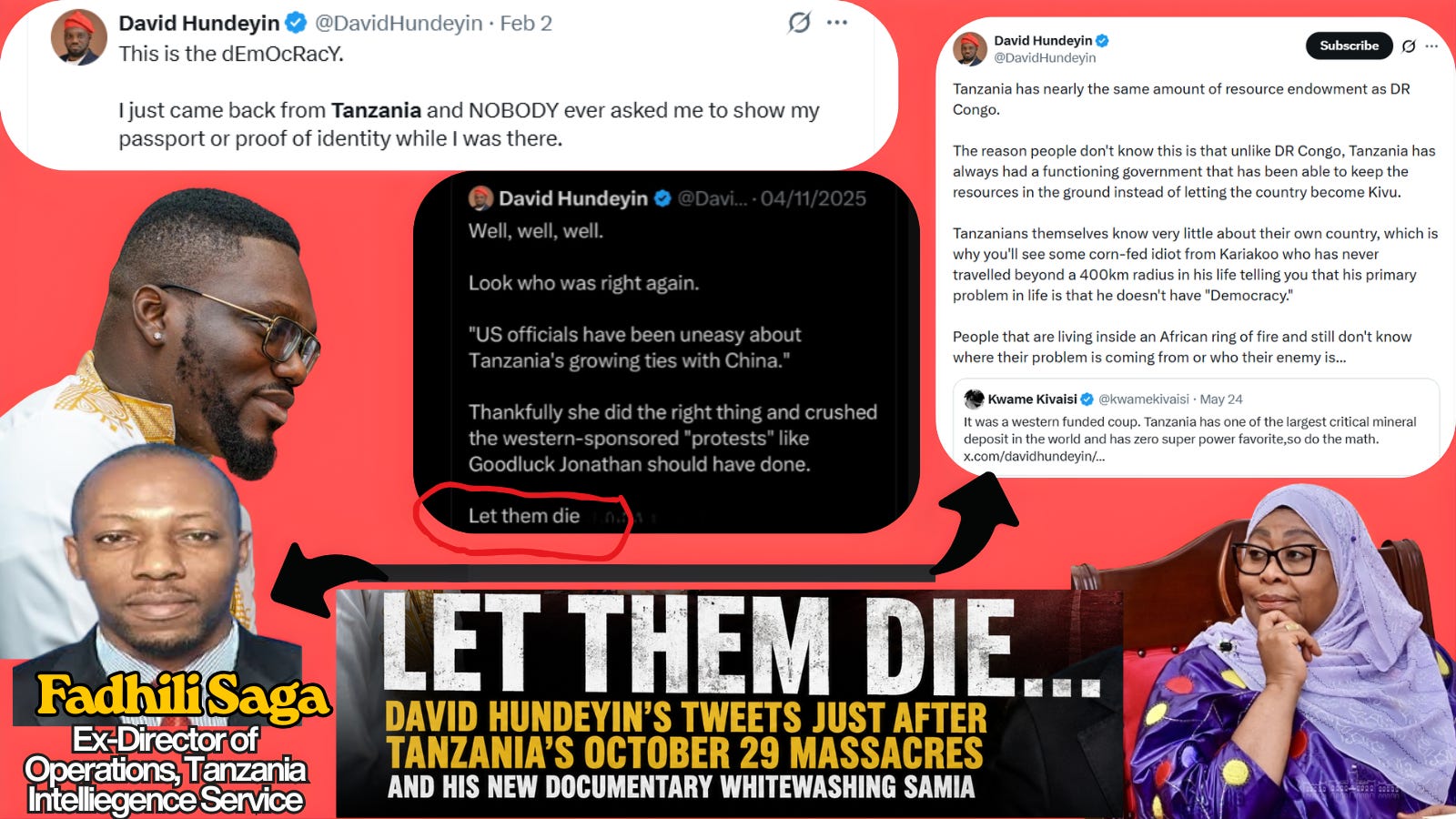
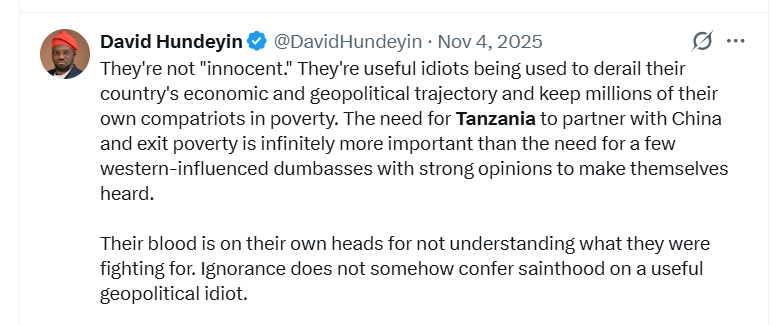
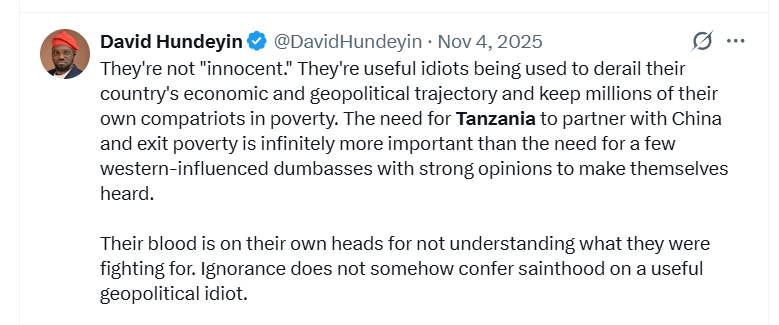
One day after the October 29 killings began, David Hundeyin framed the violence on his verified public account as “yet another western regime change psy-op,” targeting Samia Suluhu Hassan for the sole reason that her government was “pro-China and pro-Russia.” Three days later, when a follower challenged him directly, asking how he could “dismiss innocent Tanzania youth blood being shed as an inevitable consequence of 2 world powers fighting on Tanzania soil,” Hundeyin replied: “They’re not ‘innocent.’ They’re useful idiots being used to derail their country’s economic and geopolitical trajectory... Their blood is on their own heads for not understanding what they were fighting for.”
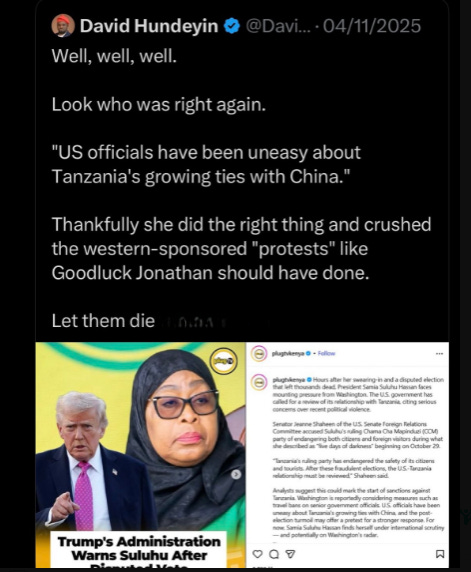
The following day, 4 November 2025, he added: “Thankfully she did the right thing and crushed the western-sponsored ‘protests’... Let them die mad about it.”
Seven months later, Hundeyin premieres What Happened on October 29?, a documentary he describes as an independent investigation into what international media got wrong about those same events. The film opened in Accra yesterday, screens in Tanzania on 29 May, and releases on YouTube on 31 May. Its central argument is that reporting of the violence was fabricated by a foreign adversary “more powerful than any African government.”
The problem the documentary cannot resolve is sequential, not analytical. Every verdict Hundeyin needed an investigation to reach, he had already delivered in public, in his own words, before a single frame was shot.
The Full Public Record, October 2025 to February 2026
The sequence of Hundeyin’s public statements on the massacre is documented across multiple timestamped screenshots and establishes a position far more explicit than the summary phrase that has circulated in accountability discussions.
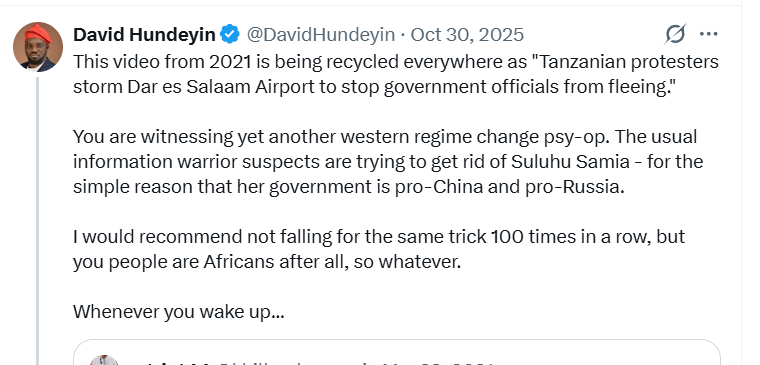
On 30 October 2025, one day after the killings began, he characterised the protests as a western regime change operation targeting Tanzania because of its alignment with China and Russia, concluding: “I would recommend not falling for the same trick 100 times in a row, but you people are Africans after all, so whatever. Whenever you wake up.”
On 4 November, responding to a follower who accused him of dismissing innocent Tanzanian youth deaths as geopolitical collateral, he refused the characterisation of the dead as innocent. They were “useful idiots” whose ignorance meant their blood was on their own hands. Tanzania’s need to partner with China and exit poverty was, he wrote, “infinitely more important than the need for a few western-influenced dumbasses with strong opinions to make themselves heard.”
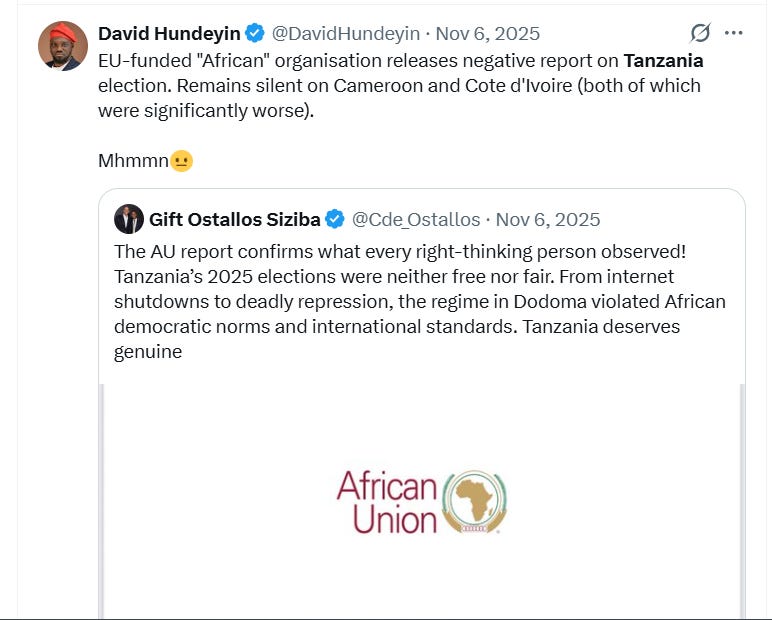
On 6 November, he dismissed the African Union’s own negative assessment of the election as the product of an “EU-funded ‘African’ organisation,” contrasting it with what he framed as selective silence on Cameroon and Côte d’Ivoire. On the same day he described Samia as “Tanzanian economy grower and friend of the Chinese,” making explicit that her geopolitical alignment was the operative basis of his defence of her.
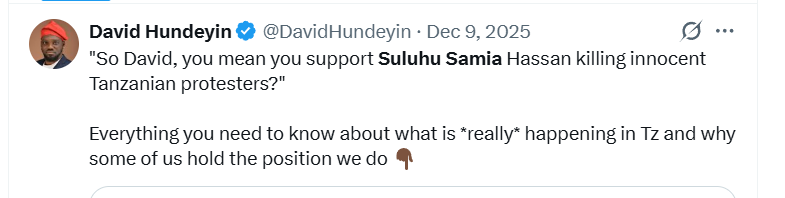
On 9 December 2025, when asked directly whether he supported Samia killing innocent Tanzanian protesters, he declined to deny it. He pointed instead to a Spearhead post that acknowledged the crackdown was “brutal and inexcusable” while structurally justifying it as a state responding to what it perceived as politico-economic encirclement. The framing condemned the method while endorsing the logic.
On 2 February 2026, he posted publicly that he had just returned from Tanzania, where nobody had asked him to show his passport, mocking democratic criticism as “dEmOcRaCY” and those raising accountability concerns as clowns.
The visit occurred during the documentary’s active production period, in a country that had by then deported two foreign human rights defenders simply for attending a court hearing in Tundu Lissu’s treason case.

This is not a journalist who held a complex position on a difficult story and then investigated it honestly. This is a journalist who declared the dead guilty, visited the country whose government killed them, and subsequently produced a film arguing the reporting of their deaths was fabricated.
Why the “Useful Idiots” Framing Is the Documentary’s Foundation
The characterisation of Tanzania’s dead as useful idiots whose blood was on their own heads is not rhetorical excess. It is the load-bearing premise of every argument the documentary makes.
For the film’s thesis to hold, the protests that followed the October 29 election cannot be what the evidence shows them to be: a popular response to documented electoral fraud, a nationwide internet blackout, and a security crackdown that killed approximately 10,000 people. They must instead be a manufactured western operation, populated by citizens too ignorant to understand they were being used. Once that premise is accepted, the approximately 10,000 dead become collateral in someone else’s geopolitical conflict rather than victims of a state that killed them. The documentary does not invent this premise. Hundeyin stated it publicly in November 2025 and has not retracted it.
The connection to Tundu Lissu follows the same logic. Within The Spearhead’s internal framework, as documented in communications published by former team member Trevor Mukholi and corroborated by former colleague Annah Ashaba, Lissu was characterised as a foreign-backed candidate, a western instrument rather than a Tanzanian politician with a Tanzanian constituency. This characterisation converts everyone who voted for CHADEMA into a participant in a foreign operation rather than a citizen exercising a political choice. It is the framing that makes endorsing their killing available as a coherent position.
The factual record does not support it. Lissu has been a persistent challenger of successive Tanzanian governments since entering Parliament in 2010. He was arrested for sedition in 2017. He was shot 16 times outside his home in Dodoma later that year in an attack whose perpetrators have never been identified or prosecuted. He underwent more than 20 operations in Kenya and Belgium. He returned to Tanzania in 2020 to contest the presidential election. He was charged with treason in 2025 for a speech calling on citizens to resist electoral manipulation and has remained detained since. His personal assistant was subjected to an attempted abduction as recently as 20 May 2026. A man facing that record of state violence is not a foreign convenience. He is someone a government regards as genuinely threatening.
The Chande Commission as Source and Cover
By Hundeyin’s own account, the documentary draws on the findings of the Commission of Inquiry chaired by retired Chief Justice Mohamed Chande Othman. The Commission was established by presidential decree, reported directly to State House, covered only 11 of Tanzania’s 31 regions, and excluded opposition testimony from its proceedings by design. It acknowledged 518 deaths, the first government concession of any fatalities after months of denial, while the ICC/Intelwatch dossier, cross-referenced against satellite imagery, mobile network disruption records, and survivor testimony, places the death toll at approximately 10,000.
The Commission concluded the violence was “planned, coordinated, financed, and executed by trained individuals,” a formulation designed to shift responsibility away from the security services and onto a constructed external adversary. The documentary frames the reporting of that violence as a fabricated foreign campaign. Both formulations redirect accountability in identical directions. A documentary built on the Commission’s findings does not achieve independence from it. It inherits the Commission’s geographical gaps, its methodological constraints, and its political function.
A Documented Personal Tie to the Tanzanian State Apparatus
In June 2024, Hundeyin posted publicly that his Tanzanian friend Zahoro Muhaji had been appointed by Samia to sit on the committee writing Tanzania’s 2025 to 2050 national development plan. In May 2025, he celebrated Muhaji’s birthday publicly and expressed his intention to spend time with him in Tanzania. The February 2026 visit during the documentary’s production period may have involved Muhaji, but that specific connection is not established in the available record and is not presented here as fact.
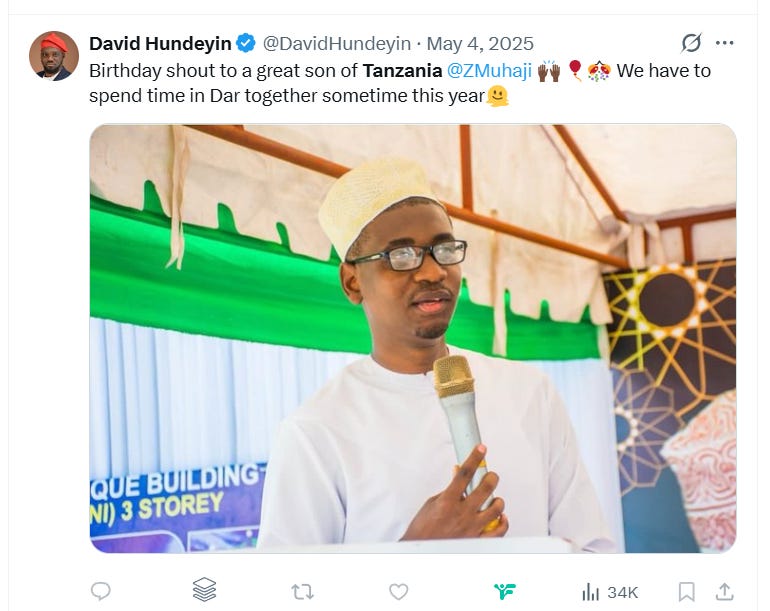
What is established is that Hundeyin maintained a documented personal friendship with a Samia-appointed government official throughout the period in which he was producing a documentary defending that government’s conduct. That friendship was public, celebrated on his own verified account, and unacknowledged in any disclosure accompanying the film’s production or promotion. A documentary claiming independence from the Tanzanian state, produced by someone with a named personal contact inside that state’s planning apparatus, carries a disclosure obligation that has not been met.
Amplifying a Dismissed TISS Official Three Days Before Premiere
On 23 May 2026, three days before the Accra premiere, Hundeyin replied to and amplified a post by the account @KwameKivaisi, whose tweet framed the October 29 events as “a western funded coup,” citing Tanzania’s critical mineral deposits as the operative motive.
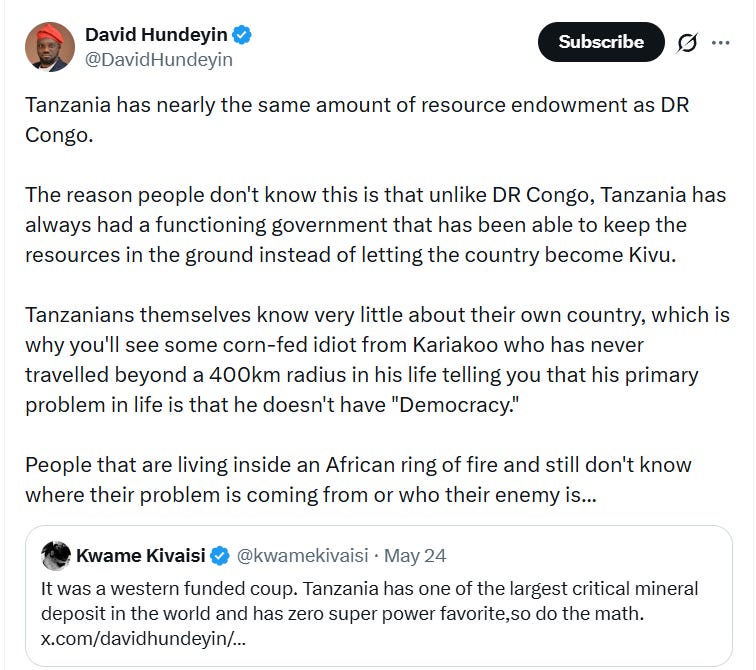
The account @KwameKivaisi is identified across multiple independent accountability sources, including the tanzaniamassacre.org perpetrators database and corroborating activist documentation, as Fadhili Mufwimi Saga, former Deputy Director General of TISS and Director of Internal Operations.
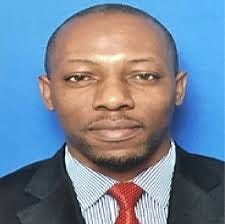
Saga is named in the ICC accountability dossier as having commanded a task force responsible for abductions, enforced disappearances, torture, and extrajudicial killings during and after the October 2025 election. He was dismissed from TISS in early December 2025 following mounting international pressure and activist documentation of his role, but remained active on social media under the @KwameKivaisi account.
Whether Hundeyin knew the identity behind the account is not established. What is established is that the account’s content, that the October 29 events were a western-funded coup, is precisely the thesis the documentary advances, and that Hundeyin chose to amplify it in the days immediately before release.
Inside The Spearhead: Dissent Purged Before the Camera Rolled
The documentary was produced inside an organisation that had already eliminated internal challenge on the central question the film claims to investigate. When Annah Ashaba challenged Hundeyin’s public statements on the massacre, she was told she lacked the mental resolve for revolution and removed from the team. When she pressed her colleague Trevor Mukholi on why he was justifying mass murder in Tanzania, he characterised Lissu as a foreign-backed candidate, the framing that converts a political opposition into a foreign operation. When Mukholi himself later raised unrelated analytical questions about the Alliance of Sahel States, he too was removed.
The full account of that internal culture, documented in Mukholi’s published essay and corroborated in detail by Ashaba’s public thread, establishes that The Spearhead was not an organisation that investigated the Tanzania crisis and reached a conclusion. It was an organisation that had reached a conclusion and removed anyone who questioned it.
The Dar es Salaam Screening: Cleared by the State It Claims to Scrutinise
The documentary screens publicly in Tanzania on 29 May. Tanzania’s information environment since October 2025 has been defined by the systematic suppression of independent coverage: the five-day internet shutdown, the exclusion of foreign journalists during the election period, the intimidation and in documented cases arrest of independent Tanzanian media staff, and the deportation of Kenya’s Boniface Mwangi and Uganda’s Agather Atuhaire simply for attending a single court hearing in Lissu’s treason case.
In that environment, a production critical of the government would not receive public screening clearance. The Hundeyin documentary has received it. A film the Tanzanian state permits to screen publicly in its commercial capital is a film the state does not regard as a threat. The clearance requires no financial transaction or commissioning document to carry analytical weight. It is the indicator.
The February visit adds a further dimension. Hundeyin moved freely inside Tanzania during the documentary’s production period, entering and leaving without incident, in a country that deported two foreign human rights defenders for attending a single court hearing. The access he was extended reflects how the Tanzanian authorities categorised him at the time.
Three Tests the Film Must Pass
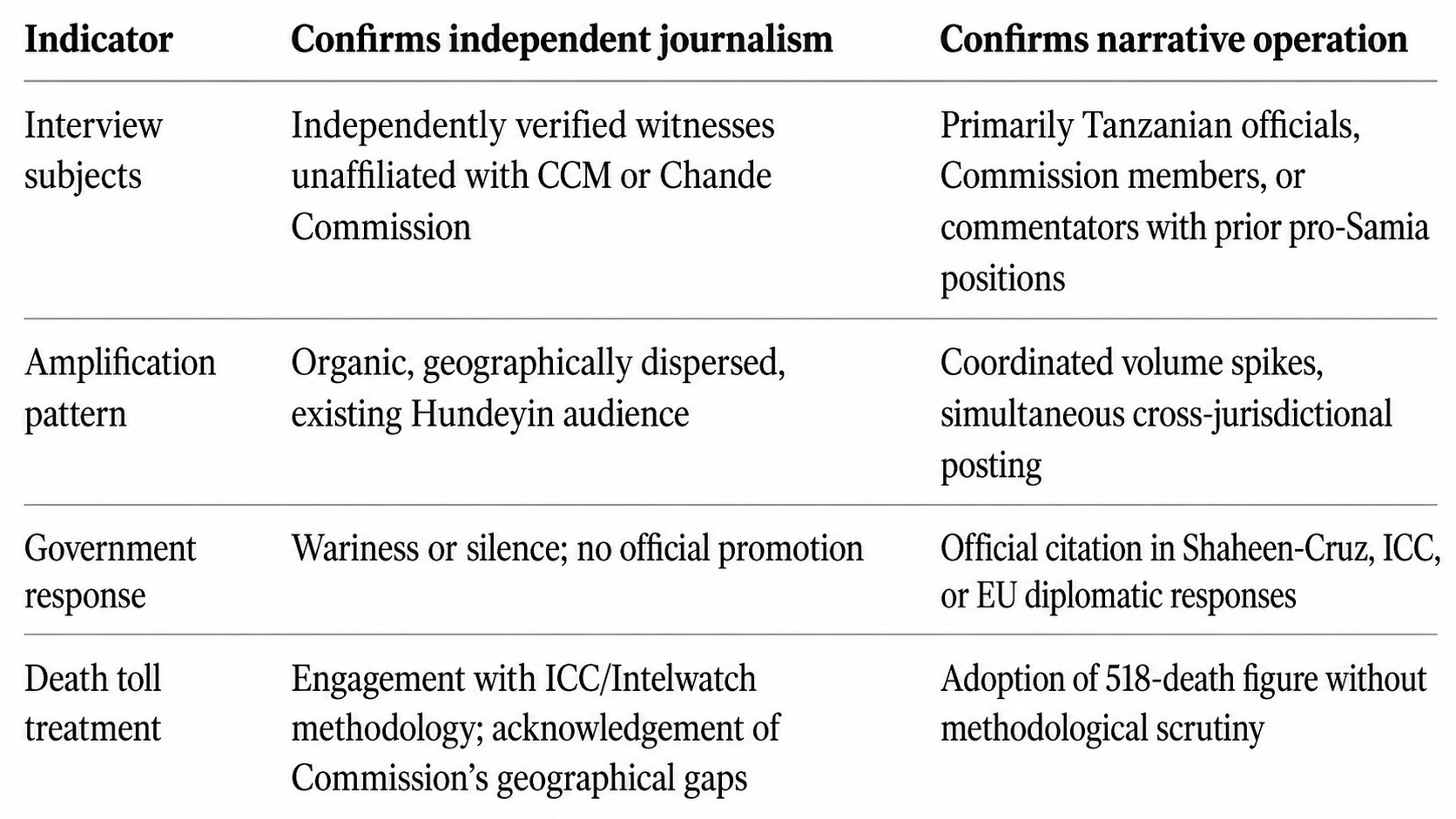
Three observable indicators will clarify, within days of the YouTube release, what the documentary actually is.
The first is the interview subjects. A documentary alleging that the reporting of a massacre was fabricated cannot sustain that claim without credible, independently verifiable witnesses unaffiliated with the Tanzanian state. If the interview roster consists primarily of Tanzanian officials, Chande Commission members, and commentators with documented prior alignment with the government’s framing, the sourcing architecture confirms the alignment regardless of how the narrative is constructed around it.
The second is the amplification pattern. Organic audience spread produces irregular, geographically dispersed engagement among networks already connected to Hundeyin’s prior work. Coordinated amplification produces simultaneous volume spikes from accounts with low prior engagement, content appearing in networks with no organic connection to the producer, and geographic distribution inconsistent with his established audience. The difference is visible within 72 hours of release.
The third is the Tanzanian government’s response. Independent journalism that challenges a government is treated by that government with wariness. A narrative operation serving a government’s interests is amplified: cited in diplomatic communications, referenced in written responses to the Shaheen-Cruz bill, the EU aid freeze review, or the ICC complementarity analysis. If Tanzanian officials begin citing this film as evidence that the documented death toll is contested by an independent African investigation, its function in the accountability evasion architecture will have been confirmed by the people it was designed to serve.
The approximately 10,000 Tanzanians who died after 29 October 2025 did not die from a narrative. The question What Happened on October 29? has a documented answer. David Hundeyin gave it himself, in public, the day after the killing began, and has added to that answer repeatedly in the months since. A documentary produced by someone who reached that verdict before the investigation began, inside an organisation that removed anyone who disagreed with it, drawing on an inquiry structurally designed to reach the same conclusion, cleared for screening by the government whose conduct it defends, and promoted in the days before release through the amplification of an account linked to the man identified as having directed the killing operations, is not journalism encountering a complex story. It is impunity with a production budget.