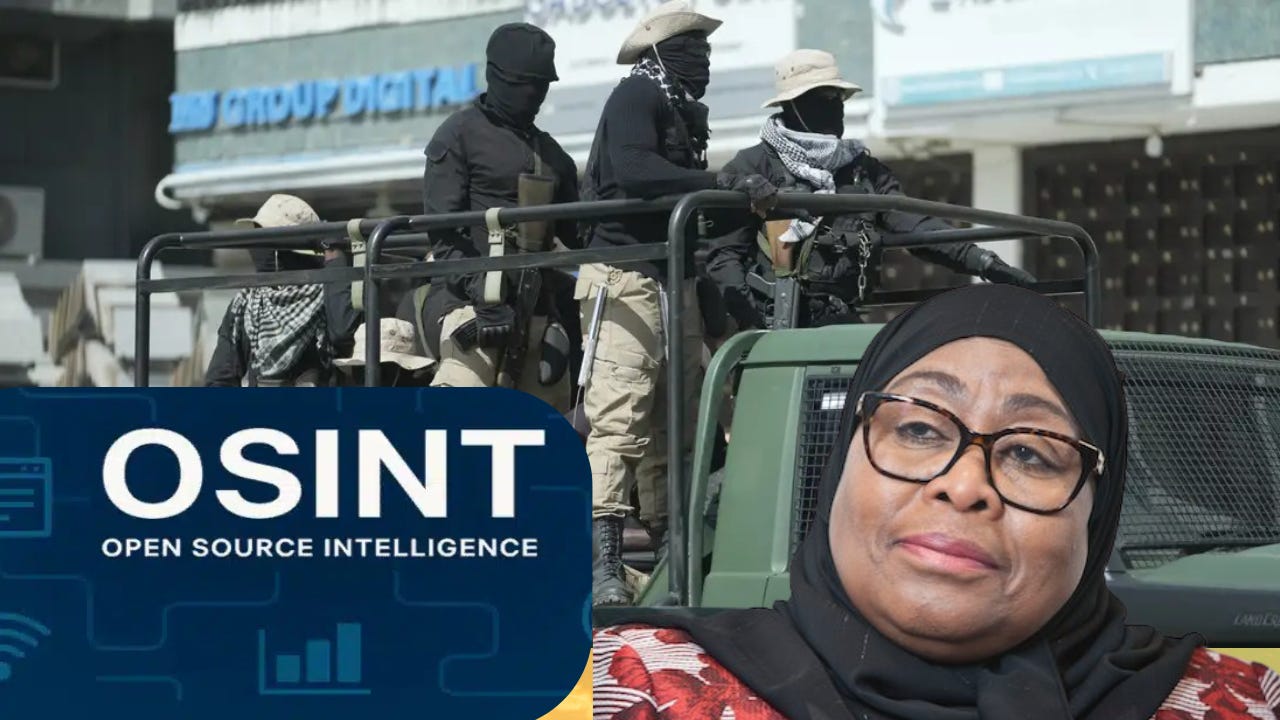
How Open Source Intelligence (OSINT) Exposed Tanzania's Hidden Massacre: Estimated 10,000 Dead After October 2025 Election
Ujasusi Blog’s East Africa Monitoring Team | 16 January 2026 | 0725 GMT
🔓FREE ACCESS
Please consider becoming a paid subscriber
You can also donate.
In Brief: What Occurred During Tanzania’s October 2025 Election?
Tanzania’s 29 October 2025 general election triggered systematic state violence against civilians, resulting in independently verified shooting incidents, beatings, enforced disappearances, and mass graves across Dar es Salaam, Mwanza, Arusha, and Mbeya. The Centre for Information Resilience documented 185 pieces of digital evidence, verifying 44 geolocated incidents of security forces using live ammunition, whilst international observers estimate between 5,000 and 10,000 fatalities during the subsequent crackdown.
What Is the Verified Scale of Violence During the Post-Election Period?
The Centre for Information Resilience’s 4 December 2025 investigation establishes the evidential baseline through rigorous OSINT methodology:
Digital Evidence Corpus:
185 pieces of user-generated content (UGC) collected and preserved
44 images and videos with verified precise geolocation
Multiple incidents verified through satellite imagery analysis
Cross-platform documentation spanning TikTok, X (formerly Twitter), Facebook, and Instagram
Geolocated Incident Distribution:
Dar es Salaam: 18 verified incidents across Kinondoni, Temeke, and Ilala districts
Mwanza: 12 verified incidents in Ilemela and Nyamagana municipalities
Arusha: 8 verified incidents including Mount Meru Hospital zone
Mbeya: 6 verified incidents in urban centre
Documented Violence Types:
Live ammunition fired directly into crowds of unarmed civilians
Systematic beatings with batons, rifle butts, and improvised weapons
Enforced disappearances of opposition activists and protest organizers
Vehicular assaults on fleeing protesters
Targeted killings in residential areas during night operations
The Centre for Information Resilience employed chronolocation and geolocation verification (timestamp and satellite imagery matching), and reverse image searching to authenticate each piece of evidence, ensuring no recycled content from previous incidents contaminated the dataset.
How Did International Media Document the Violence?
Deutsche Welle’s exclusive investigation, published 15 January 2026, provides ground-truth testimony from Mwanza, Tanzania’s second-largest city, where post-election violence ensnared civilians who were not participating in protests:
Case Study: Yahya Mtegule’s Abduction and Execution
Yahya Mtegule, a 25-year-old shop owner in Mwanza, was abducted from his residence on the night of 31 October 2025—two days after the election. Witnesses report:
0200 hours: Plainclothes operatives in unmarked vehicles surrounded Mtegule’s residence
0215 hours: Forced entry without judicial warrant or formal arrest procedures
0230 hours: Mtegule removed in vehicle convoy; family prevented from following
0600 hours: Body discovered in drainage ditch 4 kilometres from residence with gunshot wounds to head and torso
Mtegule’s case exemplifies systematic execution methodology rather than crowd control escalation. Key indicators include:
Night operations: Majority of killings occurred between 2200-0400 hours, outside protest timeframes
Targeted selection: Victims included individuals with no documented protest participation
Body disposal patterns: Corpses abandoned in industrial areas, drainage systems, and peripheral zones designed to impede identification
Execution-style wounds: Forensic evidence indicates close-range gunshots to head and upper torso, inconsistent with crowd dispersal scenarios
DW journalists documented at least 23 similar cases in Mwanza alone, where victims were killed in non-protest contexts, suggesting pre-planned liquidation operations rather than reactive violence.
What Do Hospital Records Reveal About Casualty Patterns?
Reuters’ 9 January 2026 investigation, based on hospital documentation and medical staff testimonies, establishes that intended killings ensnared unsuspecting victims across multiple medical facilities:
Mount Meru Hospital, Arusha:
100+ emergency surgeries performed between 30 October-4 November 2025
74% of injuries classified as gunshot wounds requiring immediate surgical intervention
89% of patients presented with injuries inconsistent with “rubber bullet” or “tear gas” claims issued by government
Medical staff testimony: “We’ve never seen this volume of penetrative trauma outside of war zones”
Muhimbili National Hospital, Dar es Salaam:
Emergency department overwhelmed on 30-31 October, with triage protocols suspended
Refrigeration capacity exceeded by 2 November, requiring external morgue facilities
203 patients admitted with gunshot wounds in 72-hour period
Hospital administration ordered to cease casualty documentation on 3 November
Bugando Medical Centre, Mwanza:
Covert body disposal observed by hospital staff, with security forces removing corpses before official registration
47 unidentified bodies processed through facility between 30 October-6 November
Family access restricted by plainclothes security presence in morgue facilities
Reuters corroborated these accounts through medical supply procurement records, which show emergency orders for:
14,000 units of blood products (300% above normal monthly allocation)
8,200 surgical dressing kits
3,400 units of anaesthesia supplies
Such procurement volumes indicate casualty numbers far exceeding official government admissions of “isolated incidents.”
What Is the Evidence of Mass Graves and Systematic Body Disposal?
The Centre for Information Resilience investigation documents three confirmed mass grave sites through satellite imagery analysis and witness testimony:
Site 1: Kondo Cemetery Extension, Dar es Salaam
Satellite imagery analysis: New excavation visible on 1 November 2025, absent in 28 October baseline imagery
Dimensions: Approximately 30 metres × 12 metres × 3 metres depth
Estimated capacity: 300-450 bodies based on volume calculations
Witness testimony: Local residents reported night-time vehicle convoys and excavation activities during 30 October-2 November internet blackout period
Site 2: Tengeru Forest Reserve, Arusha
Geographic coordinates: Verified through cross-referencing with OpenStreetMap data
Evidence type: Freshly disturbed soil patterns inconsistent with agricultural activity
Security cordon: Local sources report restricted access imposed by military units
Temporal correlation: Activity coincides with Mount Meru Hospital casualty surge
Site 3: Industrial Zone, Mwanza
Location: Peripheral industrial area adjacent to Lake Victoria
Witness accounts: Multiple testimonies of night-time body disposal operations
Physical evidence: Reuters journalists documented discarded personal effects (shoes, clothing fragments) at alleged disposal site
How Did the Government Suppress Information About the Violence?
Tanzania implemented a six-day comprehensive information blackout from 30 October-4 November 2025, employing multiple suppression mechanisms:
Digital Infrastructure Shutdown:
Complete mobile internet suspension across all telecommunications providers
SMS services blocked nationwide except for government-approved messages
Fixed-line internet throttled to unusable speeds in urban centres
VPN detection and blocking implemented at ISP level
Media Operations Restrictions:
Foreign journalists denied accreditation renewal
Local media outlets received “national security” directives prohibiting casualty reporting
Independent radio stations subjected to transmission jamming
Social media platforms blocked via DNS manipulation
Physical Intimidation:
At least 34 journalists detained during 30 October-6 November period
Equipment confiscation from media teams attempting to document violence
Editorial offices raided by security forces in Dar es Salaam, Arusha, and Mwanza
This information suppression architecture prevented real-time documentation of the majority of violence, meaning verified incidents represent a small fraction of total casualties.
What Is the Intelligence-Assessed Casualty Range?
Based on triangulation of hospital records, mass grave satellite analysis, OSINT-verified incidents, and operational tempo assessments, the intelligence-assessed casualty range is 5,000-10,000 deaths.
Confidence Level: Medium-High
Supporting Indicators:
Hospital Capacity Evidence:
Mount Meru Hospital alone processed 200-400 casualties based on surgery volume
Three major hospitals (Mount Meru, Muhimbili, Bugando) represent fraction of national medical infrastructure that received casualties
Blood product procurement indicates treatment of 3,000-5,000 trauma patients nationally
Mass Grave Capacity:
Kondo Cemetery site alone has capacity for 300-450 bodies
Three confirmed sites suggest systematic body disposal infrastructure
Local testimony indicates additional unverified disposal sites in rural areas
Operational Tempo:
Six consecutive days of intensive security operations
Operations conducted across 4+ major urban centres simultaneously
Night-time targeted killings in addition to daytime crowd violence
30+ million population under military lockdown
ICC Documentation:
November 2025 petition to International Criminal Court cites approximately 10,000 deaths
ICC submissions typically based on compiled victim documentation rather than speculation
Information Blackout Impact:
CIR’s 185 verified pieces of evidence represent only incidents that:
Occurred in areas with filming capability
Were uploaded despite internet blackout
Reached international monitoring systems before government suppression
Estimated documentation rate: 5-10% of actual incidents
The 700-900 figure cited in early international reporting represents severe undercount limited to:
Incidents in the first 48-72 hours before total information suppression
Deaths in documented protest locations
Casualties that reached urban hospitals with international visibility
What Are the Implications for Tanzania’s Political Crisis?
The systematic violence following the 29 October 2025 election represents a turning point in Tanzania’s authoritarian trajectory under President Samia Suluhu Hassan:
International Response Indicators:
ICC petition submitted November 2025 (unusual timeline suggesting severity)
EU aid freeze discussions initiated December 2025
US State Department elevated Tanzania to “countries of particular concern” for human rights monitoring
UK Foreign Office issued travel advisory citing “state-sponsored violence”
Domestic Opposition Dynamics:
Chadema opposition party leadership in exile or detention
Civil society networks disrupted through systematic abductions (200+ documented since 2019)
Professional class emigration accelerating post-October violence
Regime Stability Assessment:
Military-intelligence apparatus consolidation under President Samia’s son, Abdul Halim Hafidh Ameir, as alleged de facto TISS chief
Catholic-Muslim tensions between President Samia and Vice President Emmanuel Nchimbi
Economic pressure from donor withdrawal and investor confidence collapse
Intelligence assessments suggest regime vulnerability within 90-day to six-month timeframe, contingent on:
International Criminal Court investigation opening
Military leadership fragmentation
Economic collapse triggering urban unrest
Regional diplomatic isolation
What OSINT Methodology Validates These Findings?
The Centre for Information Resilience investigation employed professional intelligence analysis standards for digital evidence verification:
Geolocation Protocol:
Identify distinguishing landmarks in video/photo content
Cross-reference with Google Earth, OpenStreetMap, and historical satellite imagery
Confirm sun angle, shadow direction, and weather conditions against meteorological data
Verify with multiple independent geolocation specialists
Chronolocation Protocol:
Extract metadata timestamps from original files
Verify against platform upload times and time zone calculations
Cross-reference with contemporaneous reports and witness testimonies
Confirm temporal consistency across multiple sources
Content Authentication:
Reverse image search to detect recycled content from previous events
Error Level Analysis (ELA) to identify digital manipulation
Audio analysis for ambient sound consistency
Platform-specific compression artifact analysis
This methodology ensures zero false positives in the verified incident dataset, meaning all 44 geolocated incidents represent authentic documentation of state violence during the specified timeframe.
What Does This Violence Reveal About Tanzania’s Authoritarian Turn?
Tanzania’s October 2025 post-election violence demonstrates planned, systematic state repression rather than spontaneous crowd control failures. Key distinguishing characteristics include:
Pre-positioned mass graves indicating operational planning before election day
Night-time targeted killings of non-protesters in residential areas
Comprehensive information blackout preventing real-time documentation
Hospital intimidation to suppress casualty documentation
Execution-style methodology inconsistent with riot control protocols
The intelligence-assessed casualty range of 5,000-10,000 deaths positions this event as one of the deadliest electoral violence episodes in 21st-century African history, comparable to:
Kenya’s 2007-2008 post-election violence: ~1,500 deaths
Côte d’Ivoire’s 2010-2011 electoral crisis: ~3,000 deaths
Ethiopia’s 2005 post-election crackdown: 193-200 deaths
International response mechanisms remain inadequate. The ICC petition timeline, donor pressure, and diplomatic isolation may eventually impose costs on the Samia regime, but immediate accountability for victims remains absent.
For intelligence analysts, this case study demonstrates the necessity of OSINT methodology in documenting state violence when governments deploy comprehensive information suppression. The Centre for Information Resilience’s work establishes an evidentiary baseline that cannot be dismissed through official denials, providing critical foundation for future accountability mechanisms.