

Ujasusi East Africa Monitoring Team | 23 May 2026 | 0315 BST
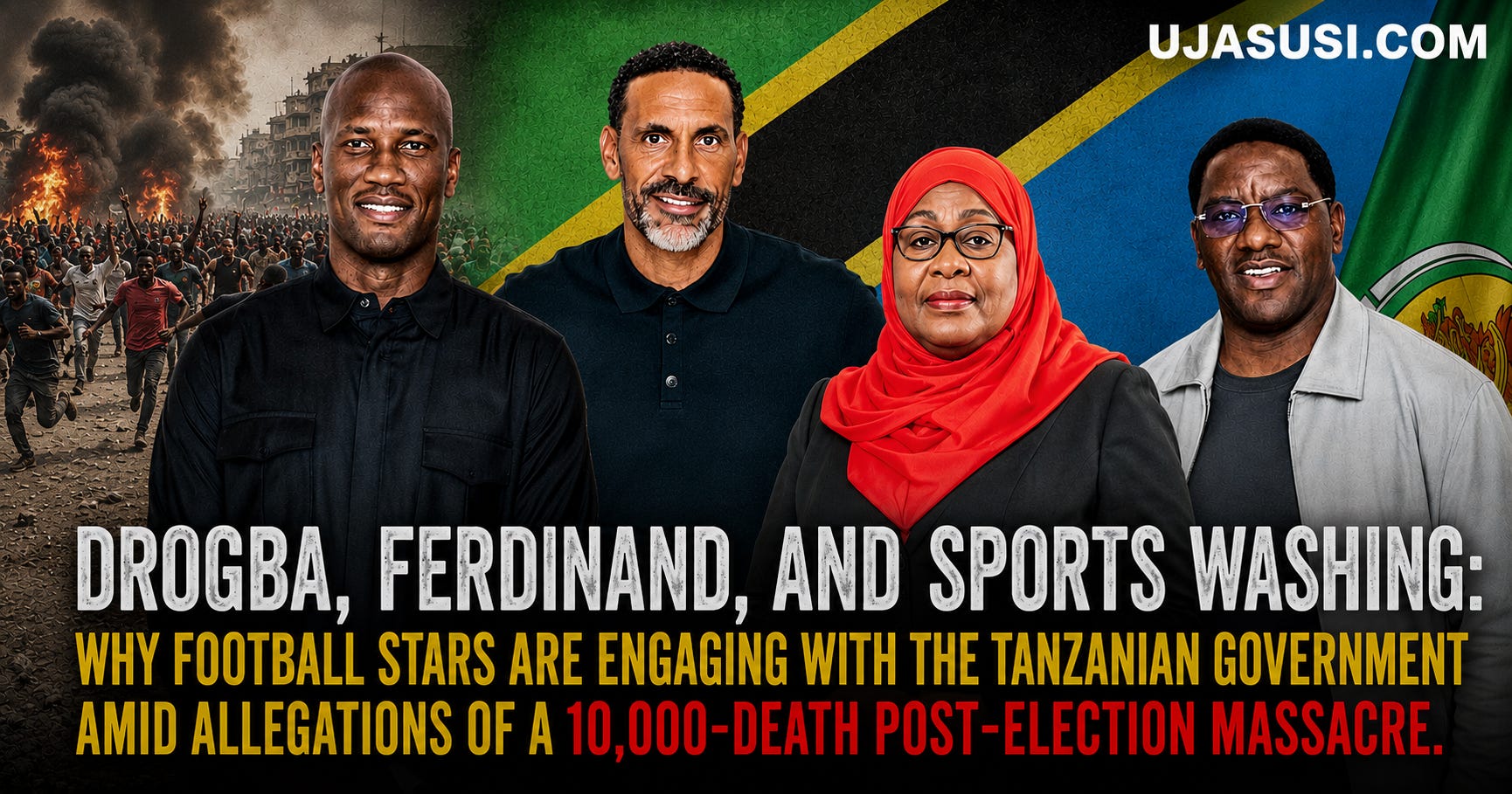
Tanzania’s government has deployed internationally recognised football personalities as instruments of reputational counter-intelligence following the October 2025 post-election violence, in which approximately 10,000 citizens were killed by state security forces. The operation is directed by US-sanctioned Minister Paul Makonda and runs in parallel to a $1.1 million FARA-registered lobbying contract with Ervin Graves Strategy Group LLC. That lobbying track produced no visible legislative dividend; Congress responded instead with the bipartisan Reassessing the United States-Tanzania Bilateral Relationship Act, introduced on 19 May 2026 — the same day Rio Ferdinand landed in Tanzania.
Table of Contents
The Drogba and Ferdinand Recruitment: Dates, Roles, and Handlers
Paul Makonda: The Sanctioned Official Running the Operation
The AFCON 2027 Cover Structure
The Ervin Graves Lobbying Track and Its Perceived Failure
Operational Pattern: What the Sequencing Reveals
Strategic Outlook: Risk Assessment for the Campaign
The Drogba and Ferdinand Recruitment: Dates, Roles, and Handlers
Drogba arrived in Tanzania on 3 May 2026, held direct talks with President Samia Suluhu Hassan, and received a formal request to serve as ambassador for the 2027 Africa Cup of Nations.
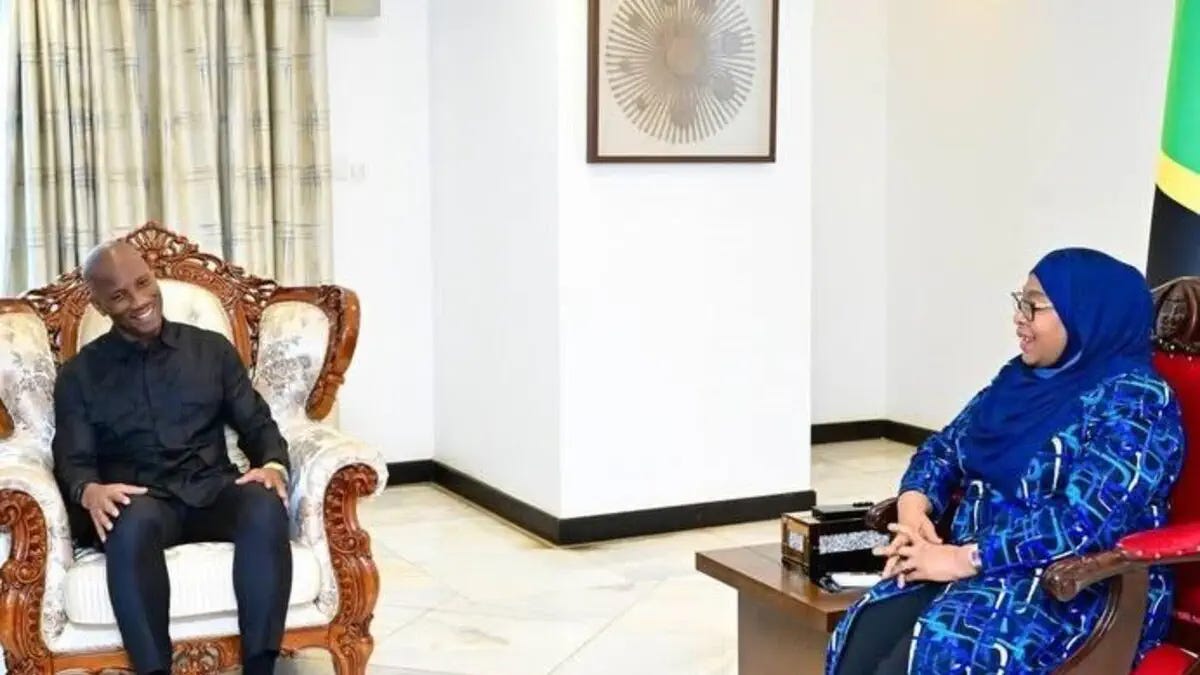
His visit was structured around the Ministry of Information, Culture, Arts and Sports budget presentation in Parliament on 4 May 2026, at which Drogba appeared alongside Minister Paul Makonda. Positioning a foreign sporting celebrity inside a legislative budget session is a deliberate sovereignty signal: it frames the recruitment as institutional rather than personal, and insulates the government from bilateral criticism by anchoring the arrangement in multilateral sporting infrastructure.
Ferdinand arrived on 19 May 2026, hosted under a direct official invitation from Makonda, and held a motivational session at Gymkhana Club before travelling to Dodoma, where he visited Parliament on 20 May.
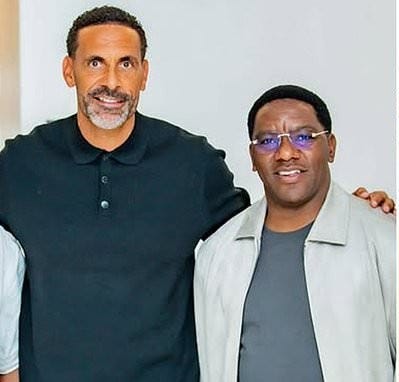
He was subsequently appointed Honorary Tourism Ambassador by Tourism Minister Ashatu Kijaji during a ceremony in Arusha. The dual appointment structure, split between the Sports Ministry and the Tourism Ministry, distributes the recruitment across two government portfolios, broadening the legitimacy surface while avoiding concentration of accountability within a single ministry.
Paul Makonda: The Sanctioned Official Running the Operation
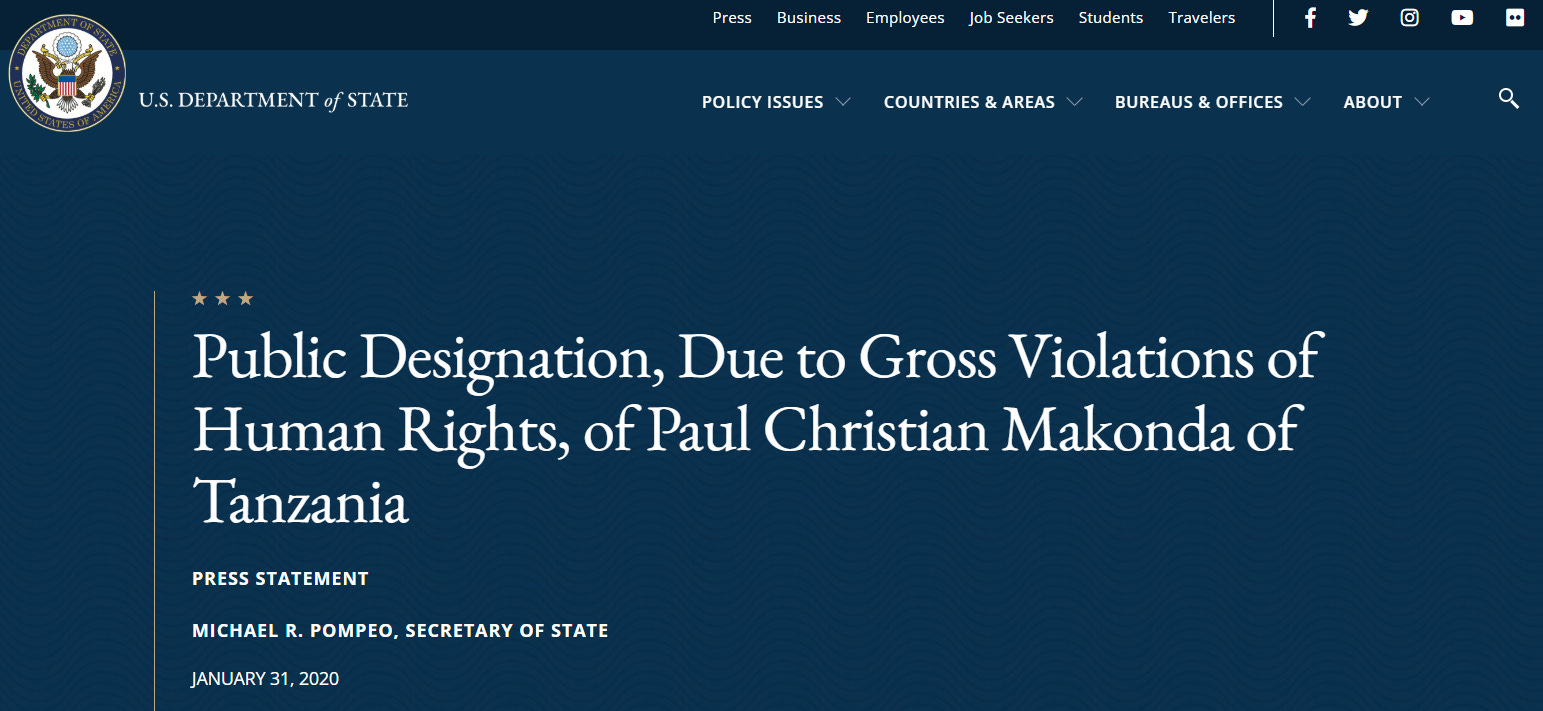
The United States Department of State publicly designated Makonda under Section 7031(c) of the FY 2020 State Department Appropriations Act for involvement in gross violations of human rights, including the flagrant denial of the right to life, liberty, and the security of persons. The designation also cited his role in launching a surveillance squad dedicated to hunting down gay people in Tanzania, and his implication in oppression of the political opposition and crackdowns on freedom of expression.
President Samia appointed Makonda as Minister for Information, Culture, Arts and Sports on 8 January 2026, a move that stunned observers given the government’s simultaneous public advocacy for reconciliation following the post-election crackdown. A US-sanctioned official placed in charge of Tanzania’s international cultural and sporting projection is not an administrative oversight. It signals that Samia’s inner circle assessed Makonda’s domestic political loyalty and CCM network as outweighing his international liability, particularly for operations conducted through non-Western institutional channels such as CAF, where the State Department designation carries no institutional effect.
Amnesty International UK’s Director of Campaigns, Felix Jakens, stated publicly that Ferdinand’s presence risks rehabilitating Tanzania’s international image while those responsible for recent abuses face no accountability, and that the visits carry all the hallmarks of sportswashing.
The AFCON 2027 Cover Structure
Tanzania’s government has publicly committed to deploying celebrity athletes and social media influencers as part of a formal strategy to market the country’s tourism attractions ahead of the tournament, which is projected to generate economic benefits exceeding two billion US dollars and attract a global television audience of 1.9 billion viewers.
The AFCON mandate serves three simultaneous functions. It generates a legitimate pretext for celebrity recruitment that CAF cannot credibly obstruct. It reframes Tanzania’s international profile from site of mass political violence to host nation of continental significance. It also creates a 13-month window, running from May 2026 to the tournament’s close in July 2027, during which a sustained flow of celebrity visits can be presented as tournament preparation rather than reputation management.
The U.S. Lobbying Track and Its Perceived Failure
Tanzania contracted Ervin Graves Strategy Group LLC for a $1.1 million two-year engagement, tasking the firm to research US government requirements for rare earth minerals, assess alignment with Tanzania’s mineral potential, and seek public relations, media, and social media opportunities. The Scope of Work, confirmed in the FARA Exhibit B filing, also covered Congressional outreach to committees with jurisdiction over foreign affairs, defence, trade, appropriations, and national security; executive branch engagement; and a third-party validation strategy targeting think tanks, former officials, and credible congressional champions.
The operational lead was Scott Hommel, Senior Vice President at Ervin Graves. Between 14 January and 3 February 2026, Hommel conducted documented outreach to schedulers for Senators Boozman, Risch, Rounds, and Cruz, and to twenty House members including Foreign Affairs Committee members Michael McCaul and Gregory Meeks. Ambassador Lazaro Nyalandu, appointed Presidential Advisor on Diplomatic Affairs in November 2025, served as the deployed envoy. The stated agenda in the FARA filings included introductory meetings, hosting a Congressional Delegation, establishing a Congressional Caucus for Tanzania, and raising concerns about the US visa ban.
The last documented outreach activity in the FARA public record is dated 3 February 2026. No confirmed congressional meetings appear in any subsequent filing. On 19 May 2026, Senators Jeanne Shaheen, Ranking Member of the Senate Foreign Relations Committee, and Ted Cruz introduced the bipartisan Reassessing the United States-Tanzania Bilateral Relationship Act, requiring a comprehensive review of the US-Tanzania relationship following the October 2025 elections in which Tanzanian authorities reportedly suppressed thousands of protesters, instituted a nationwide internet shutdown, denied the wounded access to healthcare, and collected bodies from mortuaries to obscure the scale of the repression.
Congressional staff characterised the State Department’s existing bilateral review of Tanzania as “insufficient,” and the bill set a higher bar, explicitly requiring the release of opposition detainees, accountability for security forces, and an end to media censorship before restrictions on assistance would be lifted. The bill proposes visa bans and asset freezes on individuals identified in a State Department review, as well as restrictions on certain forms of US assistance.
The Cruz dimension warrants specific analytical attention. Cruz was one of the senators Ervin Graves targeted for a meeting with Nyalandu; the FARA filing confirms Nyalandu encountered Cruz personally at Palm Beach Airport in early February 2026. Cruz co-sponsored the accountability bill on 19 May 2026. The lobbying operation not only failed to neutralise Cruz; the senator it personally briefed became a primary legislative threat.