Ujasusi East Africa Monitoring Team | 07 May 2026 | 0235 BST
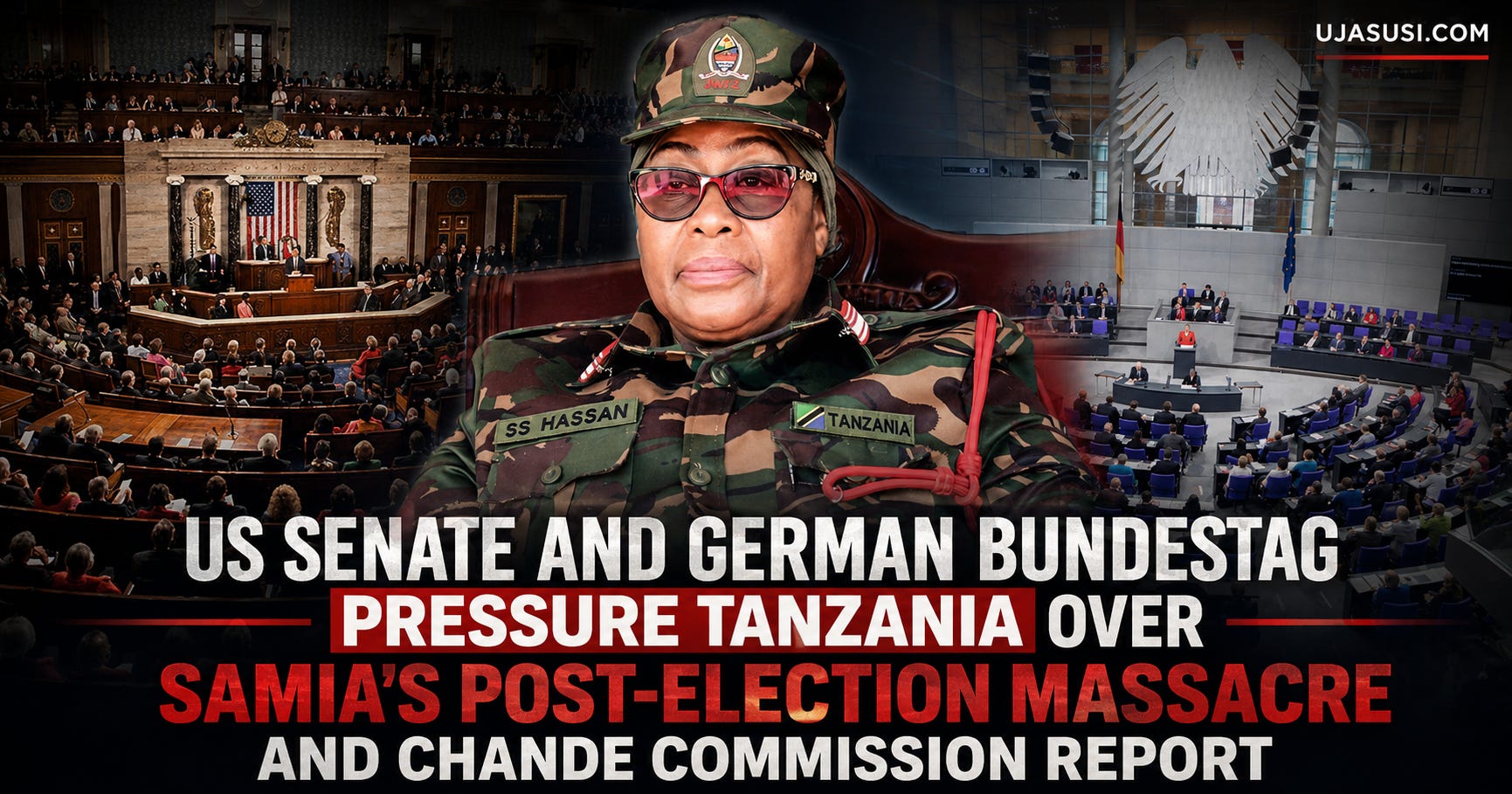
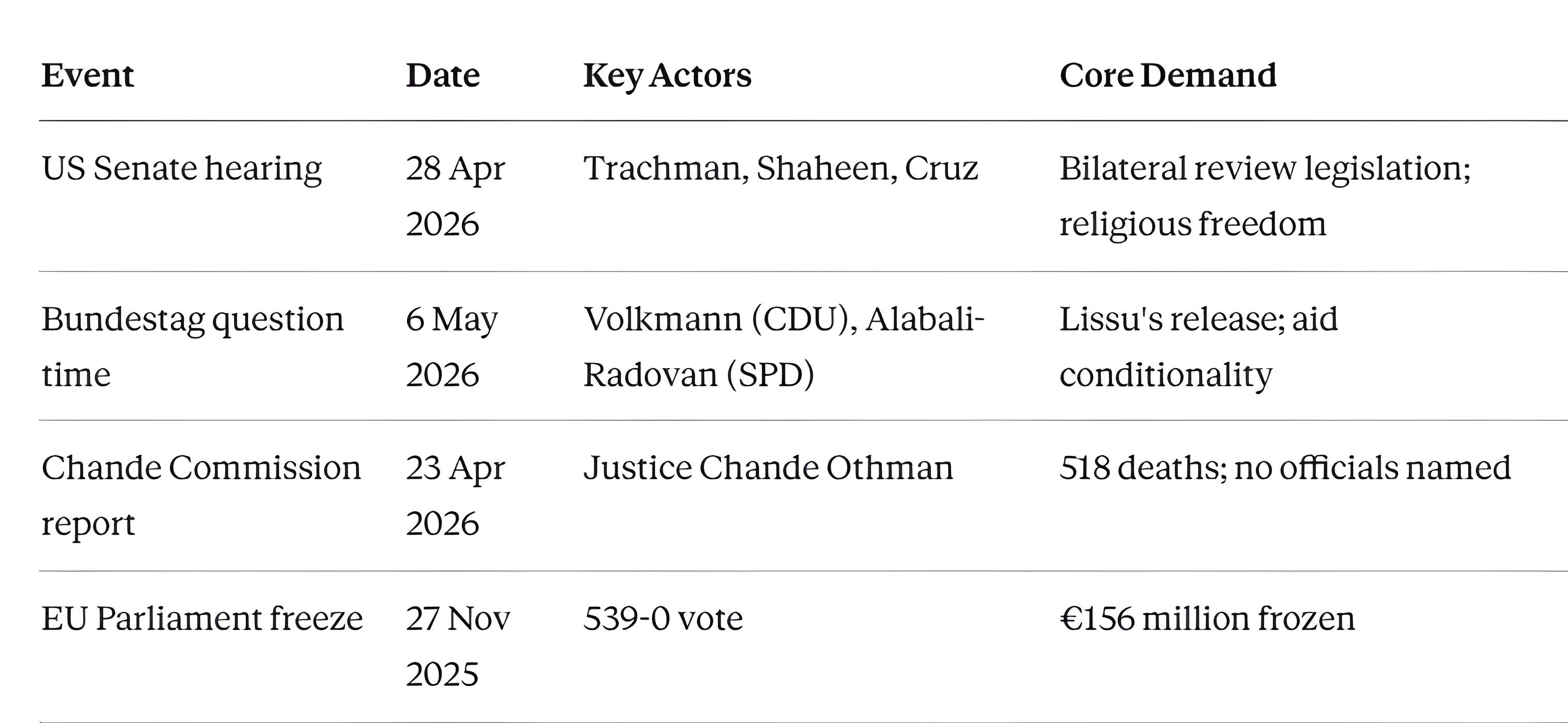
The US Senate Foreign Relations Committee and the German Bundestag addressed Tanzania’s post-election crisis within nine days of each other. On 28 April 2026, the Committee questioned William Trachman, President Trump’s nominee for Ambassador to Tanzania, during which Senator Jeanne Shaheen announced bipartisan legislation mandating a comprehensive review of the US-Tanzania relationship, and Trachman stated that the post-election violence “won’t be swept under the rug.”
On 6 May 2026, CDU Bundestag member Johannes Volkmann questioned Federal Development Minister Reem Alabali-Radovan on the consequences of Tundu Lissu’s detention and the implications for Germany’s €90 million annual development cooperation with Tanzania. Both interventions occurred within a fortnight of the Chande Commission submitting a report documenting 518 deaths — barely five per cent of the approximately 10,000 killed according to the ICC/Intelwatch accountability dossier — while naming no senior official responsible for the killings.
In this assessment:
US Senate Hearing Produces Bipartisan Accountability Commitment on Tanzania
Bundestag Question Time Exposes Gap Between German and EU Positions on Tanzania Aid
Chande Commission’s 518-Death Figure Fails Five Independent Credibility Tests
What These Developments Mean for Samia’s Accountability Exposure
US Senate Hearing Produces Bipartisan Accountability Commitment on Tanzania
The Senate Foreign Relations Committee hearing on 28 April 2026, chaired by Senator Steve Daines, placed Tanzania’s post-election conduct into the confirmation process for the next US Ambassador. Two senators — one Democrat, one Republican — raised Tanzania-specific questions, producing a bipartisan record.
Senator Shaheen (D-NH, Ranking Member) cited “over two thousand people killed in state-sponsored violence” and stated she is introducing bipartisan legislation mandating a comprehensive assessment of “our current and future relationship with the country.” She framed Tanzania as a precedent for the continent: “The continent is really watching our response to how we deal with what happened in Tanzania,” citing upcoming elections in Ethiopia, Kenya and Nigeria.
Trachman directly referenced the Chande Commission report in his response, stating: “I saw that a commission report last week came out saying that only about five hundred people died, and I think that that commission report is not fully public yet. But in any event, Tanzania must be held to account.” He confirmed the violence “will be a part of the comprehensive bilateral review that is already ongoing” and cited his professional background in “civil rights, free speech, and free association.”
Senator Cruz (R-TX) described “a sustained and escalating assault on religious freedom,” stating authorities had “barred Christian gatherings, restricted church activity, and weaponised state power to control religious expression” before the October 2025 election. He drew a parallel with Nigeria: “This is how it unfolds. The persecution of Christians is downplayed by senior officials while violence escalates... with zero accountability. We should not repeat that mistake in Tanzania.”
Trachman called religious freedom “a non-negotiable for me” and invoked Justice Scalia: “It’s easy to make those promises on paper. That’s not enough. They have to be lived.”
The Risch-Shaheen joint statement from November 2025 established the bipartisan baseline: “Tanzania’s continued pivot from the rule of law, reform, and good governance demands a genuine assessment of the U.S. bilateral relationship.”
Bundestag Question Time Exposes Gap Between German and EU Positions on Tanzania Aid
Johannes Volkmann, a first-term CDU member and former staffer to MEP Sven Simon, addressed two questions to Minister Alabali-Radovan during the 6 May 2026 Regierungsbefragung (government question time). He cited “thousands dead” from violence against opposition supporters, referred to Tanzania’s government as “socialist,” noted Germany’s €90 million in development spending for 2024, and asked how Berlin assesses Lissu’s detention against democratic standards and what consequences follow for development cooperation.
Alabali-Radovan stated she views restrictions on press, opinion and assembly freedoms “with great concern,” including cases of transnational repression. She confirmed Germany is working with the EU and like-minded partners to demand an investigation of abduction cases and the release of all political prisoners, including Tundu Lissu. She stated the Federal Government raises rule-of-law standards directly with Tanzania. On development cooperation, she said Germany supports “targeted rule-of-law projects” and considers continuing these projects appropriate. She announced no aid suspension, no conditionality review, no sanctions and no timeline for action.
Chande Commission’s 518-Death Figure Fails Five Independent Credibility Tests
The Commission submitted its findings on 23 April 2026 after 153 days, documenting 518 deaths across 11 regions. This figure carries dual significance. It is the first time Samia’s government has confirmed on the record that people were killed during and after the 29 October 2025 election — a concession contradicting months of official denial. It also revealed that children as young as five were among the dead, with 21 child fatalities recorded, including two under five, four aged seven to ten, and fifteen aged fifteen to seventeen.
The report’s documented failures are extensive.
Casualty methodology. Geographical coverage extended to only 11 of 31 regions, excluding areas where civil society documented concentrated killings. The nationwide internet shutdown from 29 October to 3 November 2025 destroyed the documentation infrastructure required for comprehensive casualty recording. The 518 figure represents what the Commission documented within its constrained mandate, not an upper bound on the actual death toll.
Unsubstantiated financial claims. The Commission asserted that coordinators recruited vulnerable groups and paid them between TZS 10,000 and TZS 50,000 to participate — advancing the government’s narrative that protests were externally organised rather than driven by domestic grievance. No verifiable evidence base for this claim has been disclosed.
Criminalisation of political speech. The report attributed blame to the opposition’s “No Reforms, No Elections” campaign, framing legitimate political speech as a causal factor in the violence rather than addressing the state’s deployment of lethal force against civilians.
Disinformation allegations. The Commission stated that some circulated images and videos “had been manipulated, using AI” and dismissed reports of mass graves as unsubstantiated, with Justice Chande declaring that fake mass grave photos “none of which exist in Tanzania” had been used to inflate casualty perceptions. AFP Fact Check independently confirmed that specific mass grave images originated from Gaza in 2023 and that one viral video of a police officer burning a presidential poster was AI-generated. However, the Commission used these genuine instances of digital manipulation to cast doubt on the entire visual evidence base — including footage independently verified by CNN, Amnesty International, Human Rights Watch, AFP, Reuters and Deutsche Welle through standard open-source authentication methods. The Commission did not disclose its own methodology for distinguishing authentic from manipulated material.
Structural conflicts. The Commission’s membership included a former Inspector General of Police and the Defence Minister who held office during the violence — a conflict Ujasusi Blog assessed before the report’s release. The full report has not been made public. President Hassan’s response focused on establishing a body to investigate the planning and financing of protests rather than addressing security force conduct.
Human Rights Watch described the report as a “missed opportunity.” Chadema and ACT-Wazalendo have both rejected the findings. ACT-Wazalendo has called for an independent international investigation under the UN, AU or SADC.