

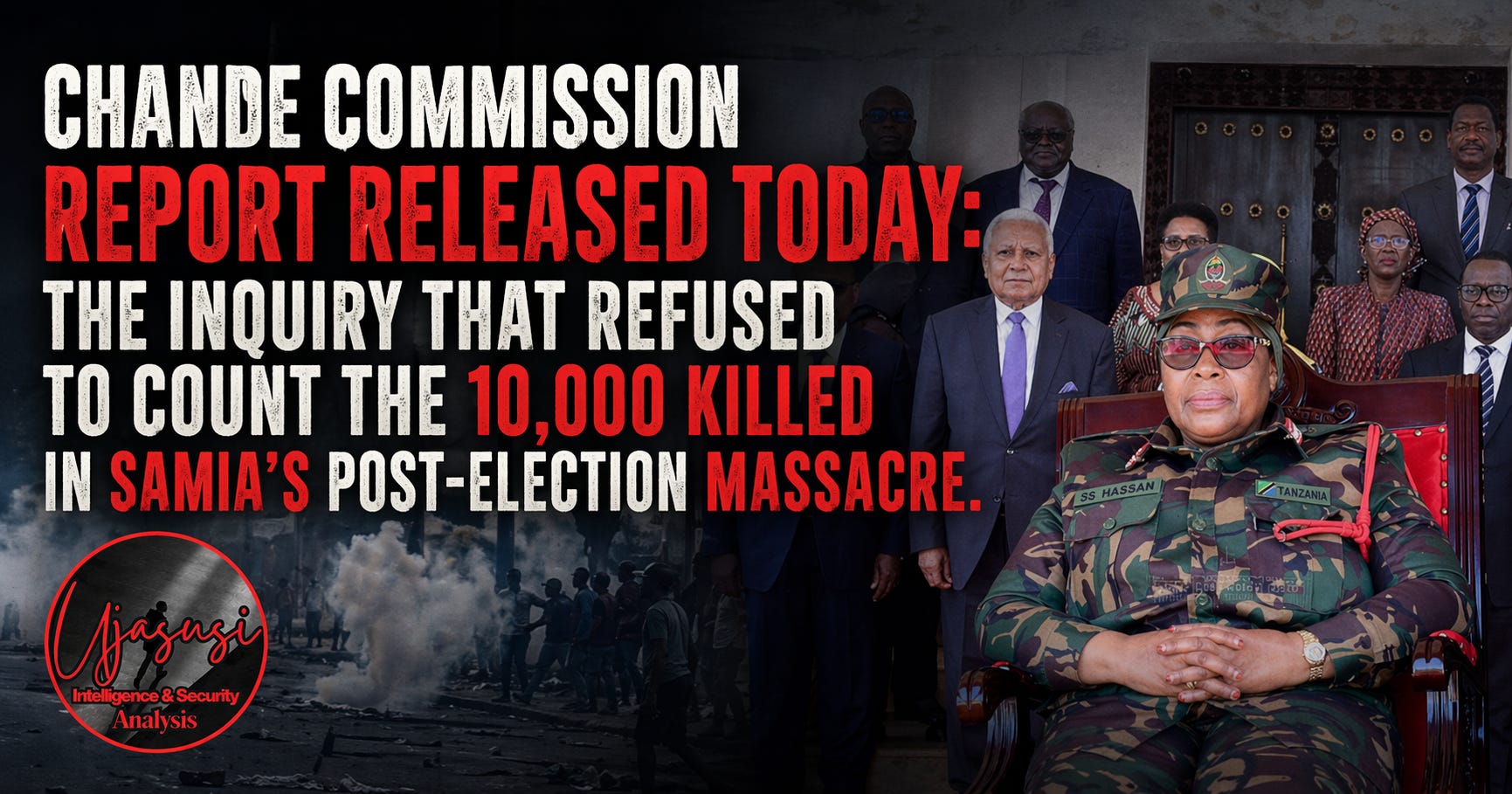
Ujasusi East Africa Monitoring Team | 23 April 2026 | 0200 BST
The Chande Commission submitted its final report to President Samia Suluhu Hassan on 23 April 2026, concluding 153 days of inquiry into Tanzania’s October 2025 post-election massacre. The commission declined to publish a casualty figure despite CNN, Amnesty International, Human Rights Watch, AFP, Reuters, Deutsche Welle, the Legal and Human Rights Centre, and an Intelwatch-led ICC submission independently documenting state killings running into the thousands, producing a report that frames the killings as diffuse “incidents of violence” rather than a centrally-coordinated state operation.
Table of Contents
The Chande Commission Submitted Its Final Report to President Samia on 23 April 2026
The Commission’s Institutional Conflicts of Interest Were Documented Before It Began Work
Justice Chande’s Procedural Framing Is the Evasion, Not an Accidental Omission
The Evidentiary Record Already Exceeds Any Threshold the Commission Could Credibly Dispute
Prime Minister Mwigulu Nchemba’s December 2025 Attack on the 10,000 Figure Pre-Positioned the Commission’s Silence
The Samia Directive Architecture: Why the Findings Track Three Pre-Determined Outcomes
Analytical Inference: The Commission’s Structural Design Was Accountability Inversion, Not Accountability Evasion
The Commission’s Refusal to Name a Casualty Figure Places It Outside Global Accountability Jurisprudence
Strategic Outlook: The Report Strengthens, Rather Than Weakens, the Case for ICC Jurisdiction
The Chande Commission Submitted Its Final Report to President Samia on 23 April 2026
The Commission of Inquiry into Incidents of Breach of Peace, chaired by retired Chief Justice Mohamed Chande Othman, formally presented its findings to President Samia Suluhu Hassan at State House on Thursday, 23 April 2026. The nine-member body, established under Section 3 of the Commissions of Inquiry Act on 18 November 2025, received two successive extensions totalling 63 days, bringing its operational tenure to 153 days from an original 90-day mandate.
The commission gathered evidence from 63,603 respondents across 21 districts in 11 regions, deploying 553 affidavits, 1,323 in-person testimonies, 4,891 anonymous questionnaires, and 56,445 mobile phone submissions, plus 3,565 specialists across 201 professional fields, including pathologists, ballistics experts, and digital-geospatial analysts verifying video and satellite imagery. This methodological scaffolding, presented by Justice Chande at his 21 April press conference, has been the commission’s principal defence against accusations of structural bias.
The report was prepared in both Kiswahili and English. Under Section 21(3) of the Commissions of Inquiry Act, Cap 32, President Samia retains unilateral authority to withhold the document from publication indefinitely without judicial review or parliamentary notification. Whether the full report will be released, and in what redacted form, remains at the President’s discretion.
The Commission’s Institutional Conflicts of Interest Were Documented Before It Began Work
The nine-member panel includes Dr Stergomena Tax, Minister of Defence during the period under investigation; Said Mwema, former Inspector General of Police; and Lieutenant General Paul Ignace Mella, a former army intelligence chief. At the 61st UN Human Rights Council session in March 2026, the British Human Rights Ambassador stated that a presidential commission cannot credibly investigate the President who appointed it. CHADEMA refused to cooperate and called for an international inquiry involving the UN, AU, and EU.
ALSO READ
