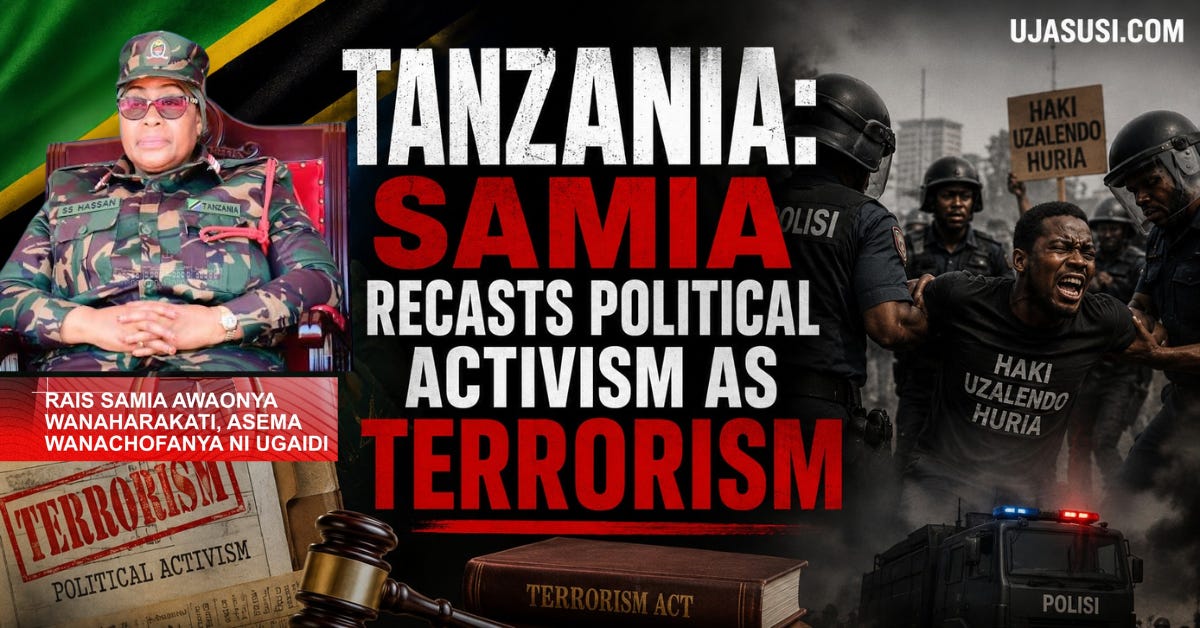
TANZANIA: Samia Recasts Political Activism as Terrorism
Ujasusi East Africa Monitoring Team | 10 July 2026 | 0315 BST
Is the Tanzanian government constructing a coordinated legal and rhetorical pathway to designate civilian activists as terrorists for the October 29, 2025 election deaths, while exonerating the security forces responsible for the killings?
Key Judgements
The Tanzanian government has assembled, across three sequenced institutional steps since April, a pathway toward formally designating activists as the terrorists responsible for the October 29 deaths, while attributing the security response to a justified reaction against organised violence. Confidence: High, based on the tight seven-week interval between the Special Criminal Investigation Commission’s mandate and President Samia’s public terrorism framing, and the absence of an equally coherent alternative explanation for that sequencing.
A terrorism designation, once applied, extends Tanzanian state reach against activists based outside the country in ways ordinary treason or public-order charges do not. Confidence: High, grounded directly in the text of the Prevention of Terrorism Act, which explicitly criminalises terrorist acts committed by Tanzanian citizens “outside the United Republic,” and in Tanzania’s Financial Intelligence Unit and Bank of Tanzania mechanisms for terrorism-financing asset freezes.
The Chande Commission’s April findings already perform the exoneration half of this outcome by contesting the higher casualty and mass-grave claims advanced by opposition and rights groups, and by framing the security response as proportionate to an organised threat. Confidence: High, based on the Commission’s own published findings and its chairman’s public remarks.
The naming of specific individuals or organisations as principal terrorism suspects has not yet occurred, and the body tasked with naming them faces an active legal challenge to its own constitutionality. Confidence: High that naming remains the unresolved step; Moderate confidence, downgraded from the prior draft’s Highly Likely, that the Lila Commission delivers a timely, uncontested report. A Kigoma High Court judge has already found no evidence the commission was gazetted as required by law, and the main opposition party has refused to cooperate with it on bias grounds.
A credible alternative explanation, that this sequence reflects institutional improvisation rather than a coordinated design, cannot be fully excluded and would, if correct, still produce a materially similar outcome for activists even without deliberate intent driving it from the outset.
Scope and Approach
This assessment addresses whether developments since April 2026 constitute a coordinated pathway toward a terrorism designation of activists connected to the October 29, 2025 unrest, and what practical consequences such a designation would carry, including for activists based outside Tanzania. It draws on the published findings of the Chande Commission, the public notice establishing the Special Criminal Investigation Commission, President Samia’s July 9 remarks in Zanzibar, ongoing judicial review proceedings against the Lila Commission, and the text of Tanzania’s Prevention of Terrorism Act and associated anti-money-laundering framework. It does not assess the underlying question of who was in fact responsible for the October 29 deaths, nor does it rely on any non-public reporting; all sourcing is open-source and Wikipedia is excluded as a source throughout. The assessment does not extend to the parallel Truth and Reconciliation Commission process, which is a separate track addressing broader national healing rather than criminal attribution.
Background
Tanzania’s October 29, 2025 general election was followed by nationwide protests and a security crackdown that killed at least 518 people according to the government’s own commission of inquiry, a figure activists and opposition parties reject as a substantial undercount. President Samia Suluhu Hassan was declared the winner with roughly 98 percent of the vote, in a contest observer missions said failed to comply with democratic standards. In the crackdown’s aftermath, over 1,700 individuals faced charges including treason and conspiracy, opposition leader Tundu Lissu remained imprisoned on treason charges dating from April 2025, and the government imposed a near week-long internet blackout.
President Samia launched the Independent Commission of Inquiry in November 2025 under retired Chief Justice Mohamed Chande Othman. Its April 23 findings framed the violence as planned, coordinated, financed and executed by trained individuals who mobilised economically vulnerable youths. Chande identified what he termed “criminal indicators requiring accountability” but declined to name specific perpetrators, recommending instead a specialised follow-on body. Receiving the report, President Samia endorsed this directly, stating that the new body “will look at the issues identified and determine those involved in planning, coordinating, and financing the events of violence or disorder.” That recommendation became the Special Criminal Investigation Commission (commonly known as the Lila Commission), announced May 18 under Court of Appeal Judge Shabani Ally Lila, alongside retired High Court judges Gad John Mjemmas, Awadh Mohamed Bawazir and Aishieli Nelson Sumari.
READ ALSO
TANZANIA: Samia's Criminal Probe Commission After Chande Report: Window Dressing Built on a Kikwete-Linked Judicial Patronage Network
Ujasusi East Africa Monitoring Team | 19 May 2026 | 0120 BST
Analysis
The exoneration function is already substantially complete
The Chande Commission’s findings perform most of the analytical work needed to shift responsibility away from the security forces. By characterising the events as an organised operation involving recruitment, payment and training of participants rather than a spontaneous reaction to electoral fraud, the Commission reframes the security response as defensive rather than repressive. Its treatment of higher casualty claims and mass grave allegations as unconfirmed directly undercuts the evidentiary basis for the crimes-against-humanity framing advanced by international rights bodies. This assessment judges that the exoneration element does not depend on the Lila Commission’s outcome at all. It is already embedded in the public record and has been amplified by state-aligned commentary describing it as proof the government was right to act as it did.
The naming function was deliberately deferred, then delegated to a body with a narrower mandate that is now under legal challenge
Chande’s explicit refusal to name individuals is analytically significant in itself. A commission with a five-month investigation and a detailed account of financing and training mechanisms was in a strong position to name suspects had it chosen to. Civil society coalitions made this point directly at the time, arguing in an April 27 joint analysis that the commission had authority to investigate criminal matters and that deferring this “appeared designed to avoid rather than achieve accountability.”
The Lila Commission inherits a narrower, prosecutorial mandate: identifying who planned, coordinated and financed the violence. Its legitimacy is now contested on two fronts. CHADEMA announced on May 23 it would not cooperate with the commission, describing it as biased. More consequentially, activists Buberwa Kaiza and Joseph Mabugo filed a judicial review challenge arguing the President lacked authority to establish a second commission after Chande’s had concluded, and that criminal investigation is the Director of Public Prosecutions’ exclusive constitutional domain. On June 8, the Kigoma High Court granted leave to proceed, with the presiding judge noting specifically that no evidence had been presented showing the commission was published in the Government Gazette, a statutory requirement under Section 20 of the Commissions of Inquiry Act. This does not resolve the underlying legality question, but it establishes that the commission tasked with naming activists as terrorism suspects is itself operating under an unresolved cloud of illegitimacy. This is a material fact absent from the prior draft of this assessment.
The rhetorical conditioning is timed to precede, not follow, the naming
President Samia’s July 9 Zanzibar remarks defined terrorism in terms broad enough to capture standard protest conduct (intimidating the public or pressuring government to accept political demands) without reference to a specific verdict or named individual. Read against the timeline, the remarks land seven weeks into the Lila Commission’s work, two days after the July 7 Saba Saba mobilisation, and amid a broader pattern of the government treating online protest coordination as criminal activity since November 2025. Preparing public opinion to accept a terrorism framing before the naming body has reported is consistent with conditioning rather than commentary, though this assessment cannot rule out that the timing tracks the Saba Saba anniversary rather than the Lila Commission’s internal progress, about which no public timeline has been disclosed.
The extraterritorial mechanism is real and statutorily explicit, not speculative
Tanzania’s Prevention of Terrorism Act states directly that no citizen of Tanzania, whether inside or outside the country, may commit a terrorist act, and applies the same standard to financing, membership and harbouring offences. Sentencing minimums are severe: at least thirty years for a terrorist act, eighteen years for membership of a terrorist organisation, and fifteen to twenty years for financing. Because terrorist financing is a predicate offence for money laundering under Tanzania’s Anti-Money Laundering Act, a terrorism designation opens the door to Financial Intelligence Unit and Bank of Tanzania asset-freeze action, and to Interpol notices and mutual legal assistance requests that ordinary treason or sedition charges do not carry with the same international traction. This gives the government a materially different (and more exportable) instrument against diaspora-based critics than anything currently in use against Lissu or other detained figures.
READ ALSO
Introducing “A Spy’s Guide to Deception” — The First in the Spy Guide Series
Intelligence work is built on deception. Every service that has ever run an agent, mounted a cover operation, or manufactured a false narrative has done so through principles that remain largely invisible to the public. Not because they are secret, but because no one has taken the time to explain them plainly.
Outlook
Lila Commission Reports on Schedule — Likely: The Lila Commission reports within the coming months, though the active judicial review and CHADEMA’s boycott introduce delay risk not present in the initial timeline. Its findings name specific individuals or organisations as principal planners and financiers, using language consistent with the terrorism framing Samia has now set publicly. Some named individuals are based outside Tanzania, prompting the government to invoke extraterritorial provisions of the Prevention of Terrorism Act. Formal terrorism charges, as distinct from continued use of treason and public-order statutes, follow within months of the report.
Designation Triggers Sharper International Fallout — Likely: The designation is applied broadly enough, or against sufficiently prominent civil society figures, to trigger a sharper diplomatic response than the EU Parliament’s vote against the €156 million aid allocation. Western governments and international rights bodies treat a terrorism designation of activists as confirmation of the authoritarian drift already flagged by the AU observer mission and UN experts, accelerating aid and diplomatic isolation beyond the current EU freeze. This case is triggered specifically if named individuals include figures with an existing international profile.
Commission Struck Down or Materially Delayed — Roughly an Even Chance: The Kigoma High Court’s judicial review proceeds to a substantive finding that the Lila Commission was unlawfully constituted, forcing either its dissolution or a re-gazetting process that materially delays or dilutes its findings. Combined with CHADEMA’s refusal to cooperate and continued civil society pressure for an internationally supervised investigation, this outcome no longer requires an unexplained change in government calculation: it has an active, evidenced legal mechanism behind it that did not exist at the time of the prior draft.
Analytical Foundations
Key Assumptions
That the Lila Commission will ultimately report despite the pending legal challenge. Evidentially mixed: the commission continues operating pending the Kigoma court’s substantive ruling, but the court has already found a specific statutory defect (absence of gazettement). If the challenge succeeds in halting or nullifying the commission, the terrorism-naming mechanism this assessment describes may not materialise in its current form, though the government retains the option of reconstituting it lawfully.
That “activists” named by Lila, if it reports, will be domestic civil society and opposition-linked figures, not primarily foreign nationals or unresolved suspects. This remains the assessment’s linchpin assumption, with the least direct evidentiary support. The entire practical significance of the “two birds” outcome (exoneration paired with activist prosecution) depends on it. Should Lila instead name principally foreign state or non-state actors, or fail to name individuals at all, the exoneration function would stand but the activist-targeting function would not be confirmed.
That a terrorism designation, once applied, will in practice be enforced against diaspora-based individuals rather than remaining a domestic legal instrument. Tanzania’s statutory framework supports this, but enforcement capacity (securing Interpol cooperation, executing mutual legal assistance requests, persuading host states to act) is not guaranteed even where the legal basis exists.
That President Samia’s July 9 remarks were a deliberate act of conditioning rather than genuine, unplanned reaction to recent events. This cannot be verified from public statements alone and is treated as a reasonable inference from timing rather than an established fact.
Alternative Assessment
A credible alternative view holds that this sequence reflects institutional improvisation rather than a coordinated plan authored from the outset. Under this reading, Chande’s commission reported what its evidence showed and declined to name individuals because it genuinely lacked a prosecutorial mandate. The Lila Commission followed as the standard next step for any inquiry that identifies organised violence without attributing it to named actors. Samia’s Zanzibar remarks reflect a president’s genuine belief, expressed repeatedly since December 2025, that the unrest was externally orchestrated rather than a calculated attempt to pre-condition a specific legal outcome. The Kigoma legal challenge, on this reading, is itself evidence against premeditated design: a genuinely improvised commission would be more exposed to exactly this kind of procedural defect than a carefully engineered one.
This assessment judges the coordinated-pathway interpretation more likely for two reasons. First, the compression of the timeline (recommendation to formation in four weeks, formation to public terrorism framing in seven) is faster than typical bureaucratic sequencing in Tanzania’s institutional environment. Second, the substance of Samia’s July 9 remarks pre-defines the terms under which any future finding would be received, which is characteristic of conditioning rather than commentary on settled fact. The gazettement defect cuts against the coordination thesis somewhat, and is noted honestly as the strongest piece of evidence for the alternative view. Even so, the distinction between design and improvisation matters primarily for judgements about intent, not for the assessed likelihood of the outcome itself: a poorly executed pathway toward the same destination is still a pathway.
What We Do Not Know
The Lila Commission’s internal timeline, evidentiary standard, and the identities of individuals under active investigation are not publicly known. It is not known whether the Commission’s findings will be published in full or, as with Chande’s report, released only as a summary with the complete document withheld from public scrutiny, a pattern Amnesty International has already criticised. The outcome of the Kigoma High Court’s substantive review is not yet determined. Whether any diaspora-based activist has already experienced adverse action (visa restriction, asset inquiry, or pressure directed at family members remaining in Tanzania) ahead of any formal designation is not established in open-source reporting and would be a significant early indicator if confirmed. Readers should weigh this assessment’s confidence levels accordingly: the institutional pathway is well-evidenced, but its legal durability and its specific human targets remain, for now, contested and forecast rather than settled fact.
No advertisers. No corporate backers. Just you. Ujasusi is 100% reader-supported. Keep our journalism independent. [Support Ujasusi]