

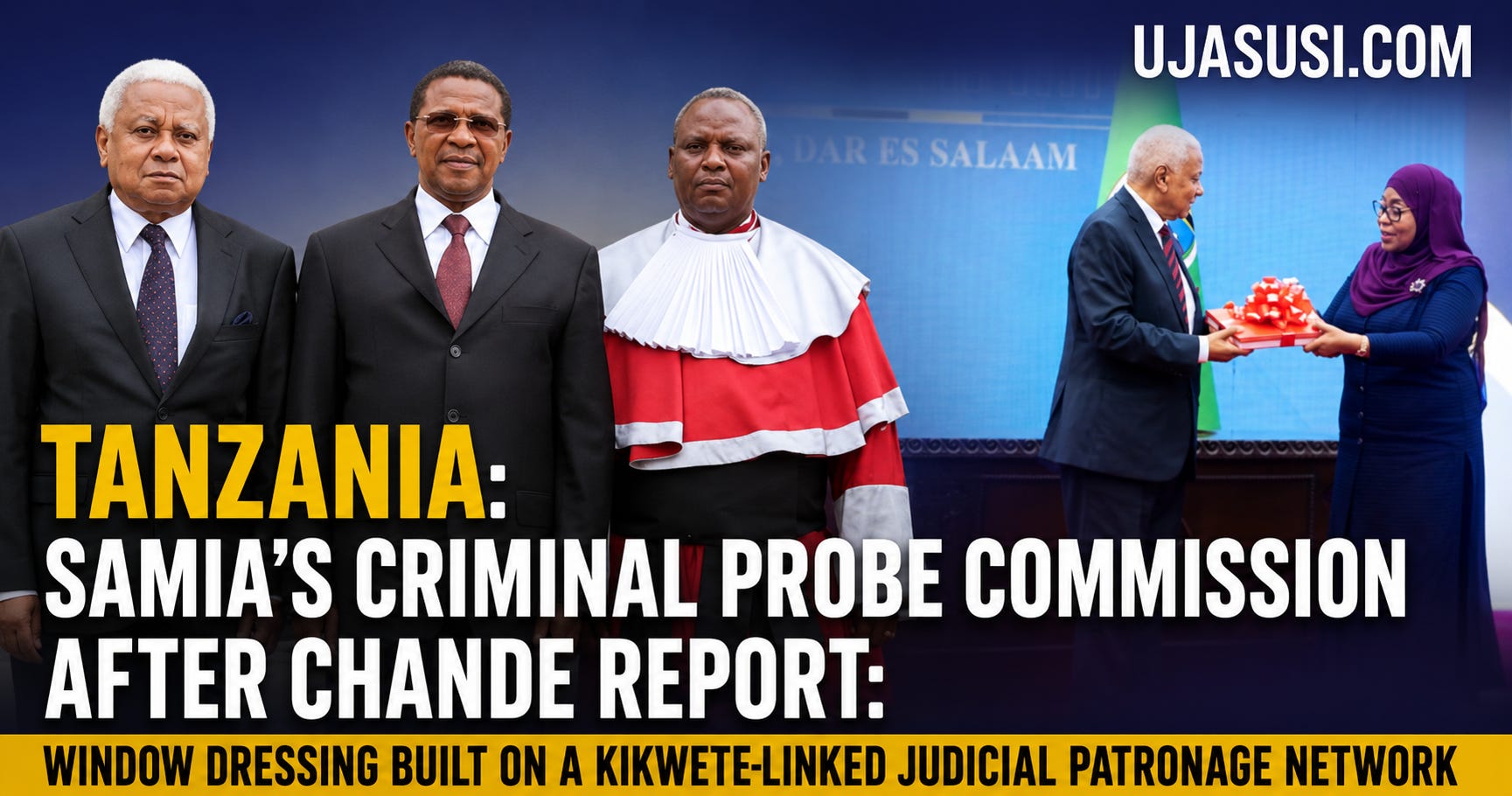
Ujasusi East Africa Monitoring Team | 19 May 2026 | 0120 BST
Tanzania’s Presidential Criminal Probe Commission, constituted by President Samia Suluhu Hassan in May 2026, is a judicially composed investigative body mandated to conduct criminal-level enquiries into the violence that accompanied and followed the October 2025 general election. Its establishment directly implements a core recommendation of the Presidential Commission of Inquiry chaired by retired Chief Justice Mohamed Chande Othman, whose report was submitted to the President on 23 April 2026. Chaired by retired Court of Appeal Judge Shaban Lila and comprising three further retired High Court judges, the commission holds prosecutorial referral authority, a formal structural advance on its predecessor’s fact-finding mandate. Whether that authority will be exercised independently of State House political direction remains the central analytical question for Tanzania accountability observers.
📋 Table of Contents
The Chande Commission Mandate and the Formal Trigger for Phase II
The Criminal Probe Commission’s Composition and Institutional Architecture
Phase I and Phase II Commission Mandates Compared
The Kikwete Thread: The Judicial Patronage Network Both Commissions Share
Credibility Indicators: Signals That Distinguish Genuine Accountability from Managed Deflection
Observable Indicators That Would Signal Genuine Criminal Accountability
Forward Assessment: Tanzania Accountability in the Regional Intelligence Context
🔍 The Chande Commission Mandate and the Formal Trigger for Phase II
The Chande Commission — formally the Presidential Commission of Inquiry into the October 2025 post-election events — concluded its public mandate with the submission of its report to President Samia Hassan on 23 April 2026. That report, produced under the authority of the Commissions of Inquiry Act, Cap. 32 of the Laws of Tanzania, documented testimonial evidence relating to 518 deaths across 11 regions, arbitrary detentions, and the conduct of security forces during and after the election period. The commission recorded 1,323 in-person testimonies, 553 affidavits, more than 33,000 SMS submissions, and nearly 5,000 questionnaires across a 153-day investigation extended twice due to the volume of public submissions. Consistent with its terms of reference, the Chande Commission was constituted as a fact-finding body; it carried no power to prefer criminal charges, compel prosecutorial action, or detain suspects.
The report’s formal recommendations included a specific call for the establishment of a dedicated criminal investigation commission with authority to pursue individual criminal liability for the offences identified. That recommendation provided the institutional trigger and the political cover for Samia Hassan’s subsequent action. By framing the criminal probe commission as a direct implementation of the Chande report recommendations, the presidency insulated the decision from characterisation as an arbitrary executive initiative, anchoring it instead within an established quasi-judicial process.
The Chande Commission’s credibility as a triggering mechanism is itself contested. Human Rights Watch assessed in May 2026 that the commission missed an opportunity to establish the full truth and lay the foundation for accountability, noting that the full report has not been made public. Main opposition CHADEMA has rejected the commission’s findings outright, describing it as “a mechanism to conceal the truth, erase evidence, and perpetuate harm against victims.” That structural contestation does not invalidate the criminal probe commission’s mandate, but it circumscribes the legitimacy of the evidentiary foundation the new body inherits.
ALSO READ

🏛️ The Criminal Probe Commission’s Composition and Institutional Architecture
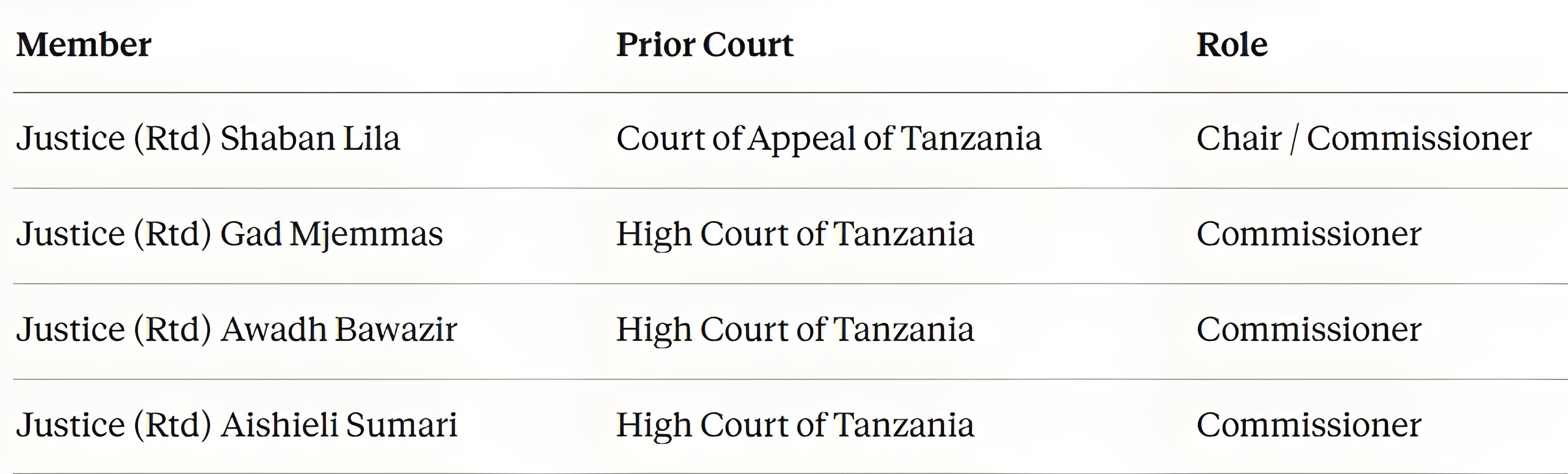
President Samia Hassan appointed Justice (Rtd) Shaban Lila, a former member of the Court of Appeal of Tanzania, as both commissioner and chairman of the criminal investigation commission. Three additional retired High Court judges complete the panel: Justice (Rtd) Gad Mjemmas, Justice (Rtd) Awadh Bawazir, and Justice (Rtd) Aishieli Sumari.
The commission’s exclusive reliance on retired jurists warrants analytical attention. Retired judges appointed to presidential commissions in Tanzania operate outside the institutional protections that active judicial appointment provides. They are susceptible to the implicit pressure of future recognition considerations, a dynamic documented across several East African jurisdictions and directly relevant to assessing the commission’s structural independence.
What mainstream coverage has not examined is that the judicial careers of both men at the apex of Tanzania’s two-phase accountability process, Chande Othman in Phase I and Lila in Phase II, share a common institutional origin traceable to a single former Tanzanian presidency. That former president’s political family remains embedded in Samia Hassan’s current cabinet. The full network analysis, and what it reveals about CCM’s structural penetration of the judiciary, is in the subscriber section below.
The government stated the commission is mandated to carry out detailed investigations and recommend appropriate legal and administrative actions. The precise terms of reference have not been made public, which constitutes a transparency deficit at the outset of the commission’s operational period.
⚖️ Phase I and Phase II Commission Mandates Compared
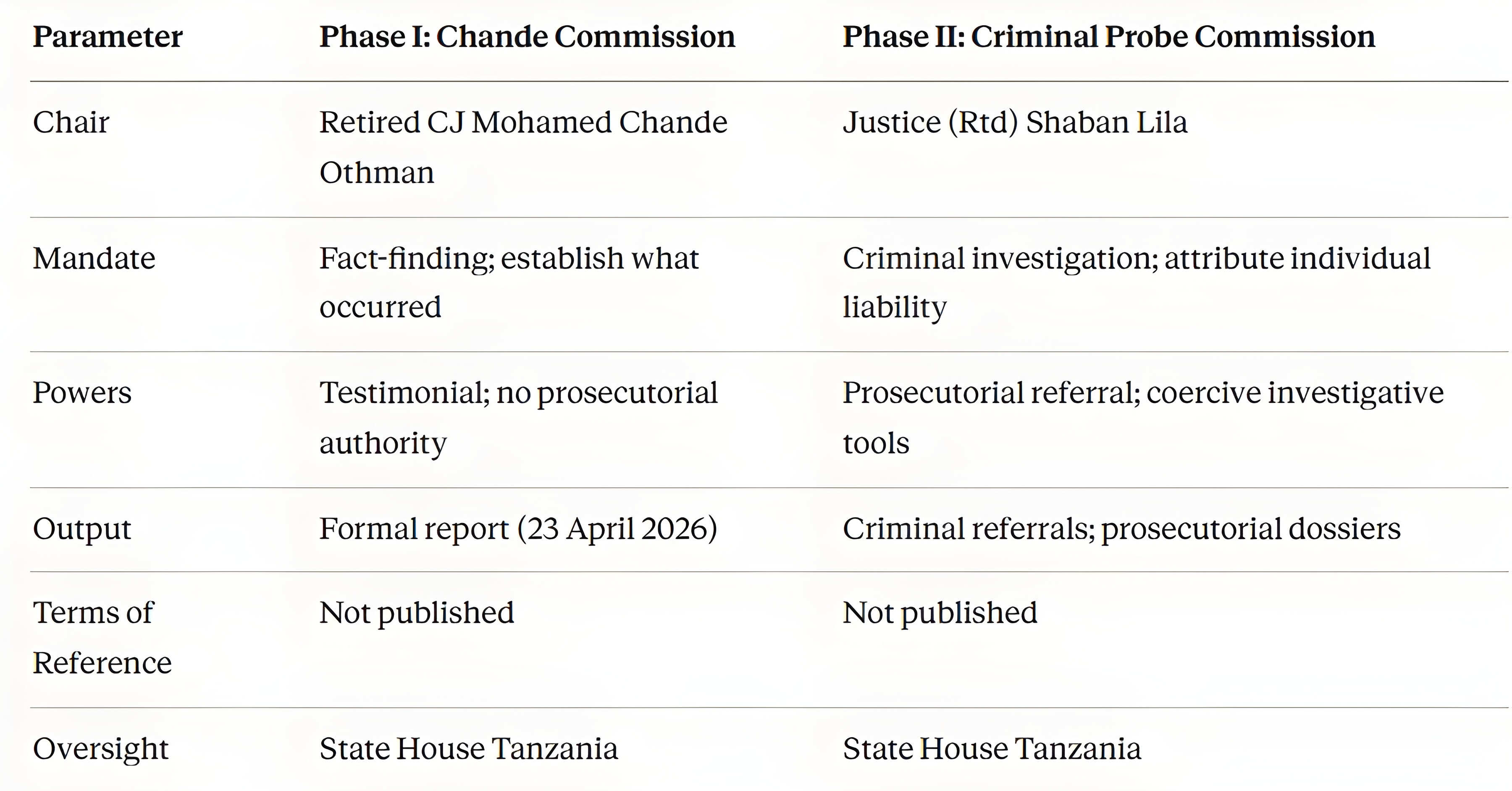
The formal advance from fact-finding to criminal investigation authority is operationally meaningful only if the commission exercises it. The Criminal Procedure Act of Tanzania and the Penal Code provide the statutory framework within which any referrals would be processed. Prosecutorial discretion, exercised by the Director of Public Prosecutions, an office not insulated from executive influence under current constitutional arrangements, remains a critical downstream variable. A commission with referral authority that refers cases to a prosecution office subject to executive direction is structurally incomplete as an accountability mechanism.
Both phases share a further structural feature that has gone unexamined in public commentary: the judges anchoring each phase owe their most senior career appointments to the same former presidency, one whose political lineage has not departed from Tanzania’s current power structure. The implications for the commission’s operational independence are assessed in full below.
The Kikwete Thread: The Judicial Patronage Network Both Commissions Share
This is the analytical dimension absent from all mainstream coverage, and the one most directly bearing on a credible independence assessment.