

Ujasusi East Africa Monitoring Team | 16 June 2026 | 0800 BST
Tanzania Faces Its Most Significant Protest Mobilisation Since October 2025
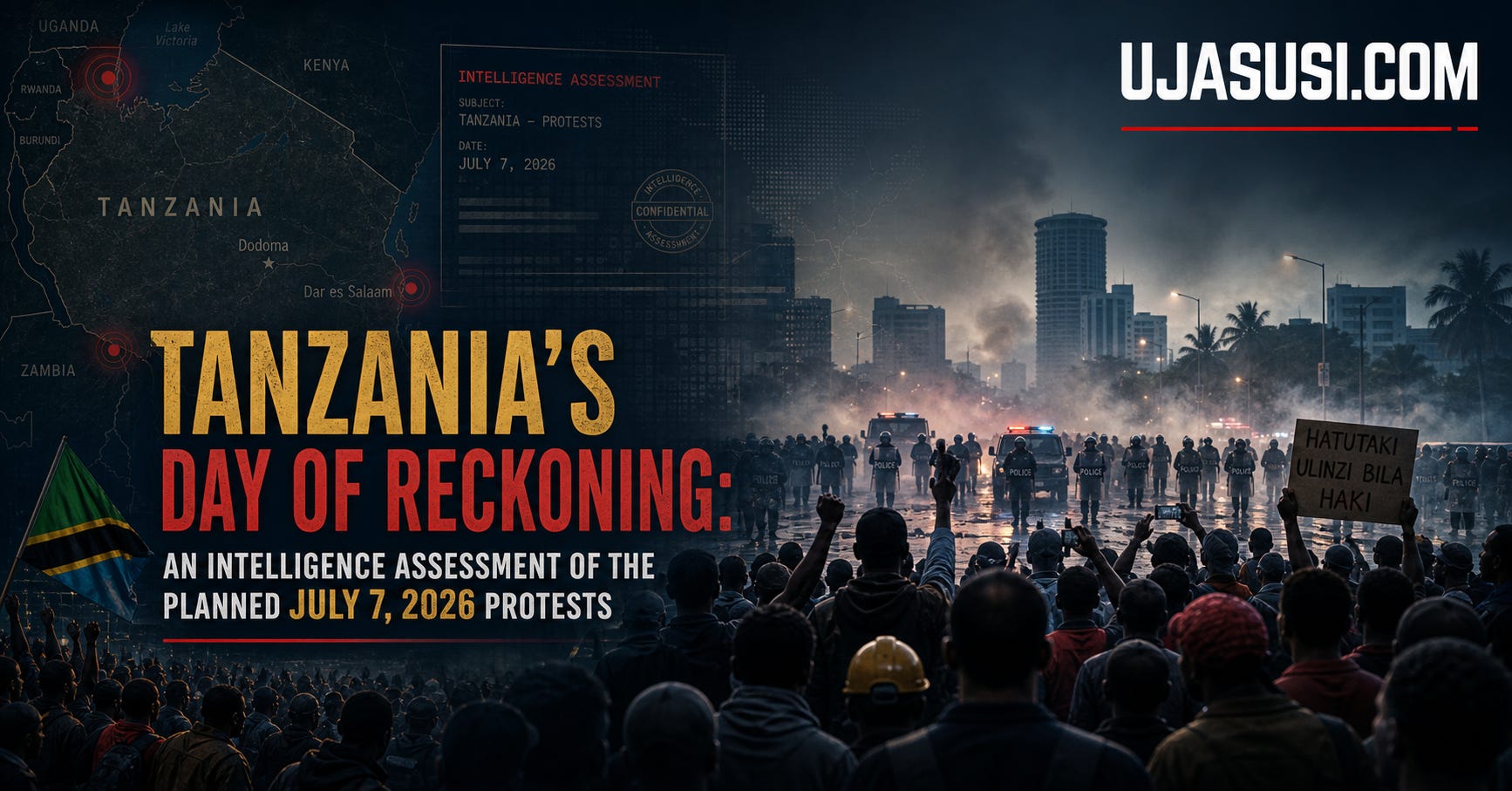
Tanzania enters the final three weeks before July 7 under conditions that make protest both more probable and more dangerous than at any point since the post-election crackdown. The October 2025 election was widely characterised as a sham, and the government’s response to the demonstrations that followed produced a political rupture that has not closed. Live ammunition, enforced disappearances, and a ten-day internet blackout were the instruments of that response.
The planned demonstrations on July 7 are not a spontaneous reaction to a single trigger. They are the latest expression of a movement whose grievance base has been accumulating since October 29, 2025, and whose international support architecture has grown more institutionalised with each passing month. The date carries its own analytical weight. Saba Saba Day is a national public holiday commemorating the 1954 founding of the Tanganyika African National Union, the movement that led Tanzania to independence. Mobilising for accountability on a day that celebrates the founding of the ruling party’s predecessor organisation is not a coincidence of timing. It is a deliberate symbolic choice that lowers the psychological barrier to participation and raises the reputational cost of suppression.
This assessment judges that turnout is the single decisive variable. If it is genuinely high across multiple cities simultaneously, the protest movement’s chances of forcing a political reckoning are materially stronger than any previous cycle has offered, because the government’s most effective instrument of suppression has become its most costly option.
The Chande Commission’s 518-Death Finding Has Deepened, Not Resolved, Tanzania’s Political Crisis
The Commission of Inquiry chaired by retired Chief Justice Mohamed Chande Othman documented 518 deaths across 11 regions following the October 2025 elections. The ICC/Intelwatch accountability dossier places the death toll at approximately 10,000. Neither figure is disputed as a ceiling by the parties that compiled it. The gap between them reflects the commission’s structural limitations, not competing empirical claims.
The commission gathered evidence from 63,603 Tanzanians through 1,323 in-person testimonies, 553 sworn affidavits, and 56,445 mobile phone submissions across 21 districts in 11 regions. It did not visit 20 of Tanzania’s 31 regions. It named no senior official responsible for the killings. It produced no prosecutorial referral. Its credibility as a triggering mechanism for accountability is therefore structurally contested before any opposition actor challenges it on political grounds.
ACT Wazalendo rejected the findings as a mechanism to shield perpetrators rather than hold them accountable. CHADEMA described the commission as an instrument to conceal evidence and perpetuate harm against victims. Opposition parties argue collectively that reconciliation cannot proceed without prior accountability, a position that places them in direct structural opposition to CCM’s state-led reconciliation framework.
The commission’s April 23 report has therefore not resolved Tanzania’s crisis. It has hardened opposition positions, provided international actors with a documented evidentiary baseline that falls far short of the documented death toll, and given protest organisers a concrete and recent accountability failure around which to frame July 7 mobilisation. The gap between 518 and 10,000 is itself a political instrument.
Tanzania’s Opposition Operates Under Conditions Closer to a Banned Movement Than a Political Party
Tanzania’s electoral commission declared Samia the winner of the October 2025 general election with nearly 98 per cent of the vote, a result that African Union and Southern African Development Community observation missions assessed as falling short of democratic standards. Tundu Lissu, the leader of Chadema, was arrested in April 2025 following a peaceful rally advocating electoral reform. He remains detained on treason charges carrying the death penalty, having been imprisoned for over fourteen months without conviction. INEC banned Chadema from electoral participation until 2030.
The structural consequence of this configuration is that CHADEMA cannot coordinate July 7 activity through formal party infrastructure without exposing its remaining leadership to arrest on the pre-existing precedent that protest organisation constitutes criminal conduct. The movement that will produce — or fail to produce — meaningful demonstrations on July 7 is therefore not party-led. It is a decentralised network of Gen Z activists, diaspora coordinators, and civil society actors operating across social media platforms without a central command structure.
READ ALSO
Introducing “A Spy’s Guide to Deception” — The First in the Spy Guide Series

Intelligence work is built on deception. Every service that has ever run an agent, mounted a cover operation, or manufactured a false narrative has done so through principles that remain largely invisible to the public. Not because they are secret, but because no one has taken the time to explain them plainly.
That architecture has two analytical implications. First, it is more resilient to pre-emptive coordinator arrests than a party-structured mobilisation, because there is no single leadership tier whose removal collapses the network. Second, it is more vulnerable to fragmentation and message inconsistency, because the absence of central coordination produces uneven geographic coverage and competing tactical approaches. Both implications are simultaneously true and their net effect on July 7 turnout is the central uncertainty this assessment cannot resolve with available information.
The Shaheen-Cruz Reassessing Act and EU Aid Freeze Have Created a Structured International Deterrence Environment
The October 2025 suppression playbook is now operating inside a fundamentally different international cost structure than it did eight months ago. Senator Jeanne Shaheen (D-NH), Ranking Member of the Senate Foreign Relations Committee, and Senator Ted Cruz (R-TX) introduced the bipartisan Reassessing the United States-Tanzania Bilateral Relationship Act on May 20, 2026.
The legislation mandates a comprehensive review of all US security, economic, and diplomatic engagement with Tanzania. It requires a report identifying government, ruling party, and security officials responsible for political violence, enforced disappearances, and censorship. It authorises visa bans and asset-blocking sanctions against individuals responsible for serious human rights abuses. It suspends US security and development assistance until the Secretary of State certifies meaningful democratic reforms and an end to politically motivated prosecutions. It prohibits Millennium Challenge Corporation support for Tanzania until the government demonstrates a renewed commitment to democratic governance.
The bill’s bipartisan architecture is the analytically critical feature. It is not a Democratic foreign policy instrument that a Republican-controlled executive branch can quietly deprioritise. A bill co-led by Ted Cruz carries institutional weight inside a Republican Senate that no single-party accountability measure directed at an African government would generate. Its momentum is structurally independent of executive branch preference in a way that matters for the Samia government’s calculation.
Simultaneously, the EU Parliament’s Committee on Foreign Affairs and Committee on Development voted 81–1 against the European Commission’s revised implementing decision for Tanzania’s 2026 allocation of €156 million. The committees cited the Chande Commission’s failure to name perpetrators, the cancelled EU human rights subcommittee visit in May 2026, and Tundu Lissu’s continued imprisonment. Critically, the committees rejected the Commission’s revised proposal — which shifted delivery from direct budget support to indirect management — as cosmetic rather than substantive. The European Parliament had previously adopted a resolution by 539 votes to zero condemning Tanzania’s post-election conduct. That the Commission’s attempted workaround was also rejected signals that the freeze has institutional depth, not merely parliamentary sentiment behind it.
Together, these instruments create an accountability architecture in which a repeat of October 2025 on July 7 would activate consequences — named individual sanctions, suspended bilateral assistance, accelerated legislative action, and a strengthened ICC/Intelwatch evidentiary record — at a speed and scale the Samia government cannot offset through alternative partnerships in the immediate term. Tanzania has sought to hedge through Gulf and Chinese partnerships, but neither offers a substitute for the scale of Western financial and diplomatic exposure now in play.
Pre-Emptive Arrest and Digital Surveillance Remain the Government’s Primary Suppression Instruments
The government has characterised online protest coordination as criminal activity since November 2025, conducting systematic monitoring of WhatsApp groups, TikTok content, and other social media platforms. Since mid-November 2025, police confirmed arrests of at least ten activists specifically for online posts connected to protest planning, in several cases after social media posts reported abductions by individuals in civilian clothing before formal arrest announcements were made.
The government has additionally restricted the broader information environment through bans on X, restrictions on JamiiForums, the suspension of Jambo TV in April 2026, and institutionalised online patrols by the Tanzania Communications Regulatory Authority.
This pre-emptive disruption model achieved its primary objective before December 9, 2025, reducing that protest cycle to minimal street activity. Its replication before July 7 is assessed as near-certain. Its effectiveness, however, faces a structural constraint it did not encounter in December: the mobilisation it must suppress is more distributed, more internationally connected, and operating on a date with a lower participation threshold than an ordinary weekday demonstration would require.
The internet blackout option remains available. Its deployment on July 7 would be assessed internationally as a direct repetition of October 2025 conduct and would strengthen rather than weaken the evidentiary record supporting sanctions activation. That cost calculation is known to the government. Whether it overrides operational instinct under pressure is not assessable from available open-source information.
Turnout Is the Variable That Determines All Other Outcomes
No security apparatus, regardless of deployment density, can simultaneously suppress peaceful civilian presence across multiple urban centres at scale without generating the footage and casualty record that activates the international instruments described above. This is the structural asymmetry that July 7 presents and that no previous Tanzanian protest cycle has possessed in equivalent form.
If turnout is genuinely high across multiple cities simultaneously, the government faces two options. Allowing demonstrations to proceed concedes political space it has refused since October 2025 and establishes a participation precedent that subsequent mobilisation cycles will build on. Deploying extreme force activates the Reassessing Act’s sanctions mechanism, hardens the EU plenary position on the €156 million, and provides the ICC/Intelwatch dossier framework with a second documented episode of state violence against civilian demonstrators on a public holiday. Neither option is recoverable on the government’s preferred terms of managed stability without accountability.
A sufficiently large crowd therefore renders the pre-emptive arrest model insufficient and the deterrence posture inadequate simultaneously. The government cannot arrest its way out of a genuinely large mobilisation without producing the international consequences it is structurally incentivised to avoid.
Against this, the fear installed by October 2025 remains the movement’s primary obstacle. For citizens who witnessed or experienced the crackdown, the individual participation calculation does not shift unless crowd size reaches the threshold at which collective presence generates its own protection. That threshold is unknowable in advance and unverifiable until the morning of July 7 itself. It is the information gap that makes confident probability assignment impossible and scenario analysis the appropriate analytical tool.
Sustained momentum beyond July 7 amplifies whatever is achieved on the day. The Kenyan protest model, in which demonstrations spread to at least 17 counties during the 2025 Saba Saba protests, confirms that geographic spread and duration determine political outcomes more than peak single-day turnout. A movement that produces visible demonstrations on July 7 and sustains pressure into the following week operates in a qualitatively different political register than one that peaks and dissipates within 24 hours.