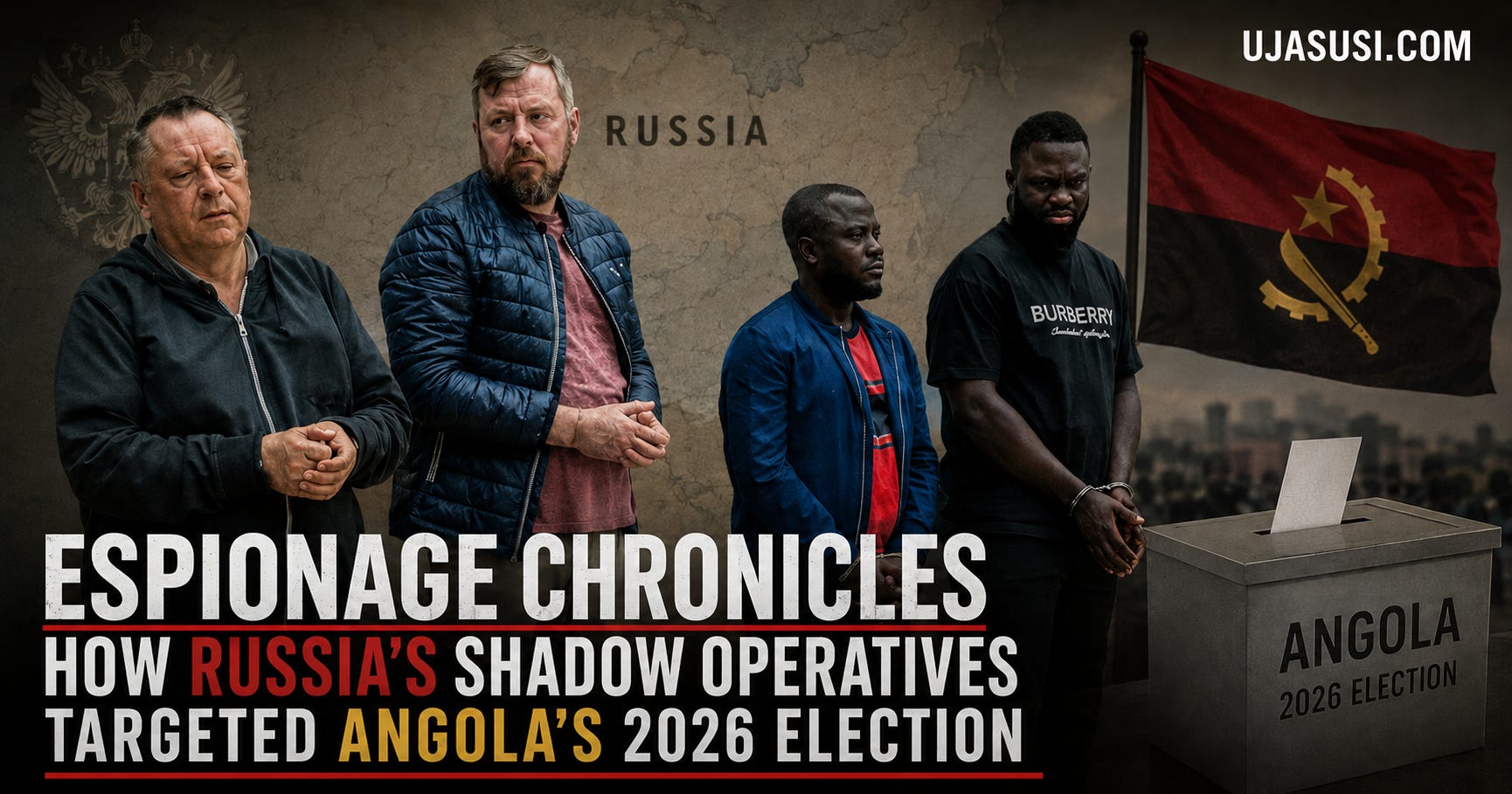
Espionage Chronicles | How Russia's Shadow Operatives Targeted Angola's 2026 Election
Espionage Chronicles | Ujasusi Originals
In August 2024, two Russians checked into a Luanda hotel claiming to be opening a cultural centre. Eight months later, they were awaiting trial on eleven charges — terrorism, espionage, and influence peddling — in a case that lays bare how Moscow’s post-Wagner apparatus is targeting African states that have drifted from Russia’s orbit.
The accused are Igor Ratchin, a political consultant who managed regional election campaigns in Russia, and Lev Lakshtanov, a Soviet-era interpreter with four decades of experience in Angola. Alongside them, two Angolan nationals face charges: sports journalist Amor Carlos Tomé on nine counts and opposition activist Francisco Oliveira on five, accused, respectively, of intelligence-gathering and facilitating access to political figures.
Who Controls Africa Politology and What Does It Want in Angola?
The prosecution alleges both men acted on behalf of Africa Politology, a clandestine network of operatives and intelligence officers that emerged from the Wagner Group following Yevgeny Prigozhin’s death in 2023, previously active in the Central African Republic, Mali, and Madagascar.
READ ALSO
Angola is a deliberate target. Under President João Lourenço, the country has executed a sustained westward pivot. Lourenço has not met Vladimir Putin since 2019, and his administration expelled Russian diamond miner Alrosa and bank VTB following sanctions. The Lobito Corridor, a Western-backed rail project routing critical minerals to Angola’s Atlantic ports, is the flagship symbol of that realignment and became a primary propaganda target in the alleged operation.
Alex Vines of the European Council on Foreign Relations described the case as reflecting “Russian anxiety about Angola’s direction under the Lourenço administration.”
What the Indictment Alleges
Between 2024 and 2025, the defendants allegedly coordinated a campaign to provoke political change, making payments exceeding $24,000 to local journalists and experts to spread propaganda through Angolan media.
The operation’s most consequential allegation concerns Angola’s presidential succession. Prosecutors claim the defendants met MPLA heavyweight General Higino Carneiro and Unita leader Adalberto Costa Junior, both potential 2026 presidential candidates, and offered Carneiro up to $15 million in campaign support alongside security assistance and intelligence gathering. The BBC found no supporting documentary evidence for this specific claim within the indictment itself.
READ ALSO:
The media layer is better evidenced. In December 2024, content targeting the Lobito Corridor appeared on a Luanda satirical page before migrating to a news portal the following day. The receiving outlet told the BBC the articles arrived via an intermediary, with no direct contact with the author and no payment. The indictment also names six additional Russian operatives who rotated through Angola across 2024 and 2025, a deployment pattern inconsistent with a cultural diplomacy mission.
The Protests, the Scapegoat Question, and the Indictment’s Flaws
Prosecutors connect the network to July 2024’s nationwide unrest, Angola’s deadliest protests since the end of the civil war, in which taxi driver demonstrations escalated into violent confrontations with security forces. That framing is contested. Human Rights Watch’s Angola researcher Sheila Nhancale told the BBC, “people were protesting because of their living conditions, not because someone from another country told them to,” with the World Bank estimating nearly 40% of Angolans live below $3 a day.
READ ALSO
The indictment carries its own credibility problems. Prosecutors state the operation began on 9 October 2024 with Maxim Shugalei’s arrival in Angola, but Shugalei had been arrested in Chad on 19 September 2024 and returned to Moscow by 16 November, a factual error the prosecution has not publicly addressed.
The Stakes Beyond the Courtroom
A conviction establishes that African judiciaries can prosecute foreign election interference on financial and digital evidence alone. An acquittal hands Moscow a template: route the operation through intermediaries, fragment the financial trail, and the evidentiary chain will not hold.
Either outcome leaves the Lobito Corridor narrative already in circulation. Africa Politology, if the prosecution’s account stands, spent less than a Washington lobbyist’s monthly retainer to seed disinformation across Angola’s media ecosystem and position assets inside both major political parties ahead of a presidential election. The structural lesson is that Angola’s western alignment remains a vulnerability to be exploited, not a settled reality, and that lesson will outlast the verdict.