

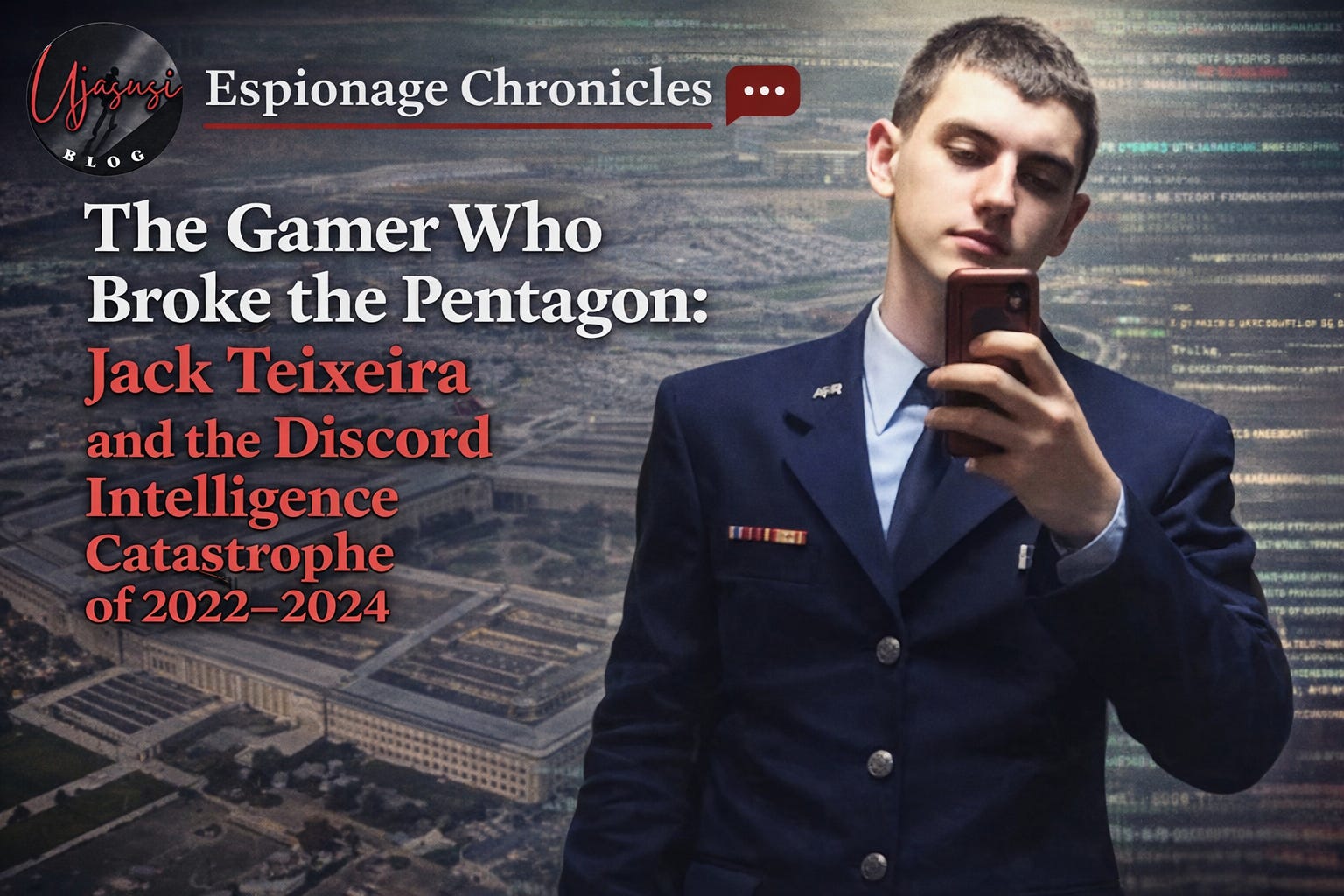
Espionage Chronicles | Ujasusi Blog Originals
🎯 When a Gaming Server Became a National Security Crisis
In the spring of 2023, intelligence analysts across Washington, London, Seoul, and Jerusalem were confronted with a question that defied easy explanation: how had some of the most closely guarded military secrets in the world ended up on a Discord server named Thug Shaker Central, shared with a group of teenage gamers who bonded over a mutual love of firearms, military hardware, and online gaming?
The answer was Jack Teixeira, a 21-year-old airman first class assigned to the 102nd Intelligence Wing at Otis Air National Guard Base on Cape Cod, Massachusetts. An IT support specialist with a Top Secret security clearance, Teixeira had spent the better part of two years accessing classified documents far beyond the scope of his duties, photographing or transcribing them, and posting them to his private Discord community to demonstrate his insider knowledge and impress his online friends.
What followed his April 2023 arrest was a reckoning that exposed not just one rogue airman but the systemic failures of an intelligence infrastructure that had been quietly expanding access to classified networks since the September 11 attacks, granting Top Secret clearances to thousands of personnel while allowing the culture of oversight to atrophy. Teixeira was sentenced on 12 November 2024 to 15 years in federal prison in what prosecutors described as one of the most consequential violations of the Espionage Act in American history. The damage he caused to allies, to ongoing operations, and to the credibility of US intelligence remains, in the words of the lead prosecutor, incalculable.
This analysis examines the full arc of the Teixeira case: his profile, his methods, the documents he exposed, the failure of supervision that enabled him, and what the case reveals about the most dangerous emerging vector in intelligence security, the digital insider threat.
🪖 Profile: The Airman No One Stopped
Jack Douglas Teixeira enlisted in the Massachusetts Air National Guard in September 2019 at the age of 17. He was assigned to the 102nd Intelligence Wing at Otis Air National Guard Base, an elite intelligence unit whose stated mission is to provide worldwide precision intelligence and command and control capability for the US military. His formal role was cyber transport systems journeyman, effectively an IT specialist responsible for maintaining the classified communications networks that intelligence analysts relied on to do their work.
That role gave him access to JWICS, the Joint Worldwide Intelligence Communications System, the classified intranet backbone over which the US intelligence community shares its most sensitive products every day. JWICS was designed for senior analysts, commanders, and decision-makers. Teixeira was a low-ranking airman in an IT support role. Yet through the structural permissiveness that had developed in the post-9/11 era of mass clearance expansion, he could read classified intelligence products not merely related to his narrow technical function but spanning the entire global intelligence picture.
His security clearance history was itself a warning that was never adequately heeded. In 2018, as a high school sophomore, Teixeira had been suspended after allegedly making threatening remarks about bringing guns and Molotov cocktails to school and making racial threats toward classmates. He was denied a firearms permit in Massachusetts in 2018 on the basis of those remarks. Two years later, after enlisting, he received that same firearms permit. A year after that, he was granted a Top Secret security clearance. The clearance background investigation had flagged the high school incident but determined it was not disqualifying. That determination would prove catastrophically wrong.
📂 The Operation: From Classified Briefings to Thug Shaker Central
Teixeira began posting classified information on Discord in early 2022, according to federal prosecutors. His Discord server, Thug Shaker Central, was an invitation-only community of approximately two dozen mostly young men and adolescents who had congregated around shared interests in guns, military culture, and online gaming. Teixeira was the server’s founder and administrator, known to members by the usernames “theexcalibereffect” and later variations thereof.
His method evolved in two phases. Initially, he transcribed classified documents by hand, retyping intelligence briefings and assessments from memory or from the screen in front of him, and posted the text directly to the server. Over time, he grew bolder. He began photographing the classified documents directly, holding his phone up to screens displaying material marked SECRET/NOFORN and TOP SECRET, capturing the official seals, classification markings, and raw intelligence content, then posting the photographs to his Discord channel.
Members of the server later described Teixeira’s motivation to investigators and journalists. He was not driven by ideology, political conviction, or a desire to inform the public. He was, in the assessment of those who knew him online, performing. He wanted to demonstrate to his online community that he had access to information they could not obtain anywhere else. He wanted to be known, within his small digital circle, as someone who knew things. Prosecutors put it plainly in court filings: Teixeira posted classified secrets to “feed his own ego and impress his anonymous friends.”
He was also reckless in a manner that bordered on contempt for authority. Court documents reveal that Teixeira told members of his server he was “breaking a bunch of UD regs”, unauthorised disclosure regulations, and boasted, “No one knows anything incriminating about me.” He continued to access and post classified material even after supervisors at the 102nd Wing had confronted him multiple times for viewing intelligence documents outside his authorised access level. In one documented incident, a supervisor observed Teixeira taking handwritten notes on classified information and placing them in his pocket. No follow-up action was taken. The notes were never confirmed destroyed. The incident was never reported to security officials.
📄 What Was Exposed: The Intelligence Damage
The documents Teixeira posted to Thug Shaker Central sat in the server for over a month before members began distributing them more widely, to other Discord servers, to 4chan, to Telegram channels, and eventually to the open internet, in early April 2023. By the time US officials became aware of the breach, the documents had circulated globally and were in the hands of foreign intelligence services.
The scope of the intelligence compromised was extraordinary. Among the categories of classified information, Teixeira disclosed:
Ukraine War Operations: Detailed battlefield assessments of Ukrainian military positions, troop movements, casualty rates, and ammunition shortages. Assessments of weapons systems being supplied by Western nations to Kyiv, including transfer methods and intended deployment. US intelligence products mapping Russian military dispositions and operational planning. Documents describing, with precision, how informed Washington was about the internal deliberations of both Kyiv and Moscow.
Surveillance of Allies: Perhaps the most diplomatically explosive category. The leaked documents revealed that the United States was conducting signals intelligence collection operations against close allies, including South Korea, Israel, and Ukraine itself. A document revealed internal South Korean government deliberations over weapons transfers to Ukraine. Another exposed Mossad’s internal assessments contradicting public Israeli government positions. The disclosures confirmed what allies suspected but had never seen in writing: that Washington eavesdropped on its partners just as it did on adversaries.
Intelligence Sources and Methods: Several documents revealed the specific platforms, intercept capabilities, and human intelligence sources the US was using to gather information. Exposure of sources and methods does not merely compromise one piece of intelligence; it compromises the entire collection architecture behind it, potentially for years. A former US intelligence official told NBC News the leaks may have permanently closed some collection channels.
Adversary Operations: Teixeira also posted material describing a foreign adversary’s active plot to attack US forces serving overseas, a disclosure that had immediate operational consequences and required emergency countermeasures.
Prosecutors would later argue that the documents contained vital national defence information whose exposure could, in the language of the Espionage Act, “cause exceptionally grave damage to the national security of the United States.” The judge who sentenced Teixeira concurred, noting the breach occurred after extensive training covering the consequences of leaks and after Teixeira had been personally warned about mishandling classified material.
🔍 The Investigation: Bellingcat Before the FBI
The manner of Teixeira’s identification is itself analytically significant. The FBI was not the first organisation to track him down. That distinction belongs to Bellingcat, the open-source intelligence investigation unit, which, working in partnership with The New York Times, traced a trail of digital metadata embedded in the leaked documents and Discord interactions to identify the origin server, Thug Shaker Central, and narrow the field of suspects to a small number of Massachusetts-based Air National Guard members.
Bellingcat’s investigation, published on 9 April 2023, was a landmark demonstration of OSINT methodology: the analysts used timezone data embedded in file metadata, distinctive photographic backgrounds visible in images of documents, unique formatting characteristics of specific intelligence products, and the behavioural patterns of the Discord administrator to build a confident attribution picture, without any classified tools or law enforcement access.
The FBI, now armed with Bellingcat’s public analysis and Discord’s voluntary cooperation, obtained billing records from the platform and executed a search of Teixeira’s home in North Dighton, Massachusetts. He was arrested by heavily armed FBI tactical agents on 13 April 2023. At his home, investigators found a substantial personal arsenal of weapons and, in a dumpster outside the property, a smashed tablet, a smashed laptop, and a destroyed Xbox gaming console, evidence of a panicked attempt to destroy incriminating hardware in the hours after news of the investigation broke publicly.
🏛️ The Institutional Failure: How 15 People Let It Happen
Teixeira’s individual culpability is not in question; he pleaded guilty and accepted his sentence. But the Air Force Inspector General’s investigation, concluded in late 2023, revealed that his crimes were enabled by a cascading institutional failure that implicated fifteen Air Force personnel, all of whom were subsequently disciplined.
The investigation found that multiple supervisors and senior personnel at the 102nd Intelligence Wing had observed Teixeira accessing classified information outside his authorised scope on repeated occasions. Each time, the response was inadequate. Supervisors confronted him informally but did not document the incidents fully. When incidents were documented, they were not escalated to security officials. When they did reach security officials, the full scope of what had been observed was deliberately withheld, investigators found that unit personnel “intentionally failed to report the full details” of Teixeira’s behaviour because they feared security officials would “overreact.”
A structural problem compounded the supervisory failure. The 102nd Intelligence Wing’s own internal policy had encouraged IT support specialists like Teixeira to attend intelligence briefings, reasoning that understanding the intelligence mission would help them better support the classified networks. That policy, the Inspector General found, was improper: it systematically exposed IT personnel to classified material at levels far beyond their operational need to know, without any commensurate increase in supervision or security protocols.
The result was that Teixeira had access to one of the most comprehensive classified intelligence networks in the world, no meaningful oversight of what he accessed, and colleagues who, when they observed anomalous behaviour, chose institutional comfort over security obligations. The 102nd Intelligence Wing was removed from its operational mission entirely in the aftermath and was not permitted to resume operations until May 2024, more than a year after Teixeira’s arrest.
⚖️ Sentencing: 15 Years and a Permanent Warning
Teixeira pleaded guilty in March 2024 to six counts of willful retention and transmission of national defence information under the Espionage Act. On 12 November 2024, US District Judge Indira Talwani sentenced him to 15 years in federal prison. Prosecutors had sought 17 years, describing the breach as one of the most significant and consequential Espionage Act violations in American history.
Before sentencing, Teixeira addressed the court directly. “I wanted to say I’m sorry for all the harm that I brought and caused,” he said. “I understand all the responsibility and consequences fall upon my shoulders alone and accept whatever that will bring.” He was led from the courtroom in handcuffs.
FBI Director Christopher Wray issued a statement framing the sentence as a deterrent: “Jack Teixeira’s criminal conduct placed our nation, our troops, and our allies at great risk. This sentencing is a stark warning to all those entrusted with protecting national defence information: betray that trust, and you will be held accountable.” Under the terms of his plea agreement, Teixeira is also required to participate in comprehensive debriefings with the Pentagon, the Justice Department, and the intelligence community, a condition that will take years to fulfil as officials attempt to map the full scope of what was exposed.
🌍 Lessons for African Intelligence Services: The Social Media Threat Is Here
The Teixeira case carries specific and urgent lessons for African intelligence services that extend well beyond the American context.
First, the digital access problem is universal. The same logic that gave Teixeira access to intelligence networks beyond his need, the post-9/11 expansion of clearance-holders to improve information-sharing, is being replicated across African intelligence architectures as services digitise their operations and adopt shared intelligence platforms. Every step toward networked intelligence infrastructure creates new Teixeira-like vulnerabilities if not accompanied by strict need-to-know enforcement and robust digital monitoring.
Second, ego is as dangerous as ideology. Traditional counterintelligence training focuses heavily on ideological recruitment, the foreign handler who identifies grievance and exploits it. Teixeira had no handler. He had no ideology. He leaked Top Secret intelligence to teenagers for social status. African services must train personnel and supervisors to recognise a different threat profile: the individual motivated not by conviction but by hubris, boredom, or the desire for online recognition.
Third, the social media audit gap is a critical vulnerability. After the Teixeira case, the US military launched a review of whether the online profiles and social media activity of personnel with clearances should be more aggressively monitored. African intelligence services, many of which have no formal social media vetting protocol for cleared personnel, are even more exposed. An officer who boasts obliquely about their work on WhatsApp, Telegram, or TikTok represents a threat that no amount of physical document security will contain.
Fourth, supervisory cultures of conflict-avoidance are lethal. The fifteen Air Force personnel disciplined in this case did not enable Teixeira through incompetence. They enabled him through a calculated decision not to report anomalous behaviour because they feared institutional consequences. That same dynamic, the reluctance to report a colleague, a superior, or a subordinate out of fear, loyalty, or conflict avoidance, is present in every intelligence service on the continent. The Teixeira case demonstrates the cost of not systematically countering that reluctance.
📚 Sources & Further Reading
Al Jazeera: Pentagon Leaker Jack Teixeira Sentenced to 15 Years
Washington Post: Discord Leaks Explained: Full Investigation
TIME Magazine: Jack Teixeira Pleads Guilty: Full Case Analysis
Air and Space Forces Magazine: Teixeira Sentencing and 102nd Wing Consequences
NBC Washington: Air Force Disciplines 15: Inspector General Report
Next Week: Operation Novichok: The Salisbury Poisoning and Russia’s Return to Cold War Assassination Tactics