

Ujasusi Blog’s East Africa Monitoring Team | 04 April 2026 | 0340 BST
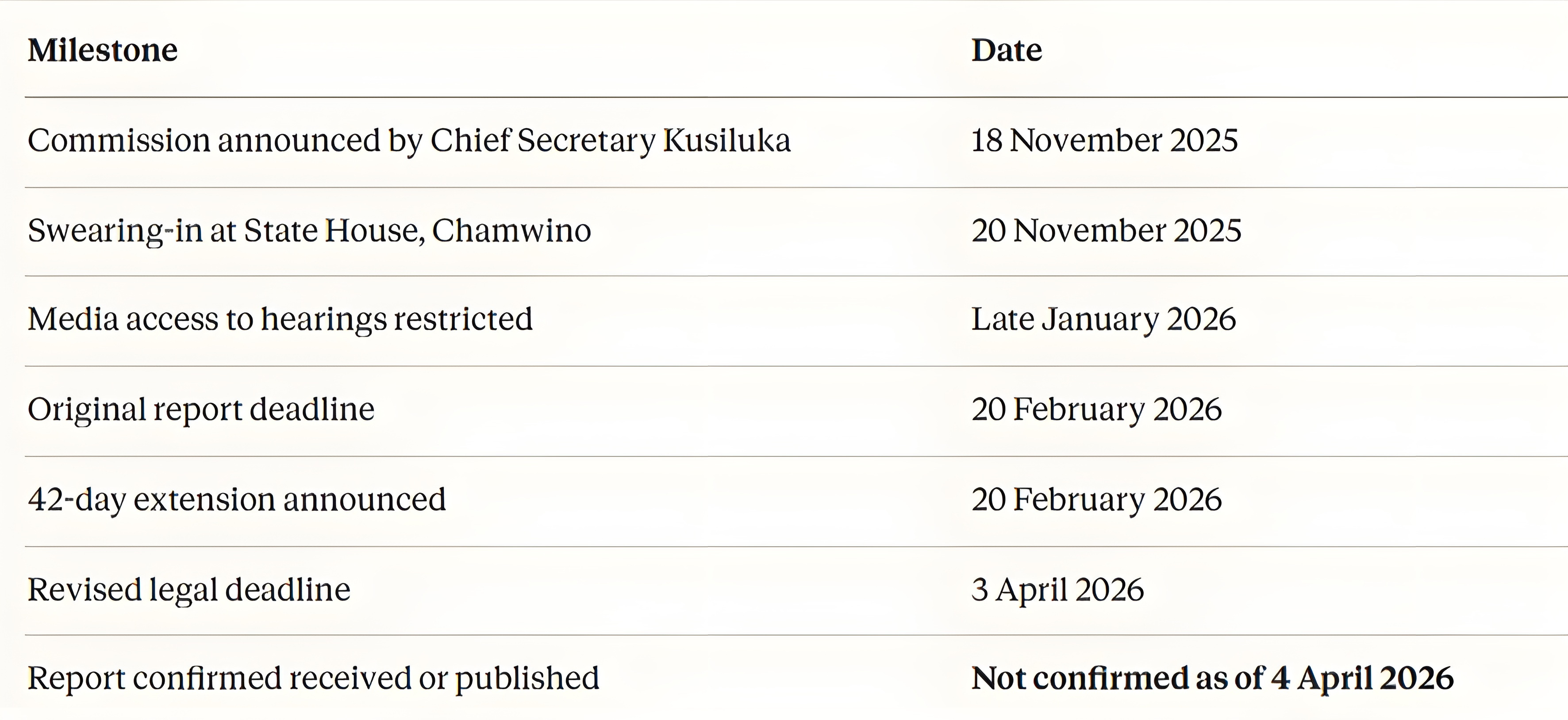
The Chande Commission — formally the Commission of Inquiry into Violence Surrounding Tanzania’s 29 October 2025 General Election — was legally required to submit its findings to President Samia Suluhu Hassan by 3 April 2026, following a 42-day extension from its original 20 February deadline. As of 4 April 2026, no report has been publicly released, no State House communiqué has confirmed receipt, and no timetable for publication has been announced. The commission’s silence, on the eve of Easter weekend, is not administrative — it is political.
Table of Contents
The Chande Commission Carried a Precise Legal Mandate with a Fixed Deadline
State House Executed a Co-ordinated Information Suppression Operation in the 72 Hours Before the Deadline
Section 21(3) of Tanzania’s Commissions of Inquiry Act Gives President Samia Unilateral Power to Suppress the Report Indefinitely
Four Explanations Account for the Report’s Disappearance — and They Are Not Mutually Exclusive
The Report’s Suppression Directly Undermines Tanzania’s Defence Against International Criminal Accountability
The Chande Commission Carried a Precise Legal Mandate with a Fixed Deadline
President Samia Suluhu Hassan officially appointed the commission on 18 November 2025, tasking it with investigating the causes and consequences of violence that erupted during and after Tanzania’s October 2025 general election. On 20 November, she presided over the swearing-in ceremony at State House, Chamwino, assigning the body seven key areas of investigation.
A government notice announced the extension on 20 February 2026, pushing the final deadline to 3 April 2026. The reasons cited included the high volume of testimony received, the need for more thorough investigation, and the requirement to deploy expert analysis on some of the evidence gathered.
The nine-member commission is chaired by retired Chief Justice Mohamed Chande Othman, a former ICTR Chief of Prosecutions and ICC special adviser. Its membership includes retired Chief Justice Prof Ibrahim Juma, former Chief Secretary Ambassador Ombeni Sefue, Ambassador Radhia Msuya, retired Lieutenant General Paul Ignace Mella, former Inspector General of Police Said Ally Mwema, Ambassador David Kapya, and former Minister of Defence Dr Stergomena Lawrence Tax.
READ ALSO

The commission’s terms of reference were contested before a single witness appeared. The mandate’s framing of “incidents of violence” structurally excludes the categories of abuse documented by international human rights organisations and UN bodies — among them enforced disappearances, the nationwide internet shutdown imposed between 29 October and 3 November 2025, and command-level accountability for security force deployments.
State House Executed a Co-ordinated Information Suppression Operation in the 72 Hours Before the Deadline
The three days preceding 3 April 2026 produced a cluster of executive decisions whose combined effect was to compress the political space available for public reaction to the report — before that report had appeared.
On 2 April 2026, the Tanzania Communications Regulatory Authority (TCRA) announced the suspension of Jambo TV, citing violations of the 2020 Online Content Guidelines. The regulatory action stemmed from commentary by veteran journalist Jackton Manyerere, published on 31 March 2026, offering critical analysis of the state of the nation ahead of the commission’s anticipated findings. ACT Wazalendo condemned the suspension as a continuation of the ruling party’s suppression of press freedom.
On the same date, State House issued a communiqué — signed by Director of Presidential Communications Bakari S. Machumu during President Samia’s visit to Zanzibar — formally appointing CCM-aligned figure Angela Kizigha as a nominated Member of Parliament. The appointment was issued between two accountability documents: the Controller and Auditor General report released on 30 March and the Chande Commission deadline of 3 April, placing a figure carrying unresolved procurement corruption allegations inside a constitutional institution without electoral mandate, at the moment when political scrutiny of either document was at its highest.
Good Friday — a statutory public holiday in Tanzania — fell on 4 April 2026, the day immediately after the commission’s legal deadline, extending through Easter Monday on 6 April. The practical consequence is a four-day window in which government offices are formally closed, parliamentary scrutiny is suspended, and the church platforms most likely to mobilise public reaction to damaging findings are consumed by liturgical observance rather than political commentary.
The sequencing — media suspension, controversial parliamentary appointment, public holiday weekend — is the operational signature of an executive managing a disclosure it cannot fully control.
Section 21(3) of Tanzania’s Commissions of Inquiry Act Gives President Samia Unilateral Power to Suppress the Report Indefinitely
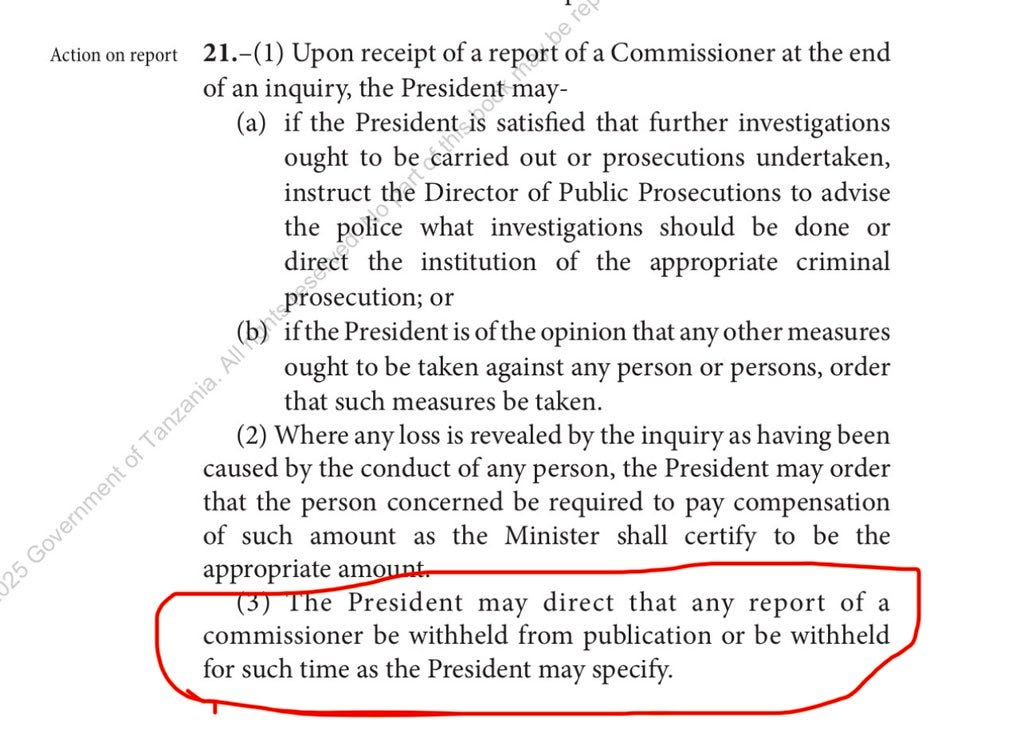
This is the legal provision that transforms the Chande Commission’s silence from an administrative ambiguity into a potential instrument of permanent suppression. Section 21(3) of the Commissions of Inquiry Act, Cap 32 states without qualification: the President may direct that any report of a commissioner be withheld from publication, or be withheld for such time as the President may specify.
The provision carries no judicial review mechanism. It requires no Gazette notification. It imposes no obligation on the executive to inform the public that the power has been exercised. A report submitted to State House can disappear into that institution without legal trace, and no court in Tanzania has the statutory basis to compel its release.
A High Court ruling on 13 March 2026 confirmed President Samia acted lawfully under Section 3 of Cap 32 in appointing the commission. That ruling addressed the commission’s establishment — it says nothing about publication of its conclusions, and it creates no obligation on State House to release whatever Justice Chande and his eight colleagues have produced.
Lawyers challenging the commission before the High Court argued the structural problem precisely: commissioners including Dr Stergomena Tax — who served as Minister of Defence during the period of violence — and Said Mwema, the former Inspector General of Police, carried institutional conflicts of interest that no declaration of independence could resolve.
The Ngorongoro precedent makes the Section 21(3) risk concrete rather than theoretical. Maasai residents raised urgent concerns in March 2026 about two presidential commissions launched in February 2025 whose findings had not been released nearly ten months past their expected deadline. Presidential commissions in Tanzania have an established pattern of producing reports that disappear into State House without public trace. The Chande Commission is operating inside the same legal and institutional environment.