

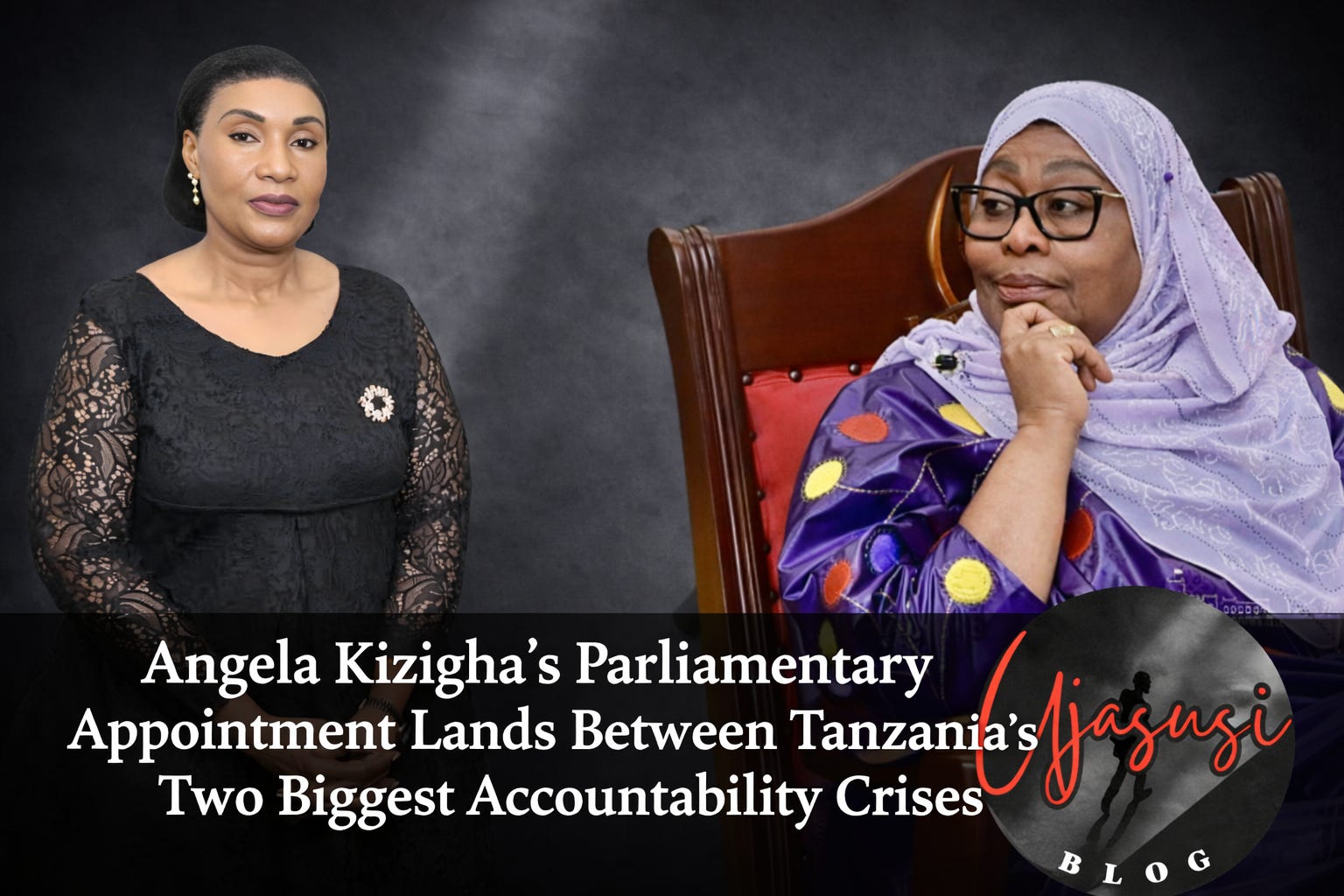
Ujasusi Blog East Africa Monitoring Team | 03 April 2026 | 0300 BST
Angela Kizigha — a Chama Cha Mapinduzi (CCM) member of the East African Legislative Assembly (EALA) identified by AFP in November 2025 as part of President Samia Suluhu Hassan’s innermost governing circle — was formally appointed as a nominated Member of Parliament of the United Republic of Tanzania on 2 April 2026, by State House communiqué signed in Zanzibar. The appointment, issued between the release of a bruising Controller and Auditor General report on 30 March and the Chande Commission report deadline of 3 April 2026, placed a figure carrying unresolved procurement corruption allegations inside a constitutional institution — without electoral mandate, without competitive vetting, and at a moment when the political cost of attracting scrutiny to either accountability document was at its highest.
Table of Contents
Angela Kizigha’s Career and Political Background
The State House Communiqué That Confirmed the Appointment
The Timing: Appointment Between Two Accountability Crises
The Procurement Allegations That Preceded the Parliamentary Seat
What AFP’s Post-Election Reporting Established
The CCM Divisions the Appointment Has Exposed
The Geopolitical Complications the Appointment Has Created
Strategic Outlook
Angela Kizigha’s Career and Political Background
Angela Charles Kizigha is the daughter of the late Charles Kizigha, a veteran journalist at the Daily News and Sunday News — Tanzania’s state-owned newspapers — and a figure understood to have had close personal ties to former President Julius Nyerere. Her political career has run entirely through CCM’s nomination structures rather than constituency competition. She served as a CCM-nominated member of the East African Legislative Assembly during the 3rd Assembly (2012–2017) and was returned to the 5th Assembly (2022–2027), during which she chaired the Tanzania Chapter of EALA. Her position in the Arusha-based regional legislature gave her a platform and formal title without requiring her to contest a domestic seat.
Before she emerged as a figure of public controversy, Kizigha was largely unknown outside CCM’s internal networks. She operated as a business figure — her commercial interests, according to multiple Tanzanian sources, include supply contracts within the public sector — and held no cabinet office under either President Magufuli or the early Samia administration. Her documented proximity to the State House intensified after 2024, concentrated in the period leading into Tanzania’s October 2025 general election and the post-election consolidation that followed.
The State House Communiqué That Confirmed the Appointment
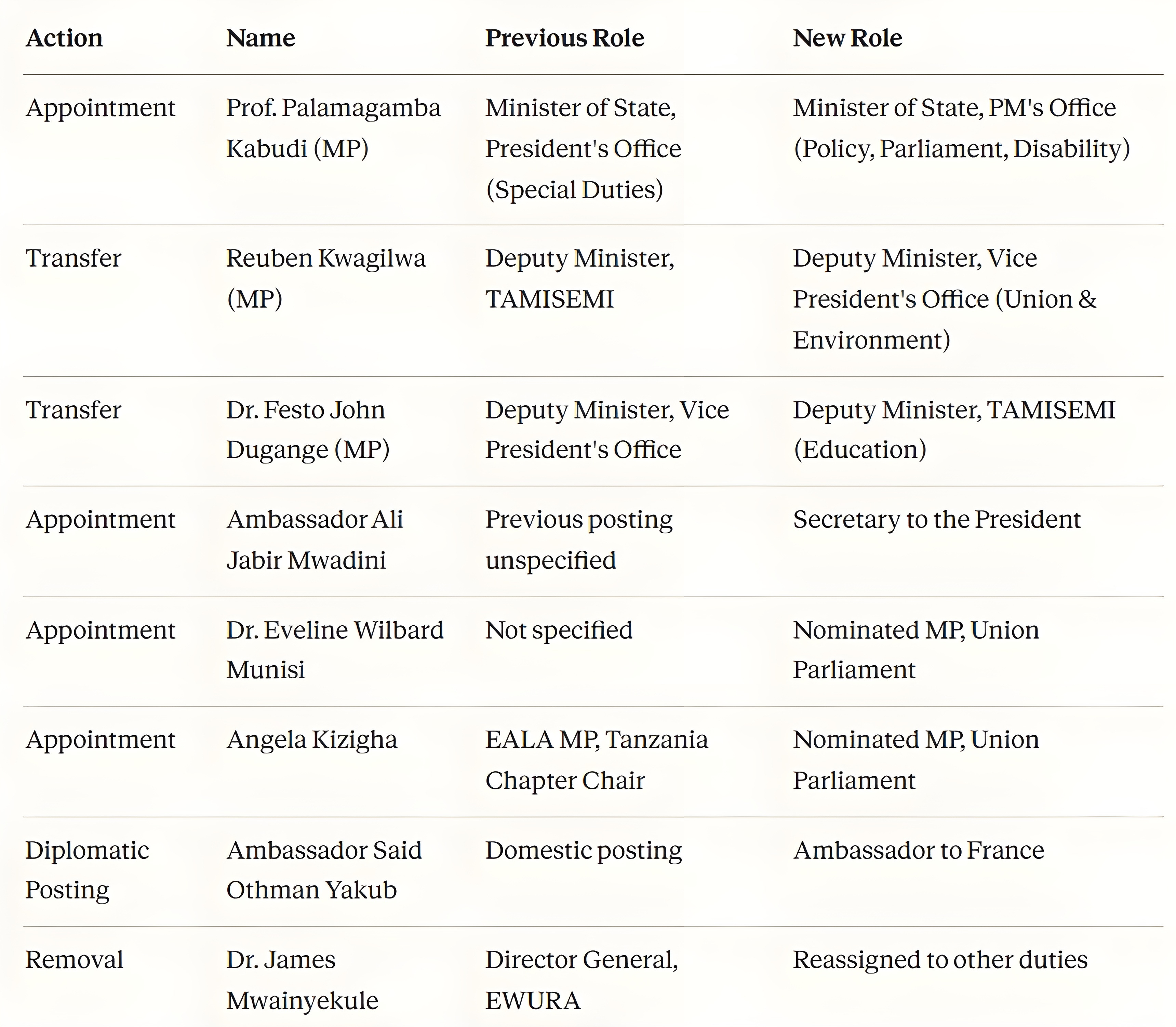
The instrument of Kizigha’s appointment is a communiqué issued by the Directorate of Presidential Communications, Ikulu (State House), dated 2 April 2026 and signed by Bakari S. Machumu, Director of Presidential Communications. The document — headed “Uteuzi, Uhamisho, Utenguzi na Kupangiwa Kituo Balozi” (Appointments, Transfers, Terminations and Diplomatic Postings) — lists her appointment at item (vi): “Bi. Angela Kizigha ameteuliwa kuwa Mbunge wa Bunge la Jamhuri ya Muungano wa Tanzania” (Ms Angela Kizigha has been appointed as a Member of Parliament of the United Republic of Tanzania).
The communiqué was produced during one of the President’s visits to Zanzibar, adding a dimension consistent with State House’s established pattern of releasing sensitive personnel decisions from Zanzibar, where domestic media coverage is thinner and opposition-aligned civil society less concentrated than in Dar es Salaam. The same document covers seven other personnel actions, including the appointment of Prof. Palamagamba Kabudi as Minister of State in the Prime Minister’s Office, the posting of Ambassador Said Othman Yakub to France, and the removal of Dr. James Andilile Mwainyekule as Director General of the Energy and Water Utilities Regulatory Authority (EWURA).
The nominated seat mechanism, established under Tanzania’s constitutional framework, allows the President to appoint Members of Parliament outside the electoral cycle. Kizigha’s appointment under this mechanism is constitutionally valid. The political context in which it was made is not.