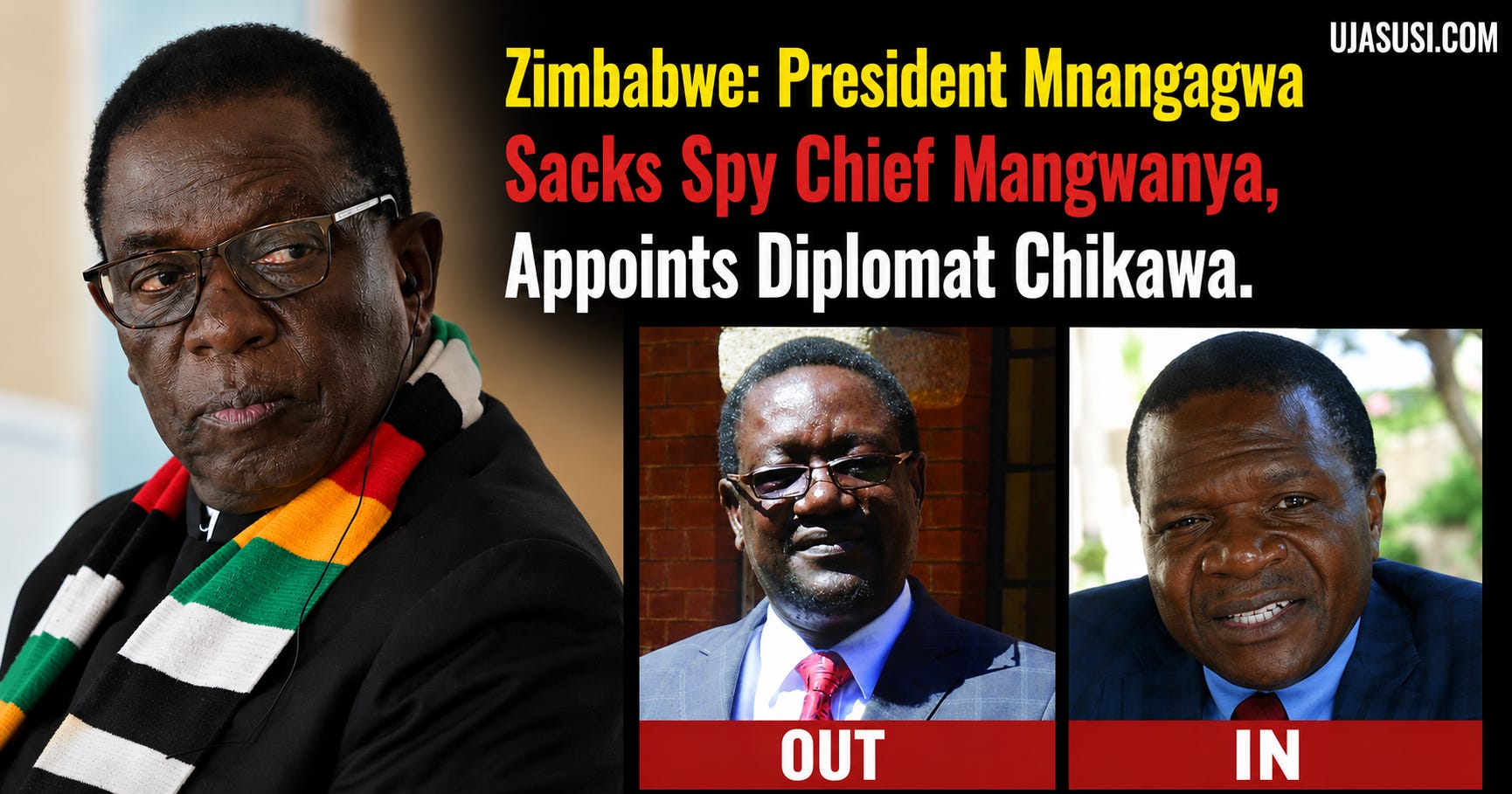
Zimbwabwe: President Mnangagwa Sacks Spy Chief Mangwanya, Appoints Diplomat Chikawa
Mangwanya's 15-month tenure is among the shortest for a CIO chief in recent years.
Ujasusi Southern Africa Monitoring Team | 11 May 2026 | 0210 BST
The dismissal of Fulton Mangwanya as Director-General of Zimbabwe’s Central Intelligence Organisation on 10 April 2026 is not a routine administrative reshuffle. It is a diagnostic event that illuminates the fault lines within President Emmerson Mnangagwa’s securocratic network, the institutional vulnerabilities of an intelligence service entangled in commercial ventures, and the calculated manner in which Harare manages loyalty at the apex of state power.
Mnangagwa Dismisses Mangwanya With Immediate Effect, Citing No Official Reason
On 10 April 2026, the Office of the President and Cabinet issued an official government statement confirmed under Section 226(1) of Zimbabwe’s Constitution, removing Fulton Mangwanya as CIO Director-General and installing Paul Chikawa with immediate effect. Chief Secretary Dr Martin Rushwaya signed the announcement. No rationale for Mangwanya’s removal was provided.
In Zimbabwe’s intelligence culture, silence at the point of a senior dismissal signals either operational sensitivity or political calculation. Multiple-sourced accounts point to a confluence of pressures that made Mangwanya’s continued tenure untenable. Internal friction and nepotism allegations centred on claims he appointed relatives to influential posts within the organisation, compounded by unverified allegations of abuse of office related to official travel arrangements.
READ ALSO
The ZACC Corruption Probe Implicates CIO’s Commercial Arm in NSSA Pension Diversion
The more structurally damaging context surrounds ZACC’s US$6.8 million probe into a construction project linked to the CIO. Investigators conducted raids at the National Social Security Authority (NSSA), Terrestrial Holdings and at least two financial services companies.
The mechanics of the alleged fraud are explicit. NSSA released US$4.5 million through Stanbic Bank into the account of Chigama Architectural Services and Project Management, ostensibly for renovation of the Avondale government complex in Harare. On the same day the funds were received, the Terrestrial Holdings pension diversion saw US$2.06 million placed in a 90-day fixed investment with Alpha Asset Management at 15% per annum, and a further US$500,000 deposited with Access Forex for 120 days at 18% per annum. Construction never proceeded.
ZACC investigators allege that the directors of Terrestrial Holdings, all CIO officials, knew from the outset that the funds would not be used for building work. Search and seizure operations ran from November 2025 to January 2026 across Stanbic Bank, Alpha Asset Management, Access Forex, Chigama Architectural Services, NSSA, and Terrestrial Holdings itself.
READ ALSO
Critically, the transaction trail pre-dates Mangwanya’s January 2025 appointment. CIO insiders alleged a coordinated campaign targeting the organisation’s leadership after it initiated internal reforms, on the basis that the alleged irregularities occurred under his predecessor, Isaac Moyo. Whether genuine defence or counter-narrative, it positions the ZACC investigation as an instrument in internal CIO power dynamics rather than a straightforward law enforcement action.
Mangwanya’s Zimparks Record and the R1.5 Million Scam Episode Compounded His Vulnerability
Mangwanya was appointed CIO Director-General in January 2025, having previously held the Zimparks Director-General role before transitioning to intelligence leadership. His 15-month tenure is among the shortest for a CIO chief in recent years.
His Zimparks record carried institutional baggage. During that period, he served as an ex officio board member before the entire board was dissolved amid financial irregularities, prompting questions about his oversight capacity that followed him into the CIO role. An intelligence chief whose administrative judgement had been publicly questioned represented a liability Mnangagwa moved to resolve.
ALSO READ
The gold dealer scam incident compounded the perception problem. Reports that Mangwanya had been defrauded of more than R1.5 million by individuals posing as gold dealer Scott Sakupwanya were subsequently briefed by the CIO as a covert operation to trap scammers. Whether accurate or retroactively constructed, the episode had damaged his standing within the service before the ZACC investigation intensified.
Paul Chikawa’s Diplomat-to-Director-General Trajectory Reflects Deliberate Succession Planning
Chikawa’s diplomatic intelligence career straddles Zimbabwe’s foreign service and its state security architecture in a manner that distinguishes him from both predecessors under Mnangagwa. He served as Deputy Director-General in the President’s Department before rotating through ambassadorial postings in China and Cuba, two of Harare’s most strategically significant bilateral relationships, before being recalled to assume the directorship.
READ ALSO
That rotation pattern — internal intelligence seniority, strategic diplomatic postings, return to apex command — is not standard foreign service progression. It is the profile of an official being deliberately prepared for a specific institutional role. Chikawa is the third CIO Director-General under Mnangagwa, following Isaac Moyo and Mangwanya, and the first to arrive with both prior CIO deputy-level experience and sustained exposure to Zimbabwe’s primary external partners.
Mnangagwa’s Security Sector Restructuring Tracks the Constitutional Crisis Over Term Extension
Chikawa’s appointment cannot be read outside Mnangagwa’s simultaneous restructuring of Zimbabwe’s broader security apparatus. Mnangagwa’s 2030 term extension effort, through constitutional amendments that would extend his presidency by two years beyond the 2028 limit and replace direct presidential elections with a parliamentary vote, has sharpened the stakes of loyalty within the security sector. Critics assess the amendments as designed to prevent Vice President Constantino Chiwenga from succeeding him.
Against that backdrop, the Forever Associates Zimbabwe trust, a covert political network established using CIO resources and linked to operative Tapfumaneyi, who served as CIO Deputy Director-General (Operations), was deployed for voter mobilisation and intimidation during the 2023 elections. Tapfumaneyi, reportedly not aligned with Chiwenga, is now being positioned toward army command succession. The restructuring is therefore simultaneous across military and intelligence chains, consistent with a presidency hardening its institutional grip ahead of a constitutionally contested transition.
Strategic Assessment: Chikawa Stabilises Leadership But Leaves Terrestrial Holdings Exposed
Chikawa’s appointment stabilises CIO leadership in the short term. It does not resolve the structural problems Mangwanya’s tenure exposed. Terrestrial Holdings remains under active ZACC investigation, and the diversion of NSSA pension funds implicates CIO officials who predate both Mangwanya and Chikawa. Whether that investigation reaches serving officers or is managed to protect institutional continuity is the clearest indicator of whether this reshuffle was genuinely corrective or cosmetic.
The CIO’s fundamental operating architecture remains unchanged: an off-budget commercial conglomerate spanning mining, real estate, agriculture, finance and telecommunications, with minimal parliamentary oversight, and a demonstrated record of using those vehicles for personal gain among its own officers. Chikawa’s diplomatic pedigree equips him for external liaison. It provides no structural answer to an intelligence service that has, under successive leaderships, treated state security as a commercial franchise.
For analysts tracking Zimbabwe’s institutional trajectory, the Mangwanya-Chikawa transition is best read as a loyalty reset under duress, executed at a moment when Mnangagwa requires absolute confidence in his intelligence directorate as the constitutional battle over his political survival intensifies.