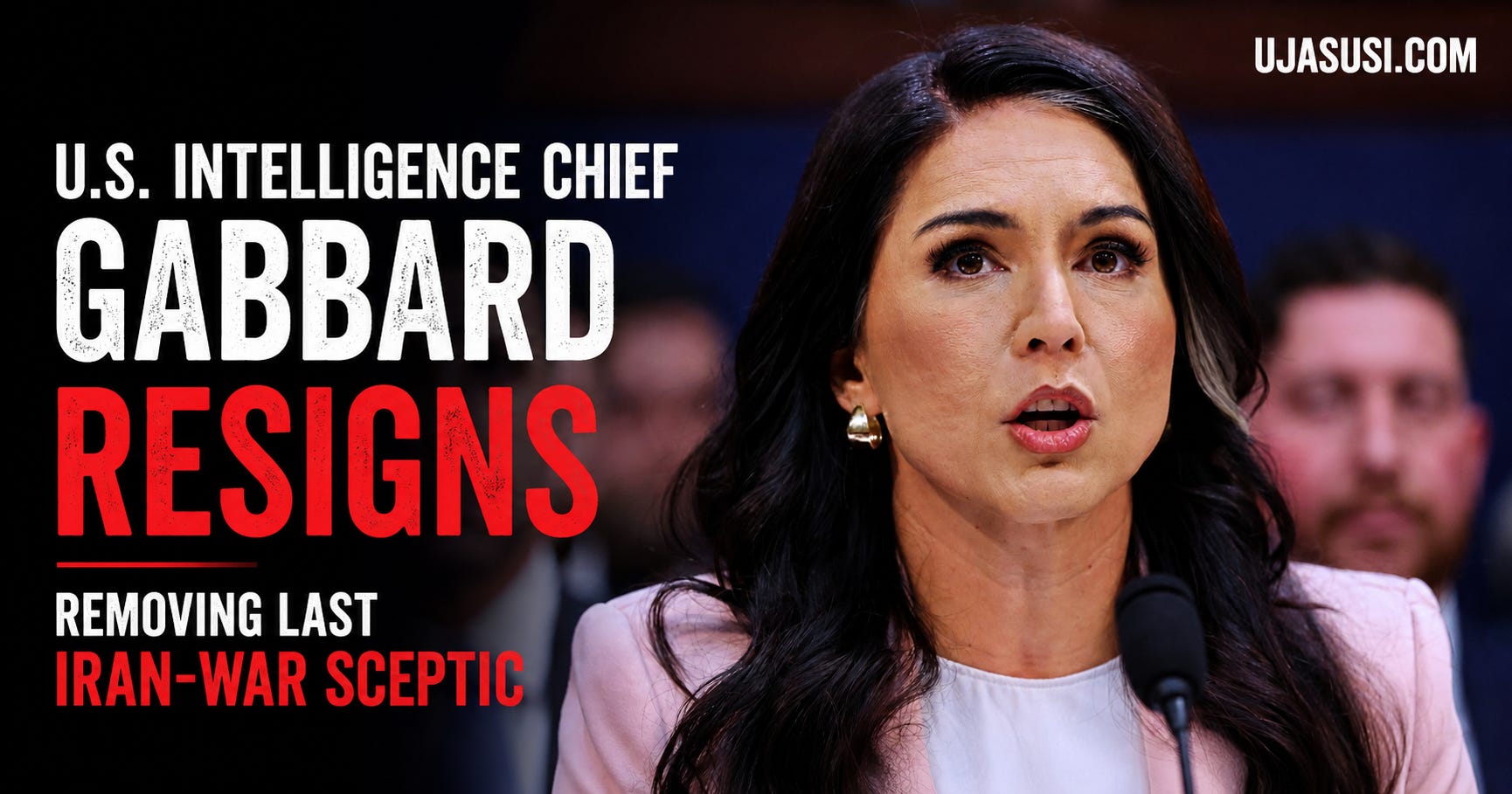
U.S. Intelligence Chief Gabbard Resigns, Removing Last Iran‑War Sceptic
Ujasusi U.S. Desk | 23 May 2026 | 0115 BST
U.S. Director of National Intelligence Tulsi Gabbard announced her resignation in a public statement, citing the need to care for her husband, Abraham Williams, who has been diagnosed with an “extremely rare and aggressive form of bone cancer.” The White House confirmed her explanation, while the Office of the Director of National Intelligence indicated that her departure would take effect at the end of June. The operational tempo of the DNI role makes full‑time caregiving incompatible with continued service.
Gabbard’s departure follows months of operational marginalisation inside the Trump national‑security system
Open‑source reporting shows that Gabbard had already been sidelined from major decision cycles. She was absent from deliberations on the U.S.–Israel strike on Iran, played no visible role in planning the Venezuela raid, and was not central to internal debates over nuclear‑site targeting. Her closest ally, Joseph Kent, resigned from the National Counterterrorism Center in protest over the Iran war, further isolating her. Additional reporting described her as increasingly marginalised within the Trump national‑security hierarchy.
Gabbard’s anti‑interventionist ideology conflicts with the Trump administration’s escalatory foreign‑policy doctrine
Gabbard’s long‑standing opposition to regime‑change wars and her warnings about nuclear escalation placed her at odds with an administration comfortable with military risk. Her critiques of U.S. interventionism, expressed in multiple interviews, emphasised restraint and diplomacy.
READ ALSO
Inside the system, she pushed for a more open posture from the U.S. Intelligence Community, advocating selective declassification and transparency—an agenda that clashed with the entrenched secrecy culture of the intelligence apparatus.
The resignation removes the most senior internal sceptic of the Iran war from U.S. intelligence leadership
Gabbard’s exit completes the removal of restraint‑minded officials from senior intelligence positions. Joseph Kent’s earlier resignation over the Iran war, detailed in reporting, removed one internal brake on escalation. Gabbard’s departure removes the other. With no senior official occupying the “restraint” lane, the Iran‑war policy environment becomes more ideologically uniform and more permissive of escalation.
The resignation consolidates power around hawkish actors including CIA Director John Ratcliffe and acting DNI Aaron Lukas
With Gabbard gone, influence shifts toward more traditional and hawkish actors. The CIA director, John Ratcliffe, has taken on a more visible strategic role, including foreign engagements highlighted in agency releases. Her deputy, Aaron Lukas, a former CIA officer, steps in as acting DNI, as reflected in the ODNI leadership directory. External analysis in broader coverage frames this shift as a consolidation of hawkish control over the intelligence portfolio.
The resignation symbolises the end of the anti‑establishment experiment within the U.S. Intelligence Community
Gabbard’s appointment was an anomaly: an anti‑interventionist politician placed atop a historically hawkish intelligence system. Her trajectory has been examined in multiple profiles and her transparency‑oriented rhetoric highlighted in analysis. Her critiques of U.S. interventionism, explored in features, sat uneasily with agencies whose histories are deeply intertwined with covert action. Her resignation marks the structural limit of integrating such an anti‑establishment figure into a militarised policy environment.
Congressional scrutiny and public silence during the Iran conflict weakened Gabbard’s standing before her resignation
Gabbard faced pointed questioning in Senate Intelligence Committee hearings over the intelligence basis for the Iran war. Her public silence during the early phases of the conflict was noted in political reporting, raising questions about whether she was being cut out of the loop. Additional coverage and analysis framed her as marginalised and increasingly irrelevant to real decision‑making.
The resignation does not change U.S. policy toward Iran but removes the final internal constraint on escalation
U.S. policy toward Iran is unlikely to shift as a result of Gabbard’s departure. Strategic direction is driven by the White House, the Department of Defense, and the CIA, as reflected in broader reporting. However, the removal of a senior sceptic increases the risk of groupthink and escalation without internal challenge. Scenario‑planning diversity narrows when dissenting voices are absent.
The resignation increases politicisation risk within the U.S. Intelligence Community
With fewer dissenters, the intelligence system becomes more vulnerable to policy‑driven pressure and narrative alignment demands. Research on intelligence and executive power, including studies, highlights how leadership homogeneity accelerates politicisation. Concerns about analytic independence, long discussed in assessments, become more acute when leadership is tightly aligned with the political centre. Commentary on intelligence‑politics dynamics, explored in essays, underscores this trajectory.
The resignation strengthens Trump’s inner‑circle control over national‑security messaging and wartime narratives
Gabbard’s departure removes a potential internal source of public contradiction. Her earlier warnings about nuclear catastrophe, visible in past posts, cut against the administration’s preferred framing. Analyses of message discipline in political briefs and the consolidation of loyalist control in reporting show a clear pattern: fewer independent voices, more centralised narrative management. Strategic communication in wartime, examined in studies, tends to favour cohesion over pluralism.
The resignation reshapes Gabbard’s political trajectory by reinforcing her anti‑war identity while exposing her limited influence as DNI
Two narratives now define Gabbard’s political future. Her anti‑war identity is reinforced—she exits during a controversial war, for reasons that can be framed as principled and personal, a theme explored in profiles. Yet her marginalisation inside the system, documented in political analysis and foreign‑policy commentary, highlights how little she was able to shape outcomes as DNI.
Synthesis: a personal event with strategic consequences for U.S. intelligence and Iran‑war policy
Formally, Tulsi Gabbard’s resignation is a response to a family health crisis. Strategically, it removes the last restraint‑minded leader from the top of the U.S. Intelligence Community. It consolidates hawkish control, narrows internal debate, and aligns intelligence leadership more tightly with an escalatory Iran policy. The key signal is not policy change but constraint removal—one less brake on a system now led by actors who largely agree with each other.