
Reporting cut-off: 17 October 2026.
Executive summary
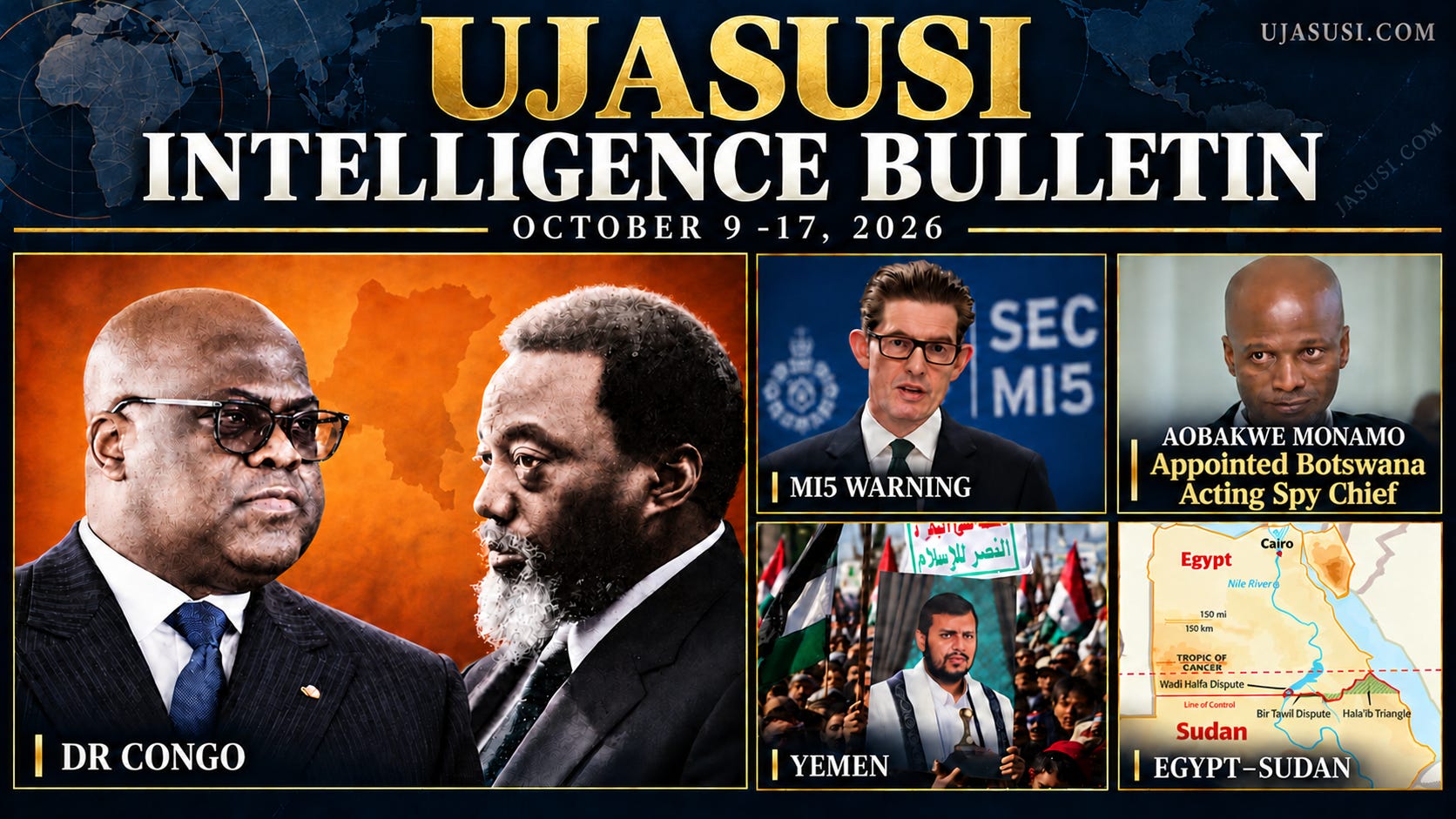
Joseph Kabila’s decision to lead the Front pour la refondation de la nation (FRN) was the principal regional development of the week. The new coalition places a former Congolese president at the head of an armed movement built around AFC/M23. The coalition seeks to broaden the rebellion’s political appeal and influence a future transition in Kinshasa. Its ability to attract support beyond eastern Congo remains unproven.
For Tanzania, Kabila’s move complicates its partnership with President Félix Tshisekedi. Security cooperation, Lake Tanganyika commerce and transport infrastructure connect Tanzanian interests to the conflict. The question is how Dar es Salaam will protect those interests if Kabila’s coalition expands its influence or the conflict deepens tensions with Rwanda.
Corruption allegations add a second source of pressure on Tshisekedi. Belgian searches linked by complainants’ lawyers to his relatives were followed by a 17 October New York Times report about a $17.6 million transfer from a Congolese government-affiliated account to a Texas defence firm. The reported White House inquiry concerns conflicting accounts from Trump allies Richard Grenell and Alina Habba Mildon. These separate matters give Kabila material for his accusations about corruption and the use of public resources, while leaving responsibility for the transactions unresolved.
Elsewhere in Africa, Botswana appointed an acting intelligence director-general following Peter Fana Magosi’s retirement. Ethiopia and Eritrea exchanged accusations of aggression as fighting continued in northern Ethiopia. Allegations of Egyptian responsibility for a deadly strike on Sudanese miners introduced a further source of strain into the Cairo–Khartoum relationship.
International developments highlighted changes in intelligence institutions and the risks of dependence on external technology. MI5 announced a dedicated AI Threat Assessment Centre. Citizen Lab documented the delivery of mercenary spyware through targeted advertisements. Restrictions on Ukraine’s Starshield service showed how limits imposed on externally controlled communications can disrupt military operations.

Advertisement · Proton affiliate partner
Your inbox deserves privacy.
Explore Proton Mail’s privacy-focused email service and its paid plans through Ujasusi’s partner link.
Ujasusi may earn a commission on qualifying purchases made through this link.
Key Judgements
Kabila’s leadership broadens the political challenge to Tshisekedi more clearly than it changes the military balance. The FRN retains leading AFC/M23 figures. Kabila gives the rebellion a prominent national figure through whom to seek support and negotiate. Confidence: Moderate.
Pressure for a political settlement before 2028 is a more plausible immediate objective than a direct military advance on Kinshasa. Negotiations, elite defections and territorial pressure could operate together. The coalition’s capacity to force a leadership change depends on support beyond its existing eastern base. Confidence: Moderate on the immediate objective; Low on the timing of any transfer of power.
Tanzania’s support for Kinshasa carries security and commercial risks. Existing cooperation and the reported arrest of a Congolese government critic demonstrate a relationship with practical consequences. They do not establish a new Tanzanian military deployment or identify an intelligence-service role. Confidence: Moderate on the alignment and associated risks.
Monamo’s appointment provides continuity, while leaving the direction of reform uncertain. An internal successor provides continuity. Changes to oversight, appointments and operational priorities would provide stronger evidence of a wider institutional shift. Confidence: Moderate.
The Starshield restrictions and AdFection findings expose different vulnerabilities arising from reliance on external digital infrastructure. Starshield concerns control over a military service. AdFection concerns the use of commercial advertising systems for surveillance. Their implications extend to organisations that depend on infrastructure they neither own nor fully control. Confidence: Moderate.
Financial allegations could strengthen Kabila’s attempt to challenge Tshisekedi on governance as well as security. Their political significance extends beyond the eventual legal findings: they create pressure for explanations of how public resources and politically connected intermediaries are used. Neither the Belgian inquiry nor the reported US inquiry establishes personal wrongdoing by Tshisekedi. Confidence: Moderate on the political implications.
🌍 African intelligence and security developments
Democratic Republic of Congo: Kabila assumes leadership of the FRN
Joseph Kabila was named leader of the FRN in Goma on 12 October. The new political and military coalition succeeds the AFC/M23 alliance. Corneille Nangaa and Bertrand Bisimwa hold vice-presidential positions. Sultani Makenga retains military command and also holds vice-presidential rank. A statement issued on 14 October and reported the following day names Freddy Kaniki as secretary-general and executive coordinator.
The coalition said it would assume existing commitments under the Doha process. Tshisekedi chaired a Supreme Defence Council on 14 October, after which the military announced instructions to defend territorial integrity and protect civilians.
Kabila brings a former president’s profile and relationships to a coalition whose senior command remains largely intact. Whether the FRN can attract political support or security-force defections beyond the Kivus will determine how far that change affects the national balance.
Botswana: Monamo succeeds Magosi in an acting capacity
Aobakwe Moemedi Monamo became acting director-general of the Directorate of Intelligence and Security (DIS) following Peter Fana Magosi’s retirement on 13 October. Monamo previously served as deputy director-general. The DIS leadership information identifies the succession as an internal appointment.
Promoting the deputy provides continuity while the permanent leadership decision remains open. Whether the succession also brings reform will depend on changes to the service’s mandate, oversight and senior personnel.
The acting appointment alone gives little indication of President Duma Boko’s longer-term intentions for the directorate.
DRC–Belgium: Financial investigation followed by restrictions on embassy contacts
Belgian police conducted searches on 14 October in a money-laundering investigation. Lawyers representing the complainants told Reuters that the properties were linked to Tshisekedi’s relatives and associates. Prosecutors confirmed the searches but did not identify those targeted. The inquiry concerns allegations that mining revenues were diverted. The family denies the allegations.
A presidency circular dated 15 October and signed by chief of staff Anthony Nkinzo Kamole restricted contacts with the Belgian embassy. The directive reported on 16 October covers presidential advisers and other specified officials and gives no reason for the restriction.
The timing suggests the directive may be a response to the investigation, but the circular gives no explanation. The restriction narrows the presidency’s direct diplomatic contacts. The reported directive requires necessary communication to pass through the Foreign Ministry.
DRC–United States: Reported White House inquiry concerns $17.6 million transfer
The New York Times reported on 17 October that a White House inquiry into a dispute between Richard Grenell and Alina Habba Mildon centres on a $17.6 million transfer made in 2025 from a bank account affiliated with the Congolese government to TX-AT, a Texas security and defence firm.
According to people familiar with the matter cited by the newspaper, Habba Mildon initially described the funds as coming from her husband, Turkish businessman Turhan Mildon. Documents initially submitted to the White House reportedly had the sender’s name redacted. Officials subsequently learned of the account’s connection to the Congolese government. Mildon has acknowledged serving as an adviser to Tshisekedi and holding a Congolese diplomatic passport.
Habba Mildon alleged that part of the money was intended for the Kennedy Center but never reached it. Grenell denied the accusations, any connection to the transfer and involvement with TX-AT at the time, while acknowledging earlier consultancy work for the firm. The Times reported that the Mildons, TX-AT, the White House and the Congolese foreign ministry did not respond to its requests for comment.
The purpose of the underlying transaction remains unclear. The reported inquiry raises questions about the source, authorisation and intended use of the funds, and the roles of intermediaries with political connections in both countries. It does not establish that Grenell received the money or that Tshisekedi authorised an improper payment.
Ethiopia–Eritrea: Fighting accompanied by competing accusations of aggression
Ethiopia accused Eritrea of an invasion in a letter to the UN Security Council dated 8 October and made public on 9 October. Eritrea rejected the accusation and alleged Ethiopian aggression. The UN secretary-general expressed concern on 10 October over fighting in Tigray, Afar and Amhara.
ACLED recorded the entry of Ethiopian forces and allied Tigray Peace Force fighters into Aksum on 14 October. Reports of Eritrean withdrawals remained contested. ACLED’s Ethiopia conflict reporting records changing control around Rama and Abiy Addi, alongside further deterioration of the political arrangements associated with the Pretoria agreement.
The competing accounts make battlefield control difficult to assess. The fighting is drawing Ethiopia’s internal conflicts and its confrontation with Eritrea closer together. Verified cross-border operations, sustained force concentrations and changes in external military support would indicate a further escalation.
Egypt–Sudan: Strike allegations place pressure on bilateral relations
Sudan’s Emergency Lawyers reported that an airstrike on the Jabal al-Uqaydat gold-mining area near the Egyptian border killed at least 72 people on 10 October. The group attributed the strike to Egypt. The precise location, death toll and responsibility remain disputed. AP separately cited a medical group reporting at least 13 deaths in the border triangle area. Egypt has not acknowledged an airstrike in Sudan.
Abdel Fattah al-Burhan ordered an investigation on 12 October. Sudanese officials maintained contact with Cairo. Egyptian authorities separately described operations against illegal mining inside Egypt, without acknowledging the alleged Sudanese strike.
A subsequent report on the Qustul crossing described the suspension of cargo and ferry movements amid tensions following the attack and shootings of drivers.
Cairo and Khartoum both have reasons to contain the dispute. Even so, allegations of a cross-border strike put sovereignty and civilian protection at issue in their security relationship. The inquiry’s findings, access to the mining area and the reopening of commercial transport will show whether efforts to contain the dispute are succeeding.
Algeria–Morocco: Algeria announces arrests over alleged sabotage preparations
Algeria’s national police announced on 11 October that 61 Moroccan nationals had been detained in Oran. The authorities alleged preparations for sabotage and said the group included a former Moroccan soldier. They described entry through Tunisia and mountain routes near El Kala.
Police did not identify intended targets or disclose detailed evidence. Their statement provides no basis for attributing the alleged operation to the Moroccan state.
The allegations could deepen an already adversarial bilateral relationship. Evidence presented in court, the charges brought against individual detainees and any official Moroccan response will determine whether it develops into a wider intelligence or diplomatic dispute.
Mauritius: Security restrictions follow protests and a police shooting
Protests over water shortages and living costs intensified after police shot and wounded a 27-year-old woman on 9 October. Demonstrations included roadblocks and damage to public buildings.
An initial curfew ran from the evening of 13 October to the morning of 14 October. The government then extended restrictions for the nights of 14 and 15 October. School closures were also announced. One officer was reportedly arrested and three others suspended in connection with the shooting and the response to it.
The immediate security concern is whether restrictions produce a sustained reduction in violence. Beneath the unrest lie grievances over basic services and confidence in police accountability. A return to normal traffic and schooling would indicate stabilisation, but would not resolve those grievances.
South Africa: National police commissioner cleared to resume duties
President Cyril Ramaphosa lifted National Police Commissioner Fannie Masemola’s suspension on 16 October, enabling his return on 19 October. Masemola had been suspended in April over charges connected to a police health-services contract. The presidency’s statement says prosecutors instructed that the charges be withdrawn on 15 September; the Pretoria Magistrates’ Court formally withdrew them on 22 September.
He returns amid wider scrutiny of alleged criminal influence within law enforcement and the justice system through the Madlanga Commission. Former deputy national commissioner Shadrack Sibiya also resigned during the week amid allegations and charges he denies.
Masemola’s reinstatement leaves the commission’s wider institutional questions unresolved. Command stability, procurement controls and the handling of ongoing investigations remain central to the police service’s credibility and effectiveness.
Nigeria and the Sahel: Continuing pressure on military positions and economic activity
Suspected Boko Haram fighters attacked an army base in Borno State’s Guzamala local government area on the night of 13 October. Reuters reported at least 10 soldiers killed, citing military sources and residents. Reports place the attack near Mairari. Neither the final toll nor responsibility had been officially established by the reporting cut-off.
The attack forms part of a wider pattern of sustained militant pressure. The Africa Center’s assessment of violence to mid-2026, published in August, recorded more than 20,000 deaths linked to militant Islamist violence across Africa for a fourth consecutive year, including an increase in the Lake Chad Basin.
Separately, ACLED’s Sahel analysis dated 8 October describes growing JNIM activity against mining operations near the Mali–Guinea border. The security implications extend beyond territorial control: attacks on military positions and extractive activity can disrupt local authority, revenue and transport. Those annual figures describe the wider conflict rather than the toll for this reporting week.
Tanzania: CHADEMA seeks international engagement on detention and accountability
Ahead of the reporting period, CHADEMA secretary-general John Mnyika appealed on 6 October to the Inter-Parliamentary Union’s secretary-general to visit detained party chairman Tundu Lissu and meet victims of the violence following the 29 October 2025 election. The appeal during the Arusha assembly placed detention and accountability before an international parliamentary audience.
Ujasusi’s earlier assessment of the accountability dispute uses an estimate of approximately 10,000 deaths. IntelWatch’s executive director has publicly alleged 5,000–10,000 deaths while discussing the coalition’s request for an ICC investigation. The estimate belongs to those making the allegation; it is not an ICC finding.
CHADEMA is using international parliamentary engagement to press for access to Lissu and recognition of victims’ accounts. The appeal reports a request, with no confirmed agreement to the proposed meetings.
🌐 International intelligence and technology developments
United Kingdom: MI5 sets out state-threat priorities and announces AI assessment centre
In his annual threat update on 13 October, MI5 director-general Ken McCallum said the service was devoting more resources to state threats than during the Cold War. He identified Russia as the leading state aggressor and said Iran-linked operations had resulted in more than 50 UK arrests over the previous year.
McCallum also announced that MI5 had established the AI Threat Assessment Centre during 2026. The centre brings together expertise from the AI Security Institute, National Crime Agency and National Cyber Security Centre to produce all-source assessments.
The centre gives AI threats a dedicated place in MI5’s assessment work. The wider speech also points to the importance of countering proxy activity and protecting infrastructure alongside conventional counterespionage. Its work will be one measure of how the service translates those priorities into practice.
Germany: Former BND director remains under investigation
Former BND director August Hanning and his former chief of staff, Manfred D., remained in custody following arrests and judicial decisions earlier in October. The Federal Prosecutor’s Office announced their arrests on 6 October. Hanning denies serious wrongdoing through his lawyer.
Media reporting has linked aspects of the case to Azerbaijan, which rejects the allegation. Prosecutors have not publicly identified the foreign state concerned. Reuters reported on 9 October, citing Spiegel, that Hanning had longstanding contacts with a former senior Chinese officer. The reported relationship does not identify the recipient of any alleged disclosure.
The case raises questions about former officials’ access to classified information and their continuing relationships inside an intelligence organisation. Any consequences for liaison partners will depend on the material involved, the recipients and the findings of the investigation.
Russia–Japan: Detention of Japanese journalist creates consular dispute
Russia’s FSB announced on 13 October that it had detained Yuki Imai, a Hokkaido Shimbun journalist based in Yuzhno-Sakhalinsk, on suspicion of espionage. Japan summoned the Russian ambassador the following day and sought information, consular access and humane treatment.
Russia has alleged espionage; the allegation has not been proved. Consular access, the basis for continued detention and disclosure of the evidence are now central to the diplomatic dispute.
United States: Research security and FBI personnel decisions under scrutiny
The Government Accountability Office published a report on 15 October, publicly released on 16 October, finding that the FBI lacked a plan to strengthen relationships with academic institutions in addressing non-traditional intelligence collectors. The GAO review identified cultural differences and inconsistent relationships as obstacles to information exchange. The FBI agreed to the recommendation.
Universities’ willingness to report concerns depends partly on whether they trust the FBI as a source of assistance. GAO’s category concerns collection for foreign entities, not a person’s nationality or academic status.
Separately, nine former FBI employees filed a lawsuit on 15 October, alleging unlawful dismissal because of their work on the investigation into Donald Trump’s handling of classified documents. They seek reinstatement and back pay. The claims remain untested in court.
Together, the cases raise questions about the bureau’s relationships with research institutions and the treatment of staff assigned to politically sensitive investigations.
United States: OpenAI employee charged over alleged recording of meetings
The FBI arrested OpenAI employee Abdulrahman Alfozan on 9 October following the discovery of a suspicious device in a company conference room. OpenAI said it used its own models to assist analysis of the device. The Justice Department’s account of the complaint dates the device’s discovery to about 30 September. The complaint also describes alleged use of a chatbot account to research the device and meeting-room information.
The reported charge concerns interception of oral communications. It does not establish espionage on behalf of a foreign state.
For organisations handling sensitive research, the case underlines the importance of physical access to meeting rooms alongside protection of digital systems. Alleged motive and any external beneficiary remain separate questions for the investigation.
Surveillance technology: Citizen Lab documents advertising-based spyware delivery
Citizen Lab’s AdFection investigation, published on 15 October, documents how Discover-Tech connected targeted advertising infrastructure with mercenary surveillance vendors. The researchers linked attacks against Al Jazeera to Candiru spyware delivered through advertisements requiring no user interaction.
At least 45 Al Jazeera devices were targeted during 2024 and 2025. That is a count of devices targeted, not a confirmed count of infections. The investigation prompted restrictions on Discover-Tech’s access to advertising platforms.
The attack route extends beyond malicious messages and links. Advertising systems can provide both identifying data and a route for selective delivery of code to a target. For organisations handling sensitive information, this makes advertising and tracking infrastructure part of the security perimeter. Its confirmed Al Jazeera case does not establish infections at African organisations. The wider report also discusses profiling activity affecting countries in Africa.
France: Cyberattack disrupts commercial refrigeration systems
Attackers remotely altered refrigeration controls at French supermarkets overnight into 12 October. Reporting described spoiled food and fires, and Paris prosecutors opened an investigation into the compromise of refrigeration systems.
Accounts differ over the number of affected shops. Technical reporting points to internet-accessible control systems. The attackers’ identity and motive remain unknown.
The incident demonstrates the potential for remote access to operational equipment to cause physical and commercial damage. Food distribution and other sectors using connected industrial controls face similar risks. Attribution of this attack remains open.
United States–Ukraine: Starshield restrictions affect drone operations
Ukraine reported restrictions on Starshield connectivity for terminals moving at speed. In an interview published on 16 October, a Ukrainian presidential adviser said Kyiv was negotiating with SpaceX and the Pentagon over a limit cutting connections above 160 km/h.
Reuters, citing two US officials and a Western official, reported that the instruction originated inside the White House. The officials did not identify the person responsible. Trump denied ordering restrictions. The dispute arose amid disagreements over Ukrainian strikes on Russian oil infrastructure.
For Ukrainian forces, the practical problem is the speed limit: a connection that works on a stationary terminal can fail when a drone exceeds the permitted speed. The episode demonstrates how contractual, technical and political control over externally supplied communications can affect battlefield capability.
Yemen: Missile attack on Aden government complex
Houthi missiles struck the al-Maashiq presidential palace complex in Aden on 15 October. Yemen’s health minister reported five deaths and 16 injuries. The government said the prime minister and cabinet members were unharmed. The Houthis described their target as a Saudi military headquarters; that account remains unverified.
The attack on the government complex raises questions about protection of senior officials and the ability to sustain government activity at the site. The wider relevance is to Red Sea and Gulf of Aden security. No African operational role in this strike has been established.
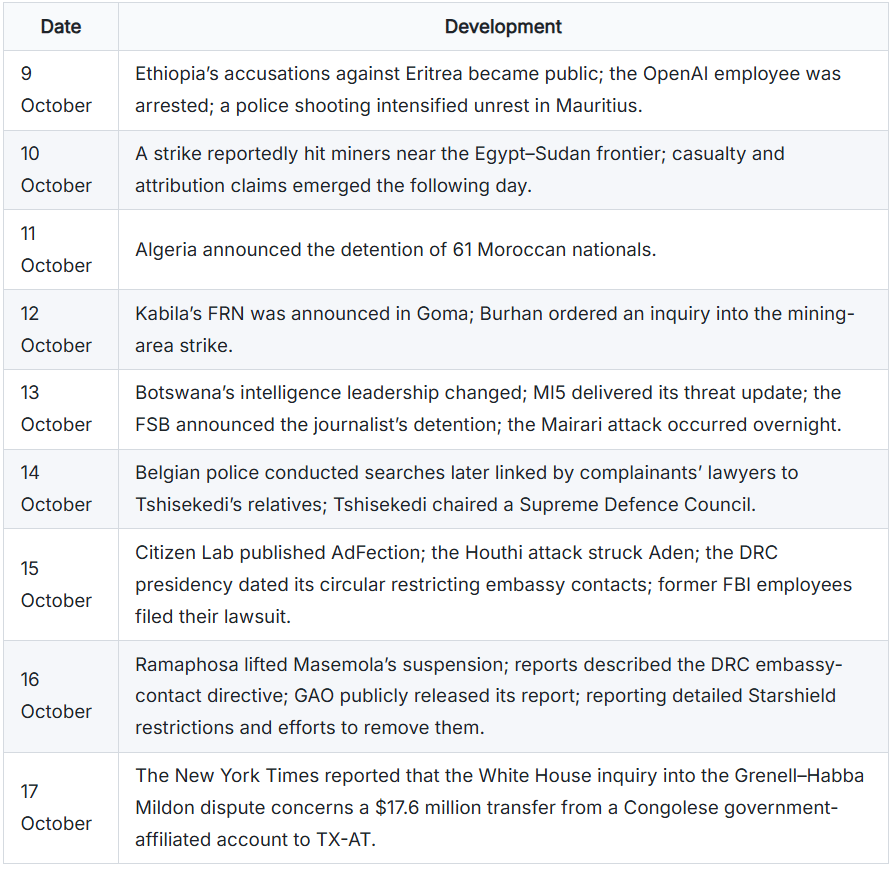
📅 Timeline of principal developments