

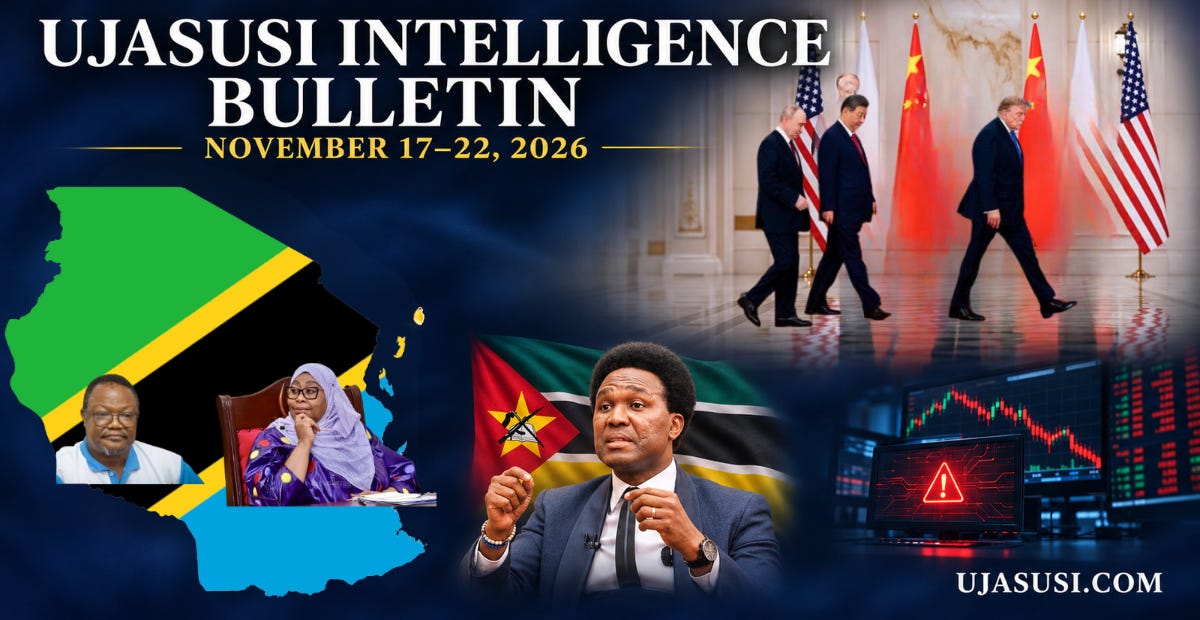
Intelligence Cut-Off Date and Time: 23 November 2026 at 0405 GMT
Table of Contents
Part One — The Bulletin
The week in twelve developments
Tanzania — Reconciliation commission and constitutional timetable
Tanzania — Reported prosecution challenge to Lissu’s acquittal
Tanzania — Ndejembi and competition within CCM
Zimbabwe — Uebert Angel arrested
Uganda — Muhoozi’s endorsements and military appointments
Mozambique — Mondlane’s trial opens
Somalia — UAE ambassador expelled
Terrorism and insurgency — Russian drone operations in Mali
Cybersecurity — Intrusion at an African stock exchange
Counterintelligence — UK investigation transferred to US authorities
Counterintelligence — Denmark attributes assassination plot to Russia
Strategic affairs — Trump, Xi and Putin meet in Shenzhen
Part Two — Paid Subscriber Feature
Tanzania’s reconciliation offer — participation, accountability and constitutional change. Each of the twelve stories above includes its own Ujasusi Assessment.

Advertisement · Proton affiliate partner
Your inbox deserves privacy.
Explore Proton Mail’s privacy-focused email service and its paid plans through Ujasusi’s partner link.
Ujasusi may earn a commission on qualifying purchases made through this link.
Part One — The Bulletin
President Samia Suluhu Hassan renewed her promise of a reconciliation commission, while a prosecutor was quoted confirming an intended challenge to Tundu Lissu’s treason acquittal. Elsewhere, Zimbabwean police arrested Uebert Angel, Mozambique opened Venâncio Mondlane’s trial, and Somalia ordered the UAE ambassador to leave. Newly published security findings concerned Russian drones in Mali, an African stock exchange intrusion and a thwarted assassination attempt in Denmark. Trump, Xi and Putin issued a declaration following their 19 November meeting in Shenzhen.
The week in twelve developments
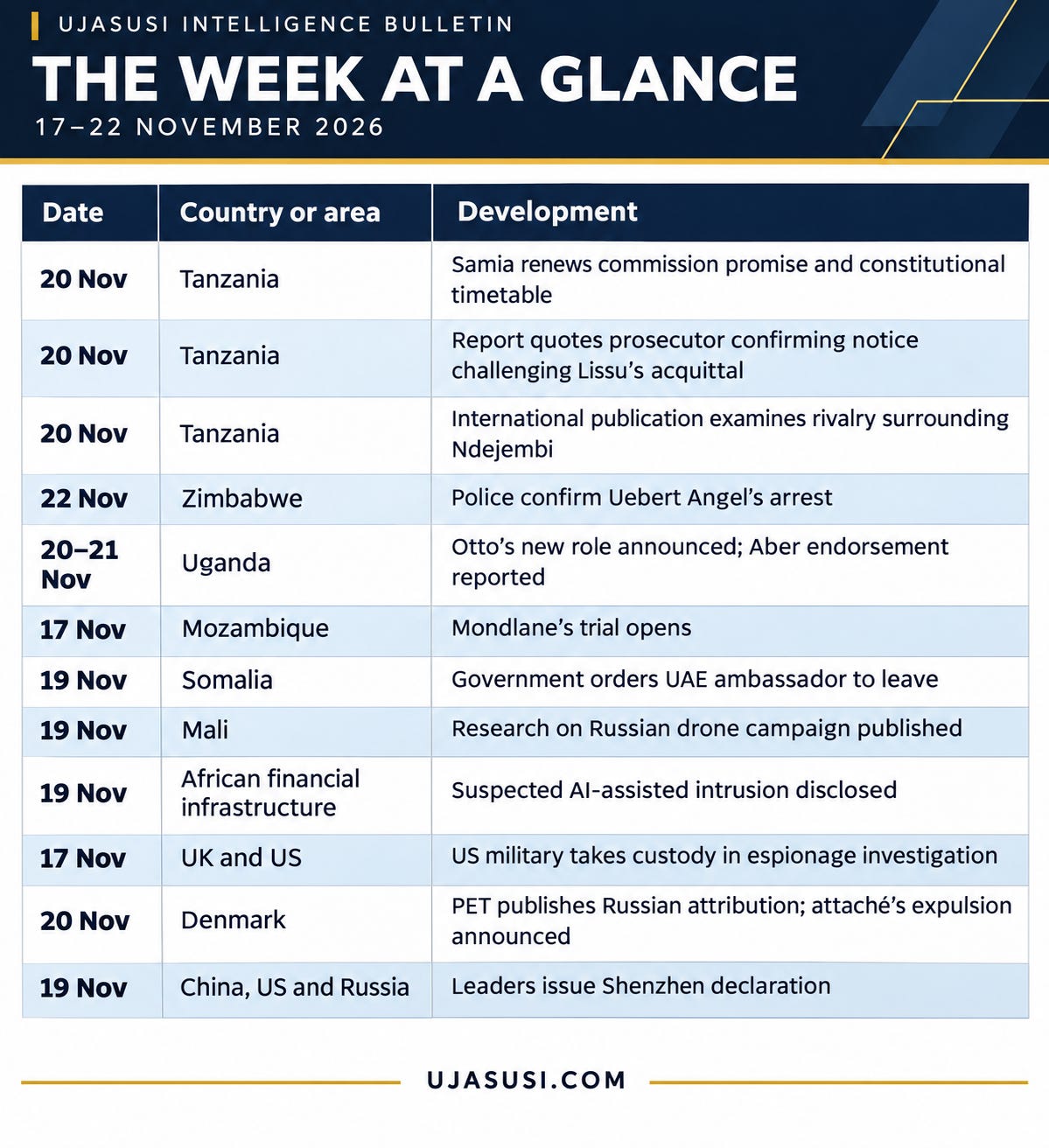
Dates identify the development or public disclosure covered here. Several underlying operations occurred earlier.
1. Tanzania — Reconciliation commission and constitutional timetable
Speaking to senior police officers in Moshi on 20 November, President Samia said a reconciliation commission would be announced soon and linked the process to a new or amended Constitution by 2028/29. Nominations were being sought from religious organisations, political parties and civil society. The remarks followed a 16 November State House meeting with political-party representatives, which CHADEMA did not attend. A participant subsequently said Samia wanted the party represented in the proposed commission.
The initiative predates this week. Her year-end address outlined commission consultations, while July consultations renewed the reform promise. CHADEMA has sought an independent mediator and raised its chairman’s imprisonment as an obstacle to participation. The proposed reconciliation body is separate from the Lila inquiry into responsibility for election violence.
Ujasusi Assessment
The repeated promise matters because the commission was already under discussion at the beginning of the year. Repetition can sustain expectations of progress while difficult decisions remain unresolved. It can also reflect disputes over representation and authority. The available evidence establishes an implementation gap; it does not establish that delay is the initiative’s sole purpose. The practical test is whether the next announcement settles who appoints members, who controls the agenda and what follows from recommendations.
CHADEMA’s demand for mediation addresses the asymmetry created when the government is both a participant in the dispute and the organiser of its resolution. An agreed intermediary could help settle procedural disagreements, although it cannot guarantee a political settlement. Meaningful progress would involve published terms, participation negotiated before appointments are finalised, and a procedure for recording dissent. A commission’s inauguration without those arrangements would leave its central credibility problem unresolved.
2. Tanzania — Reported prosecution challenge to Lissu’s acquittal
The High Court acquitted Tundu Lissu of treason on 6 November but convicted him of incitement and sentenced him to four years. A 20 November report reproducing Mwananchi’s account quoted Principal State Attorney Nassoro Katuga confirming that prosecutors had lodged a notice on 13 November challenging the acquittal. The stamped prosecution notice and registry entry have not been independently examined, and the original Mwananchi article was inaccessible during verification.
Lissu’s lawyers separately initiated a challenge to conviction and sentence. The notices should be distinguished from completed appeal grounds and subsequent court orders. No appellate outcome or hearing date is established here.
Ujasusi Assessment
If confirmed by the filing, the prosecution’s challenge would keep the treason acquittal contested while Lissu seeks to overturn his incitement conviction. That uncertainty affects opposition organisation and negotiating capacity, but it must not be confused with an automatic extension of detention. His custody rests on the conviction, sentence and any subsequent orders. The prosecution’s specific grounds remain necessary to judge what legal error it alleges and what remedy it seeks.
The political effects require examination independently of prosecutorial intent. Restricted access to an opposition chairman can affect consultation and decision-making even without evidence of an instruction to use the courts politically. The immediate indicators are access to records and counsel, applications concerning release, appeal scheduling and CHADEMA’s ability to consult its leader. A forecast of the final outcome or a precise completion date would require substantially more procedural evidence than is currently available.
3. Tanzania — Ndejembi and competition within CCM
A 20 November Africa Intelligence article examined factional competition surrounding the vice-presidency. Its accessible introduction describes Deogratius Ndejembi as having a weaker political base than his predecessor, Emmanuel Nchimbi, while other CCM figures seek the position. The full subscriber article was not available for direct examination in this preparation; this account is limited to its accessible text. No official decision to replace Ndejembi is established by it.
Ujasusi Assessment
Ndejembi’s reported weakness within CCM raises a question about the durability of authority derived principally from presidential backing. Such backing can protect an officeholder while also making his position sensitive to changes in presidential priorities. Limited independent support may leave fewer influential figures with an immediate interest in defending him. That vulnerability does not establish that removal is imminent or that a replacement has been selected.
The publication also needs to be distinguished from earlier hostile social-media activity. Similar content and reputational effects do not demonstrate a common sponsor. A stronger assessment would trace identifiable participants, material and distribution, while monitoring senior endorsements, changes in responsibilities and the emergence of alternative candidates. The complete article and any underlying records are needed before extending its claims beyond the accessible introduction. Dismissal rumours should guide collection, not supply a forecast.
4. Zimbabwe — Uebert Angel arrested
Zimbabwean police confirmed Angel’s arrest on 22 November on allegations of indecent assault and sodomy. Reports placed the arrest at the Hippodrome church premises in Harare. The police announcement did not establish guilt or supply a detailed account of the allegations.
Angel’s public profile includes political access and his appearance in Al Jazeera’s earlier Gold Mafia investigation. That investigation concerned separate alleged conduct. Reporting also places the arrest after public exchanges involving Vice-President Constantino Chiwenga and Temba Mliswa; those exchanges do not establish the reason for police action.
Ujasusi Assessment
Angel’s arrest is politically consequential because the perceived protection attached to his relationships is part of his public influence. Police action can weaken that perception before a court rules on the allegations. Several explanations remain possible: a complaint reaching an evidential threshold, a change in willingness to investigate, factional pressure, or overlapping factors. The public exchanges preceding the arrest establish context but do not identify which mechanism drove the decision.
The most informative evidence will concern the complaint chronology, charges, judicial reasoning and any demonstrable departure from normal handling. Bail opposition alone would not establish retaliation, nor would continued use of an official title prove protection. The assessment should change if records reveal intervention, selective procedure or a clear relationship between political pressure and investigative action. Until then, the criminal allegations and hypotheses about the timing need separate treatment.
5. Uganda — Muhoozi’s endorsements and military appointments
Reporting published on 21 November recorded Muhoozi Kainerugaba’s endorsement of Lillian Aber for the vice-presidency held by Jessica Alupo. The endorsement was not an appointment or confirmation of Alupo’s removal. Separately, the UPDF’s 20 November announcement confirmed Richard Otto’s special-operations appointment. His duties include monitoring northern Uganda’s security and supporting the return of LRA remnants from Darfur and the Central African Republic. Otto’s replacement at military intelligence occurred before this reporting window.
A 17 November parliamentary update described continued railway preparations involving Yapı Merkezi, pending financing for full construction. This does not support a fresh cancellation this week: Muhoozi’s earlier cancellation claim was subsequently reversed.
Ujasusi Assessment
Muhoozi’s activities combine formal military authority with public efforts to influence civilian leadership. Otto’s assignment is an executable personnel decision; the Aber endorsement is political pressure. Treating them as equivalent would overstate what changed, while dismissing the endorsement as mere commentary would overlook the leverage created by Muhoozi’s office and presidential proximity. The relevant issue is whether civilian institutions consistently identify which decisions they recognise and implement.
The railway episode demonstrates the costs of ambiguity for external partners. Contractors require legally effective decisions, yet public statements can alter expectations before the responsible institutions have acted. Subsequent parliamentary reporting is therefore more useful for establishing the project’s status than a resurfaced cancellation claim. The outlook should follow formal appointments, contractual decisions and institutional responses. It should not assume that every intervention forces Museveni either to comply with or publicly confront his son.
6. Mozambique — Mondlane’s trial opens
Venâncio Mondlane’s trial opened on 17 November at the Supreme Court over his alleged role in protests following the disputed 2024 election. He faces five charges, including instigating and inciting terrorism, and denies wrongdoing. The court’s president has rejected allegations of political influence. The proceedings concern the relationship between his public mobilisation and alleged criminal conduct; no verdict is established in this bulletin.
Ujasusi Assessment
The central question is how prosecutors connect Mondlane’s public mobilisation to particular offences. Protest movements contain participants with different intentions and conduct, so a leader’s prominence cannot substitute for proof of responsibility. Recordings may provide relevant evidence, but their context, the conduct allegedly encouraged and the connection to subsequent acts require examination. The seriousness of the charge does not itself resolve those questions.
Comparison with Lissu is useful for examining political space and the prosecution of opposition speech, but the cases involve different legal provisions and evidence. Restrictions on live broadcasting limit one form of access without establishing that proceedings are closed or that a conviction is predetermined. Published reasoning and independent accounts of the hearings will be important. The consequences extend beyond Mondlane because the court’s interpretation may influence how political actors assess the legal risks of future mobilisation.
7. Somalia — UAE ambassador expelled
On 19 November, Somalia’s cabinet ordered the UAE ambassador to leave within 72 hours and recalled its own envoy for consultations. Federal authorities alleged interference in sovereignty and rejected parallel security arrangements bypassing Mogadishu. The announced diplomatic measures escalated an existing dispute. The UAE rejected the Somali president’s criticism. Abu Dhabi’s relationships with Somaliland, Puntland and Jubbaland form part of the disagreement between federal authorities, regional administrations and the external partner.
Ujasusi Assessment
The rupture concerns who can authorise and sustain external security relationships within Somalia. Mogadishu’s assertion of federal authority confronts relationships maintained by regional actors, making this both a foreign-policy dispute and a domestic governance problem. An ambassador’s expulsion expresses that claim forcefully without automatically giving the federal government control over every disputed arrangement.
Operational consequences must be demonstrated through personnel movements, financing, training, equipment and access. It is premature to call the split complete or assume the UAE will deepen every regional relationship. Abu Dhabi could escalate, negotiate or preserve selected links discreetly. Statements from Puntland and Jubbaland will indicate political positioning; implementation will show whether the confrontation changes capabilities. A sustained widening of parallel arrangements would be a more consequential development than diplomatic rhetoric alone.
8. Terrorism and insurgency — Russian drone operations in Mali
Research published on 19 November described Africa Corps’ increased use of Lancet attack drones alongside surveillance drones. Conflict Insights Group’s findings on the ongoing campaign identified at least ten strikes using the pairing since April and described a broader increase in air and drone operations. The research also raised concerns about civilian harm. These are attributed research findings about operations preceding the publication date, rather than a deployment beginning this week.
Ujasusi Assessment
The surveillance-to-strike pairing can improve the speed at which forces observe and attack targets, but it does not establish accurate identification or durable military results. Intelligence interpretation and target approval remain critical. Strike totals should therefore be assessed alongside civilian harm, insurgent adaptation and the ability of state forces to retain access and territory. Increased activity is evidence of operational effort, not a sufficient measure of success.
Civilian casualties can create grievances that armed groups exploit, but a claim of increased recruitment requires evidence about mobilisation, defections or force regeneration. The outlook is conditional: repeated harm without credible investigation or redress could weaken community cooperation and create opportunities for insurgent recruitment and propaganda. That possibility deserves monitoring rather than a precise prediction unsupported by recruitment data. Further independent documentation of targeting and local responses would strengthen the assessment.
9. Cybersecurity — Intrusion at an African stock exchange
On 19 November, Symantec disclosed suspected AI-assisted intrusion activity at an unidentified African stock exchange. A 41-module PowerShell toolkit ran for just over three minutes on 20 September, searching for credentials and testing access to financial systems. Researchers could not establish whether the tested credentials worked. They identified Witchetty-linked implants on the same server but did not attribute the toolkit to that group. Financial theft and espionage remained possible motives. The short toolkit execution time does not establish the total duration of the intrusion.
Ujasusi Assessment
Two findings must remain separate: suspected AI assistance in the toolkit and Witchetty-linked implants on the server. The second does not establish who operated the first. Financial access could support theft, collection of investment information or preparation for another operation, while a compromised server may host more than one actor. The source leaves motive unresolved, so a categorical state-espionage assessment would exceed its findings.
The three-minute window describes observed toolkit execution, not the attackers’ total dwell time. The important questions are what access was obtained and whether the tools produced usable results. Exchange security teams should investigate exposed servers, potentially compromised credentials and related authentication activity. Rotation or revocation of affected secrets should be coordinated with system owners to contain exposure while avoiding unnecessary disruption. Further evidence of successful access, data collection or operator control would materially change the attribution and impact assessment.
READ ALSO
New Book: NYERERE TO SAMIA — The Road to Tanzania’s Post–October 2025 Election Massacres

The killings that followed Tanzania’s 29 October 2025 election demand an explanation that reaches beyond the events themselves. Nyerere to Samia: The Road to Tanzania’s Post–October 2025 Election Massacres traces the institutions, political networks and security practices built across six presidencies—and asks how they made such violence possible.
10. Counterintelligence — UK investigation transferred to US authorities
On 17 November, the Metropolitan Police confirmed transfer into US military custody of a US Army member arrested in Gloucestershire on 10 November in a national-security investigation concerning Russia. The transfer followed consultations involving British investigators, prosecutors, the Attorney General’s Office and American partners. A 20 November official speech separately described defence counterintelligence’s role in the arrest. Arrest and transfer establish neither guilt nor successful disclosure of protected information.
Ujasusi Assessment
This case illustrates the complexity of counterintelligence investigations involving allied personnel stationed abroad. Military investigators, civilian police and prosecutors have different responsibilities, and an international transfer can determine which authority progresses the matter without resolving the allegations. The confirmed cooperation is significant, but it does not establish that protected information reached Russia or that the alleged conduct produced an operational compromise.
The next assessment should follow charges, court documents and evidence about access, intent and any attempted or completed disclosure. Those distinctions matter for understanding both the suspected threat and the effectiveness of the defensive response. The transfer should neither be treated as the case disappearing nor presented as proof of guilt. Its wider relevance is the need for clear allied arrangements that preserve investigative continuity and individual legal accountability.
11. Counterintelligence — Denmark attributes assassination plot to Russia
On 20 November, PET published its assessment that Russian intelligence had planned a thwarted assassination attempt against a Ukrainian-American citizen at a concert north of Copenhagen. The official account of the plot describes links to the banned Loyal to Familia gang and charges against two individuals, including attempted murder and assisting a foreign intelligence service. Police stopped the attempted attack on 25 September.
Denmark also announced the expulsion of Russia’s defence attaché. Russia rejected the allegations. The expulsion does not itself identify the directing intelligence service or establish the attaché’s operational involvement.
Ujasusi Assessment
The alleged use of local criminal intermediaries matters because an external service may acquire capabilities without directly deploying every participant. Such arrangements can complicate attribution and divide knowledge between sponsors, intermediaries and operational actors. PET’s overall assessment and the criminal case answer related but different questions: who it assesses directed the operation, and what individual defendants knew and did.
The defence attaché’s expulsion is a diplomatic response, not independent proof of GRU direction or personal operational involvement. A service-specific attribution requires additional evidence. For African counterintelligence, the comparative lesson is to investigate connections between local capability and external direction through communications, financing and assistance. Criminal associations provide leads; they do not automatically establish foreign tasking. Subsequent judicial evidence and official disclosures should determine whether the assessment can become more specific.
12. Strategic affairs — Trump, Xi and Putin meet in Shenzhen
The three leaders met in Shenzhen on 19 November and issued a declaration addressing nuclear-risk dialogue, UN reform, official immunities and petroleum-product supplies. The four areas of agreement included criticism of perceived international-court overreach. The statement contained no concrete arms-reduction targets and omitted the Ukraine and Iran wars. It established a commitment to dialogue in specified areas rather than a comprehensive settlement of the leaders’ disagreements.
Ujasusi Assessment
The declaration is significant because strategic competitors found common language on selected institutional questions despite unresolved conflicts. Governments can disagree on territorial, economic and security interests while sharing a preference for fewer external constraints on their decisions. The language on official immunities and international courts therefore deserves close examination. It remains a political statement, however, rather than a legal change cancelling obligations or determining immunity in a particular case.
For African states, the test of UN reform is whether concrete proposals increase representation and influence, not whether the summit endorsed reform in general. The energy commitments likewise require implementation before their effects can be assessed. The meeting establishes selective convergence rather than a durable alliance or agreed division of the world. Follow-through through institutions, coordinated diplomacy and identifiable policy changes will reveal whether this convergence materially alters the international environment.