

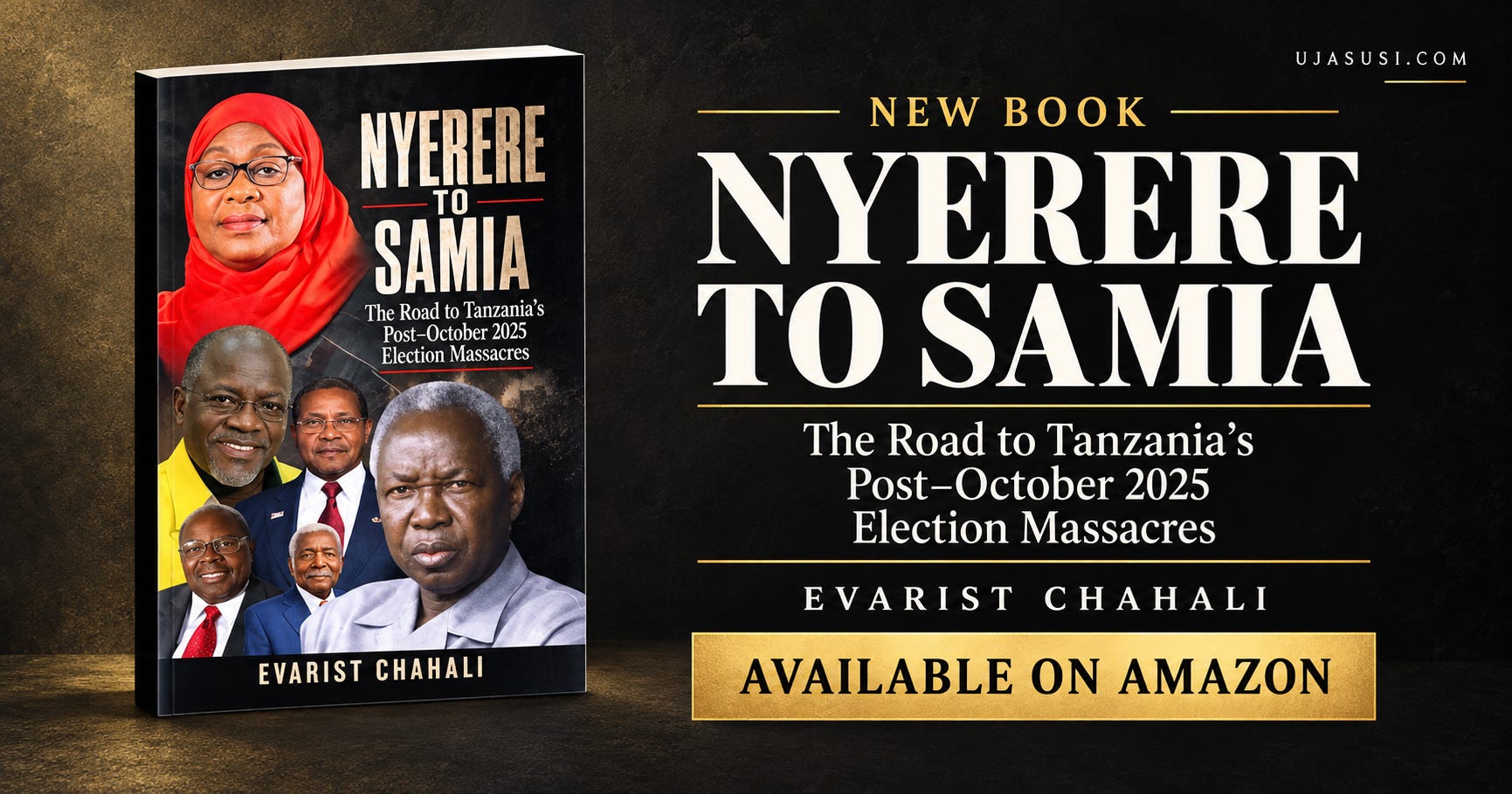
The killings that followed Tanzania’s 29 October 2025 election demand an explanation that reaches beyond the events themselves. Nyerere to Samia: The Road to Tanzania’s Post–October 2025 Election Massacres traces the institutions, political networks and security practices built across six presidencies—and asks how they made such violence possible.
Former Tanzanian intelligence officer Evarist Chahali connects that institutional history to the crisis and its aftermath. An introduction and twenty chapters take readers from the foundations of the post-independence state to the difficult questions of responsibility, accountability and reform.
📖 Twenty chapters that build the argument
🏛️ Part I: Foundations
1. The Mwalimu’s Bargain
Shows how Nyerere’s nation-building project combined national unity with political monopoly, establishing institutions that outlived his presidency.
2. The Invisible Architecture
Traces the intelligence service’s development from colonial Special Branch to TISS, revealing how political surveillance became embedded in government.
3. Mwinyi and the Zanzibar Fault Line
Explores economic liberalisation and multiparty politics alongside the survival of coercive institutions and unresolved Union tensions.
🕸️ Part II: Consolidation
4. Mkapa’s Quiet Hand
Probes the relationship between reform, political control and security-force violence beneath an administration associated with technocratic government.
5. Kikwete’s Velvet Fist
Investigates the intersection of political networks, commercial interests, intelligence and the management of dissent.
6. The Zanzibar Laboratory
Connects successive disputed elections, security operations and political settlements to the book’s argument about recurring violence without accountability.
7. The Mtandao
Maps the political-commercial network, its influence, its disruption under Magufuli and its subsequent re-emergence, distinguishing documented connections from allegations.
8. The Intelligence Dimension
Analyses presidential control, patronage, opposition penetration and digital surveillance, asking whose interests intelligence institutions serve.
⚙️ Part III: The Magufuli Disruption
9. The Bulldozer
Assesses Magufuli’s transformation from anti-corruption reformer to increasingly restrictive ruler, separating his innovations from the powers he inherited.
10. MKIRU: The Forgotten Massacre
Investigates alleged extrajudicial killings and disappearances in Mkuranga, Kibiti and Rufiji, including the case of journalist Azory Gwanda.
11. Sexual Violence as Weapon of State
Documents cases and allegations of sexual violence and torture, identifying the institutional conditions that enable abuse.
12. The Death of the President
Scrutinises the secrecy surrounding Magufuli’s illness and death, distinguishing the official account from competing hypotheses and unproven allegations.
🔎 Part IV: Samia and the Collapse
13. The Two Phases of Samia
Traces the initial political opening and its reversal, examining why expectations of reform gave way to renewed repression.
14. Ameir and Lissu: Power, Allegation and Political Targeting
Examines Lissu’s sustained targeting and allegations concerning informal influence around the presidency.
15. Haji Omar Kheir
Uses a security official’s career and alleged influence to explore the distance between formal office and practical authority.
16. The October 29 Massacres
Reconstructs the election crisis, internet shutdown and mainland killings, examining operational patterns, responsibility, competing assessments and the basis for the book’s working figure of approximately 10,000 deaths.
⚖️ Part V: Reckoning
17. The Chande Commission
Tests the official inquiry’s mandate, methods and findings against the demands of credible investigation and criminal accountability.
18. The ICC and Article 17
Explains the international accountability questions, distinguishing submissions and allegations from findings by judicial institutions.
19. The Architecture Exposed
Brings the evidence together, showing how surveillance, patronage, coercive law, information control and impunity can reinforce one another.
20. What Comes After
Sets out what institutional transformation would require, and considers what the crisis means for Tanzania, Zanzibar and the wider region.
💡 Why does this book deserve your attention?
Its strength lies in connecting subjects too often considered separately: presidential leadership, intelligence operations, political networks, violence and failed accountability. Across the chapters, individual events become part of a larger inquiry into how power is organised, exercised and protected.
For Tanzanians, the book offers a framework for scrutinising the institutions that shape their political lives. For readers of intelligence studies and African politics, it presents a case through which to examine how security services, ruling parties and informal networks interact across successive administrations.
Readers need not agree with every assessment to recognise the importance of the questions. Understanding which practices survived leadership changes—and why—matters when judging what meaningful reform would require.
Tanzania’s future cannot be understood through its leaders alone. The institutions they inherit, and leave behind, deserve equal scrutiny.
Nyerere to Samia is available in paperback through African Books Collective and Amazon and as a Kindle eBook.