

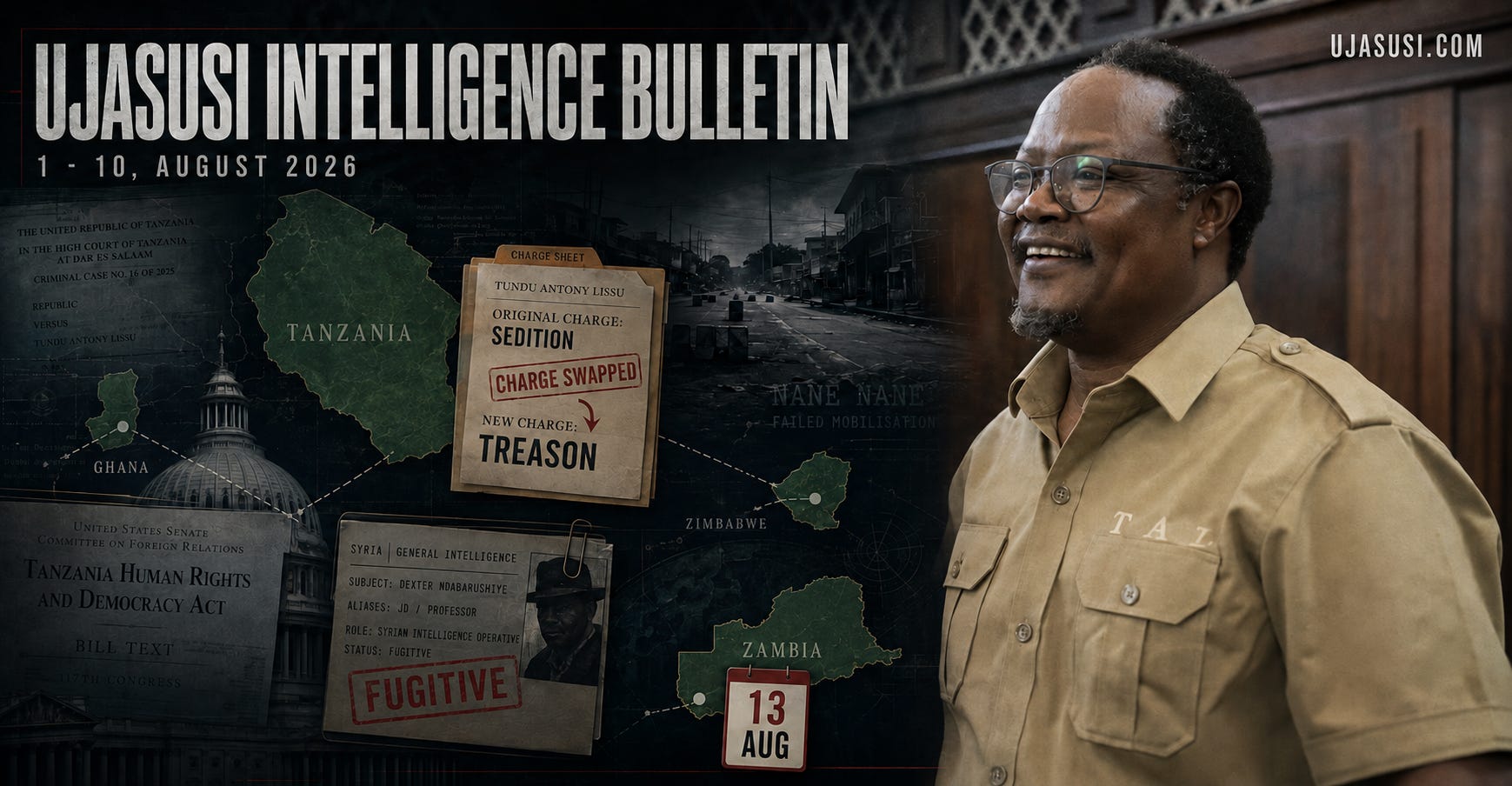
Ujasusi Intelligence Bulletin | 1 August 2026 – 10 August 2026
This bulletin covers:
Tanzanian opposition leader Tundu Lissu’s treason trial resuming the day the Commonwealth’s 30-day deadline expired
A charge-swap pattern in the case of Neema Chozaire, an official of CHADEMA, Tanzania’s main opposition party
The collapse of street mobilisation planned for Nane Nane, Tanzania’s 8 August national holiday
The US Senate’s Tanzania sanctions bill reaching the floor calendar
Intelligence-service reshuffles in Ghana and Zimbabwe
A tradecraft file on a fugitive spy chief from Bashar al-Assad’s fallen Syrian regime
Zambia’s 13 August election as regional context
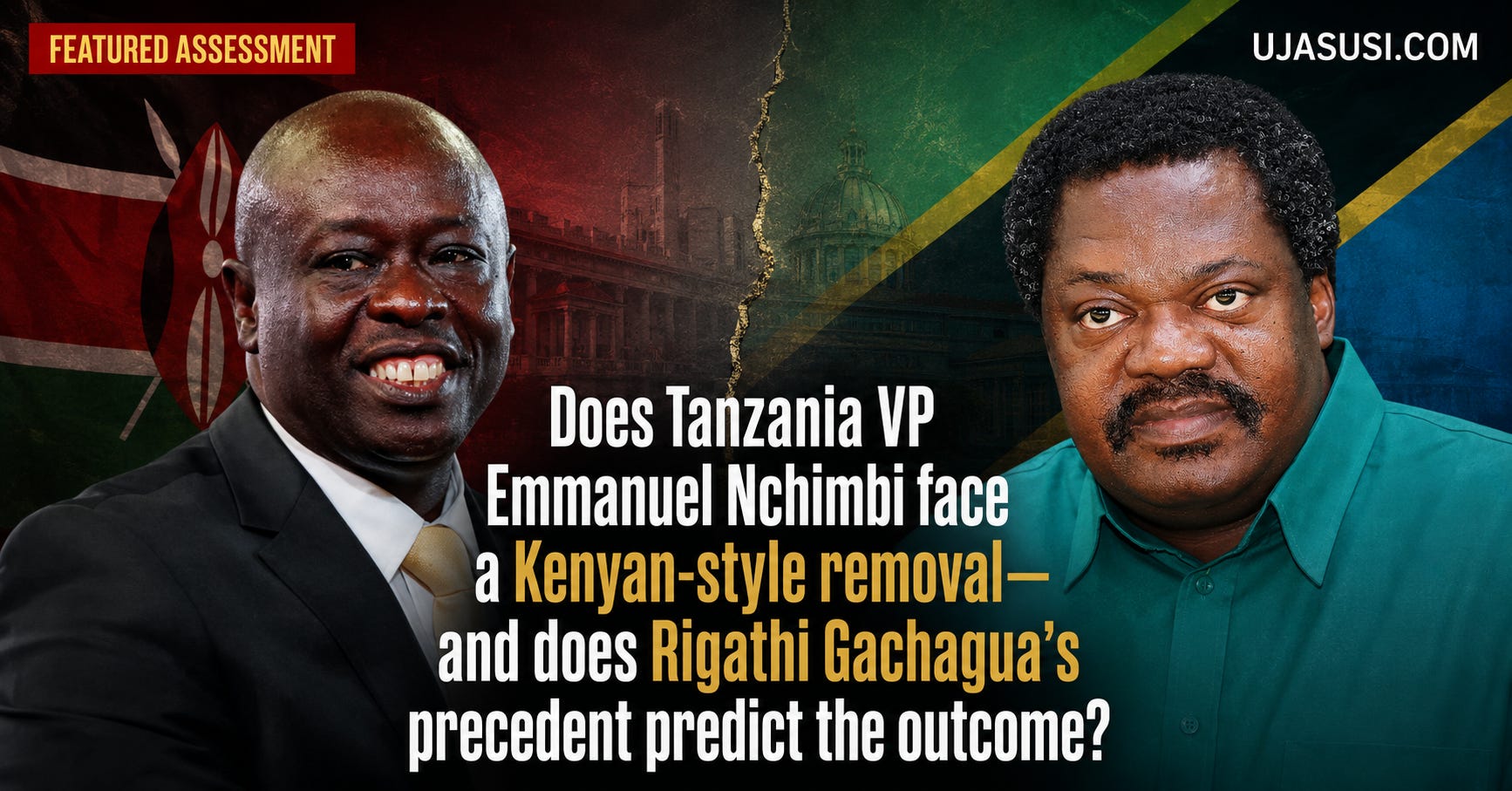
A Featured Assessment compares Tanzanian Vice President Emmanuel Nchimbi’s position to Kenya’s precedent of impeached former Deputy President Rigathi Gachagua.
Lead Item
Two clocks converge: Lissu’s trial resumes as the Commonwealth deadline expires
Tanzania’s two principal accountability tracks, the domestic judicial process and the Commonwealth’s diplomatic pressure campaign, collided on 10 August. The High Court in Dar es Salaam resumed the treason trial of Tundu Lissu, chairman of CHADEMA, Tanzania’s main opposition party, after a five-month suspension, the same day the Commonwealth Ministerial Action Group’s 30-day deadline for resolving his detention expired. The court has scheduled hearings to run from 10 August to 7 September, meaning the case will still be active when CMAG reconvenes next month.
CMAG’s 73rd extraordinary session, held on 10 July, set three benchmarks: a political or legal pathway to Lissu’s release within 30 days, restored digital and media freedoms within 60 days, and a neutral-facilitated inter-party forum within 90 days. The government of President Samia Suluhu Hassan has responded procedurally rather than substantively: officials said in July they were “assessing” the recommendations, while CHADEMA ruled out talks without Lissu’s release and independent mediation.
This assessment concludes with moderate confidence that the trial’s resumption on the exact day the deadline lapsed is not coincidental scheduling but a deliberate signal: the state is demonstrating procedural motion on Lissu’s case without conceding the substantive outcome CMAG required. The five-month suspension, driven by a prosecution appeal over additional evidence that the Court of Appeal ultimately dismissed, has already cost Lissu roughly 490 days in pre-trial custody on a capital, non-bailable charge. Continued incremental hearings allow Tanzania to argue engagement with the Commonwealth process while the underlying detention persists unresolved.
READ ALSO

Secondary Items
The charge-swap pattern: Neema Chozaire and the collapse of the bail route
CHADEMA’s Geita Rural chairperson, Neema Chozaire, has moved through the same procedural sequence now visible in Lissu’s case, compressed into six weeks. Reported missing on 29 June, confirmed arrested on 1 July on a charge of conspiracy to murder police officers, she spent 22 days in custody before a High Court petition secured her release on bail on 21 July. According to a CHADEMA-affiliated Instagram account, the state subsequently withdrew that charge and re-arraigned her on terrorism grounds, a non-bailable offence, returning her to prison; the case has been adjourned to 24 August. This report has not yet been corroborated by mainstream Tanzanian outlets, and it is treated here as credible but unconfirmed pending independent verification.
If accurate, the sequence (bailable charge, bail granted, charge withdrawn, non-bailable charge substituted) mirrors the parallel track reportedly opened against Lissu himself, in which a second, terrorism-based charge sits behind the treason case as a hedge against any judicial or political resolution of the latter. Assessed with moderate confidence: this represents a repeatable prosecutorial technique rather than an isolated decision, designed to neutralise bail as a release mechanism for opposition figures irrespective of the underlying facts of any individual case.
Nane Nane’s non-event and the shrinking options for the President’s opponents
Activists and Gen-Z-led online mobilisation had circulated calls for demonstrations across Tanzania timed to 8 August, Nane Nane, a national public holiday marking the country’s farmers, and the second such planned protest date after Saba Saba on 7 July, when police pre-emptively arrested more than 130 people and the planned protest failed to materialise under a heavy security presence. Ujasusi’s monitoring network assesses that the Nane Nane call collapsed even more completely: security services reportedly did not consider the call credible enough to warrant the pre-emptive warnings and arrests that preceded Saba Saba, itself an indicator of how thoroughly the state judges street mobilisation to have been suppressed as a viable opposition tool.
This assessment concludes with moderate confidence that the anti-Samia camp’s remaining options have narrowed to three tracks, none of which offers a fast outcome: the judicial route, tested through habeas-style petitions of the kind that briefly freed Chozaire; the external-pressure route, running through CMAG and the US Congress; and the route running through the ruling party, Chama Cha Mapinduzi (CCM): specifically the rift between the President and Vice President Emmanuel Nchimbi, examined in the Featured Assessment below, which offers the only visible fracture inside the ruling party itself. Street protest, the tool that produced the October 2025 killings and briefly appeared to threaten the government’s legitimacy, is assessed as having been effectively removed from the opposition’s repertoire for the remainder of 2026.
Washington’s sanctions bill reaches the Senate floor calendar
The Reassessing the United States-Tanzania Bilateral Relationship Act, S.4577, advanced from committee markup to the Senate’s general legislative calendar on 27 July, placed as Calendar No. 511 after being reported out by Foreign Relations Chairman Jim Risch with a substitute amendment. The bill authorises targeted sanctions and visa bans against named officials, suspends categories of security and development assistance, and bars Millennium Challenge Corporation support until the State Department certifies meaningful reform.
The floor calendar placement matters less for its content, which was substantially settled at the June committee markup, than for its timing: it now sits available for a floor vote in the same week the CMAG deadline expired and Lissu’s trial resumed, giving Congress a live legislative vehicle that can be scheduled quickly should either track produce a further deterioration. Available reporting does not indicate a scheduled floor vote date; this remains a key unknown heading into the August recess.
Regional intelligence services: reshuffles in Accra and Harare
Two African intelligence establishments underwent leadership disruption this period. In Ghana, a feature analysis by Mustapha Bature Sallama examined the personnel and structural changes to the country’s national security architecture under President John Mahama, framing the reshuffle as an attempt to establish a new intelligence doctrine distinct from the previous administration’s approach.
In Zimbabwe, Gambakwe Media reported the removal of 32 senior officers from the Central Intelligence Organisation. This report has not yet been corroborated by a second independent source and is graded accordingly: plausible given Zimbabwe’s history of periodic CIO purges tied to succession politics, but not yet confirmed. Readers should treat the figure of 32 as provisional pending further reporting.
Tradecraft file: the phone book that found Assad’s spy chief
A BBC investigation reconstructed how analogue detective work, cross-referencing an old personal phone directory rather than digital surveillance, led investigators to the hiding place of a senior figure in Bashar al-Assad’s intelligence apparatus after the Syrian government’s collapse. The piece is a useful corrective to assumptions that fugitive tracking in 2026 is a purely digital discipline; low-technology human networks and paper records remain productive avenues when a target has gone to ground precisely to avoid digital exposure.
Regional context: Zambia’s 13 August vote
Zambia goes to the polls on 13 August, with incumbent President Hakainde Hichilema facing challenger Brian Mundubile in what regional monitors are calling a genuine two-horse contest. The vote falls two days after this bulletin’s publication and sits outside Tanzania’s immediate crisis, but it is included here as a comparative data point: a Southern African Development Community member state conducting a contested election without the security-force posture currently on display in Dodoma offers an implicit benchmark against which Tanzania’s own conduct continues to be measured by regional and Commonwealth observers alike.
READ ALSO

What to Watch
CMAG’s September reconvening. The Ministerial Action Group is due to reassess Tanzania’s compliance with the 30/60/90-day benchmarks. A failure to show a political or legal pathway on Lissu by then would represent the clearest indicator yet of the process moving toward escalation rather than continued probation.
Chozaire’s adjourned hearing, 24 August. If the terrorism re-charge is confirmed by further reporting and the case proceeds on that date, it would corroborate the charge-swap pattern assessed above and strengthen the analytical case that this is now standard prosecutorial practice against opposition figures who secure bail.
Whether S.4577 receives Senate floor time before recess. A floor vote, or its absence, before the August recess would indicate how much legislative priority the bipartisan sponsors are able to command relative to other business.
Zambia’s 13 August result and any Commonwealth commentary drawing a comparison. A peaceful, competitive Zambian election result would sharpen regional and international framing of Tanzania as an outlier within its own neighbourhood.
━━━━━━━━━━━━━━━━━━━━━━━━━━━━━━━━━━━━ ━━━━━━━━━━━━━━━━━━━━━━━━━━━━━━━━━━━━
FEATURED ASSESSMENT
Key Judgements
President Samia Suluhu Hassan is assessed as likely to be pursuing a strategy of political marginalisation against Vice President Emmanuel Nchimbi rather than formal removal, given the higher constitutional and political cost of impeachment relative to Kenya’s precedent. Confidence: Moderate.
The June 2026 parliamentary “Judas” speech and Nchimbi’s exclusion from the Central Committee and Cabinet meetings almost certainly originated from CCM’s Zanzibar-aligned bloc with the President’s tacit or active endorsement, given the coordinated timing and the absence of any disciplinary response against the speaker. Confidence: High.
Unlike Gachagua, whose removal proceeded through a documented parliamentary impeachment process with judicial review, Nchimbi’s position is being contested through informal exclusion, public rhetoric and bureaucratic sidelining. This assessment judges it unlikely that Samia’s government pursues a formal impeachment vote before the CCM’s 2030 succession cycle, given the reputational cost of a second internal crisis while Tanzania is already under Commonwealth and Congressional scrutiny. Confidence: Moderate.
Nchimbi’s public pivot toward constitutional reform advocacy, most visibly his 24 July address calling for a new constitution built on national consensus, is assessed as a defensive repositioning strategy, converting a weakening internal position into a public reform credential that would be politically costly for Samia’s government to attack directly. Confidence: Moderate.
Scope and Approach
This assessment examines whether the deteriorating relationship between President Samia Suluhu Hassan and Vice President Emmanuel Nchimbi is trending toward a formal removal comparable to Kenya’s October 2024 impeachment of then-Deputy President Rigathi Gachagua, and whether the Kenyan case offers a reliable predictive template for Tanzania. It draws on Tanzanian parliamentary reporting, CCM internal signalling as documented by independent Tanzanian outlets, and Kenyan court reporting on the Gachagua case through June 2026. It does not assess the substantive merits of either country’s underlying political disputes, nor does it draw conclusions about criminal liability on any side.