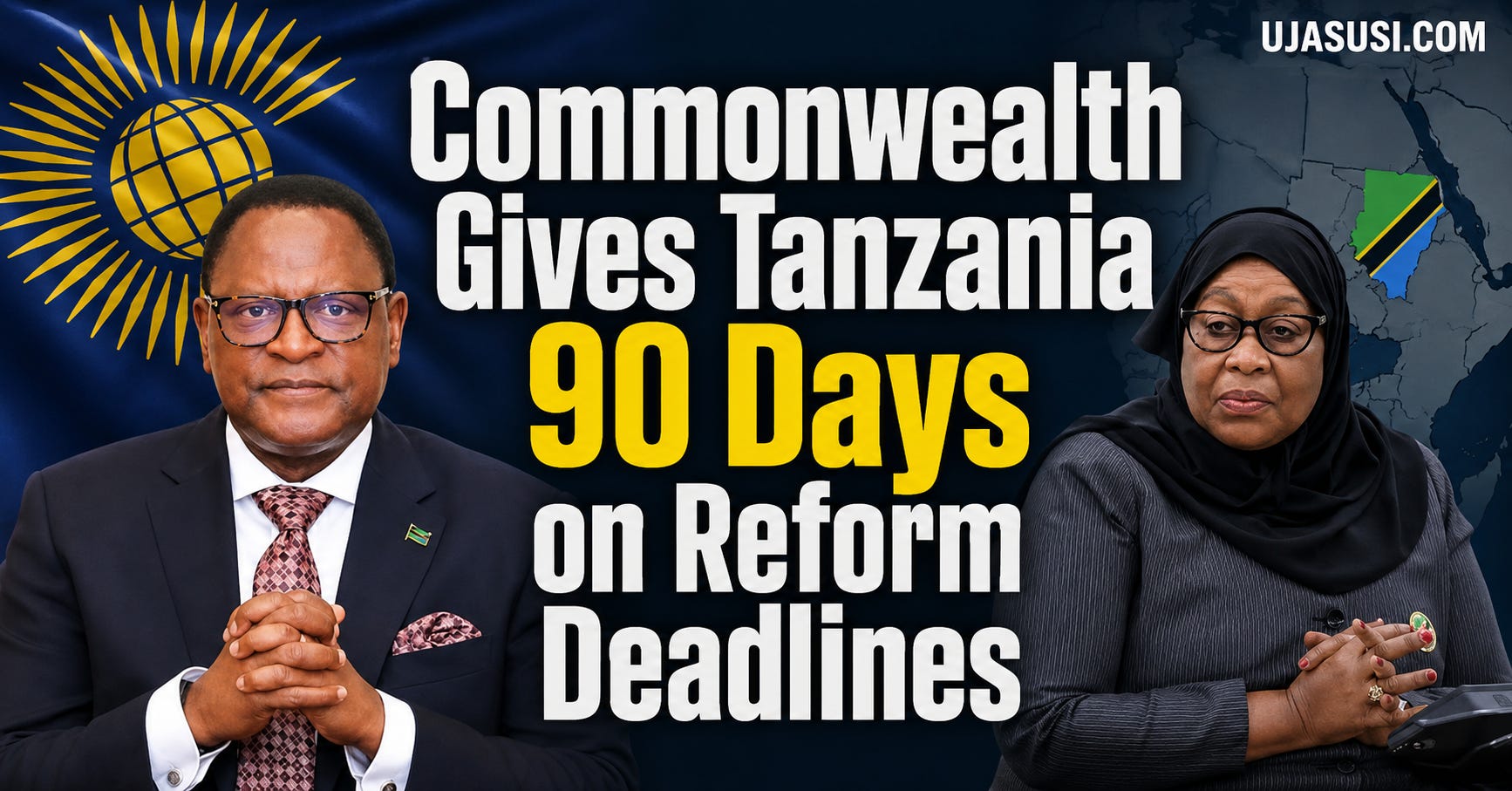
Commonwealth Gives Tanzania 90 Days on Reform Deadlines
Ujasusi East Africa Monitoring Team | 11 July 2026 | 0315 BST
SUBJECT: CMAG’s Seventy-Third Meeting Retains Tanzania on Formal Agenda, Sets Time-Bound Benchmarks Amid Assessed Post-Envoy Deterioration
KEY JUDGEMENT
The Commonwealth Ministerial Action Group’s decision to retain Tanzania on its Formal Agenda, combined with its finding that conditions have worsened since Special Envoy Chakwera’s April visit, signals that Dodoma’s strategy of granting access while resisting substantive concessions has bought time rather than credibility. The new 30/60/90-day benchmarks convert what had been an open-ended review into a dated compliance test, materially raising the diplomatic cost of continued inaction ahead of the September session.
SITUATION
CMAG held its seventy-third meeting in extraordinary session on 10 July 2026, chaired for the first time by Malta’s Chris Fearne following Dr Ian Borg’s transition out of the role. The Group received the Secretary-General’s report on Special Envoy Dr Lazarus Chakwera’s visit to Tanzania, undertaken in April 2026 following instruction at CMAG’s seventy-first meeting. During that visit, Chakwera met President Samia Suluhu Hassan, Zanzibar’s leadership, the judiciary, the electoral commissions, and leaders of all nineteen registered political parties, including CHADEMA chairman Tundu Lissu, whom the envoy met while Lissu remained in pre-trial detention.
CMAG’s concluding statement records that of the four conditions set in December 2025, one has been met, one partially met, and two remain unaddressed. The Group states explicitly that conditions have deteriorated since the envoy’s visit, citing a nationwide restriction on political activities, continued pressure on civic space and media, and the unresolved detention and legal proceedings of Tanzania’s principal opposition leader.
That detention concerns Tundu Lissu, held since 9 April 2025 on a capital treason charge and additional Cyber Crimes Act counts, following a rally where he called for electoral reform ahead of the October 2025 general election. Treason is non-bailable under Tanzanian law, so Lissu has remained in custody without possibility of release, moving through the Kisutu Resident Magistrate’s Court and the High Court to the Court of Appeal.
As of 11 July 2026, Lissu had spent 458 days in pre-trial detention on capital charges. The last available count of substantive hearing days is fifteen, as of March 2026; a current figure was not available in this session’s sourcing.A Court of Appeal review hearing on the prosecution’s bid to reopen evidence was heard on 3 July 2026, one week before CMAG’s meeting. That timing suggests the trial remains in a preliminary procedural phase, with no resolution in near-term sight.
CMAG’s new time-bound recommendations require resolution of Lissu’s detention through a political or legal pathway within thirty days; restoration of full digital platform access and cessation of intimidation of media and free-expression advocates within sixty days; and a neutral-facilitated inter-party forum on electoral reform, political competition, detainees, and accountability within ninety days.
CMAG also called for immediate initiation of the independent criminal investigation recommended by Tanzania’s own Commission of Inquiry, including defined victim compensation terms. The Group will reconvene in extraordinary session in September 2026, with Tanzania invited to submit a progress report beforehand, and will “consider further action” in November 2026 absent expected progress.
Introducing “A Spy’s Guide to Deception” — The First in the Spy Guide Series
Intelligence work is built on deception. Every service that has ever run an agent, mounted a cover operation, or manufactured a false narrative has done so through principles that remain largely invisible to the public. Not because they are secret, but because no one has taken the time to explain them plainly.
ASSESSMENT
Dodoma’s strategy of facilitating envoy access while withholding structural concessions has produced a narrow diplomatic dividend: CMAG credits the access itself as a confidence-building step, without the substance of the four original conditions being addressed. That is a moderate-confidence judgement, resting on the gap between CMAG’s positive characterisation of the access and its sharper language on deterioration.
The dated benchmarks are a meaningful procedural escalation, even though CMAG stopped short of naming a suspension track. Unlike the open-ended monitoring language used at the seventy-first and seventy-second meetings, specific deadlines create discrete, publicly verifiable failure points ahead of September. It is assessed as likely that the thirty-day Lissu benchmark will lapse without resolution, given that his Court of Appeal proceedings remain at a preliminary procedural stage with no indication the state intends to expedite or discontinue the prosecution.
CMAG’s approach, building a documented compliance record ahead of a sharper decision point rather than forcing an immediate suspension debate, looks like a deliberate sequencing choice by member states. It fits the incremental pattern of the process so far: four consecutive meetings have now retained Tanzania on the Formal Agenda without escalation. This brief does not compare Tanzania’s case with other Commonwealth states’ suspension histories; that would require separate verification.
WHAT TO WATCH
Lissu detention pathway (30-day window, by approximately 9 August 2026): any political or judicial move to resolve his status, whether a discontinuance of the treason charge or a bail-adjacent legal manoeuvre, would be the clearest indicator of Tanzanian responsiveness to CMAG pressure.
Digital platform restoration (60-day window): continued restriction of social media access through early September would confirm the deterioration finding and strengthen the case for escalation at the September meeting.
Terms of the Commission of Inquiry’s independent criminal investigation: whether Tanzania announces defined eligibility, funding, and timelines for victim compensation, distinct from the domestic inquiry’s own findings, will show whether accountability commitments extend past the report stage.
Tanzania’s pre-September progress report: its content and specificity will shape whether CMAG treats the record as good-faith engagement or continued stalling.
Composition and mandate of any inter-party forum (90-day window): whether CHADEMA, suspended from political activities by the High Court in June 2025, is allowed genuine participation will determine whether this condition is met in substance or only on paper.
WHAT WE DO NOT YET KNOW
The full text of the Secretary-General’s underlying report and Chakwera’s own assessment has not been published alongside the concluding statement, which limits visibility into which specific incidents CMAG relied on in reaching its deterioration finding. It is also unclear which of the four original December 2025 conditions CMAG regards as met and partially met, respectively. The concluding statement does not map its finding onto the earlier enumerated conditions with precision, so this brief’s inference on that point should be read as an interpretation, not a confirmed reading.