

Ujasusi Intelligence Bulletin | 15 August 2026 | 0100 BST
This bulletin covers:
President Samia Suluhu Hassan’s meeting with Tanzania Episcopal Conference bishops in Dodoma, and the online accusations of betrayal that followed
Germany’s approval of its most sweeping intelligence-service reforms since the end of the Second World War
The suspension and resumption of vote counting in Zambia’s general election amid violence against poll staff
An Africa Center for Strategic Studies assessment that Somalia’s federal government risks losing the capital, Mogadishu, to the al Shabaab insurgency
Continent-wide data showing militant Islamist violence in Africa has surpassed 20,000 deaths for a fourth consecutive year
Reporting that Sahel-based jihadist groups are converging on Nigeria, drawing on a United Nations Security Council report
Rising risk of renewed war between Ethiopia’s federal government and Tigray, nearly four years after the Pretoria Agreement
A French survey ranking Britain’s Secret Intelligence Service (MI6) first among European intelligence agencies
CIA-linked research arguing that artificial intelligence is reviving Cold War-era human intelligence tradecraft
A new mutual defence pact between Saudi Arabia, Türkiye and Pakistan, signed in Mecca
South Africa’s Madlanga Commission recommending a criminal investigation into a suspended deputy national police commissioner
A Featured Assessment examines why the Samia-TEC meeting, welcomed by political analysts as constructive dialogue, generated public accusations that the Catholic Church had betrayed the citizens it claims to represent.
LEAD ITEM
Samia’s Dodoma meeting with TEC bishops draws “betrayal” accusations online
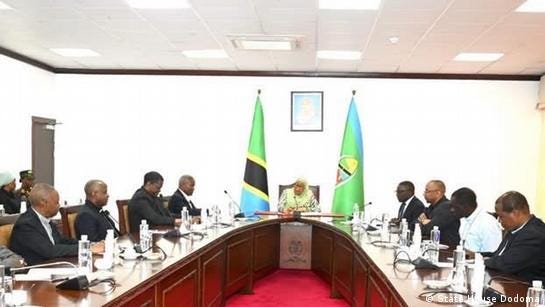
President Samia Suluhu Hassan met leaders of the Tanzania Episcopal Conference at Chamwino State House in Dodoma on Monday 10 August, the first such encounter since months of unprecedented tension between the state and Tanzania’s Catholic Church over the killings that followed last October’s general election. The TEC delegation was led by Bishop Wolfgang Pisa, TEC President and Bishop of Lindi, and included Secretary General Fr Dr Charles Kitima, TEC Vice President Bishop Eusebius Nzigilwa, Cardinal Protase Rugambwa, and the archbishops of Mwanza, Arusha and Dodoma. According to a statement from State House Director of Communications Bakari Machumu, the session covered politics, faith, development, national solidarity and moral stewardship; Kitima’s own remarks, reviewed separately by this desk, put the meeting’s length at roughly ninety minutes.
The meeting followed a January 2026 visit by Foreign Minister Mahmoud Thabit Kombo to Pope Leo XIV, widely read as an attempt to ease strain with the global Catholic leadership, and comes five days after Samia’s 5 August announcement of a Reconciliation Commission. Political analysts quoted by The Citizen, including Dr Aviti Mushi, welcomed the engagement as bridge-building. That elite reading sits at odds with a harsher reaction online, where sections of Tanzanian social media have accused TEC of betraying citizens by meeting a government they hold responsible for mass killings, without securing visible commitments on accountability. This division between institutional and public reaction is the subject of this week’s Featured Assessment, below.
READ ALSO

SECONDARY ITEMS
Germany approves most sweeping intelligence reforms since 1945
Germany’s Federal Cabinet has approved reforms that would, for the first time since the BfV and BND were founded in the 1950s, permit both agencies to conduct offensive operations abroad, including sabotage, offensive cyber activity and, in self-defence, the use of firearms. Interior Minister Alexander Dobrindt called the change “a revolution” in German security policy. The government frames the reform as a response to what it terms Russian “state terrorism,” a characterisation that aligns with a CIA warning, reported to European counterparts the same day the Cabinet approved the reforms, that Moscow is preparing to intensify sabotage against European infrastructure alongside false-flag operations. The reforms require Bundestag ratification in September and are highly likely to pass given the governing coalition’s majority. This is a significant shift for a state whose entire postwar intelligence architecture was built on defensive, oversight-heavy design; the practical test will be whether parliamentary oversight mechanisms, built for a purely defensive service, can adapt at the same pace as the new operational mandate.
Zambia’s election count halted, then resumed, after attacks on poll staff
Zambia’s Electoral Commission suspended vote counting nationwide on Friday 14 August, a day after the general election, citing violence against polling staff and theft of marked ballots in several districts. Counting resumed hours later after what the Commission described as containment of the security threat, with riot police and army units deployed around the Lusaka tallying centre. Incumbent President Hakainde Hichilema, seeking a second term against Tonse Alliance leader Brian Mundubile, called for calm; Mundubile’s camp said delayed results risked masking irregularities. Zambia has held largely peaceful multiparty elections since 1991, making Friday’s disruption a genuine departure from precedent rather than a recurring pattern. Results, originally expected Monday, may now be delayed.
Africa Center assessment: Somalia’s federal government at risk of collapse to al Shabaab
A November 2025 Africa Security Brief by Matt Bryden, last revised 6 August, assesses that al Shabaab is closer than at any point in two decades to seizing Mogadishu, driven less by the group’s own strength than by the collapse of political cooperation between Villa Somalia and the federal member states of Puntland and Jubaland. Both states have suspended relations with the federal government. Compounding this, the African Union’s AUSSOM peacekeeping mission has received barely a quarter of its 2025 budget, and the United States has objected to new UN funding mechanisms that would sustain it. Gulf-state rivalry deepens the fracture: Qatar and Türkiye back President Hassan Sheikh Mohamud’s Islamist-aligned centre, while the UAE backs the more federalist member states. The assessed likely near-term scenario, absent a government of national unity, is continued erosion of federal authority; the assessed worst case is an al Shabaab takeover of the capital before Mohamud’s term expires in May 2026.
Militant Islamist violence in Africa surpasses 20,000 deaths for fourth straight year
An Africa Center for Strategic Studies infographic published 12 August records 23,872 fatalities linked to militant Islamist violence across Africa in the twelve months to mid-2026, a 77 percent increase since 2021 and nearly 150 percent above the 2017 figure. The Sahel accounts for 42 percent of the continental total, with the JNIM coalition responsible for 76 percent of fatalities in that theatre alone. Somalia and the Lake Chad Basin each account for 28 percent, with Lake Chad fatalities up 60 percent on the year, driven by a Nigerian-led military offensive against Boko Haram and ISWAP. Mozambique’s ASWJ insurgency has risen 58 percent since the departure of SADC forces in July 2024. Remote violence, principally airstrikes and a growing share of drone strikes, rose 42 percent and now accounts for around 40 percent of deaths in Somalia specifically, reflecting a broader continental shift toward stand-off tactics by both militaries and militant groups.
Nigeria named as the next convergence point for Sahel-based jihadist groups
Citing the United Nations Secretary-General’s 23rd strategic report on ISIL/Da’esh (S/2026/638, briefed to the Security Council on 5 August), a TruthNigeria report argues that JNIM’s economic blockade of Bamako, territorial gains by JNIM and Islamic State Sahel Province in Burkina Faso, and the continued expansion of ISWAP, the report’s named most active Islamic State affiliate globally, are converging on Nigeria’s northwest and Middle Belt. The report cites JNIM’s first claimed attack on Nigerian soil near the Benin border in October 2025, a Lakurawa-linked killing of 162 people in Kwara State in February 2026, and a US airstrike on ISSP camps in Sokoto’s Tangaza county on 25 December 2025, described as the first known American kinetic action inside Nigeria against a Sahel-linked group. A note on sourcing: TruthNigeria is an advocacy publication focused on the persecution of Nigerian Christians rather than a wire service or specialist security outlet, and its framing should be read as opinion pending corroboration from primary UN or specialist reporting; the underlying UN report and the specific dated incidents it cites are independently verifiable and warrant separate confirmation.
Ethiopia-Tigray tensions edge toward renewed conflict after Shererina clash
An 14 August analysis by Horn of Africa specialist Yohannes Woldemariam catalogues a build-up toward renewed war between federal Ethiopian forces and the Tigray Defence Forces, nearly four years after the Pretoria Agreement ended the 2020-2022 war. Federal-TDF clashes resumed in January 2026 for the first time since Pretoria, and fighting broke out at Shererina in western Tigray on 1 August, described by Al Jazeera as one of the most serious threats yet to the peace agreement. Journalist Martin Plaut has characterised Shererina as a federal probe of TDF capacity that produced unexpectedly heavy federal losses, though these figures remain unconfirmed. A further drone strike hit Merewa on 10 August. The author’s central argument, an interpretation rather than settled fact, is that Washington’s 18 June visa restrictions on TPLF “hardliners” may have signalled diplomatic cover to Addis Ababa rather than restraining Tigray, given that the TPLF restored its pre-war regional government in May citing federal violations of Pretoria and was excluded from Ethiopia’s June 2026 national election. Ethiopia’s parallel dispute with Eritrea, formally accused by Addis Ababa of military aggression in February, adds a second axis that did not exist during the 2020-2022 war, when Eritrea fought alongside federal forces against Tigray.
British intelligence ranked top in Europe by French survey; assessment disputed by a serving officer
French magazine L’Express canvassed 60 intelligence professionals across 25 countries and placed Britain’s Secret Intelligence Service (MI6) first in Europe, ahead of France and the Netherlands, whose foreign intelligence services are DGSE and AIVD respectively, and every other European service assessed. A former DGSE chief credited British services with playing “the long game” and a particular flair for what he termed dirty tricks. An unnamed Western intelligence officer dismissed the ranking exercise itself as “a load of codswallop,” a reasonable caution given that comparative rankings of secret services rest on necessarily incomplete and unverifiable information. Former CIA Europe and Eurasia operations chief Ralph Goff is quoted crediting Britain with leading Western intelligence support to Ukraine. The piece, written by a former British Army colonel, ties the ranking to a fresh US intelligence warning that Russia could attempt a limited incursion or cyber campaign against NATO states between this autumn and 2029, and argues for higher UK defence spending; this argumentative framing should be read as advocacy rather than as independent confirmation of the underlying ranking’s methodology.
CIA-linked research argues AI is reviving Cold War-era human tradecraft
A paper published in the CIA-affiliated journal Studies in Intelligence, authored by RAND researcher and former CIA officer Thomas Mulligan, argues that AI-generated deepfakes and synthetic messages are eroding confidence in digital communications to the point that classical human intelligence tradecraft, dead drops, brush passes and in-person meetings, is regaining strategic value. The underlying logic is straightforward: a dead drop or brush pass verifies that information originated from a specific human source in a way no digital channel currently can, once AI-generated deception is assumed to be present in any electronic exchange. The argument runs counter to the prevailing assumption that AI simply expands intelligence collection capacity; Mulligan’s case is that the same technology simultaneously degrades trust in the product that expanded collection generates.
Saudi Arabia, Türkiye and Pakistan sign Mecca Joint Defence Agreement
Leaders of the three states signed a mutual defence pact in Mecca on 7 August, declaring that an armed attack on any one signatory will be treated as an attack on all three. The agreement builds on an existing Saudi-Pakistan Strategic Mutual Defence Agreement signed in September 2025 and combines, according to the 2026 Global Firepower Index, close to 1.4 million active military personnel, Türkiye’s NATO-derived defence-industrial base, Saudi financial and geographic weight, and Pakistan’s status as the only nuclear-armed Muslim state. Analysts at the Atlantic Council caution this is a framework for closer strategic and defence-industrial coordination rather than a NATO-equivalent alliance, though Turkish Foreign Minister Hakan Fidan has said Ankara wants to expand membership beyond the three signatories. This desk assesses, with moderate confidence, that the pact reflects Gulf states hedging against reliance on US security guarantees following repeated Iranian drone and missile activity in the region; the Atlantic Council’s own commentary points in this direction but does not state it as directly as this framing implies.
READ ALSO

South Africa’s Madlanga Commission refers suspended deputy police chief for criminal probe
The Madlanga Commission of Inquiry’s second interim report, handed to President Cyril Ramaphosa on 29 May and made public on 6 August, recommends criminal investigation and disciplinary proceedings against suspended Deputy National Police Commissioner Lieutenant-General Shadrack Sibiya, along with a protected witness known as Witness G, suspended Sergeant Fannie Nkosi, and alleged political fixer Brown Mogotsi. Evidence before the Commission linked Sibiya to accused corruption figure Vusimuzi “Cat” Matlala, including alleged cash payments and a delivery of impala to Sibiya’s property. The recommendation substantially validates over a year of allegations first raised publicly by KwaZulu-Natal police commissioner Nhlanhla Mkhwanazi against Sibiya, and marks the first time the Presidency has confirmed a Commission recommendation naming a deputy national police commissioner for criminal referral.
WHAT TO WATCH
Tanzania — TEC’s next public statement. Whether TEC issues a follow-up statement addressing the “betrayal” accusations directly, or maintains silence, will indicate whether the institution intends to manage the backlash or absorb it. Timeframe: two to three weeks.
Ethiopia — further drone activity around Tigray. Additional strikes beyond Shererina and Merewa, particularly any resumption of ground operations, would indicate the federal government has drawn the “escalate via air power” lesson rather than the “avoid ground war” lesson from Shererina. Timeframe: ongoing.
Somalia — AUSSOM funding decisions. EU and other donor funding commitments over the coming weeks will determine whether the mission can sustain even a reduced posture through 2026. A funding shortfall confirmed publicly would sharply raise the probability of the adverse scenario in the Africa Center assessment above.
Zambia — final result timing. Whether results are announced on the original Monday timeline or delayed further will signal whether Friday’s disruption reflects contained, localised violence or a deeper credibility problem with the count.
Germany — Bundestag ratification debate in September. The scope of parliamentary amendments to the reform package, if any, will indicate how much oversight capacity is retained alongside the new offensive mandate.
Turkey-Saudi-Pakistan pact — membership expansion. Any formal move to add signatories beyond the original three would mark a shift from bilateral hedging to a genuine minilateral security architecture in the Gulf and South Asia.
ANALYTICAL NOTE
Three items in this summary, Somalia, the continental militant Islamist violence data, and the Nigeria convergence reporting, describe the same underlying phenomenon from different angles: a jihadist landscape in Africa that has not merely persisted but has restructured itself around economic warfare (JNIM’s Bamako fuel blockade), cross-border convergence (Sahel groups moving into northwest Nigeria), and remote-strike tactics that are reshaping both militant and state approaches to violence. Read together rather than separately, they support a single working judgement, held with moderate confidence: Africa’s militant Islamist threat is no longer contained within traditional theatre boundaries, and West African and Horn of Africa security planning increasingly needs to be conducted as a single interconnected problem rather than as separate regional files.
RELATED

FEATURED ASSESSMENT
Why the Samia-TEC meeting produced accusations of betrayal rather than credit for dialogue
KEY JUDGEMENTS
The gap between elite and public reaction to the 10 August meeting reflects a genuine divergence in what each audience believes the meeting was for, not simply a communications failure on TEC’s part. Confidence: Moderate. Elite commentary treats dialogue itself as the desired outcome; large parts of the online public treat dialogue as valuable only if it produces visible accountability commitments, which the available public record does not show it did.
Fr Kitima’s press framing of the meeting, examined in detail below, structurally resembled past TEC statements defending institutional engagement with government on other contested issues, most notably the 2023 port concession dispute, but was read far more harshly this time because the underlying grievance, alleged mass killings following an election, carries a different moral weight than a commercial contract dispute. Confidence: Moderate.
TEC’s institutional position is almost certainly shaped by a genuine and specific personal safety calculation, not solely institutional politics. Confidence: High. Fr Kitima was physically assaulted at TEC headquarters in April 2025 and disclosed in December 2025 that he was living in fear and being actively hunted; any assessment of TEC’s current posture that omits this context risks mischaracterising caution as complicity.
The meeting is highly likely to be read by the CMAG and broader international accountability track as evidence of internal Tanzanian dialogue progress, regardless of its substantive content. Confidence: Moderate. This creates a structural incentive for the government to prioritise the optics of engagement with religious leadership over the substance of accountability demanded by CMAG’s 30-60-90 day roadmap.
Absent a specific, public TEC statement addressing the accountability gap directly, the credibility cost to the institution is likely to persist and could affect TEC’s standing as an intermediary in the government’s broader Reconciliation Commission process. Confidence: Low to Moderate, given the genuine uncertainty over how quickly public sentiment on this specific episode will fade relative to the wider news cycle.
SCOPE AND APPROACH
This assessment addresses a single analytical question: why did a meeting between the President and the country’s Catholic bishops, one that most conventional political analysts described as constructive, generate accusations online that TEC had betrayed the citizens it claims to represent? It draws on Tanzanian and international press reporting of the meeting itself (The Chanzo, Daily News, The Citizen, Michuzi Blog), the official State House statement, and a detailed textual analysis of Fr Kitima’s press remarks conducted in a prior Ujasusi session. It does not attempt to verify the content of the online backlash quantitatively, no polling or systematic social media analysis was available at time of writing, and readers should treat the characterisation of “significant online backlash” as consistent with the person’s direct observation and with the general pattern of Tanzanian civic discourse since October 2025, rather than as an independently measured metric.
BACKGROUND
Tanzania has been in sustained political crisis since violence surrounding the general election of 29 October 2025, in which approximately 10,000 people are assessed to have been killed, a figure the Ujasusi desk treats as established for editorial purposes and outside the scope of further verification in this product. The Tanzania Episcopal Conference, representing all Catholic bishops in the country, has occupied an unusually prominent and unusually dangerous position in the aftermath. Fr Kitima, TEC’s Secretary General, was assaulted at TEC headquarters in Kurasini on 30 April 2025 following a meeting of religious leaders convened to discuss the run-up to the election, an attack that followed documented social media death threats and that TEC’s own leadership has linked to Kitima’s advocacy on electoral justice and his public criticism of the treason charges brought against opposition leader Tundu Lissu. President Samia directly and publicly criticised TEC by name in a December 2025 address, citing what she characterised as inconsistency across the institution’s eight public statements on the crisis. Kitima disclosed the following week that he was living in fear and being actively hunted, restricting his own movements for safety reasons.
Against this backdrop, the Commonwealth Ministerial Action Group’s 30-60-90 day roadmap, adopted in July, set a target of resolving Lissu’s detention within roughly 30 days, meaning by approximately 9 August, one day before the Samia-TEC meeting took place. A January 2026 Vatican engagement between Foreign Minister Kombo and Pope Leo XIV, and an earlier meeting between Kitima and Prime Minister Mwigulu Nchemba, both preceded the 10 August meeting, suggesting a deliberate government sequencing strategy aimed at normalising relations with the Catholic hierarchy ahead of, and possibly in service of, the broader Reconciliation Commission the President announced on 5 August.