

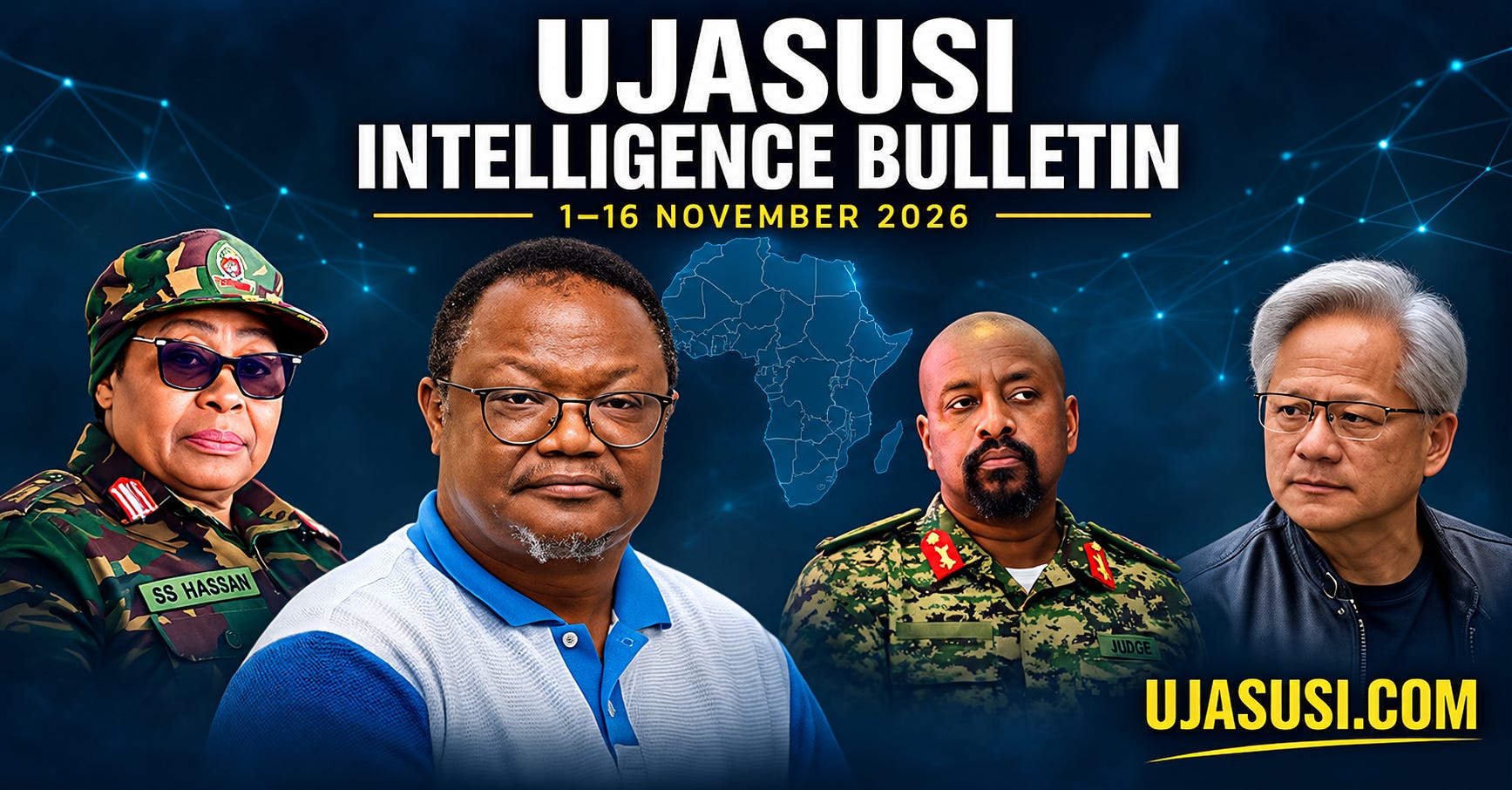
Intelligence Cut-Off Date and Time: 16 November 2026 at 1700 GMT
🧭 Executive summary
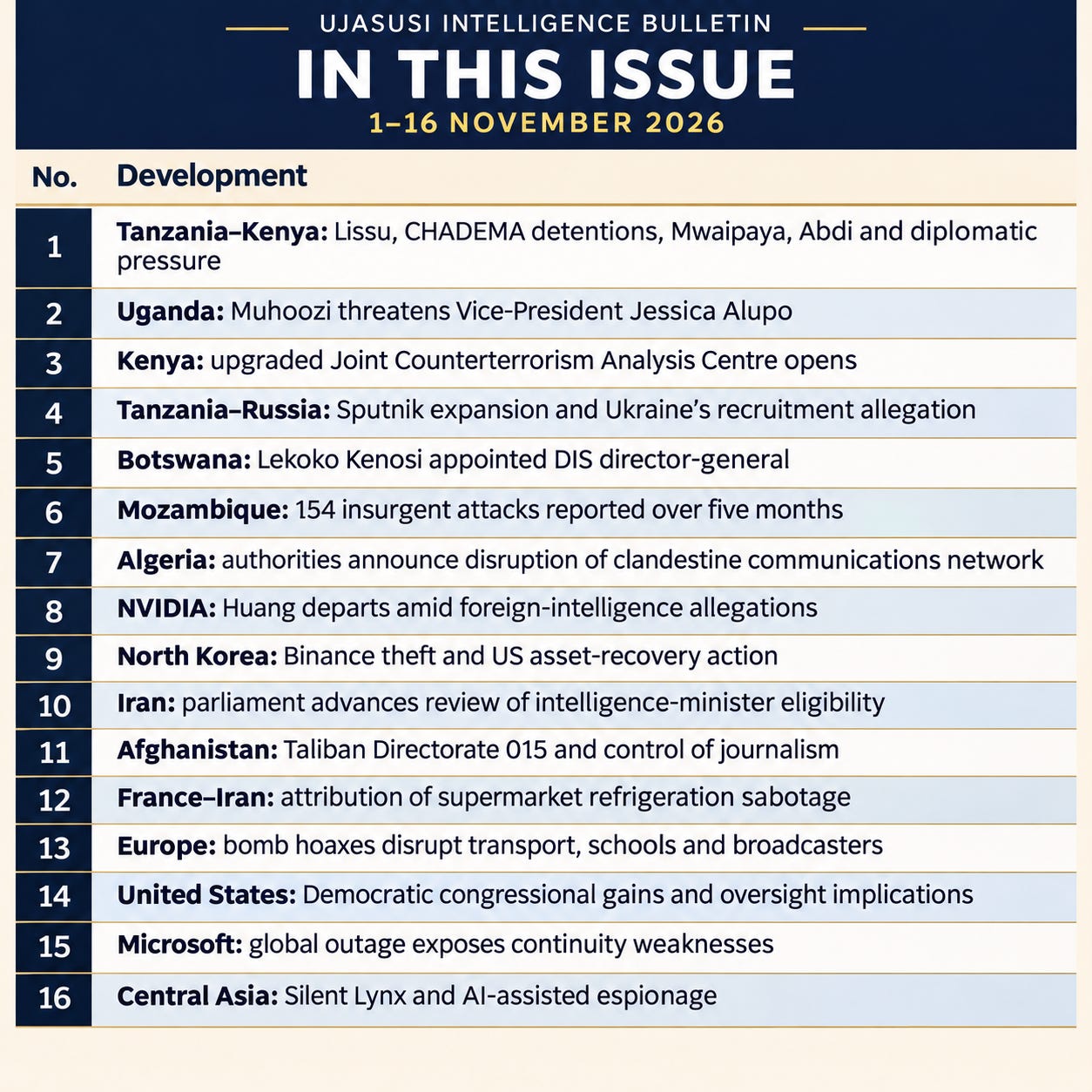
Lissu’s continued imprisonment, the reported detention of local organisers and inadequate replacement capacity are likely to constrain CHADEMA’s mobilisation through February 2027. Tanzania’s international engagement is likely to continue alongside criticism, while the Kenyan disappearance proceedings increasingly test judicial follow-through on evidence, witness protection and accountability. The practical effects of intelligence leadership and institutional changes in Botswana, Kenya and Iran will depend on implementation, oversight and the distribution of authority. NVIDIA’s leadership transition is unlikely to end scrutiny of security and export governance; the wider cyber cases demonstrate how access to people, finance and shared infrastructure can produce strategic consequences for African as well as global institutions.
📌 Key judgements
If Lissu remains imprisoned and the reported detention of regional and local organisers continues, CHADEMA is likely to face constraints on mobilisation through February 2027, particularly where substitutes and legal support are inadequate. The scale of lost activity remains unmeasured.
Tanzania’s international engagement is likely to continue alongside criticism of its domestic conduct. The announced COP31 programme and Britain’s statement point to parallel engagement and concern. A shift towards stronger external pressure would require specific follow-through on detention, fair process or accountability.
The Kenyan proceedings are likely to test judicial follow-through more sharply than the initial demands to locate the missing men. Abdi and Maalim’s return puts continuation of the inquiry at issue; Mwaipaya’s case tests protection of witnesses and production of evidence. No common perpetrator has been established.
NVIDIA’s leadership transition is unlikely to end scrutiny of the company’s security and export-governance arrangements. The records-preservation request extends the issue beyond Huang’s personal conduct to official licensing decisions and due diligence.
The November institutional announcements will yield uneven results. Kenya’s upgraded analysis centre can improve information exchange, but sustained warning performance depends on cooperation and action. Iran’s eligibility proposal is likely to change the candidate pool only if enacted; its proposed appointment arrangements could simultaneously concentrate political control.
Basis of assessment: official documents establish decisions and stated positions; reporting and witness accounts provide additional evidence. Allegations remain attributed. Outlooks are analytical estimates, with their assumptions and observable tests stated where they affect the judgement.
Estimative language: “Likely” denotes the expected outcome; “unlikely” denotes an outcome not expected; “realistic possibility” denotes a plausible alternative that is not the expected outcome. These terms express likelihood. The supporting evidence and its limitations are described alongside each judgement.
For paid subscribers: a full featured assessment of Tanzania’s opposition, state coercion and the limits of external pressure, including alternative explanations, scenarios, assumptions and collection priorities.
🌍 East Africa
1. Tanzania–Kenya: Lissu’s sentence, pressure on CHADEMA and the struggle for accountability
Assessment: CHADEMA is likely to remain under substantial organisational pressure through February 2027 if Lissu remains imprisoned and the reported detention of regional and local organisers continues, particularly where substitutes and legal support are inadequate. These constraints would affect the links needed to turn national decisions into activity. Tanzania’s continuing diplomatic engagement is likely to give the presidency room to manage external criticism.
Key reporting:
On 6 November, Tanzania’s High Court acquitted CHADEMA chairperson Tundu Lissu of treason but convicted him of incitement and imposed four years’ imprisonment. The result removed the treason conviction sought by the prosecution while leaving the opposition leader in custody.
The appeal process has begun. A report describing the notice and its registry stamps places the document’s date on 7 November and its lodging on 9 November. It challenges both conviction and sentence. The defence’s reported objections include jurisdiction and the opportunity to answer the alternative offence. A completed appeal memorandum, hearing date and grant of bail pending appeal remain unverified.
The legal exposure also continues outside the concluded treason proceedings. Reporting published on 13 November places a separate case concerning alleged false online publications before Kisutu Resident Magistrate’s Court for mention on 19 November.
CHADEMA’s statement of 8 November alleged that police were holding ten officials and members without proper court process, legal access or bail. Those named included Grace Shio, Hamad Mbeyale, Neema David Mhanuzi, Issa Kwisa Lupembe, Gwamaka Mbughi and Saragana Bwire. The party alleged torture and forced confessions; it said Bwire was arrested at the High Court while awaiting Lissu’s verdict. The named officials occupy regional, zonal and local roles that connect national decisions to activity on the ground. Their alleged treatment and current custody status require case-by-case confirmation.
In Kenya, The Citizen reported that a protected witness gave evidence on 9 November concerning Mwaipaya’s disappearance. Its account, based on Amnesty International Kenya’s statement, describes an interception by a pickup and reported court restrictions intended to protect the witness from questioning without counsel and from repatriation. The hearing’s closed nature limits public scrutiny of the evidence. No verified material reviewed here resolves Mwaipaya’s whereabouts or establishes responsibility by a named service.
Abshir Abdi’s case has changed materially. Abdi and Ayub Maalim were found in Marsabit County on 12 November and appeared in court the following day. Their return leaves unanswered who detained them and what happened during their disappearance. A reported ruling on 23 November will address whether the habeas corpus proceedings continue.
Britain’s 10 November statement expressed concern about Lissu’s conviction, recalled the UN Working Group on Arbitrary Detention’s findings and urged fair trial protections and political reconciliation. On the same date, Tanzania announced Samia’s COP31 visit to Antalya, including climate discussions and planned talks with President Recep Tayyip Erdoğan.
Significance: The principal vulnerability is the connection between national direction and local activity. Legal work, custody disputes and uncertainty can absorb the people and resources needed to sustain that connection. The Kenyan proceedings add a regional accountability test. Diplomatic pressure will matter most where it produces specific changes in legal access, disclosure or participation.
Indicators: Lissu’s appeal memorandum and any bail order; current status of each named detainee; the 19 November Kisutu listing; the reported 23 November Abdi ruling; witness protection and disclosure in Mwaipaya’s case.
READ ALSO
New Book: NYERERE TO SAMIA — The Road to Tanzania’s Post–October 2025 Election Massacres

The killings that followed Tanzania’s 29 October 2025 election demand an explanation that reaches beyond the events themselves. Nyerere to Samia: The Road to Tanzania’s Post–October 2025 Election Massacres traces the institutions, political networks and security practices built across six presidencies—and asks how they made such violence possible.
2. Uganda: Muhoozi’s threats against Alupo expose succession tensions
Assessment: Muhoozi’s threats are likely to intensify succession positioning and political pressure on Alupo. Their immediate significance is the army commander’s public challenge to the vice-presidency; the available evidence does not support a reliable forecast of her removal or arrest.
Key reporting:
Uganda’s Chief of Defence Forces, General Muhoozi Kainerugaba, used X on 9 November to threaten Vice-President Jessica Alupo with removal and possible arrest, and suggested that he could assume her position. His account became inaccessible on 10 November. Reporting did not establish whether this resulted from his own action or platform intervention.
Muhoozi is President Yoweri Museveni’s son as well as army commander. No formal change to Alupo’s office is established in the reporting reviewed.
Significance: Because Muhoozi is both the army commander and the president’s son, his demands test the practical relationship between military influence and civilian office. President Museveni’s response will be more consequential than the accessibility of Muhoozi’s X account.
Indicators: State House statements; formal appointments; any reassignment of Alupo’s duties; renewed threats or evidence of coercive action.
3. Kenya: upgraded counterterrorism analysis centre opens
Assessment: The upgraded JCTAC is likely to improve opportunities for inter-agency information exchange. Its effect on attack prevention will depend on whether participating institutions contribute useful information, resolve competing assessments and act on warnings.
Key reporting:
Interior Cabinet Secretary Kipchumba Murkomen opened the upgraded Joint Counterterrorism Analysis Centre at the National Security Fusion Centre on 12 November, with National Intelligence Service Director-General Noordin Haji participating. The stated purpose is to improve intelligence sharing, joint assessment and coordination. Murkomen’s account, reported by The Star, dates the existing centre to 2015. The November event was an upgrade, rather than the creation of a new intelligence service.
Significance: The centre strengthens a mechanism for joint assessment. For Kenya and its neighbours, its value will be demonstrated by timely warnings and coordinated responses, supported by lawful information handling and effective oversight.
Indicators: Published governance arrangements; participation by relevant agencies; attributable examples of warnings acted upon; oversight of sensitive data.
4. Tanzania–Russia: Sputnik’s footprint draws a Ukrainian intelligence allegation
Assessment: Sputnik’s local production and distribution relationships are likely to strengthen Russia’s ability to shape narratives reaching Tanzanian and regional audiences. Ukraine’s allegation that this environment assists military recruitment remains an interested intelligence-service claim requiring separate evidence.
Key reporting:
On 9 November, Ukraine’s military intelligence service linked Russia’s growing African media network to efforts to create an information environment favourable to military recruitment. Its statement identified Sputnik editorial hubs in Dar es Salaam and Johannesburg and described wider relationships with local broadcasters and journalists.
The offices’ existence is separately reported. Their October opening is background, while the November Ukrainian statement is the new development. The allegation that media expansion supports recruitment comes from an intelligence service belonging to a state at war with Russia. The recruitment interpretation has not been independently established.
Significance: Local production, language and broadcaster relationships can make foreign messaging a persistent presence in a country’s information environment. For Tanzania, the strategic issue is the reach and accountability of that influence infrastructure.
Indicators: Partnership terms; funding and ownership disclosures; distribution agreements; independently documented recruitment approaches linked to named entities.

Advertisement · Proton affiliate partner
Your inbox deserves privacy.
Explore Proton Mail’s privacy-focused email service and its paid plans through Ujasusi’s partner link.
Ujasusi may earn a commission on qualifying purchases made through this link.
🛡️ Rest of Africa
5. Botswana: Lekoko Kenosi takes charge of DIS
Assessment: Kenosi’s appointment is likely to bring information-governance and diplomatic experience into DIS leadership. An institutional reform agenda remains an open question: personnel decisions, records practice and oversight relationships will show whether the appointment changes how the service operates.
Key reporting:
President Duma Boko announced Professor Lekoko Kenosi’s appointment as director-general of Botswana’s Directorate of Intelligence and Security in his 9 November State of the Nation Address. Government reporting places the start of his service on that date. He had been serving as Botswana’s ambassador to China and several other Asian states.
Kenosi’s background combines military service, diplomacy, academia, archives and information governance.
Significance: For Botswana, the appointment creates a point at which to evaluate continuity and change in intelligence governance. His previous diplomatic posting alone provides no basis for assigning a new foreign alignment to DIS.
Indicators: Senior appointments; budget scrutiny; records-management decisions; engagement with oversight bodies; handling of politically sensitive matters.
6. Mozambique: attack distribution shows the continuing burden of insurgent mobility
Assessment: Insurgent mobility is likely to remain a central constraint on security in northern Mozambique. The reported spread of attacks indicates a warning and response burden across multiple districts, even where particular strategic sites receive protection.
Key reporting:
A 5 November report of a presentation by Brigadier General Sérgio Estrela, commander of the EU Military Assistance Mission in Mozambique, recorded 154 insurgent attacks between June and the end of October. The incidents extended across 120 localities in 16 districts: 15 in Cabo Delgado and one in Niassa. The presentation also highlighted kidnapping, ransom demands and adapting tactics.
The figures come from the commander’s presentation; they describe reported incidents rather than territorial control.
Significance: For Tanzania, the relevant regional risks are geographical movement, displacement and pressure on transport and border areas. The reported attack count does not itself establish an imminent operation on Tanzanian territory.
Indicators: Changes in incident geography; population movement; transport access; kidnapping patterns; evidence of reliable local warning networks.
7. Algeria: clandestine communications allegation requires a clearer evidential chain
Assessment: The announced disruption demonstrates Algerian authorities’ concern about concealed communications infrastructure. The evidence described publicly is insufficient to distinguish foreign-directed espionage from criminal or telecommunications activity with comparable technical features.
Key reporting:
Algeria’s defence ministry announced on 11 November that the National Gendarmerie had disrupted an organised network in Tipaza operating illegal electronic communications infrastructure. Its account included a Moroccan national among the suspects and alleged links to hostile foreign entities. Reported seizures included internet call-transfer equipment, phones and SIM cards.
The alleged foreign links remain the ministry’s account; public reporting identifies no proven handler or judicial finding.
Significance: The network’s significance depends on the connection between infrastructure, users and tasking. In the Algeria–Morocco setting, a suspect’s nationality is a particularly weak substitute for evidence of state sponsorship.
Indicators: Charges; forensic findings; identified users or handlers; judicial findings; independently examinable links to foreign tasking.
🌐 Global intelligence and geopolitics
The global items show how access to people, money and connected systems can create security consequences relevant to African governments, intelligence services and infrastructure operators.
8. NVIDIA: Huang’s departure turns the spying allegation into a leadership and oversight crisis
Assessment: NVIDIA’s leadership change is unlikely to contain the crisis within the company. Congressional interest in licensing and due diligence is likely to sustain scrutiny of corporate and government decision-making alongside the foreign-intelligence allegations.
Key reporting:
NVIDIA announced on 12 November that Jensen Huang had resigned as president, chief executive and board member. Its regulatory filing records board acceptance on 11 November. Colette Kress became interim chief executive while retaining her finance role; Harvey C. Jones became board chair.
The departure followed reporting that Huang had been targeted through a relationship with a woman suspected of working for Chinese intelligence, including allegations involving the Ministry of State Security. China rejected the spying allegations. The extent of any information compromise remains unresolved; Huang is not established as an intelligence agent.
The share-price decline added commercial urgency, but the governance question extends beyond the market response. On 12 November, Senator Ron Wyden and Representative Richard Neal requested preservation of Commerce Department records relating to NVIDIA exports, licensing and communications. Their letter makes serious allegations about policy decisions and due diligence; it is an inquiry document, not a judicial determination.
Ahead of the 17 November earnings briefing, Kress remains interim chief executive and the board is selecting a search firm. The briefing will be an immediate test of leadership continuity and customer commitments.
Significance: The case connects executive access, strategically important technology and export policy. Replacing a chief executive can address leadership continuity while leaving information exposure, customer vetting and policy decisions unresolved.
Indicators: The 17 November earnings briefing; investigation findings; permanent succession; responses to records demands; evidence of information transfer; changes in customer vetting and export compliance.
9. North Korea: Binance theft prompts large-scale US asset action
Assessment: The US asset action is likely to constrain access to some of the stolen Binance funds while recovery efforts continue. The strategic contest is over how much value authorities can restrain before laundering disperses it beyond practical reach.
Key reporting:
On 12 November, the US Justice Department announced action concerning cryptocurrency stolen from Binance. It attributed the theft of more than $6 billion around 29 October to North Korean military actors tracked as TraderTraitor. Authorities said public-private efforts had frozen more than $2.7 billion, including over $1.2 billion covered by court-authorised seizure or restraint.
The same announcement described a separate FaceStealer social-engineering campaign involving deceptive video meetings and more than $400 million in theft. The campaigns and sums must remain distinct. Frozen assets are not automatically recovered and returned to victims.
Elliptic’s analysis, updated on 16 November, describes automated laundering across almost 27,000 wallets and at least 16 blockchains. Its estimate that around $2.55 billion remained in theft-linked addresses is a different measure from the Justice Department’s frozen-assets total. It must not be added to that total or treated as money already recovered.
Significance: For African exchanges and financial investigators, the case underscores the importance of timely cooperation and credible identity checks. Asset restraint can disrupt state-linked revenue generation before final forfeiture or restitution is achieved.
Indicators: Forfeiture proceedings; additional freezes; final asset returns; further attribution evidence; separately reported developments in FaceStealer.
10. Iran: intelligence-minister reform advances, but no new permanent chief is established
Assessment: Iran’s proposal could widen eligibility for intelligence leadership while increasing direct control over important internal functions. If enacted as reported, it would change both the candidate pool and the distribution of appointment authority; it would not by itself establish greater ministerial autonomy.
Key reporting:
Iranian lawmakers voted on 15 November to expedite consideration of a proposal removing the requirement that the intelligence minister possess the Islamic jurisprudential qualification of ijtihad. Earlier reporting contained conflicting accounts of committee approval. The later vote establishes procedural progress, not final enactment or the appointment of a non-cleric.
Reporting also describes proposals for internal-security and ideological bodies whose heads would be appointed directly by Supreme Leader Mojtaba Khamenei. The 9–14 November reports reviewed describe the ministry as lacking a permanent minister since Esmail Khatib’s death in March. The identity and powers of the acting leadership remain unresolved in the material reviewed.
A separate 16 November report quotes Revolutionary Guards commander Mohammad Jafar Asadi, a former deputy inspector at Khatam al-Anbiya Central Headquarters, acknowledging infiltration of security and government institutions in an interview with Defa Press. His remarks add public pressure for security repair; they do not independently establish the extent of penetration or enact the proposed reform.
Significance: The central institutional question is who controls appointments and functions, rather than whether the minister wears clerical dress. The permanent-minister vacancy also places acting authority and succession arrangements under scrutiny.
Indicators: Final legislative text; Guardian Council action; confirmed appointments; the powers of proposed internal bodies; clarification of acting leadership.
11. Afghanistan: Directorate 015 combines coercion with information control
Assessment: Directorate 015 appears to integrate coercion against journalists with active management of the information environment. On RSF’s evidence, this combination is likely to reinforce self-censorship and give the Taliban greater control over public narratives.
Key reporting:
Reporters Without Borders’ investigation published on 4 November describes Taliban General Directorate of Intelligence unit 015 as central to surveillance and repression of journalists. Its evidence includes anonymous testimony and reviewed threatening messages. Accounts describe detention, interrogation, torture and pressure to identify other journalists.
RSF also reports social-media monitoring, propaganda production and filmed forced confessions. Documents published by exiled media purportedly outline an influence programme; RSF’s analysis found consistently pro-Taliban and closely synchronised output from accounts named in those documents. That corroborates aspects of their behaviour without independently authenticating every document or proving the identity of every operator.
Significance: Suppressing independent reporting also risks narrowing the information reaching rulers about their own failures. The combination of collection, coercion and narrative production can make regime protection an obstacle to accurate strategic warning.
Indicators: Further documented detentions; authenticated directives; corroborated account coordination; changes in outlets’ ability to report independently.
12. France attributes refrigeration sabotage to an Iranian cyber unit
Assessment: France’s attribution raises the refrigeration attacks from a commercial disruption issue to an overt interstate security dispute. Its announced pursuit of sanctions is likely to extend the response into European institutions, while the exposed dependency on connected equipment remains a wider resilience concern.
Key reporting:
France publicly attributed October cyberattacks on supermarket refrigeration systems to Iran in statements issued on 9–10 November. The government identified Shahid Kaveh, a unit affiliated with the Revolutionary Guards’ electronic warfare and cyber-defence organisation. Its official account describes more than 700 French retail sites affected, fires, equipment damage and food losses worth tens of millions of euros.
The November development is attribution and the announced response, rather than the date of the original attacks. France said it would summon Iran’s ambassador, pursue European sanctions and retain other proportionate response options. Public attribution states the government’s assessment; it does not make all underlying intelligence publicly examinable.
On 16 November, Foreign Minister Jean-Noël Barrot said he expected EU sanctions to be agreed on 14 December, following discussions with European counterparts. This is a French objective and expectation, rather than an adopted EU decision. Iran rejects the accusation.
Significance: Retail and other civilian operating systems can create physical losses as well as information risks. Comparable dependencies matter to African food distribution and health systems even where no link to the same actor is established.
Indicators: Technical findings; supplier remediation; the proposed 14 December sanctions decision; evidence connecting separately reported incidents.
13. Europe: bomb hoaxes disrupt transport, schools and broadcasters
Assessment: The incidents demonstrate that threat messages can consume substantial public-safety resources and disrupt transport, education and broadcasting without explosives. A coordinated disruption campaign remains a realistic possibility, alongside imitation and unrelated threats.
Key reporting:
Bomb threats disrupted numerous European flights in early November, producing diversions, inspections and military escorts. Reuters reported that an Aer Lingus Dublin–Rome flight diverted to Évreux on 5 November. Other affected services included Finnair and Ryanair flights. Searches reported in the coverage found no explosives.
An emailed claim invoking a Russian extremist group did not establish responsibility; the group’s founder denied involvement. Publicly available evidence reviewed for this edition does not resolve whether the episodes were coordinated, imitative or a mixture.
By 16 November, CNN’s reporting described threats affecting more than 50 flights, thousands of schools, broadcasters and a cruise ship. The wider target set makes the allocation of public-safety resources a central issue alongside aviation security. The reporting leaves sponsorship unresolved.
Significance: Repeated alerts consume police, aviation and military resources and can reduce public confidence. Neither the disruptive effect nor the name invoked in a message establishes sponsorship.
Indicators: Common sender or infrastructure patterns; arrests and charges; technical attribution; evidence distinguishing coordination from copycat activity.
14. United States: the Democratic congressional gains create new oversight opportunities
Assessment: Democratic control of the incoming Congress is likely to increase opportunities for scrutiny of executive security decisions. The immediate change is prospective oversight capacity; policy outcomes will depend on committee priorities, legislation and bargaining with the executive.
Key reporting:
Democrats won control of both congressional chambers in the November midterm elections, with reporting documenting substantial gains against President Donald Trump’s Republican Party.
The security implications will emerge through the incoming Congress’s committee leadership, investigations, appropriations and confirmation work. Congressional control changes in January; it does not immediately transfer executive authority or reverse existing policy.
Significance: For African governments, relevant effects will emerge in country-specific scrutiny, assistance conditions and legislation. The NVIDIA records inquiry provides an existing example of documentary oversight, without establishing the incoming Congress’s full agenda.
Indicators: Committee leadership and agendas; appropriations conditions; export-policy inquiries; country-specific hearings and legislation.
15. Microsoft: global service failure exposes shared operational dependence
Assessment: The outage demonstrates that common cloud dependencies can interrupt essential work without hostile action. Organisations relying on the same platform for operations and recovery communications are likely to face additional coordination difficulties during comparable failures.
Key reporting:
The global outage began on 12 November. A publicly reproduced copy of Microsoft’s preliminary post-incident report, dated 15 November, places active customer impact between 16:20 UTC on 12 November and 16:10 UTC on 13 November, followed by monitoring and backlog recovery. Final customer updates followed on 14 November.
The report identifies a latent defect introduced in July, a change in load after Teams traffic moved to a shared gateway, and reduced gateway capacity. Together these triggered a cascading failure. The finding changes the assessment from a generic service interruption to a failure involving interacting resilience mechanisms. Microsoft’s incident updates state that the event was unrelated to cyberattack or AI agents. The preliminary report schedules fuller repair findings for 20 November.
Significance: For intelligence, public administration and humanitarian work, continuity depends on the relationships among identity, email, collaboration and recovery channels. Restoring access does not automatically clear delayed messages or dependent workflows.
Indicators: The final post-incident findings expected on 20 November; unresolved backlogs; affected organisations’ continuity reviews; evidence that fallback communications function independently.
16. Silent Lynx: exposed attacker infrastructure illuminates AI-assisted espionage
Assessment: CloudSEK’s findings indicate that AI agents can support several stages of an espionage operation while human operators retain important roles. The case suggests a risk of narrow institutional access exposing a much wider document environment when permissions and monitoring are weak.
Key reporting:
CloudSEK’s investigation published on 11 November describes an exposed server associated with Silent Lynx and espionage activity against Central Asian government and infrastructure systems. The researchers identified AI-assisted reconnaissance, collection and cleanup, including use of the Hermes agent framework and DeepSeek models. Their findings included compromised Tajik railway systems and government documents.
CloudSEK assesses a Kazakhstan nexus. That assessment should remain distinct from proven direction by Kazakhstan’s government. Likewise, the use of an AI agent in parts of an operation does not establish that the entire campaign ran autonomously or without human decisions.
Significance: For African agencies adopting connected document systems, access scope and auditability matter alongside AI-specific safeguards. An effective response requires visibility of both human and automated access to sensitive records.
Indicators: Independent validation; affected institutions’ responses; evidence of actual agent actions; remediation of access and document-sharing weaknesses.
👁️ Intelligence leadership change check
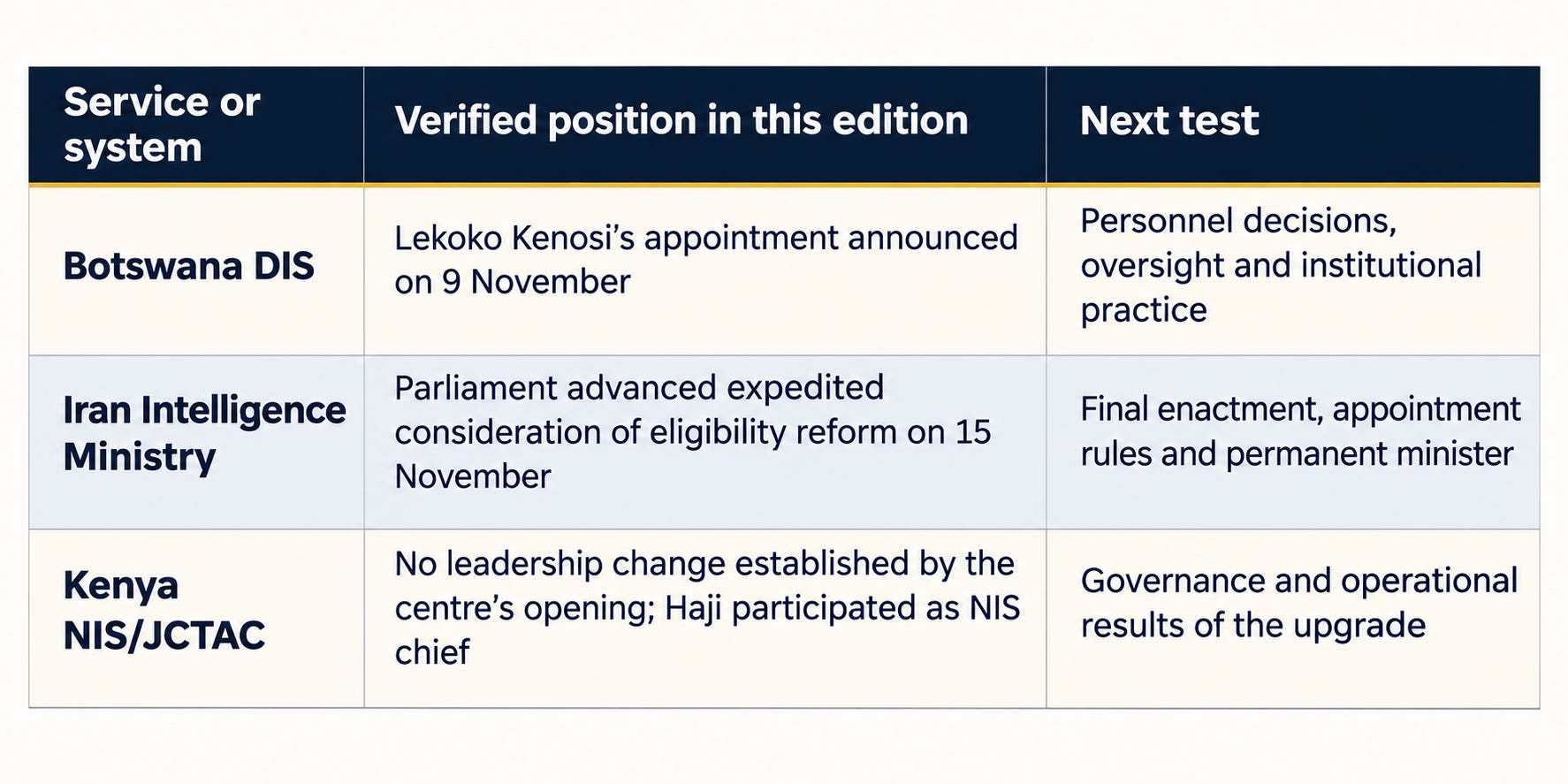
Botswana supplies the confirmed leadership change in this edition. Iran’s procedural vote remains a reform proposal. Kenya’s opening concerns analytical infrastructure and leaves NIS leadership unchanged in the reporting reviewed.
🔭 What to watch
19 November: the reported mention of Lissu’s separate online-publication case, including any effect on custody or legal representation.
23 November: the reported decision on continuation of Abdi’s habeas corpus case following his return.
Tanzania: completion of Lissu’s appeal record; any bail application or order; an individually verified account of the ten CHADEMA detainees.
Mwaipaya: witness protection, further admissible evidence and any verified disclosure of his whereabouts.
Uganda: action affecting Alupo’s office or authority, and an official response to Muhoozi’s threats.
Botswana and Iran: implementation of leadership decisions and completion of legislative steps.
17 November — NVIDIA: the earnings briefing under interim leadership; permanent succession, investigation findings and responses to congressional records demands.
Cyber and infrastructure: Binance asset recovery and laundering; Microsoft’s fuller repair findings expected on 20 November; the proposed 14 December EU sanctions decision over the French attacks; independent validation of the Silent Lynx findings.