
Ujasusi East Africa Monitoring Team | 01 July 2026 | 0230 BST
SUBJECT: What does Dodoma’s blanket ban on political rallies, imposed eleven days before the planned 7 July demonstrations, reveal about the government’s own assessment of its security position?
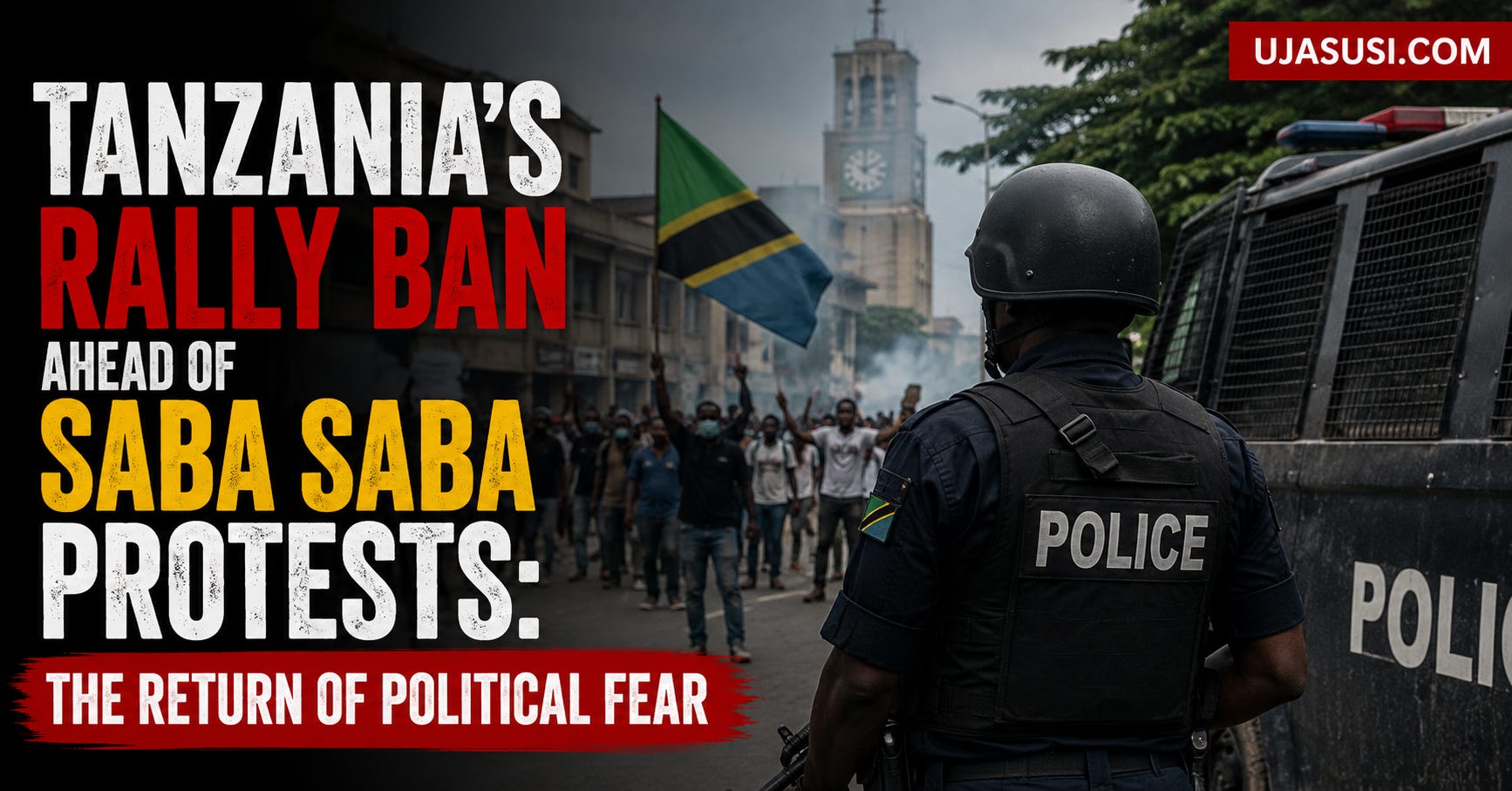
Tanzania’s government banned all political rallies nationwide on 26 June 2026, eleven days before Gen Z-organised protests planned for Saba Saba Day. Home Affairs Minister Patrobas Katambi cited security concerns tied to the Dar es Salaam International Trade Fair. The ban reverses tolerance shown to Chadema rallies through May and June.
In This Assessment
Key Judgements
Why the government moved from selective tolerance to a blanket ban
Whether the ban will actually stop 7 July from happening
Is the 27 June national grid failure connected to Saba Saba
Will the courts intervene before 7 July
What the trade fair framing reveals about the government’s real audience
Outlook: three scenarios for 7 July and beyond
Key assumptions, alternative assessment, and what remains unknown
Scope and approach
This assessment addresses the analytical question of what the 26 June 2026 rally ban communicates about the Tanzanian government’s internal risk calculus, rather than simply chronicling the ban itself. It draws on open-source reporting from wire services, regional outlets, and parliamentary statements, cross-referenced against Ujasusi’s own prior assessments of the July 7 mobilisation cycle. It does not attempt to forecast the precise scale of turnout on Saba Saba Day. That figure depends on variables, particularly weather, transport disruption, and last-minute arrests, that cannot be reliably modelled from the current evidentiary base.
Background
Tanzania’s October 2025 general election produced the country’s first sustained post-election protest movement, following a result in which the ruling Chama Cha Mapinduzi was credited with nearly total victory after Chadema’s boycott and the disqualification of the second-largest opposition party’s presidential candidate. The violence that followed is, by the government-appointed Chande Commission’s own figures, the most lethal in Tanzania’s multiparty history, though the commission’s count of roughly 518 fatalities sits far below the approximately 10,000 deaths assessed by independent and ICC-linked monitoring. That gap between official and assessed tolls has itself become a mobilising grievance for Saba Saba organisers.
Chadema’s chairperson, Tundu Lissu, has now spent more than fourteen months in detention on treason charges that carry the death penalty, without conviction. The party itself remains barred from electoral participation until 2030. President Samia Suluhu Hassan, who in 2023 ended the six-year rally ban imposed by her predecessor John Magufuli, had presided over a comparatively open permitting environment through May and June 2026, a period in which Chadema staged large, government-tolerated rallies, including Iringa on 13 June at which deputy chairperson John Heche directly rejected government claims that the party was inciting violence.
That tolerance ended on 26 June, when Home Affairs Minister Patrobas Katambi told Parliament that all rally permits would be withheld and directed Inspector General Camillus Wambura accordingly. The announcement was timed eleven days before the country’s planned 7 July demonstrations and overlaps with the government-organised Dar es Salaam International Trade Fair.
READ ALSO
Introducing “A Spy’s Guide to Deception” — The First in the Spy Guide Series

Intelligence work is built on deception. Every service that has ever run an agent, mounted a cover operation, or manufactured a false narrative has done so through principles that remain largely invisible to the public. Not because they are secret, but because no one has taken the time to explain them plainly.
This is not the first date-specific mobilisation call since the October violence, and the record of the previous attempt matters directly to what follows. A call for nationwide protests on 9 December 2025 (Tanzania’s Independence Day) was met with a blanket protest ban, mass preventative arrests beginning in mid-November, heavy security deployment, and public warnings characterising any demonstration as an illegal act. Bloomberg’s reporting from that day described Dar es Salaam’s streets as deserted, with residents heeding government orders to stay indoors. A further mobilisation call for 1 January 2026 is understood to have followed a comparable pattern, though this assessment has not independently verified that date to the same sourcing standard as 9 December. In both instances the state’s toolkit, preventative detention, security saturation, and public deterrence messaging, was substantially the same one deployed again on 26 June 2026.
Feature 2016 Magufuli Ban 2026 Rally Ban Stated basis Post-election consolidation “Security concerns” tied to Saba Saba mobilisation Duration before lift Approximately six years Undefined; described as temporary Scope All political party activity Rally permits specifically Judicial challenge Not independently verified by this assessment Announced, outcome pending Trigger event General consolidation of power Specific protest date (7 July)