

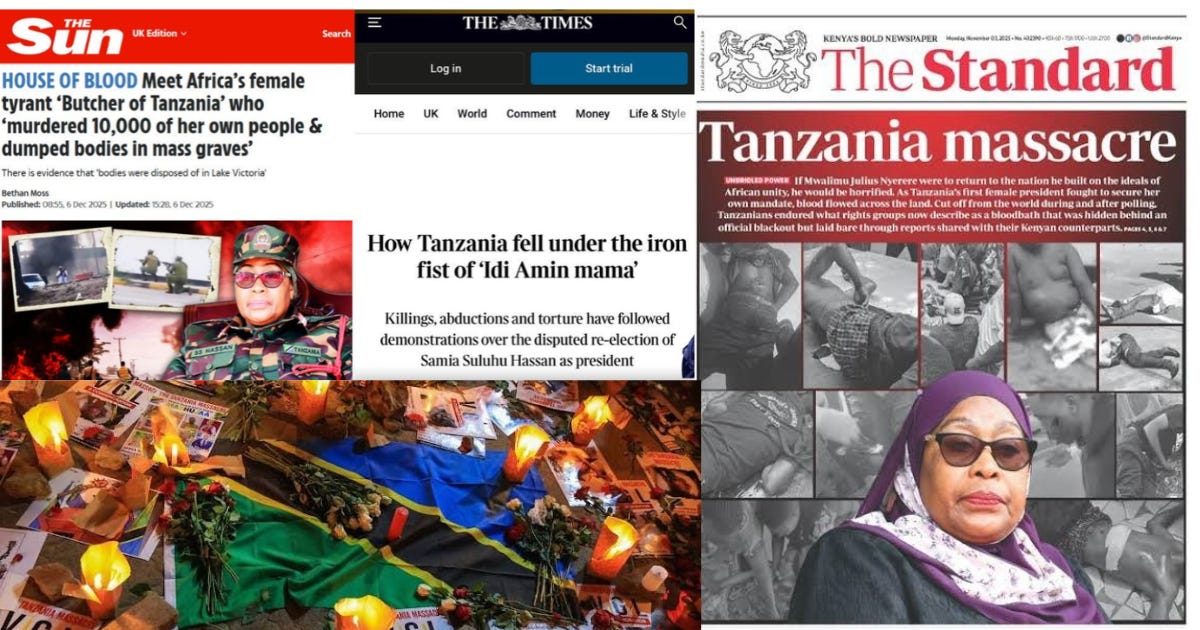
Ujasusi East Africa Monitoring Team | 29 October 2026 | 0015 GMT
One year after Tanzania’s October 29 massacres, President Samia Suluhu Hassan and CCM remain in power while victims’ families await justice. Intelwatch has estimated approximately 10,000 deaths; the government-appointed Chande Commission recorded 518. Its full report remains unpublished. The first of three approaching tests comes within days, as Commonwealth leaders gather in Antigua and Barbuda.
Executive Summary
The killings followed an election in which the main opposition party had been excluded and its leader faced a treason charge. Security forces used lethal force against protesters and bystanders during days of unrest and an internet shutdown.
The Chande Commission presented its findings in April 2026, but the government has not released its full report. A second commission began work in August. Meanwhile, opposition figures remain under pressure, and relatives of the dead and missing continue to seek answers.
Protest calls during the past year did not produce sustained nationwide mobilisation. International lobbying has kept Tanzania on the diplomatic agenda, while Samia’s government has continued to engage with foreign partners and host major international meetings.
READ ALSO
New Book: NYERERE TO SAMIA — The Road to Tanzania’s Post–October 2025 Election Massacres

The killings that followed Tanzania’s 29 October 2025 election demand an explanation that reaches beyond the events themselves. Nyerere to Samia: The Road to Tanzania’s Post–October 2025 Election Massacres traces the institutions, political networks and security practices built across six presidencies—and asks how they made such violence possible.
The killings and the two figures
The election of 29 October 2025 took place after months of political repression. CHADEMA, the main opposition party, had been excluded from the election after refusing to sign the electoral code of conduct, citing concerns about the integrity of the process. Its leader, Tundu Lissu, had been charged with treason.
Protests began on election day and continued in the days that followed. Security personnel used live ammunition and unlawful force against protesters and other people who posed no imminent threat of death or serious injury. A nationwide internet shutdown made it harder for families to communicate and for journalists and human rights monitors to document events.
Intelwatch’s executive director estimated approximately 10,000 deaths. The estimate has not been independently verified.
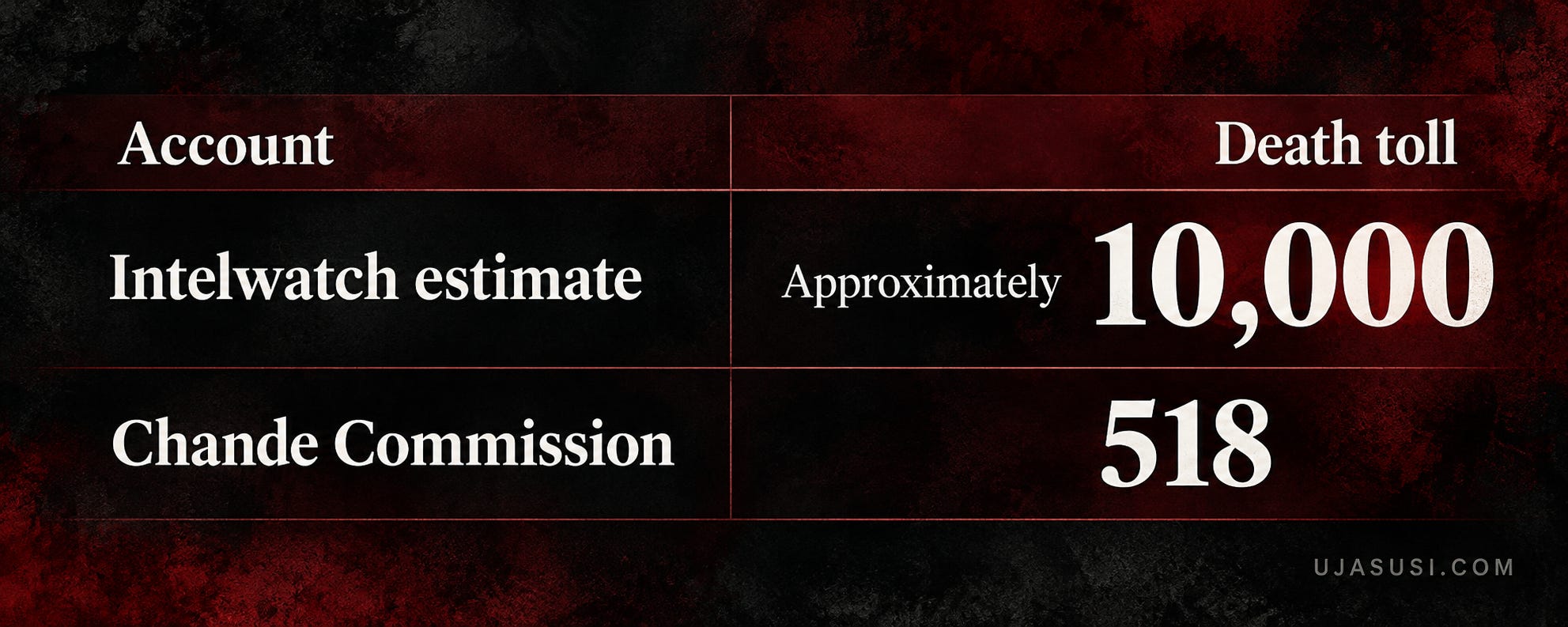
The Chande Commission’s figure was presented to President Samia in April 2026. The commission acknowledged that its count might not be conclusive. The full report remains unpublished, preventing public examination of its evidence, methods and treatment of missing-person cases.
The commission also presented police records of missing persons: of 758 cases recorded between 2023 and 2025, 245 people had not been found. Those figures cover a wider period and cannot be treated as a count of people missing specifically because of the October massacres.
Protest calls and the state response
Activists called for demonstrations on 9 and 25 December 2025, and 1 January, 7 July and 8 August 2026. None developed into sustained nationwide mobilisation capable of fundamentally challenging Samia’s government.
Ahead of 9 December, police arrested alleged organisers, banned demonstrations and monitored online calls. Police and soldiers deployed in force. Ahead of 7 July, the authorities again deployed security personnel after suspending political rallies and mass gatherings.
On 9 July, police announced that 130 people had been arrested over alleged incitement of criminal acts. On 26 July, police said 36 of those arrested had been arraigned on charges linked to terrorism and the promotion of unrest. Police said defence and security agencies had monitored the suspects’ activity, including on social media. The charges were allegations to be determined by the courts.
Lobbying and the government’s response
Tanzanian activists, lawyers, rights organisations and diaspora campaigners have pressed foreign governments and international institutions to address the killings. Their efforts have included protests, lobbying, documentation of abuses and submissions seeking international legal scrutiny.
The European Parliament called for an inquiry and consideration of sanctions. In the United States, the Reassessing the United States–Tanzania Bilateral Relationship Act advanced through the Senate Foreign Relations Committee and was placed on the Senate legislative calendar on 27 July 2026. It has not become law.
The Commonwealth Ministerial Action Group, or CMAG, set time-bound expectations for Tanzania covering political dialogue, civic freedoms and the treatment of detainees. At its September meeting, CMAG continued to monitor the situation. Its next ordinary meeting is scheduled in Antigua and Barbuda alongside the Commonwealth Heads of Government Meeting in St John’s, 1–4 November.
Tanzania has also continued to engage internationally. In October, Arusha hosted the 153rd Inter-Parliamentary Union Assembly, bringing together parliamentarians from more than 130 countries. The gathering marked the end of Tanzanian parliamentarian Tulia Ackson’s term as IPU president.
In August, Samia established a second commission chaired by retired Court of Appeal Judge Shaban Ally Lila. Its mandate includes investigating those who planned or coordinated the violence, alleged excessive force and the whereabouts of missing people. The commission was initially given five months to complete its work.
Key Judgements
Samia and CCM are likely to retain the political initiative in the near term. The government controls the security apparatus, while its opponents remain fragmented and exposed to repression.
Repeated protest calls could widen the gap between online activists and ordinary workers. The risk is greatest when threatened unrest costs traders and casual workers income without producing a visible political result.
CCM is likely to remain aligned with Samia. The suppression of political competition benefits the ruling party and helps preserve its dominance.
The first international test is days away. The Commonwealth meeting begins on 1 November; the US bill and the Lila Commission extend the pressure window into early 2027.
Selective investigation is a major accountability risk. A process focused on alleged organisers and funders, while leaving security-force conduct and command responsibility unresolved, would reinforce impunity.
Why the streets remained quiet
Fear is a central reason the post-massacre protest calls failed to produce sustained mobilisation. The October killings showed what participation could cost; arrests and security deployments made that warning visible again before later demonstrations.
The movement’s fragmentation also matters. Opposition parties, domestic activists, diaspora campaigners and online personalities face different risks and do not always share trusted leadership or a common strategy. A protest call can circulate widely without creating the local organisation needed to sustain action.
A previous Ujasusi assessment of declining mobilisation identified repression, organisational fragmentation, the loss of online mobilisation channels and intelligence infiltration as factors. The extent of infiltration remains difficult to establish, but suspicion itself can damage the trust required for collective action.
Low turnout should not be interpreted as approval of Samia or indifference to the dead. It shows how difficult and dangerous public resistance has become.
Online activism and daily bread
For many street vendors, motorcycle taxi riders, market traders, casual labourers and other hustlers, the immediate priority is earning enough to feed their families. A day without work can mean a day without income.
When a protest is threatened, businesses may close or customers may stay away in anticipation of unrest. Those losses can occur even if the demonstration never materialises. The impact varies by place and date, but the political risk is clear: repeated calls that carry economic costs without visible results could cause working people to distance themselves from online campaigners.
That would benefit the government. It would allow the authorities to portray activists as detached from the citizens whose support they seek.
The movement needs to connect justice for the massacres with livelihoods, the cost of living and the ability to work without fear. A Tanzanian who cannot afford to lose a day’s earnings is not necessarily a government supporter.
The intelligence and security dimension
The state response combined lethal force, monitoring of protest calls, arrests, digital restrictions and security deployments. Killings have been attributed to police and people in plain clothes. Authorities also detained alleged organisers ahead of later protests.
The July arrests show how surveillance and counterterrorism powers entered the response. Police said defence and security agencies had monitored the suspects’ activities before announcing the arrests; some were subsequently charged with terrorism-related offences.
Assessment: moderate confidence. The pattern is consistent with intelligence-led monitoring and disruption of political mobilisation. Pre-emptive arrests and surveillance of online calls indicate collection and targeting before protesters reach the streets. The available evidence does not establish which institution directed each operation or whether the plainclothes personnel involved in killings belonged to TISS.
The question is how intelligence was collected and used: whether agencies identified genuine threats of violence, treated peaceful political activity as a security threat, or did both. Deployment orders, operational communications and command records are necessary to establish responsibility.
CCM and religious backing
CCM is not reluctantly standing beside Samia. The ruling party benefits when opponents are excluded, critics are intimidated and political competition is restricted.
Its leadership endorsed the Chande Commission’s findings, providing political cover for the government’s response. The likely outlook is continued alignment: the system that protects Samia also protects CCM’s dominance.
Influential religious institutions have strengthened the president’s position. After the violence, Muslim institutions including BAKWATA supported Samia’s inquiry and reconciliation initiative. Pentecostal figures, including Mwamposa, have also been part of the religious support around her. Their public reach gives the government access to audiences and moral authority that political institutions alone cannot provide.
Calls for peace matter. But reconciliation cannot require families to abandon questions about who killed their relatives or what happened to the missing.
Three tests in the coming months
Commonwealth: within days. CMAG’s next meeting is scheduled alongside the St John’s gathering beginning on 1 November. It is likely to keep Tanzania under scrutiny and continue diplomatic engagement. Suspension is unlikely in the near term, given the group’s response so far. The test is whether outstanding demands produce consequences beyond another appeal for progress.
US Senate bill: before 3 January 2027. The bill remains a source of pressure, but its place on the calendar does not guarantee a vote. With limited legislative time remaining, it is likely to lapse at the end of the current Congress unless it advances or its provisions are included in another measure.
Lila Commission: early 2027. The inquiry could establish a fuller record, but it is likely that the government will continue to emphasise alleged organisers and funders. Whether the commission gives comparable scrutiny to security-force conduct remains uncertain. Its treatment of commanders, operational records, witnesses and missing persons will be the clearest indicators of whether it is pursuing accountability.
Victims’ families and their lawyers should have a safe opportunity to submit documented incidents and missing-person cases to the commission. Those submissions and the commission’s responses can also inform scrutiny by Tanzanian civil society, Commonwealth representatives and foreign legislators.
Outlook
The most likely near-term outcome is continued political control without meaningful accountability. Samia retains the support of CCM’s leadership and the security apparatus. The opposition remains divided, and international pressure has not yet compelled the government to publish the Chande report or deliver justice.
A more consequential challenge would require trusted coordination among opposition parties, domestic activists, diaspora campaigners and victims’ families, combined with a strategy that recognises the economic realities of ordinary Tanzanians. International partners would need to match deadlines and statements with measurable consequences.
The greatest danger is that the massacres become normalised: remembered by families and activists, acknowledged in diplomatic statements, but never subjected to an investigation capable of establishing responsibility.
The dead cannot be normalised away
The Chande report should be published. The Lila Commission should investigate security-force conduct and command responsibility, protect witnesses and release its findings. Families should be able to report deaths and disappearances without fear. Evidence of crimes should reach independent prosecutors.
The dispute between Intelwatch’s estimate and the commission’s figure must not obscure the people behind it: Tanzanians who were killed, families who buried loved ones, and relatives who still do not know what happened.
A year has passed. Samia’s government has survived. The dead have not received justice.