
Ujasusi East Africa Monitoring Team | 10 June 2026 | 0440 BST
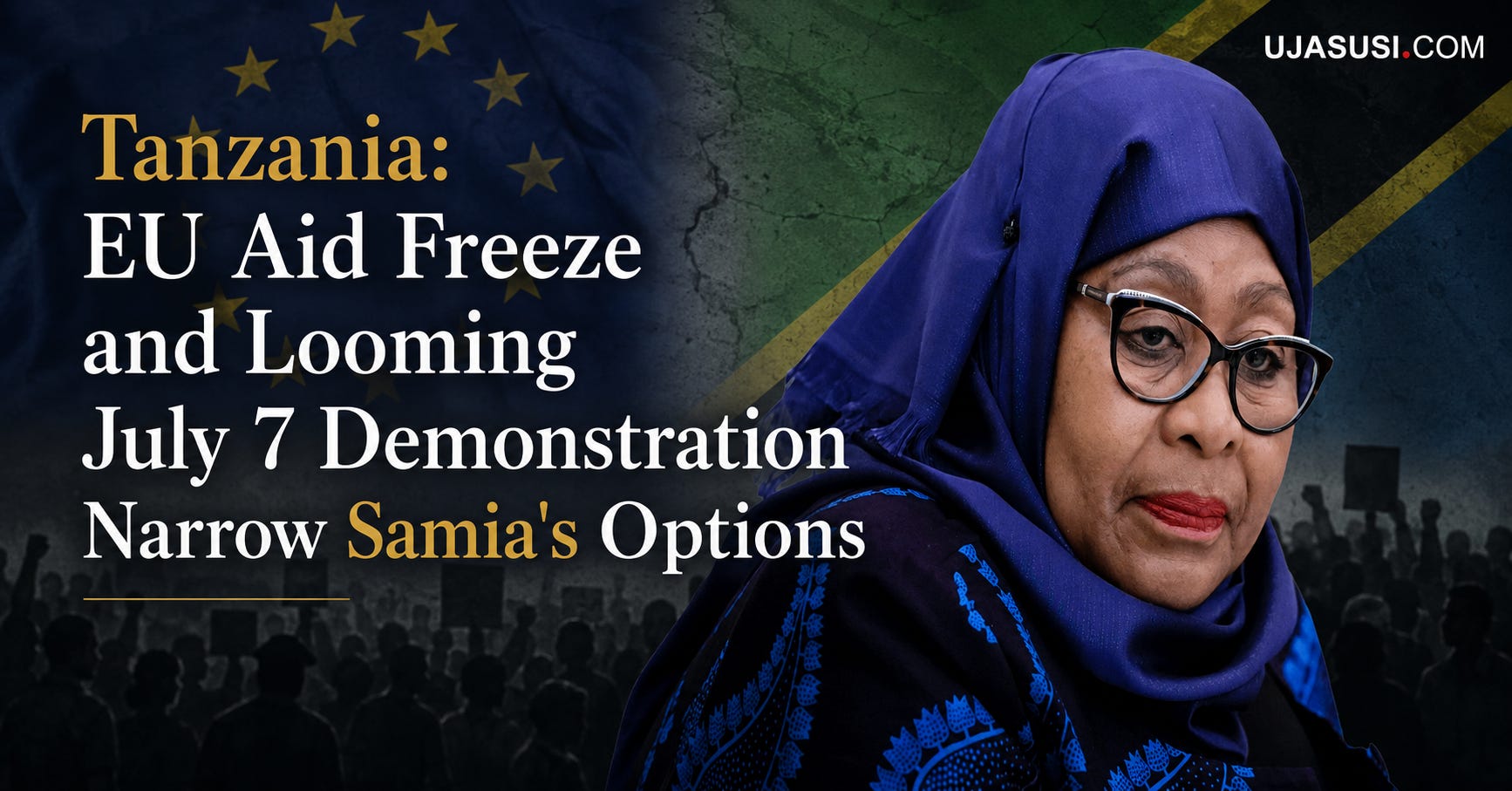
The European Parliament’s committee vote against the €156 million (TZS 477 billion) Tanzania financing plan confirms that Brussels will not normalise relations without accountability for the post-election killings. With Gulf partners distracted by the Middle East war, Russia constrained by Ukraine, and China offering diplomatic cover but not budget support, President Samia Suluhu Hassan enters July’s planned nationwide demonstrations with fewer resources and more scrutiny than at any point since October 2025.
What did the European Parliament committees actually decide?
The Committee on Foreign Affairs and the Committee on Development voted 81–1, with four abstentions, against the European Commission’s revised implementing decision for Tanzania’s 2026 allocation. The Commission had suspended the original plan in November 2025 after parliamentary objections, then returned with a proposal that retained the same amount and broadly the same actions, shifting only the delivery mechanism from direct budget support to indirect management. The committees rejected this as cosmetic, with foreign affairs chair David McAllister noting that the revised plan contains no meaningful conditionality and no consequences for further deterioration.
The vote carries no binding force. The Commission, not Parliament, controls disbursement. But the practical effect is real: the funds remain frozen while the Commission decides whether to withdraw the draft entirely, as the committees demand, and the plenary vote expected this month will harden the political cost of releasing the money without conditions. The committees’ grievances are specific: the Chande Commission’s admission that at least 518 people died, against the approximately 10,000 deaths documented in the ICC/Intelwatch dossier — without identifying a single perpetrator; the cancelled human rights mission in May; and Tundu Lissu’s continued imprisonment.
Why can’t Samia’s alternative partners fill the gap?
The hedging strategy visible in Dodoma’s diplomacy assumes that pressure from traditional partners can be offset elsewhere. That assumption is failing on three fronts.
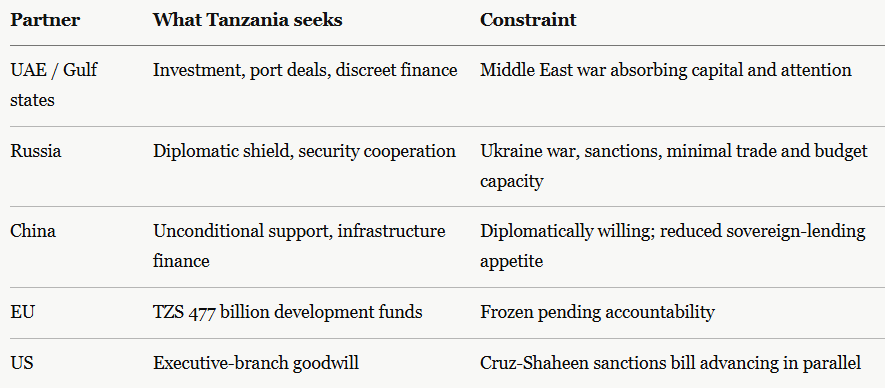
The Gulf option mattered because Emirati capital has functioned in practice as the politically unconditional alternative to Western finance. The regional war is assessed to have redirected that capital towards security and reconstruction commitments closer to home, leaving little appetite for new East African exposure on the timeline Dodoma requires. Samia’s Moscow visit, only the second by a Tanzanian president since Nyerere in 1969, produced symbolism and a likely deepening of the TISS-GRU interface, but Russia’s investment, trade, and budgetary weight in Tanzania remains marginal, and a sanctioned wartime economy cannot replace European development finance.
READ ALSO
Introducing “A Spy’s Guide to Deception” — The First in the Spy Guide Series

Intelligence work is built on deception. Every service that has ever run an agent, mounted a cover operation, or manufactured a false narrative has done so through principles that remain largely invisible to the public. Not because they are secret, but because no one has taken the time to explain them plainly.
That leaves Beijing. China has already provided an unconditional diplomatic shield through the crisis and is the only partner with both the balance sheet and the political will to substitute for Western flows. But Chinese support arrives as project lending and trade facilitation, not as the budget support that keeps ministries liquid. Beijing’s caution on African sovereign exposure since the debt-restructuring cases of the early 2020s means any rescue package will be slower, smaller, and more collateralised than Dodoma needs before the fiscal year tightens.