

Ujasusi East Africa Monitoring Team | 08 July 2026 | 0500 BST
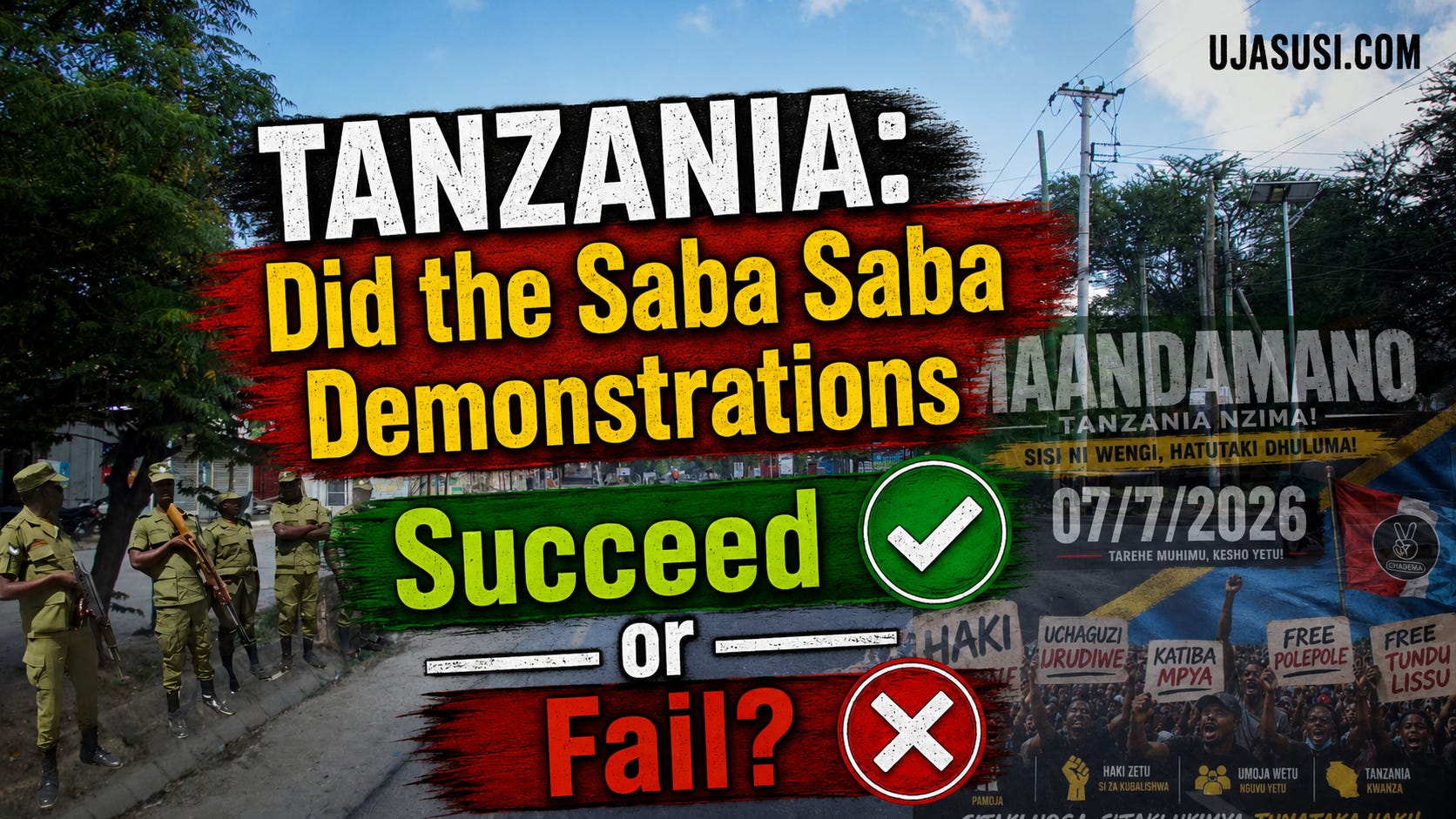
Tanzania’s government and its opponents are advancing irreconcilable accounts of the same day. This assessment tests both against the only criteria that can be measured, stated objectives and observed turnout, and against a third, less examined outcome that neither side planned for.
📋 SCOPE AND APPROACH
This assessment addresses a single analytical question: which of the two competing public narratives about 7 July, the government’s claim of a peaceful, uneventful day and activists’ claim of a demonstrated political victory despite low visible turnout, better withstands scrutiny against verifiable evidence. It draws on Tanzanian and regional open-source reporting from the days immediately before and after 7 July, cross-referenced against Ujasusi’s own prior assessments of the mobilisation cycle. It does not attempt a comprehensive casualty or arrest count for the day, which remains incomplete in open sources at the time of writing, and it does not extend to Zanzibar, where mainland-focused sourcing provides no visibility.
🧭 BACKGROUND
Saba Saba Day commemorates the 1954 founding of the Tanganyika African National Union, predecessor of the ruling Chama Cha Mapinduzi. For activists calling for nationwide action, the date was chosen precisely because it forces the ruling party to defend a rally banned on the anniversary of its own founding movement. The call built on grievances accumulated since the disputed October 2025 election, in which President Samia Suluhu Hassan was declared winner with a near-total vote share that independent observers judged fell short of democratic standards.
The violence that followed remains, by the government’s own commission of inquiry, the most lethal in the country’s multiparty history. The Chande Commission’s count of 518 fatalities, however, sits far below the approximately 10,000 deaths assessed by independent and ICC-linked monitoring, a gap that has itself become a mobilising grievance.
READ ALSO
Introducing “A Spy’s Guide to Deception” — The First in the Spy Guide Series

Intelligence work is built on deception. Every service that has ever run an agent, mounted a cover operation, or manufactured a false narrative has done so through principles that remain largely invisible to the public. Not because they are secret, but because no one has taken the time to explain them plainly.
The government pre-empted 7 July with a nationwide ban on political rallies, announced in Parliament eleven days before the planned demonstrations. Prior Ujasusi reporting has characterised government messaging in the run-up to 7 July as framing the protests as a foreign-instigated threat rather than a domestic grievance requiring accommodation; this framing is not independently corroborated in this assessment against a primary Nchemba statement and should be treated as a secondary attribution pending re-verification.
This was not the state’s first response to a date-specific mobilisation call since October: a comparable call for 9 December 2025, Tanzania’s Independence Day, was reported, via Bloomberg as cited in that prior Ujasusi assessment, to have been met with the same toolkit of preventative arrests, security saturation and public deterrence messaging, producing comparably deserted streets. 7 July appears, on available evidence, to replicate that pattern rather than depart from it.