
Ujasusi Blog’s East Africa Monitoring Team | 16 April 2026 | 0245 BST
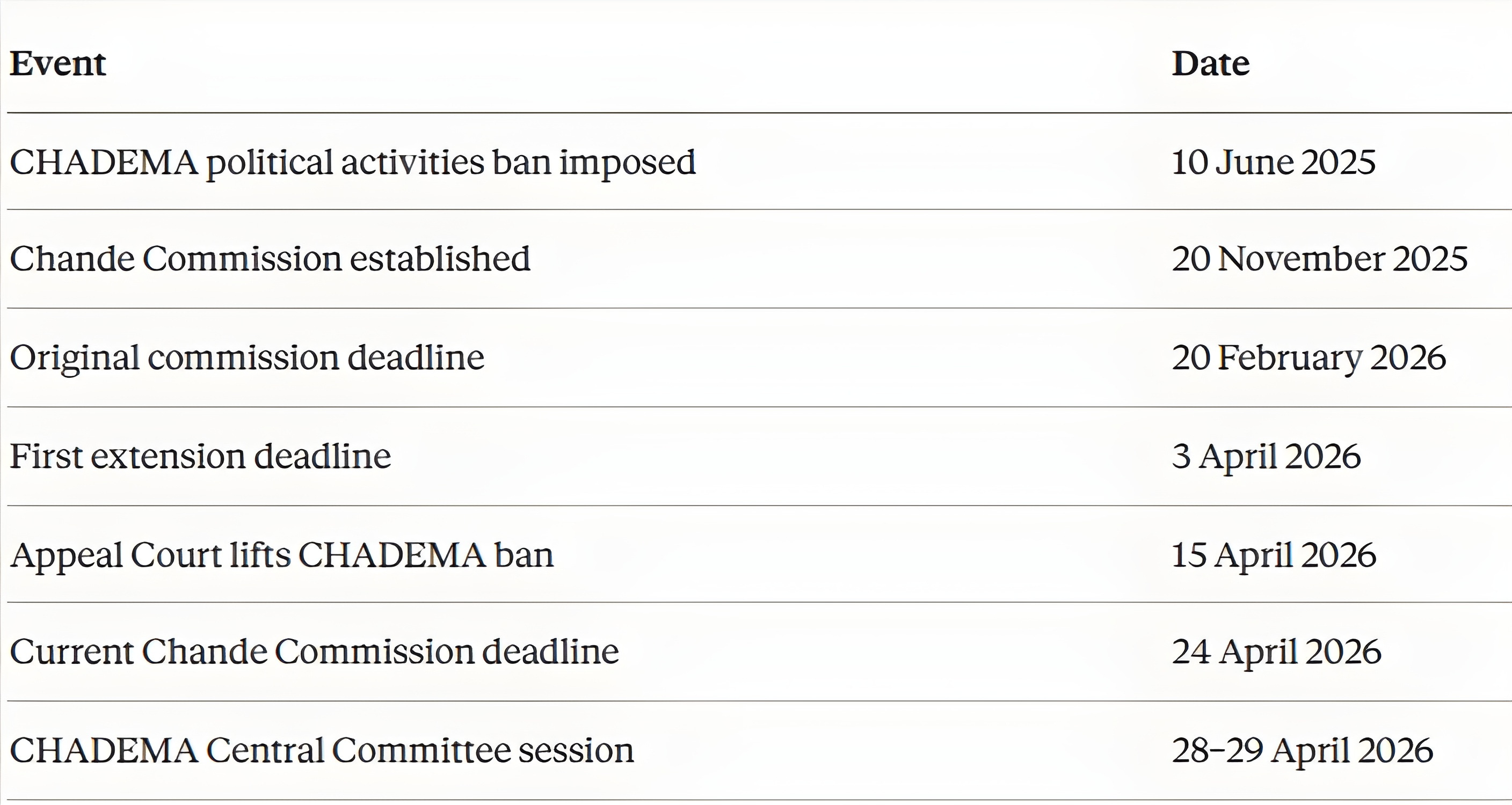
On 15 April 2026, Tanzania’s Court of Appeal set aside a High Court injunction that had suspended CHADEMA’s political activities since 10 June 2025 — a ban of 310 days. The ruling restores the party’s right to operate across mainland Tanzania. It arrives nine days before the Chande Commission is legally required to submit its findings on the October 2025 election violence, and 13 days before CHADEMA’s Central Committee convenes to chart its next course of action.
Here is a paywall-optimised table of contents. The architecture is deliberate: the free tier delivers enough analytical credibility to hook a first-time reader, while the paid tier titles are specific enough to signal genuine intelligence value without giving the analysis away.
Table of Contents
The Court of Appeal Ruling and What It Actually Decided
How the June 2025 Injunction Was Imposed
What the Chande Commission Is and When Its Report Is Due
The Terms of Reference and Their Structural Implications for CHADEMA
Why the Timing of the Ruling Is Itself an Intelligence Signal
CHADEMA’s Structural Position After the Ruling
The Court of Appeal Ruling and What It Actually Decided
A three-judge panel comprising Augustine Mwarija, Issa Maige, and Abraham Mwampashi delivered the ruling on 15 April 2026, arising from review proceedings initiated by the Court of Appeal in relation to a dispute over the alleged unequal distribution of party resources between mainland Tanzania and Zanzibar. The procedural basis for the decision is critical to understand: the Court did not adjudicate the merits of the underlying asset-distribution dispute. It found, as CHADEMA’s advocate Dickson Matata confirmed, that the High Court erred in proceeding with the injunction application after the respondents’ counsel had withdrawn from the proceedings, thereby denying the respondents a fair hearing. The injunction was consequently voided on procedural grounds and the substantive case has been remitted to the High Court to determine whether the original petition was filed within the statutory limitation period.
The original lawsuit was filed by Said Issa Mohamed, the party’s former Vice Chairperson for Zanzibar, alongside two trustees. CHADEMA’s legal team, led by Chief Counsel Dr Rugemeleza Nshala, argued throughout that the case was time-barred, with plaintiffs admitting grievances dating to 2016 yet filing their petition only in April 2025. That argument remains unresolved. The High Court — now assigned a different judge following Mwanga’s removal from the matter — must still rule on this foundational question.
What CHADEMA gained on 15 April 2026 is operational freedom, not legal finality. The substantive case persists. The mechanism that produced a 310-day ban remains intact.
How the June 2025 Injunction Was Imposed
The injunction was issued ex parte — without the party’s legal representation present. According to a letter sent by CHADEMA to the Chief Justice on 23 February 2026, the party’s former counsel, Jebra Kambole, had withdrawn from the case to attend a funeral. Despite this, Judge Hamidu Mwanga proceeded with the hearing and granted the injunction. In his remarks on 15 April 2026, CHADEMA’s Secretary General John Mnyika noted that the Zanzibar trustees behind the case filed their petition on the same day CHADEMA’s then-chairman Freeman Mbowe was arrested — a coincidence Mnyika explicitly rejected as improbable. Police used the expired order to block party activities as recently as February 2026. Dr Nshala confirmed at a press conference in Dar es Salaam on 15 April that the enforcement order underpinning the ban is no longer legally operative, and issued a direct warning to security forces against interfering with party activities.
The chronology of the ban’s origins — filed the same day CHADEMA’s chairman was arrested, granted without the respondents present, enforced beyond its legal expiry — is not consistent with routine civil litigation.
What the Chande Commission Is and When Its Report Is Due
President Samia Suluhu Hassan established the Chande Commission under the Commissions of Inquiry Act, Cap 32 on 14 November 2025, six days after her inauguration speech in which she acknowledged loss of life during the post-election period without providing casualty figures. Ujasusi’s prior assessment of the commission’s composition, mandate, and structural conflicts of interest remains the most detailed open-source analysis of the body available. The commission is chaired by retired Chief Justice Mohamed Chande Othman, a former ICTR Chief of Prosecutions and ICC special adviser. Its nine-member panel includes retired Chief Justice Prof Ibrahim Juma, former Chief Secretary Ambassador Ombeni Sefue, Ambassador Radhia Msuya, and retired Lieutenant General Paul Ignace Mella. Lawyers challenging the commission before the High Court argued that commissioners including Dr Stergomena Tax — who served as Minister of Defence during the period of violence — and Said Mwema, the former Inspector General of Police, carried institutional conflicts of interest that no declaration of independence could resolve.
The commission received a further 21-day extension, pushing its submission deadline to 24 April 2026. This is the body’s second extension: the commission, originally required to conclude within 90 days of its 20 November 2025 establishment, had its first deadline moved from 20 February to 3 April 2026, with the second extension announced via government gazette on 4 April 2026.
The April 24 deadline sits four days before CHADEMA’s Central Committee convenes on 28 April 2026. The gap between the report’s submission and the party’s first major internal decision-making session since the ban was imposed is analytically precise: narrow enough to ensure the commission’s findings land before CHADEMA can collectively formulate a response strategy.