
🕵🏾♂️ A Spy’s Guide to Counter-Intelligence at Home and Work
How to Stop Colleagues, Partners, or Neighbours from Spying on You (Without Becoming Paranoid)

Ujasusi Originals
Counter-intelligence is about reducing what others can learn about you and detecting when they try. In daily life, that means controlling information, spotting unusual behaviour, and closing simple security gaps.
🧠 1. Counter-Intelligence (CI): What It Actually Means
What does it mean in intelligence
Counter-intelligence is the practice of protecting secrets and detecting spying attempts—from hostile states, insiders, or opportunists.
How it works
Identify what needs protection
Limit access to it
Detect suspicious interest or collection
Respond by reducing exposure or cutting access
Civilian application
You don’t need “secrets”—you have:
Personal data
Work information
Financial details
Private conversations
👉 CI for you = control who knows what about you
🔐 2. Information Control (The “Need-to-Know” Rule)
What does it mean in intelligence
Sensitive information is shared only with those who absolutely need it to perform a task.
How it works
Compartmentalisation
Minimal disclosure
Different people know different pieces
Civilian application
Don’t overshare plans, income, passwords, or conflicts
Separate circles (work ≠ personal ≠ neighbours)
Be careful with casual conversations
Example:
A colleague doesn’t need to know your job search.
A neighbour doesn’t need to know your schedule.
👉 The less you reveal, the less others can exploit.
👀 3. Surveillance Awareness (Spotting When You’re Being Watched or Probed)
What does it mean in intelligence
Officers are trained to detect surveillance or probing behaviour—people trying to gather information.
How it works
Look for repeated interest
Notice unusual questions
Track behaviour over time
Civilian application
Watch for:
People asking too many personal or strategic questions
Someone repeatedly showing interest in your routines
“Casual” conversations that feel like information fishing
Example:
“Just curious—what time do you usually leave?”
→ That’s not always innocent.
👉 One question is normal. Repeated probing is a signal.
🧩 4. Pattern Recognition (When Curiosity Becomes Collection)
What does it mean in intelligence
Analysts identify patterns to confirm whether behaviour is random or deliberate.
How it works
Track repeated actions
Look for consistency
Confirm intent through pattern
Civilian application
Same person always asking about your plans?
Same colleague digging into your work?
Same neighbour watching your movements?
👉 Patterns reveal intent.
🧠 5. Elicitation: The Friendly Way People Extract Information
What does it mean in intelligence
Elicitation is a technique where someone gets information from you without you realising it, through casual conversation.
How it works
Flattery (“You seem like someone who knows…”)
False sharing (“I heard you’re moving—true?”)
Leading questions
Civilian application
Recognise:
“I’m just asking…”
“Off the record…”
“Between us…”
Response technique:
Stay vague
Change topic
Give non-committal answers
👉 Not every question deserves a full answer.
⚖️ 6. Access Control (Who Can Reach Your Information?)
What does it mean in intelligence
Limiting physical and digital access to sensitive material.
How it works
Locks, passwords, clearance levels
Controlled environments
Restricted entry
Civilian application
Lock devices (phone, laptop)
Don’t leave documents open at work
Be careful who uses your devices
Secure Wi-Fi at home
👉 Most “spying” is just easy access you didn’t control.
🔄 7. Behavioural Discipline (Don’t Make Yourself an Easy Target)
What does it mean in intelligence
Operatives are trained to avoid behaviours that expose vulnerabilities.
How it works
Consistent routines (or controlled variation)
Avoid careless talk
Maintain awareness
Civilian application
Don’t discuss sensitive matters loudly in public
Avoid posting everything on social media
Be mindful of who is around you
👉 Convenience often creates exposure.
🎭 8. Cover & Personal Boundaries
What does it mean in intelligence
“Cover” is how much of your real life is visible to others.
How it works
Limit what others know
Maintain a controlled personal narrative
Civilian application
You don’t need to explain everything about your life
Set boundaries without over-justifying
Example:
“I prefer to keep that private” is enough.
👉 Privacy is not secrecy—it’s control.
🧭 9. Response: What To Do If Someone Is Probing Too Much
What does it mean in intelligence
When suspicious activity is detected, the response is not confrontation—it’s control and limitation.
How it works
Reduce information flow
Change behaviour
Increase awareness
Civilian application
Share less with that person
Avoid sensitive topics
Observe without reacting emotionally
👉 You don’t need drama—you need control.
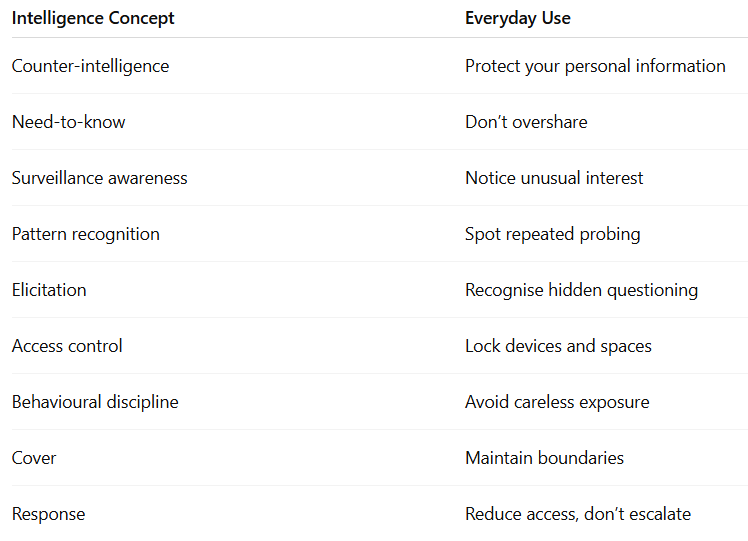
📊 Tradecraft Translation
🧠 Final Assessment
Most people don’t get “spied on” in a dramatic way.
They give away information without realising it.
The biggest security risk in daily life is not technology—
it’s oversharing and inattention.
🔎 Ujasusi Takeaway
You don’t need to live like a spy—just think like one:
Share less
Notice more
Control access
That alone will put you ahead of 99% of people in protecting your personal and professional life.
No advertisers. No institutional backers. Just readers. Support Ujasusi at HERE.