
Ujasusi East Africa Monitoring Team | 14 July 2026 | 0000 BST
SUBJECT: Does President Samia Suluhu Hassan’s address to Tanzania’s government lawyers in Arusha signal compliance with, or resistance to, the Commonwealth’s 30-day deadline on Tundu Lissu’s detention?
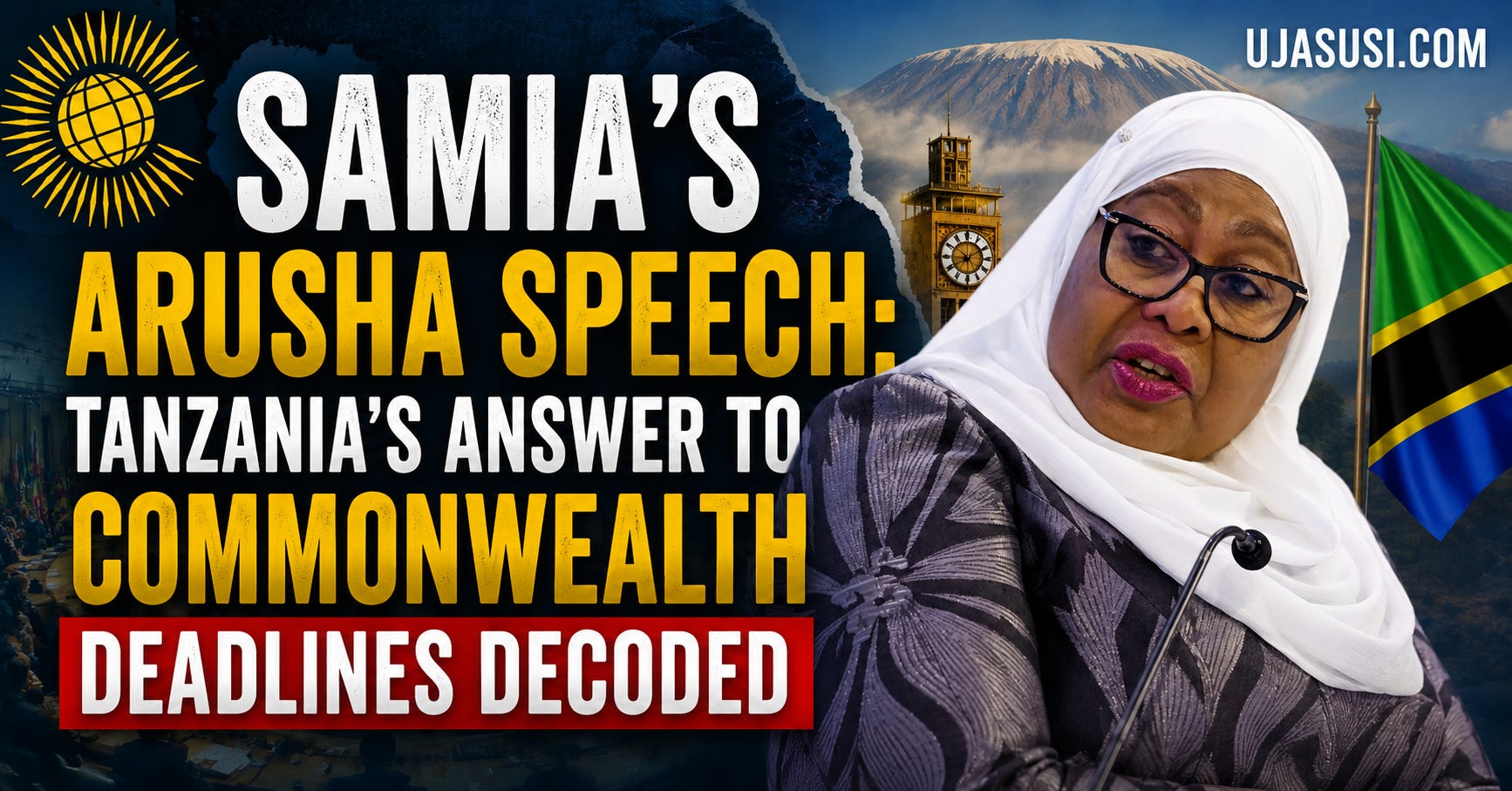
President Samia Suluhu Hassan has answered the Commonwealth without ever naming it. Her address opening the annual general meeting of the Tanzania Public Bar Association (TPBA) in Arusha on 13 July, three days after the Commonwealth Ministerial Action Group (CMAG) issued time-bound reform deadlines, tasked the state’s legal corps to contest international pressure rather than prepare for compliance, while carefully preserving a face-saving exit.
READ ALSO
Commonwealth Gives Tanzania 90 Days on Reform Deadlines

Ujasusi East Africa Monitoring Team | 11 July 2026 | 0315 BST
What the president said in Arusha
The setting matters as much as the words. President Hassan opened the 2026 annual general meeting of the government lawyers’ association in Arusha before an audience that included Chief Justice George Mcheche Masaju, Attorney General Hamza Johari, Director of Public Prosecutions Sylvester Mwakitalu and the Solicitor General. The entire prosecutorial and judicial chain that controls the fate of CHADEMA chairman Tundu Lissu, now past 460 days in pre-trial detention on capital treason charges, sat in the room.
The speech never mentions the Commonwealth, CMAG, or Lissu by name. It did not need to. Three days earlier, on 10 July, the Commonwealth Ministerial Action Group’s seventy-third extraordinary meeting had noted that conditions in Tanzania have deteriorated since Special Envoy Lazarus Chakwera’s April visit to Tanzania, and adopted the envoy’s time-bound recommendations: resolve Lissu’s detention through a political or legal pathway within 30 days; restore digital platform access and end intimidation of media within 60 days; and convene a neutral-facilitated inter-party forum within 90 days. CMAG will reconvene in September 2026 and has signalled that its November meeting will consider further action if progress is absent.
Against that backdrop, the President told her lawyers that shifting economic policies and “matamko na mwelekeo wa kisiasa duniani” (international pronouncements and political currents) are placing developing states in a difficult, contested position. She described a global wave persuading young people that African governments violate human rights, and answered it with a sovereigntist legal history: Tanzania entrenched a bill of rights in its constitution, ratified the African Charter, and hosts the African Court on Human and Peoples’ Rights in Arusha. She summarised foreign criticism with a proverb: give the dog a bad name in order to hang it. And she drew the line that matters most for the Lissu file: no one is above Tanzania’s laws, and whoever breaks the law “atashughulikiwa” (will be dealt with).
She then issued operational instructions. Government lawyers must become experts in international pronouncements and protocols, analyse them rapidly, translate them into the Tanzanian context and produce fast responses “ili kuhami uhuru wetu” (to defend national sovereignty). Every government institution was directed to build systems for identifying legal risks early, across contracts, land, procurement, projects and digital services. The lawyers were warned not to allow their profession to be used to legitimise anything “lenye nia ovu dhidi ya taifa letu” (with ill intent against the nation), and reminded that money circulates globally so that powerful actors can achieve their aims.