

Ujasusi East Africa Monitoring Team | 08 June 2026 | 0130 BST
EXECUTIVE SUMMARY
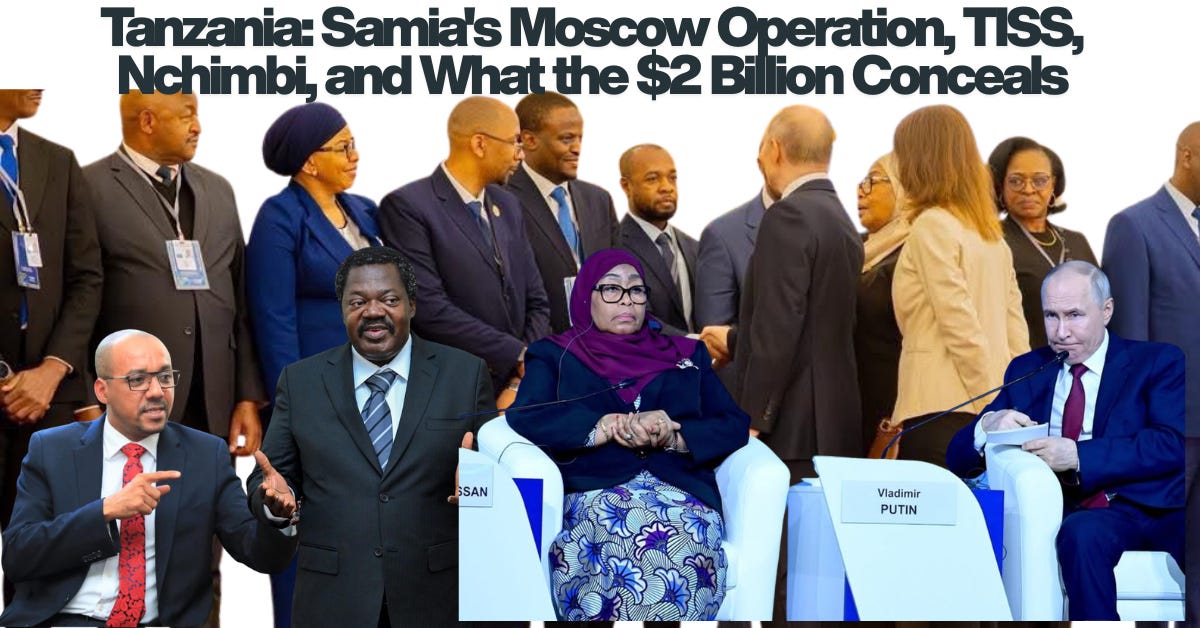
President Samia Suluhu Hassan’s three-day state visit to Moscow and St. Petersburg (3–5 June 2026) was a multi-track authoritarian consolidation operation conducted simultaneously on four lines: international legitimacy laundering through the Kremlin; probable intelligence cooperation between TISS and Russian intelligence, with the GRU assessed as a primary counterpart alongside possible FSB interface on political security operations; a sanctioned domestic political strike against Vice President Emmanuel Nchimbi, engineered through the Zanzibar parliamentary bloc; and a narrative management campaign designed to repackage these operations as economic statecraft.
The visit produced a limited set of tangible outputs: one signed investment framework agreement between TISEZA and the Roscongress Foundation; an unverified projection of $2 billion in Russian investment interest over three to five years; a direct Air Tanzania route to Moscow announced for 2 July 2026; and sector-level pledges formalised at the May 2026 Joint Intergovernmental Commission in Arusha. Against these outputs, the primary strategic function of the visit was regime durability, not national development.
The press conference through which Hassan declared the visit a success — unusual in frequency and tone for a leader whose communications posture is tightly managed — was the narrative management track’s central instrument. It failed on its most consequential question. Asked about Western sanctions against Russia and what Tanzania’s alignment with a sanctioned state implies, Hassan substituted an answer about sanctions against Tanzania. This was not an oversight. It was the moment the visit’s constructed success narrative could not survive direct interrogation and collapsed under its own weight.
Assessed probability that the visit materially advances Tanzania’s national economic interests within a three-year horizon: LOW TO MODERATE. Assessed probability that it advances regime survival interests of the ruling CCM elite: HIGH.
1. CONFIRMED OUTPUTS
The visit produced the following documented outputs: the announcement that Air Tanzania will launch direct services connecting Dar es Salaam, Moscow, and Zanzibar from 2 July 2026; the signing of an investment framework agreement between the Tanzania Special Economic Zones Authority (TISEZA) and Russia’s Roscongress Foundation on 5 June; and bilateral pledges to expand trade and investment across mining, agriculture, energy, transport, and technology.
Five memoranda of understanding were expected to be signed during the visit, with business leaders at SPIEF 2026 targeting new investment commitments of approximately $1 billion. The post-visit government briefing escalated this figure significantly. The Ministry of Foreign Affairs Director of Economic Diplomacy, Ambassador John Ulanga, announced on 7 June that Tanzania expects $2 billion in investments from Russia over the next three to five years, characterising the visit as having opened new opportunities in several strategic sectors.
The base from which any growth narrative must be measured is modest. Bilateral trade in 2024 amounted to approximately $304 million, of which $295 million comprised Russian exports to Tanzania — predominantly wheat and fertilisers — and approximately $9 million represented Tanzanian exports to Russia. Putin noted during Kremlin talks that bilateral trade grew significantly in 2025, by between 20 and 25 per cent, but a 25 per cent increase on a $304 million base yields approximately $380 million — directionally positive, structurally negligible against Tanzania’s total external trade volume, and insufficient to justify a visit of this diplomatic rank on commercial grounds alone. When the stated cause is too small to explain the event, the real cause lies elsewhere.
2. STRATEGIC CONTEXT AND TIMING
The visit cannot be assessed without its political context. It was Hassan’s first foreign trip since October — the election that delivered an official 97.66 per cent victory margin, followed by violent protests and a security crackdown that left approximately 10,000 people dead by independent assessment.
Western diplomats and rights groups accused the government of massacring hundreds during post-election unrest and conducting a campaign of abductions and killings of critics in the run-up to the vote. The United States announced it was reviewing relations with Tanzania following the violence, and a senior official was sanctioned over the torture of two well-known activists.
The relationship’s architecture preceded the visit by seven months. Shortly after the disputed election, a Russian delegation met Hassan on 6 November 2025, led by Sergei Kiriyenko, First Deputy Chief of Staff of the Russian Presidential Administration, delivering a personal message from Putin. Kiriyenko’s primary known associations within the Russian system are domestic political management and influence operations, not foreign economic development. His post-election appearance in Dodoma carried a specific message: Moscow recognised the outcome, was prepared to assist in consolidating it, and possessed relevant expertise. That the February 2026 visit was postponed — with Foreign Minister Kombo sent to Moscow in Samia’s place — suggests the relationship was progressing through a structured engagement sequence, with the state visit as its deliberate culmination.
Putin congratulated Hassan first among major foreign leaders following the disputed election result — implicit endorsement of an outcome that independent observers and Western governments refused to validate. An analyst on Russia’s approach observed that Russia does not pay much attention to the internal affairs of the countries it chooses to cooperate with, and that visiting Russia carries significant diplomatic weight specifically because many Western countries have imposed sanctions on certain Tanzanian leaders, depriving them of the chance to visit those nations. This framing — offered by a Tanzanian source, not a Western critic — is among the most candid assessments of what Moscow provides: diplomatic shelter, not development capital.
3. THE PRESS CONFERENCE AS INFORMATION OPERATION AND ITS FAILURE
The press conference convened to declare the visit successful is analytically important both as a communications act and as the site of the operation’s most significant public failure.