
Ujasusi East Africa Monitoring Team | 6 May 2026 | 0200 BST
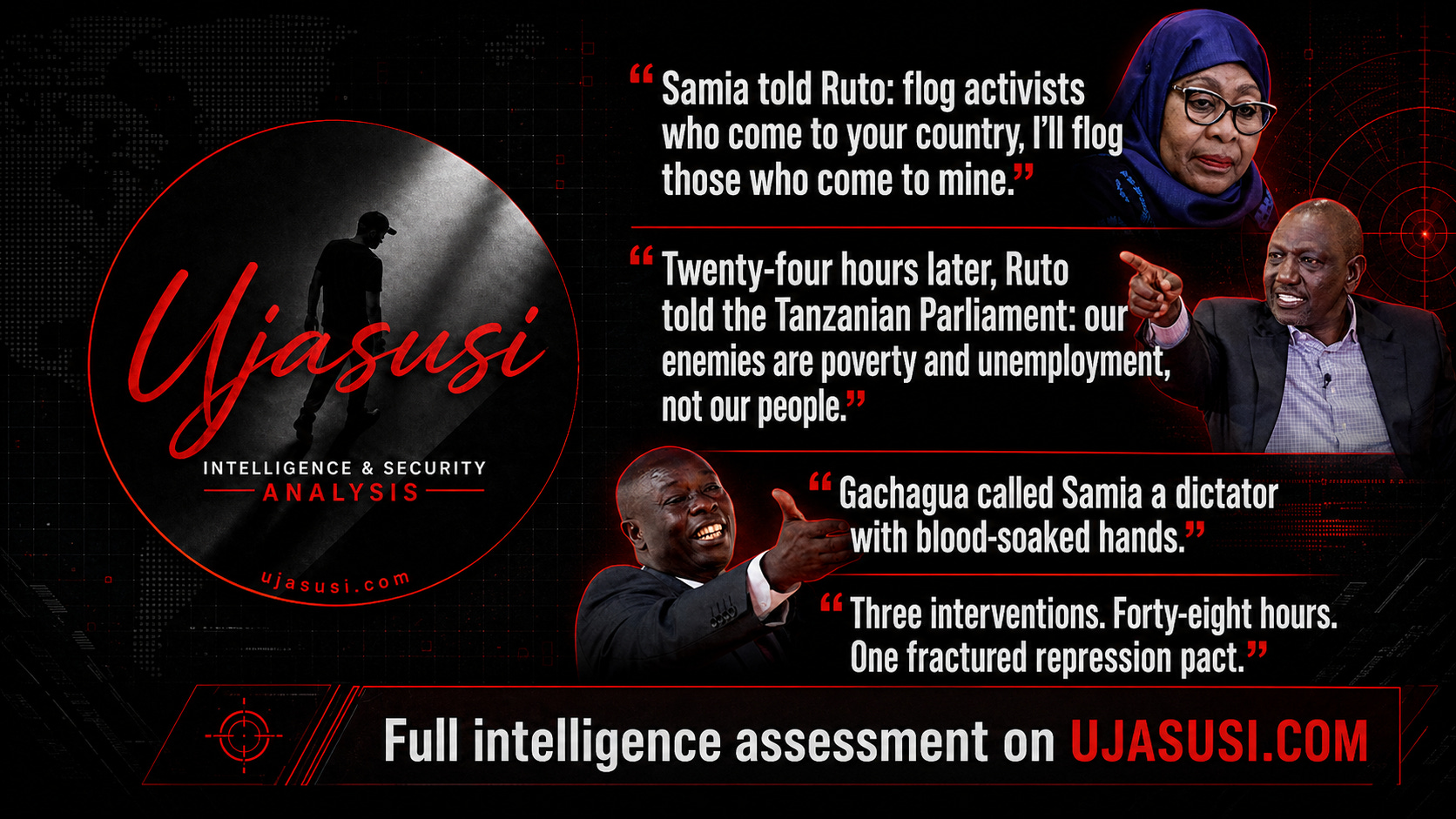
Tanzanian President Samia Suluhu Hassan used her Kenyan counterpart William Ruto’s 4–5 May 2026 state visit to Tanzania to propose an inter-state compact for the coordinated suppression of youth-led democratic dissent across East Africa. Within twenty-four hours, Ruto delivered a parliamentary address in Dodoma that reframed the bilateral relationship around economic cooperation and explicitly identified poverty and unemployment, not activists, as the shared enemy. Former Kenyan Deputy President Rigathi Gachagua described Samia as a dictator with blood-soaked hands and welcomed the ICC’s accelerating interest in her conduct.
These three interventions, occurring within a single forty-eight-hour diplomatic cycle, expose a fracture in the authoritarian solidarity framework that Samia is constructing around Tanzania’s post-massacre accountability crisis.
Table of Contents
Samia Proposes Cross-Border Enforcement Against Democratic Dissent
Samia’s Remarks Are a Self-Incriminating Admission of Command Authority
The Mwangi-Atuhaire Ordeal Proves the Repression Pact Is Already Operational
Karua and Mutunga Deportations Sealed Tanzania’s Isolation of the Lissu Trial
Ruto’s Dodoma Speech Redefines the Enemy Away from Activists
Ruto Validates the Chande Accountability-Substitution Mechanism
The Tanga Refinery Dispute Exposes the Bilateral Power Dynamic
Gachagua Labels Samia a Blood-Soaked Dictator and Welcomes ICC Pressure
ICC Complementarity Implications of the Forty-Eight-Hour Cycle
Four Intelligence Indicators to Monitor
Samia Proposes Cross-Border Enforcement Against Democratic Dissent
Samia used the Kenya-Tanzania Business Forum on 4 May to call for coordinated action against what she described as disruptive activism threatening both countries.
She told Ruto that she had discussed with him how to handle “these ill-mannered children of ours who call themselves Gen Z,” who she claimed were fighting for democracy across the region while destabilising governments. The remarks, delivered in Kiswahili at a joint press briefing in Dar es Salaam, were operationally precise.
The critical passage is her explicit call for reciprocal cross-border enforcement. She instructed Ruto that dissidents arriving in her jurisdiction would be flogged with canes by authorities (”chapa mikwaju”), and demanded he apply the same treatment in Kenya.
This language is not metaphorical. “Chapa mikwaju” in colloquial Kiswahili denotes physical beating with sticks. Delivered by a head of state whose security forces killed approximately 10,000 people in the October 2025 post-election massacre, and whose Chande Commission managed the toll down to 518, this amounts to a public endorsement of state violence against civic actors across borders.
Samia explicitly rejected externally derived democratic norms, stating that democracy should not be permitted to “spoil our countries, our traditions or our customs.” This is a doctrinal statement positioning Tanzanian autocracy as culturally legitimate.
Her framing of cross-border dissent as a bilateral security threat, rather than an expression of domestic accountability failure, directly converts regional integration machinery into an enforcement architecture against civil society.
Former Kenyan Chief Justice David Maraga condemned the axis of tyranny, warning that the Ruto-Samia coordination threatened to return the region to autocracy.
Samia’s Remarks Are a Self-Incriminating Admission of Command Authority