
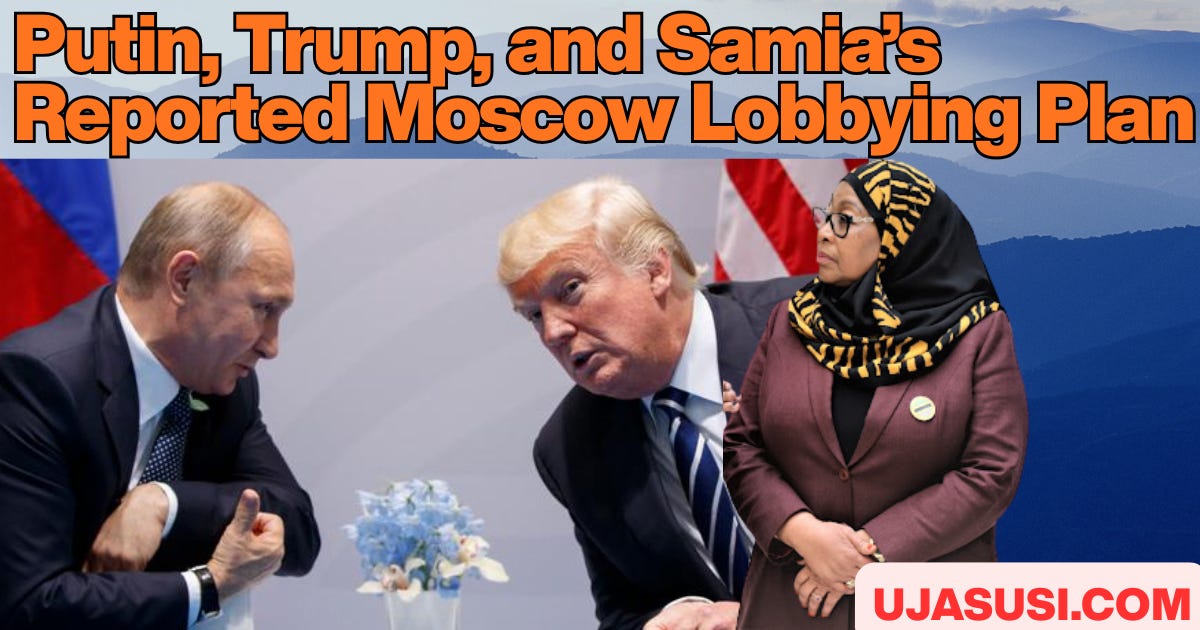
Putin, Trump, and Samia’s Reported Moscow Lobbying Plan

Ujasusi | Intelligence & Security Analysis — East Africa Monitoring Team
03 June 2026 | 1900 BST
🧭 Bottom Line Up Front
A credible source has reported that President Samia Suluhu Hassan is planning to ask President Vladimir Putin to lobby President Donald Trump against potential US measures targeting her regime over the post-October 2025 massacre, in which approximately 10,000 civilians were killed.
The report is credible on feasibility and should be retained as a live intelligence lead, not dismissed as speculation. It is not proven on OSINT, but the mechanism is plausible: Samia has a regime-survival motive; Putin has strategic reasons to cultivate Tanzania; and Trump’s record of accommodation toward Putin creates a channel through which Moscow could reinforce an already permissive US posture.
The key point is that any Russian intervention would not need to reverse Washington’s position. It would only need to strengthen a disposition already visible inside the Trump administration. US sanctions and related pressure tools are heavily dependent on executive discretion, and the administration has already signalled that it does not intend to press Tanzania hard.
A hawkish current inside Washington — religious-freedom advocates, Republican Senator Ted Cruz, Democratic Senator Jeanne Shaheen, the bipartisan Tanzania sanctions bill, and parts of the foreign-policy bureaucracy — creates friction. But friction is not a firewall. On a low-salience issue such as Tanzania, Trump can absorb, override, or slow-walk that pressure if he chooses.
The decisive analytic caveat is therefore not plausibility, but proof. A soft US outcome is likely. What may remain impossible to prove on OSINT is whether that softness results from Trump’s own instincts, Putin actively lobbying Trump, or Trump’s posture itself being shaped by the Russia relationship. Moscow’s hand can be neither shown nor excluded at this stage. It should not be assumed absent by default.
🔑 Key Judgements
KJ-1 — High confidence. The credible source report that Samia may seek Putin’s help with Trump is feasible. The reported plan fits Samia’s regime-survival incentives, Russia’s Africa strategy, and Trump’s documented deference toward Putin.
KJ-2 — High confidence. US pressure on Tanzania is implemented primarily through executive discretion: OFAC designations, State Department reviews, waivers, certifications, sanctions enforcement, and security-assistance decisions. Congressional action matters politically, but it does not remove the executive’s ability to under-implement, delay, narrow, or soften pressure.
KJ-3 — Moderate-to-high confidence. The Trump administration’s baseline disposition is already lenient. A State Department response to the Cruz–Shaheen Tanzania bill signalled that Washington would avoid “lecturing” Tanzania and would not seek to force its hand. That is precisely the posture through which any Putin-to-Trump intercession would operate.
KJ-4 — High confidence on outcome; causation undecidable. A soft US line is likely. What cannot be isolated is causation. Trump’s accommodationist posture, a possible Putin request, and the broader Trump–Russia relationship are entangled, not cleanly rival explanations.
KJ-5 — Moderate confidence. The hawkish current in Washington is friction, not a structural firewall. Senator Cruz, religious-freedom advocacy, the Trachman nomination, and Democratic involvement through Senator Shaheen keep Tanzania on the agenda. But none of these actors can force a disinclined White House to escalate if Trump chooses restraint.
🕵🏾 The Source Report Under Examination
A credible source has reported that Samia is planning to ask Putin to lobby Trump against potential US measures targeting her regime over the post-October 2025 massacre.
This assessment does not treat the report as proven fact. It treats it as an intelligence lead whose feasibility, logic, and observable indicators can be assessed. The question is not whether OSINT currently proves a Samia–Putin–Trump lobbying chain. It does not. The question is whether the reported plan is plausible enough to be retained as a live hypothesis. It is.
The reported plan rests on three linked assumptions. First, Samia has a clear motive. Her regime faces escalating reputational, diplomatic, and sanctions exposure after the post-election massacre. Any serious US measures — individual designations, security-assistance restrictions, a damaging bilateral review, or symbolic isolation — would increase regime vulnerability.
Second, Putin has a reason to listen. Tanzania offers Russia strategic value: diplomatic access in East Africa, military-technical cooperation, mining and energy opportunities, and potential alignment in multilateral forums. Moscow does not need Tanzania to become a formal ally. It only needs Tanzania to become useful, available, and politically grateful.
READ ALSO

Third, Trump is the relevant American variable. US sanctions may be framed by Congress, human-rights groups, or the State Department, but the key implementation levers sit with the executive. If Trump does not want a hard line on Tanzania, the pressure can be softened, delayed, narrowed, or made largely symbolic.
The depth of Trump’s Russia problem is not an invention of his critics. A bipartisan US Senate inquiry documented extensive contacts between Trump’s 2016 campaign and Russia, including what it described as a grave counterintelligence threat. The controlled-asset interpretation advanced elsewhere remains unproven and is not required for this assessment. Behavioural deference alone is sufficient to raise the analytic prior.
🏛️ Why Congress Is Friction, Not a Firewall
The Tanzania sanctions bill introduced on 20 May 2026 by Republican Senator Ted Cruz and Democratic Senator Jeanne Shaheen seeks to hold Tanzanian officials accountable for human-rights abuses following the post-October 2025 massacre.
Its bipartisan authorship matters. Cruz represents a Republican hawkish current with strong religious-freedom and human-rights messaging. Shaheen, a senior Democrat on foreign-relations issues, gives the initiative cross-party weight. This means the Tanzania file is harder for the administration to bury completely.
But the bill still does not self-execute. It authorises, directs, pressures, and signals. It does not by itself impose every measure in a way that bypasses the White House.
Designations under sanctions frameworks are made by executive agencies such as the Treasury Department’s Office of Foreign Assets Control and the State Department. Security-assistance restrictions often contain waiver space or national-interest exceptions. Bilateral reviews can be completed aggressively, narrowed quietly, or slow-walked. Enforcement intensity is also an executive choice.
READ ALSO

That is why the reported Putin channel matters. If the White House is already inclined toward restraint, Moscow does not need to defeat Congress. It only needs to reinforce the executive’s preference for non-escalation.
The administration has already signalled such restraint. Asked about the Cruz–Shaheen initiative, a State Department spokesperson indicated a restrained approach, invoking the administration’s doctrine of not lecturing sovereign states. That is exactly the environment in which a Putin message to Trump would be useful.
⚖️ Feasible Does Not Mean Proven
The reported plan is feasible. It is also unproven.
OSINT cannot currently show whether Samia has formally asked Putin to intervene with Trump, whether Putin would accept such a request, or whether Trump would respond to it. Back-channel intercession rarely leaves a documentary trail, especially when all parties have reasons to preserve deniability.
But the absence of visible proof does not equal the absence of activity. That is especially true in leader-to-leader diplomacy involving Russia, personalist regimes, and sanctions-sensitive governments.
The cleanest analytic position is therefore symmetric. A lenient US outcome could reflect Trump’s own reluctance to sanction sovereign governments over human rights. It could reflect Putin reinforcing that reluctance. Or it could reflect the deeper reality that Trump’s accommodationist posture toward Russia and Russia-aligned preferences is itself partly shaped by the relationship documented above.
Those explanations are entangled, not rival. It is unsafe to treat the most benign explanation as the default simply because it is easier to defend publicly. The source report cannot be verified on current OSINT, but it also cannot be responsibly dismissed.
🇷🇺 Why Moscow Matters to Samia
Samia’s Moscow visit should not be read only as ceremonial diplomacy. It sits inside a broader regime-survival logic.
Her state visit to Moscow on 3–5 June 2026 is historically significant: only the second by a Tanzanian head of state since Julius Nyerere’s 1969 visit. The trip offers Tanzania arms access, mining and energy opportunities, diplomatic signalling, and a relationship with a permanent UN Security Council member.
Russia has already pledged deeper military-technical cooperation with Tanzania. For a regime under international scrutiny, that matters. Moscow can provide diplomatic cover, alternative security partnerships, and symbolic protection against Western isolation.
This does not mean Tanzania is abandoning Washington. Nor does it mean Russia must replace the United States. The more likely pattern is dual-track survival: Moscow supplies hard insurance, while a permissive Trump administration supplies soft cover.
Tanzania’s Washington lobbying operation does not eliminate the Putin channel. The regime has reportedly operated through FARA-registered lobbying channels in the United States, but a contract lobbyist and a head-of-state relationship trade in different currencies. A lobbyist can shape talking points and access. Putin can operate at the level of leader-to-leader political signalling.
That is why the lobbying hypothesis and the Russia pivot should not be treated as alternatives. They reinforce each other.
📡 Indicators to Watch
The following indicators would help assess whether the reported plan is moving from feasible lead to observable pattern:
Whether the Trump administration completes, slow-walks, or narrows any mandated review of US–Tanzania relations.
Whether further individual designations follow the Mafwele designation, or whether the process stalls.
Whether any security-assistance restrictions are softened through waivers, national-interest determinations, or narrow implementation.
Whether Russian officials defend Tanzania in the UN Security Council or other multilateral forums.
Whether the Moscow visit produces concrete deliverables: arms cooperation, mining agreements, energy commitments, military-technical arrangements, or SPIEF-linked outcomes.
Whether Trump personally comments on Tanzania, Samia, sanctions, sovereignty, or African human-rights pressure.
Whether any Trump signal on Tanzania follows the Moscow visit or coincides with Russian diplomatic messaging.
Whether Tanzanian state media or pro-government channels begin framing Moscow as a shield against Western pressure.
Whether Washington lobbying narratives and Russian diplomatic narratives begin to converge around sovereignty, non-interference, and anti-Western “lecturing”.
🔮 Strategic Outlook
The most likely outcome is selective and largely symbolic US pressure.
Washington may issue periodic individual designations, critical statements, or narrow bureaucratic measures. But severe regime-level escalation is less likely if Trump remains disinclined to press Tanzania hard. The executive has enough discretion to soften, delay, or under-implement congressional pressure.
That is exactly why the source report matters. If Samia is indeed planning to ask Putin to lobby Trump, she is not chasing an impossible mechanism. She is attempting to exploit a plausible vulnerability in the US policy chain: a sanctions process that depends heavily on executive will, led by a president with a long record of accommodation toward Putin.
Moscow’s value to Samia is therefore twofold. It offers hard insurance through arms, energy, mining, diplomatic cover, and potential UNSC protection. It may also offer soft cover if Putin can reinforce Trump’s reluctance to escalate against Tanzania.
The source report is therefore neither verified nor dismissed. It describes a mechanism that is feasible, consistent with the record, and beyond proof on current OSINT. The correct posture for Ujasusi is to treat the soft US outcome as the central finding; to treat Moscow’s role as an open and deliberately unresolved question; and to revisit attribution only if one of the listed indicators produces a clearer signature.
Samia does not need Putin to control Washington. She only needs Putin to influence, reinforce, or encourage a White House already inclined toward restraint. That is why the report should be treated seriously.