

Ujasusi East Africa Monitoring Team | 02 May 2026 | 0600 BST
This intelligence assessment examines President Samia Suluhu Hassan’s 3–5 June state visit to Russia: the confirmed agenda, the strategic logic driving each side, the documented record that predicts how the relationship will function, the single-source reporting on a youth-recruitment channel and security cooperation, the alternative readings, the second-order effects, and the indicators that will confirm or weaken the central judgement across the visit’s seventy-two hours.
Contents
Bottom line up front
Key judgements
The confirmed record
What Moscow is buying: the uranium node and the sanctions calculus
What the clique is buying: recognition, a survival curriculum, protection
Killing at scale: the Samia–Putin comparison
Transnational repression and the GRU parallel
Single-source reporting and its plausibility
Alternative judgements
Second-order effects
Indicators and warnings
Collection gaps
Outlook
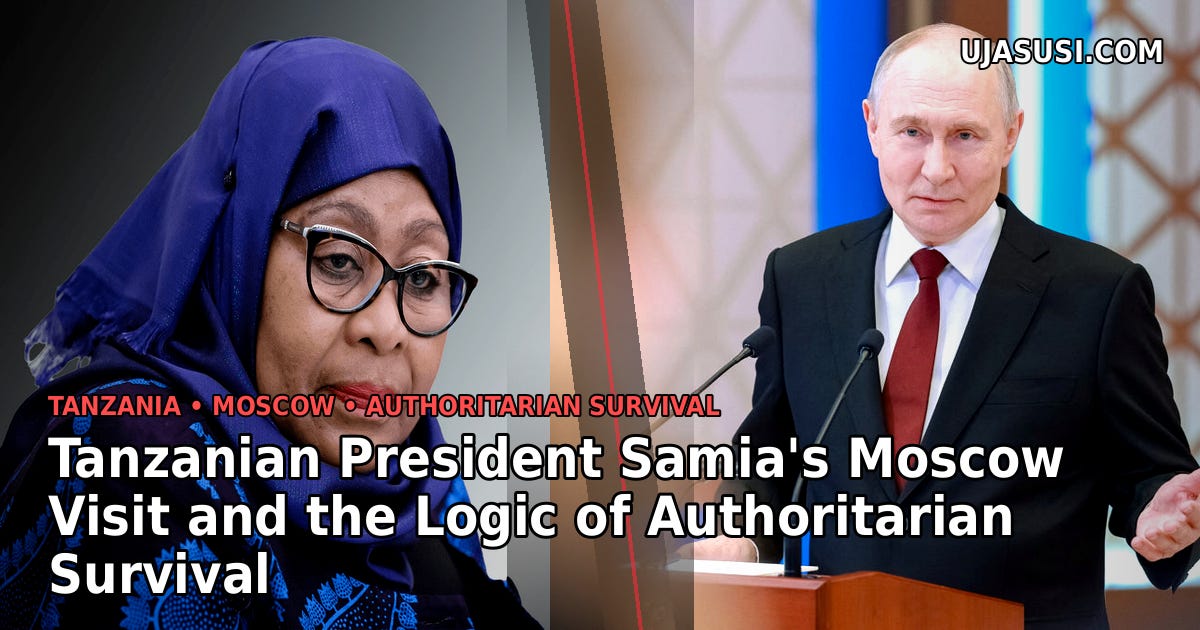
Tanzanian President Samia’s Moscow Visit and the Logic of Authoritarian Survival 🇹🇿🇷🇺
Intelligence Assessment · 2 June 2026 · Tanzania / Russia–Africa
This assessment examines President Samia Suluhu Hassan’s 3–5 June state visit to Russia: the confirmed agenda, the strategic logic driving each side, the documented record that predicts how the relationship will function, the single-source reporting on a youth-recruitment channel and security cooperation, the alternative readings, the second-order effects, and the indicators that will confirm or weaken the central judgement across the visit’s seventy-two hours.
Contents
Bottom line up front
Key judgements
The confirmed record
What Moscow is buying: the uranium node and the sanctions calculus
What the clique is buying: recognition, a survival curriculum, protection
Killing at scale: the Samia–Putin comparison
Transnational repression and the GRU parallel
Single-source reporting and its plausibility
Alternative judgements
Second-order effects
Indicators and warnings
Collection gaps
Outlook
1. Bottom line up front
The visit is best understood not as a trade mission but as a regime-durability operation. A leadership that has forfeited its standing with the West is purchasing, in Moscow, the means to outlast that loss.
The probable returns to Tanzania’s rulers are international recognition, a tested method of authoritarian survival, security tradecraft and the prospect of protection.
The probable costs to the country are strategic minerals locked into a sanctioned supply chain and, on reliable reporting, the lives of young Tanzanians fed into Russia’s war.
The published agenda’s own numbers point this way: a bilateral trade relationship worth US$307.5 million a year cannot account for a state visit of this rank, addressed by the head of state to a global plenary, crowned with an honorary doctorate.
When the stated cause is too small to explain the event, the real cause lies elsewhere.
2. Key judgements
Judged with high confidence, the visit’s primary function is political shelter and legitimacy laundering, timed to offset Western pressure that has intensified since the October 29 killings of approximately 10,000 people. The Section 7031(c) designation against a senior Tanzanian figure, the Reassessing the United States–Tanzania Bilateral Relationship Act now before the US Senate, and the European Parliament’s aid freeze have closed the Western channel at the precise moment the visit elevates the Eastern one. The timing is not coincidental; it is causal.
Judged most likely, Russia’s controlling interest is a uranium supply node insulated from Western sanctions. This is the central original inference of the assessment: the Mkuju River project converts Tanzania into a component of Moscow’s nuclear value chain beyond the reach of Western enforcement, and that strategic position, rather than the negligible trade figure, is what Moscow is actually securing. Everything else Russia gains, a friendly African vote and a head of state lending the SPIEF stage credibility, is secondary to the mineral.
Judged likely, Putin functions for Samia as a working model of survival, having held power for more than a quarter-century through sanctions, an International Criminal Court warrant and a catastrophic war. For a leader who fears a reckoning over October 29, that record is not inspiration but instruction.
Judged probable, security and intelligence cooperation forms part of the agenda whether or not a public text is released, given the close overlap in method between the two states and Russia’s standing practice of exporting such cooperation to its partners.
Judged with moderate confidence, the relationship will deepen the extraction of Tanzanian strategic minerals in exchange for non-economic returns that accrue to the ruling clique rather than to the population.
3. The confirmed record
State House announced the visit on 1 June through the Directorate of Presidential Communications. The published programme covers a Kremlin meeting with Putin, an address to the plenary of the 29th St. Petersburg International Economic Forum, cooperation agreements in higher education, science and technology, investment and ICT, and an honorary doctorate from RUDN University.
The communiqué frames the trip as historic, the second by a Tanzanian head of state to Russia after Julius Nyerere in October 1969. That comparison is itself revealing: Nyerere travelled as the leader of a young non-aligned republic seeking development partners across both blocs; Samia travels as an isolated incumbent seeking a single patron willing to overlook how she retained power.
The relationship already rests on a material foundation. Mantra Tanzania, a subsidiary of Uranium One within Russia’s state nuclear corporation Rosatom, commissioned a pilot uranium processing facility at Mkuju River in Namtumbo, Ruvuma, in July 2025, with Samia attending in person. The broader US$1.2 billion uranium venture is projected to make Tanzania Africa’s third-largest uranium producer after Niger and Namibia. The visit was first scheduled for 12 February, then postponed, with Foreign Minister Kombo carrying Samia’s message to Moscow during the February ministerial talks at which Tanzania signalled its intent to elevate the relationship.
Russia’s conduct across its African theatres is a matter of documented record, and it is the most reliable predictor of how this relationship will operate. Africa Corps, the rebranded Wagner structure now under Russia’s defence ministry, is tied to the Moura massacre of civilians in Mali, where more than three hundred people were killed over five days, and to a continuing pattern of killings, abductions and abuses recounted by refugees who fled the same fighters.
The record in the Central African Republic is comparably grim, and in Sudan Moscow has worked both sides of the war to secure gold. On the war that frames Putin’s own standing, Dutch military intelligence estimated in April 2026 that more than 500,000 Russian soldiers have been killed since 2022, among the highest such estimates, while the probate-based count by Mediazona and Meduza documents at least 352,000 killed and their named-record list confirms over 200,000 by identity, alongside thousands of separately verified Ukrainian civilian deaths.
4. What Moscow is buying: the uranium node and the sanctions calculus
The trade figure is the tell. At US$307.5 million a year, commerce between the two states is trivial by the standard of a state visit, which means the visit’s purpose is not to grow that number in any way that matters to the wider economy. The asset that does matter is uranium, and the entity controlling its processing is the same state corporation that fuels Russia’s military-nuclear complex.
This is qualitatively different from the Gulf mineral and port deals that have drawn domestic criticism. Uranium is a strategic, dual-use material, and a processing stake gives Rosatom a foothold inside Tanzanian sovereignty that no ordinary export contract confers.
For Moscow, the value is twofold. A processing position in Tanzania extends the global nuclear supply network it has been building across Africa, from the Sahel juntas to coastal states, at a moment when Western sanctions are designed to choke precisely that network.
And a friendly producer outside the Western enforcement perimeter offers a route to move, blend or account for material in ways that complicate Western tracking. The familiar charge that the president is selling the country to Arab interests acquires a new and more dangerous beneficiary; the buyer is now Russian, and the commodity is fissile.
The political economy compounds the risk. The Mkuju deposit sits beside the Nyerere National Park within the former Selous ecosystem, an arrangement that already drew a decade of conservation objections before the politics of the moment overrode them. Revenue and equity terms inside the Mantra structure are opaque, which is consistent with a pattern in which strategic resources are committed by a narrow circle and the returns are not visible to the public that bears the environmental and sovereign cost.
5. What the clique is buying: recognition, a survival curriculum, protection
Three things the West will no longer supply are available in Moscow, and each maps onto a specific anxiety inside the ruling circle.
The first is recognition. The SPIEF plenary and the honorary doctorate are instruments of image. A head of state addressing a global forum and collecting an academic honour generates the picture of a respected leader, which is precisely the picture that the killings of October 29 threaten to erase. The honour from RUDN is not incidental; it is a reputational laundering device, and its timing, months after a mass-casualty crackdown, is the point.
The second is method. Putin’s endurance is a curriculum in authoritarian survival: how to absorb sanctions without elite defection, how to capture courts and convert them into instruments of incumbency, how to manage exposure to international justice, how to control information and narrative through a long crisis, and how to keep a security elite loyal by binding its fortunes to the regime’s. A leader contemplating years of Western pressure and possible accountability proceedings has strong incentive to study the one man who has done it longest.
The third is protection, and it is the most consequential. Russia is governed by the siloviki, the security and intelligence men who turned the organs of state into guarantors of their own power and wealth. The network around Samia, the apparatus long described in this body of work as the deep-state structure that has captured Tanzania’s institutions, follows the same design, having repurposed the security services from national defence to regime defence. Moscow does not merely model that arrangement; it offers to reinforce it. The relationship a leadership builds with a state experienced in shielding its own is the relationship it builds when it fears it will one day need shielding.
6. Killing at scale: the Samia–Putin comparison
The two leaders are joined by more than circumstance. Samia stands accused over the deaths of approximately 10,000 citizens during the October 29 period. Putin presides over a war that has killed nearly half a million of his own soldiers and thousands of Ukrainian civilians. The magnitudes are not equivalent, and the contexts differ, but the operative trait is shared: a willingness to treat human life as an acceptable cost of holding or projecting power, and a refusal to permit independent accounting of the dead.
Neither state discloses its true toll; both rely on suppression, denial and the reframing of casualty figures as enemy propaganda. The comparison matters less as moral equivalence than as predictive signal. A leadership that has already crossed the threshold of mass killing, and that now allies with the most prolific practitioner of impunity available, is unlikely to retreat from coercion as its governing instrument.
7. Transnational repression and the GRU parallel
Tanzanian authorities have sought to extend abduction and intimidation operations beyond national borders to reach critics living abroad. The pattern mirrors the conduct of Russia’s military intelligence service, the GRU, which has been linked across Europe to assassinations, attempted poisonings, abductions and sabotage against opponents of the Kremlin.
The relevance to this visit is direct. A state that wishes to professionalise extraterritorial repression could find no more experienced tutor, and the documented European record demonstrates both the methods and the willingness to deploy them in third countries. The judgement that security cooperation belongs on the agenda rests in part on this fit: each side has a capability or a need that the other can satisfy.
8. Single-source reporting from a reliable channel
The following comes from a source of established reliability with a proven reporting record. It is single-stream, meaning it has not yet been confirmed through a second independent channel, and several elements concern commitments not yet concluded, which the visit itself will bear out. The source’s track record, reinforced by the consistency of the reporting with Russia’s documented conduct, places this material well above rumour and warrants treatment as probable.
The source reports that Samia will sign an agreement publicly framed as offering Tanzanian youth opportunities in Russia, the true purpose of which is to channel young Tanzanians to the Ukrainian front. The reporting aligns with established precedent: Russia has recruited fighters from Nepal, Cuba and other poor states under the promise of work, contracts or study, then routed them to combat. A labour-mobility agreement is the natural legal vehicle for such a scheme, which is why the wording of any youth or employment clause is the first indicator to watch.
The same source reports that the GRU will train Tanzania’s intelligence service and the units known as watu wasiojulikana in abduction and the removal of opponents, and supply the equipment for such operations. This is consistent with Russia’s standing export of security tradecraft to client states and with the transnational-repression fit described above.
The source further reports that Putin will agree to provide Russian operatives to assist in pursuing diaspora critics. If concluded, this would internationalise Tanzanian repression through the apparatus most experienced at extraterritorial targeting. Independent corroboration is the outstanding requirement.
A separate claim, of lower confidence and presented as an unverified rumour, holds that the figure referred to as Abdul is under Africa Corps protection. If substantiated, it would indicate the security relationship has advanced well beyond the public record. It remains an open collection requirement.
Taken together, the reliability of the channel and the fit with Russia’s established base rate place this reporting on firm ground for single-stream human intelligence. It is not yet documentary fact, and the indicators in section 11 are where it converts.
9. Alternative judgements
A disciplined reading must hold open the possibilities that would weaken the central thesis. The visit may prove largely symbolic, producing memoranda of intent that are never operationalised, a common outcome of Russia–Africa summitry where announced figures outrun delivery.
The uranium relationship, though strategically significant, may advance slowly given commodity prices, environmental litigation and the technical difficulty of the deposit. The recruitment and security claims, resting on single sourcing, may not survive corroboration, and a labour agreement may be exactly what it says.
And the survival-curriculum framing, while analytically strong, risks over-reading intent into what could be opportunistic diplomacy by a leadership simply diversifying partners. None of these alternatives is judged more probable than the central reading, but each defines the evidence that would require the assessment to be revised.
10. Second-order effects
The regional consequences deserve attention. A deepening Tanzania–Russia security relationship would unsettle Nairobi and complicate East African Community dynamics already strained by recent disputes over the regional treatment of activists and political detainees. It would also place Tanzania, a coastal non-junta state, inside a Russian African network previously anchored in Sahel coup regimes, marking a wider southward extension of Moscow’s reach toward the Indian Ocean.
Western capitals are likely to read the SPIEF appearance as confirmation of the case behind the Senate bill and the European freeze, hardening rather than softening their posture and accelerating further designations. Domestically, the Zanzibar dimension bears watching, given the island’s long function as a testing ground for security arrangements later generalised to the mainland.
Each of these effects feeds back into the regime-durability calculus: the more isolated Tanzania becomes from the West, the more dependent it grows on the Eastern patron, which is a condition that suits Moscow precisely.
11. Indicators and warnings
Several signals across the seventy-two hours, and in the weeks following, would move the central judgement toward confirmation. The wording of any labour or migration instrument is paramount; a vaguely framed “opportunities for youth” clause is the form a concealed recruitment pipeline would take, and specificity or its studied absence is the tell.
Any security, policing or intelligence memorandum, whether signed or merely alluded to in official language, would corroborate both the assessed and the single-source reporting, and the absence of a public text should not be read as the absence of an understanding.
Fresh Rosatom commitments or an enlarged Mkuju footprint would confirm uranium as the price rather than the prize. A subsequent uptick in surveillance, approaches or intimidation directed at diaspora critics would lend weight to the operative-provision claim.
And any visible Russian security presence associated with protected individuals would bear on the unverified protection rumour.
12. Collection gaps
The youth-channel, tradecraft-transfer and diaspora-operative claims come from a reliable single source; independent second-channel corroboration and the documentary confirmation the visit will provide are the outstanding requirements. The existence and terms of any security agreement are unknown pending the visit. The Abdul protection claim is unverified. The revenue, equity and offtake terms inside the Mantra structure remain opaque, as does whether new uranium terms are concluded in St. Petersburg. The disposition of any signed texts, several of which may remain unpublished, is the central documentary gap. These constitute the priority requirements for the coming week.
13. Outlook
State media will present the visit as recognition of a respected leader on the world stage. The more accurate reading is of a leadership buying the means to outlast the West, prepared to commit strategic resources and, on reliable reporting, young lives to that end. Three scenarios frame the near term. In the most likely, the visit yields a mix of substantive uranium and education agreements alongside quieter security understandings, advancing the relationship without a single dramatic announcement. In a harder scenario, an explicit security or labour instrument surfaces, marking a clear step from authoritarian alignment toward operational partnership and triggering sharper Western response. In the softer scenario, the visit proves largely ceremonial, banking legitimacy for Samia while deferring the operational substance to later channels. The agreements concluded between 3 and 5 June, published and unpublished, will indicate which path has been taken and who actually benefits. The line to watch is the one between a state diversifying its partners and a state importing the architecture of its own permanence.
No advertisers. No institutional backers. Just readers. Support Ujasusi at HERE.