
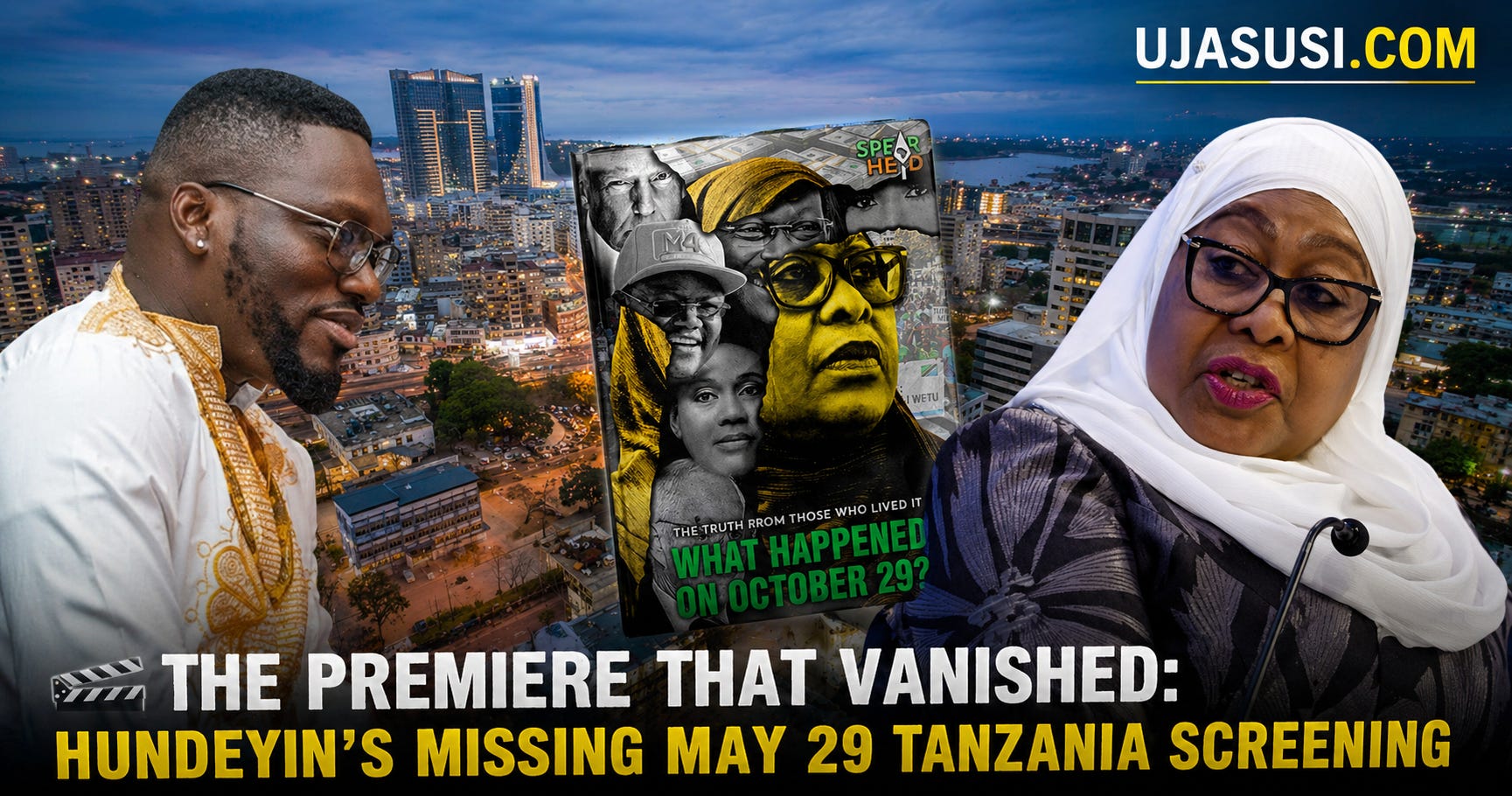
🎬 The Premiere That Vanished: David Hundeyin’s Missing May 29 Tanzania Screening

Ujasusi East Africa Monitoring Team | 30 May 2026 | 0400 BST
David Hundeyin’s documentary What Happened on October 29? was billed to screen in Dar es Salaam on 29 May 2026. A day later, no venue, photograph, or confirmation has surfaced. Ujasusi assesses, with moderate confidence, that the Tanzania leg was suppressed or quietly abandoned, and that the campaign’s wider rollout has underperformed the visibility its producers sought.
📅 An announced rollout that underdelivered
The promotional schedule was specific and on the record. The film opened at the WAGMC Auditorium, University of Ghana, on 26 May. It was billed to screen in Dar es Salaam on Friday 29 May and in Nairobi on Sunday 31 May, with a YouTube release the same day through The Spearhead’s channel. Ghanaian outlets carried the full premiere schedule, and the dates appeared in the producer’s own promotion.
The Accra leg happened, but it did not land. Despite weeks of pre-event promotion, the premiere drew limited social traction and functioned closer to a private screening than the landmark moment its billing implied. The volume of hype exceeded the volume of response, which is the signature of an event being talked up rather than taking off. A film designed to dominate a narrative opened to a room rather than a region. The Tanzania leg, billed for the following day, produced no footprint at all.
🗓️ The 29 May date mirrored the October 29 killing date
The Tanzania screening was set for the 29th, and the film is named for the 29th. A documentary titled What Happened on October 29? opening on the monthly echo of the killing date is not an accident of the calendar but a deliberate choice. It frames the screening as an anniversary act, a seven-months-on restatement of the counter-narrative on the very date the massacre carries in its name.
That choice is where the Tanzania leg’s contradiction sharpens. The 29th belongs to the victims. Staging a film that recasts their deaths as foreign fabrication on that date, in the capital where the killing was heaviest, attempts the appropriation of a day of mourning, and it is maximally provocative: the single date most likely to concentrate opposition and diaspora attention, raise the prospect of counter-mobilisation, and turn a screening into a flashpoint. A campaign seeking a quiet domestic launch and a campaign seeking a symbolic 29 May launch want incompatible things. The date the screening was meant to happen may be part of the reason it did not.
READ ALSO

🔇 A screening that left no trace
A public film premiere is a visibility event by design. It produces artefacts: a venue named in advance, invitation or ticketing notices, attendee photographs, a clip on the producer’s channels, and at minimum a triumphant post afterwards. The Accra screening produced a thin version of that footprint. The Dar es Salaam screening, twenty-four hours on, has produced none of it.
There is no announcement of the venue. There is no confirmation from Hundeyin, who is otherwise prolific on his verified account. There is no notice from The Spearhead. No outlet, Tanzanian or international, has reported that the screening took place. A film recasting the killings of approximately 10,000 people as foreign fabrication is exactly the event state media would be expected to amplify, and that amplification has not materialised. For a production whose entire purpose is narrative, silence on its most symbolically loaded screening is itself a datapoint.
🎯 Four readings of the silence
The absence of confirmation admits several explanations, and intelligence discipline requires holding them open.
Held quietly, by design. A closed, low-publicity screening would let the producers claim a domestic launch while avoiding scrutiny of who attended or who arranged the venue.
Postponed or cancelled. A logistical, security, or clearance problem may have pushed the leg, with the producers preferring silence to an admission of delay.
Never a genuine public event. The Dar es Salaam date may have functioned as rollout decoration, a line signalling domestic legitimacy without a screening ever being committed to.
Deliberately invisible. Keeping the Tanzania leg out of view preserves the film’s claim to independence while still allowing domestic distribution through controlled channels.
The first and fourth fit the operation’s logic best. The campaign needs the film to look like a sympathiser’s independent work, not a state product, and a televised public premiere in the capital would corrode precisely that impression.
READ ALSO

📰 The scrutiny factor: did pressure move the leg?
A reading the producers will not volunteer is that sustained external scrutiny raised the cost of a visible Tanzania premiere. In the run-up, Ujasusi’s documented case presenting the documentary as a state-aligned narrative measure, alongside its account of Hundeyin’s own pre-investigation verdicts, circulated strongly on X and pushed the financing and independence questions into the conversation before a single domestic screening.
Ujasusi assesses, with low confidence given the absence of direct evidence, that this scrutiny contributed to the Tanzania leg’s disappearance. A public premiere staged while the operation was under active, well-circulated examination would have invited exactly the documentation the producers most need to avoid: photographs of an approving official audience, a named venue, a confirmable guest list. Causation cannot be established. The coincidence of timing, and the asymmetry between a hyped Accra event and a vanished Tanzania one, is consistent with a campaign retreating from visibility under pressure rather than executing a confident rollout.
🧩 Why the Tanzania leg was always the awkward one
A screening inside Tanzania carried analytical weight the other legs did not. Public screening clearance in a state that jails citizens for circulating protest footage is the indicator: a film permitted to screen openly in the commercial capital is a film the authorities do not treat as a threat. Clearance needs no commissioning document to carry meaning.
That same logic cuts against the producers. A high-visibility premiere, complete with images of an official audience, would convert an implicit alignment into an explicit one and confirm what the film most needs to deny: that its thesis and the government’s position are two doors into the same room. A muted or unannounced Tanzania screening resolves that tension. The film reaches its domestic audience while the producers retain deniability about the welcome it received. Ghana is neutral ground, where a premiere advertises reach without implicating the subject state. Tanzania is the one venue where visibility is a liability.
READ ALSO

📡 A hostile launch awaits the release
The screenings were the warm-up. The 31 May YouTube release is the payload, the moment the film becomes a distributable asset rather than a series of room-sized events. That launch now faces an organised hostile reception. Anti-Samia diaspora audiences, plausibly acting with Kenyan digital-activist allies, are positioned to mass-report the video on release. Sustained flagging can trigger platform review and temporary removal, disrupting the controlled rollout the producers planned and handing critics a procedural win regardless of YouTube’s eventual ruling.
Three indicators will clarify what this is. First, the manner of spread: organic circulation looks nothing like coordinated bursts across many accounts, and the Streisand dynamic already documented means even amplified distribution widens the audience for the evidence the film aims to bury. Second, the financing, unexplained for a seven-month, four-country shoot, whose continued opacity would itself be informative. Third, the official Tanzanian reaction: enthusiastic state amplification undercuts the independence claim, studied distance preserves it.
The vanished Tanzania premiere and the flat Accra one point the same way. A campaign confident in its framing screens proudly and posts the photographs. A campaign managing exposure hypes a private event, stages the domestic leg in silence, and hopes the upload survives first contact with an audience that has been waiting for it. Tomorrow’s release will show which campaign this is.