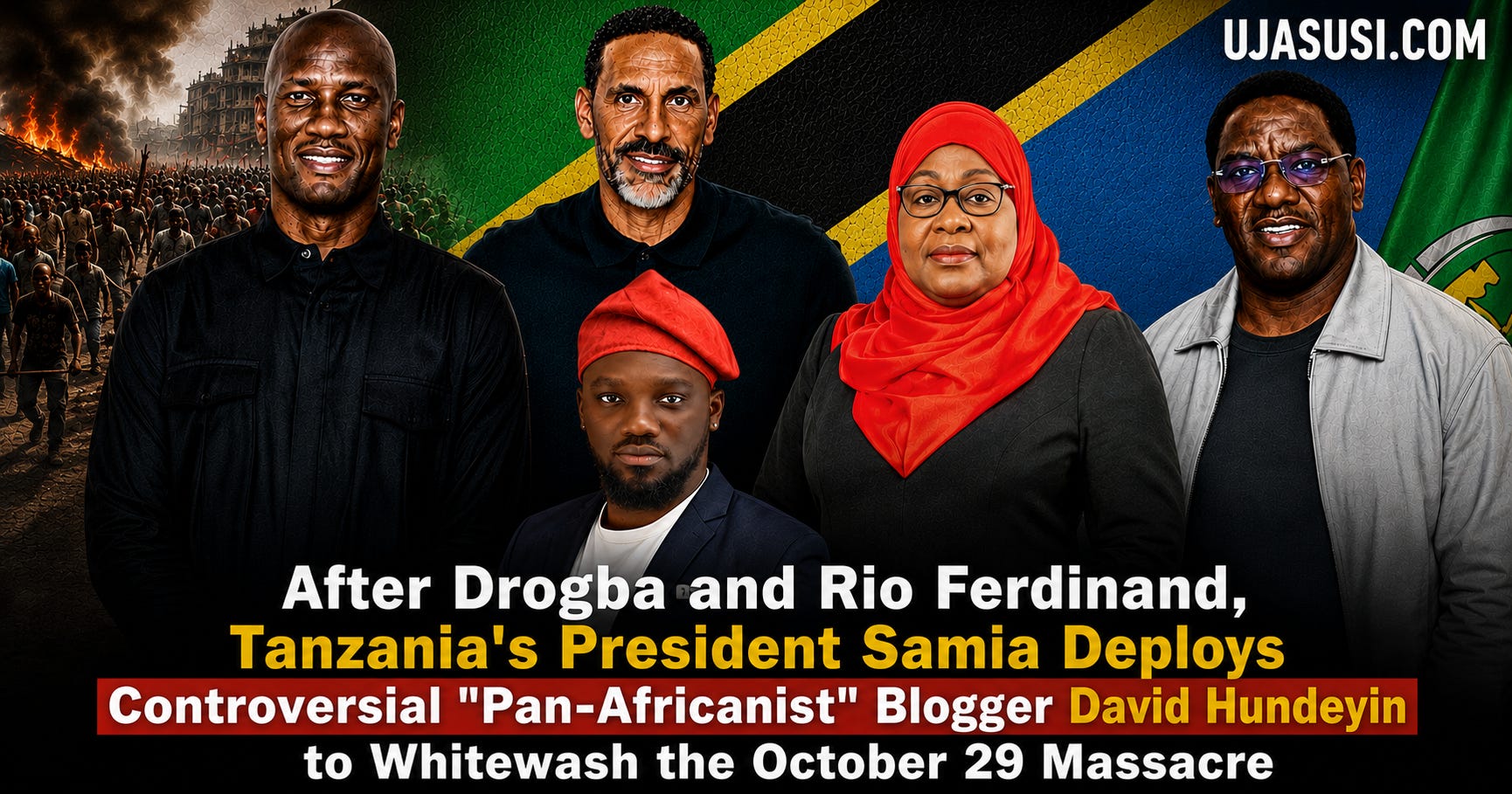
After Drogba and Rio Ferdinand, Tanzania's President Samia Deploys Controversial "Pan-Africanist" Blogger David Hundeyin to Whitewash the October 29 Massacre
Ujasusi East Africa Monitoring Team | 24 May 2026 | 0515 BST
Bottom line up front: Ujasusi assesses, with high confidence, that David Hundeyin’s documentary What Happened On October 29? serves the Tanzanian government’s interest in recasting the post-election massacre as foreign disinformation, and that its release belongs to a wider rehabilitation effort visible since the Drogba and Ferdinand visits. We assess, with low-to-moderate confidence, that the film was directly commissioned or financed by the Tanzanian state, because the alignment of interest is documented while the question of direction and funding is not. An alternative explanation, that Hundeyin acts from sincere ideological conviction with no state involvement, remains consistent with every known fact and is examined below. The film’s financing is the single piece of evidence that would move the second judgement, and it is presently unknown.
READ ALSO
The Established Facts 📋
David Hundeyin will premiere the film in Accra on 26 May 2026, with subsequent screenings in Dar es Salaam and Nairobi and a YouTube release on 31 May. The producers’ own promotion frames the thesis as a question of whether the reporting was completely fabricated by an adversary “more powerful than any African government.” Hundeyin built his reputation through exposés including the Flutterwave financial misconduct allegations and a contested investigation into Bola Tinubu’s record. He has since been removed from West Africa Weekly, the publication he founded, and now operates The Spearhead, the outfit producing this documentary. He is, in short, an operator of considerable name recognition working through a personal vehicle, no longer accountable to the editorial structure that built his reputation.
The surrounding sequence is equally well documented. On 5 May 2026 Samia hosted Didier Drogba at State House and invited him to be Tanzania’s AFCON 2027 ambassador. Rio Ferdinand followed for a visit that took in Parliament, Serengeti and stadium. Separately, the Presidential Commission of Inquiry chaired by retired Chief Justice Mohamed Chande Othman reported on 23 April 2026 that the events did not constitute peaceful protest and that the violence was “planned, coordinated, financed, and executed by trained individuals.”
READ ALSO
The Assessment of Alignment 🎯
The film’s thesis and the Tanzanian state’s official position are functionally identical. Both shift responsibility for the killings away from the security services and toward an external or orchestrated cause. The Commission frames the violence as a planned operation by trained, financed actors; the documentary frames the reporting of the violence as a fabricated foreign campaign. These are two doors into the same room. By the producer’s own account, Hundeyin’s research drew on the Commission’s findings, which means the film is not an independent inquiry arriving coincidentally at the government’s conclusion. It is, at least in part, a popularisation of that conclusion.
READ ALSO
This is why the alignment judgement carries high confidence while the direction judgement does not. A documentary built on a government inquiry’s conclusions, premiered abroad and carried by a nominally independent African journalist, has the practical effect of laundering an official narrative into apparent independent corroboration, regardless of whether a single shilling of state money changed hands. The Dar es Salaam screening sharpens the point. A documentary genuinely hostile to the Tanzanian state could not openly schedule a Dar es Salaam premiere in a jurisdiction where independent coverage of the massacre has been suppressed and foreign journalists were barred during the election. That the premiere has been publicly announced at all implies the authorities have already cleared it, and a film the state is content to see screened in its commercial capital is, by that fact, a film it does not regard as a threat. The clearance is the indicator.
The Pattern Is Not New 🌍
The Hundeyin model fits a template now well documented across the continent, which is what allows it to be assessed with confidence rather than treated as a novel event. Across the Sahel, foreign actors have systematically recruited authentic African voices to launder state-serving narratives, precisely because a message delivered by a local, credible figure defeats audience scepticism in a way that official channels cannot. Investigative reporting on Russian operations in West Africa documented paying local media outlets per article to promote favoured narratives and discredit adversaries, and even funding cultural figures to carry political messaging at events. The Africa Center for Strategic Studies has separately tracked how state sponsors launder official narratives through African media ownership, training, and content-sharing arrangements, with documented disinformation campaigns rising sharply since 2022.
READ ALSO
The relevance is structural, not an accusation of equivalence. Whatever the funding source, the form of the Hundeyin documentary, an indigenous, credible, anti-imperialist voice recasting a domestic atrocity as foreign manipulation, is the recognised signature of a narrative operation. The technique works because it exploits a genuine and justified African grievance about Western distortion of the continent’s affairs, and turns that grievance into cover for a specific government’s specific crimes. The pan-African framing is the delivery mechanism. The payload is impunity.
The Competing Explanation, Fairly Stated ⚖️
Honesty requires giving the alternative its full weight rather than a token sentence. Hundeyin has, for years, advanced a coherent worldview in which African crises are attributed to Western manipulation, and he publicly refused a paid commission from a foreign-funded advocacy organisation to attack a Nigerian target. On that record, it is entirely plausible that he produced this film from sincere conviction, genuinely persuaded that Western media distorted the Tanzania story, with no Tanzanian state involvement whatsoever. This explanation fits every established fact as completely as the state-direction reading does.
Crucially, the two hypotheses are not mutually exclusive, and this is the analytic heart of the matter. A sincere ideological sympathiser is exactly the figure whose independent work a government can benefit from without ever directing it. State direction and genuine conviction can coexist, and the most effective narrative assets are often true believers rather than paid contractors, because their conviction is real and therefore persuasive. This means the “he genuinely believes it” defence, even if entirely true, does not rebut the alignment judgement. It explains the mechanism by which the alignment operates. The distinction that remains genuinely open is narrow: whether money or instruction flowed from the Tanzanian state to the production. On that narrow question, the evidence is not yet there, and any assessment claiming to resolve it is speculating.
READ ALSO
Why the Film’s Central Claim Fails Regardless 🔍
The provenance question, however it resolves, does not rescue the documentary’s substantive thesis, which collides with an independently assembled evidentiary record. The crackdown killed approximately 10,000 people, a figure submitted to the International Criminal Court alongside morgue documentation, hospital records, and what the submission describes as thousands of videos. Reuters reconstructed the Mjimwema massacre in Mwanza, verifying footage of thirteen bodies and interviewing nine witnesses to eight separate incidents in which officers fired on non-protesters. CNN’s forensic investigation found evidence of deadly fire and secret burials. Human Rights Watch documented the use of live ammunition against protesters, and the UN human rights office recorded killings under a nationwide internet shutdown, noting credible reports that security forces removed bodies to undisclosed locations.
The film’s thesis requires its audience to believe that all of these organisations, working independently with forensic methods, verified imagery, and named witnesses, were either deceived by or complicit in a single coordinated foreign campaign. That is the claim’s structural weakness, and it holds whoever paid for the film.
The government’s own inquiry, far from supporting the fabrication thesis, quietly undermines it. The Commission confirmed 518 deaths while its chairman conceded the true figure was likely higher because families had buried relatives privately, bypassing morgues. It recorded 245 people still unaccounted for, and 39 families who said they had identified relatives’ bodies in morgues only for those bodies to later vanish. These admissions describe exactly the pattern of concealment that the OHCHR independently reported. An honest documentary engaging this material would have to reckon with a state inquiry that confirms mass death, missing bodies, and disappeared corpses. A documentary built to argue fabrication cannot, which tells us something about its purpose. The same Commission chairman’s claims that circulating images were “manipulated using AI” and that some of the missing had “disappeared for romantic reasons” illustrate the strain the official narrative is already under, and the film exists to relieve that strain.
It bears noting that the Commission remains contested on all sides. Both CHADEMA and ACT-Wazalendo rejected its report, the full document has not been made public, and the opposition’s own early tallies ran far higher than the official count from the first days of the crisis.
Strategic Outlook 🔭
Ujasusi assesses the documentary is likely the first iteration of a repeatable model rather than a one-off production. In the weeks following the 31 May release, the film will probably be cut into short segments and pushed across the pan-African content networks that already carry comparable continental counter-narratives, timed to circulate while the Chande report remains unpublished and pressure for its release builds. The probable function is to pre-seed the information environment, so that when accountability demands sharpen, a ready-made “foreign disinformation” rebuttal is already in circulation under an African byline rather than a government spokesman’s.
For readers following this story, the film’s true character will become legible in three places once it is released. The first is who appears on camera. The selection of interviewees will indicate whether the production leaned on voices close to the Tanzanian state or on genuinely independent ones, and a documentary alleging fabrication that cannot field credible independent witnesses to its central claim tells its own story. The second is the money. The Spearhead is Hundeyin’s vehicle and the film’s named producer, and a seven-month shoot across four countries is expensive; if the funding is as independent as the film will imply, it should be straightforward to explain, and if it is never explained, that silence is itself informative. The third is the manner of its spread. Whether the clips travel organically or arrive in coordinated bursts across many accounts will be visible to any attentive observer within days, and coordinated amplification is the signature of an operation rather than a film finding its natural audience.
The judgement that outlasts the documentary is this. The progression from Drogba to Hundeyin is an escalation in ambition, not merely a change of personnel. The celebrity visits generated goodwill without touching the accountability problem; the film attacks that problem directly, whether by the government’s design or through the convergent interest of a willing sympathiser. The counter-history of October 29 has stopped being left to fade and started being actively constructed. That shift, more than any single film, is what warrants sustained attention through the approach to AFCON 2027, when Tanzania’s global visibility and its incentive to control the story will both reach their peak. A nation preparing to welcome the continent will not want the memory of approximately 10,000 dead travelling with the football, and the work of burying that memory has visibly begun.
Confidence summary: High confidence that the documentary aligns with and serves the Tanzanian state’s narrative interest. Low-to-moderate confidence that the state directly commissioned or financed it, pending evidence on the production’s funding. High confidence that the film’s central factual claim is contradicted by the independent forensic record and, in part, by the government’s own commission.
No advertisers. No institutional backers. Just readers. Support Ujasusi at HERE.