


What you need to know:
Since the 1971 military coup that brought Idi Amin to power, the mentality of resorting to guerrilla warfare to topple a sitting government or resolve political questions has never left Uganda.
The Gabonese coup was particularly surprising because Gabon is one of those dull, uneventful African countries that rarely makes it to the world news headlines.
For five and a half decades, it appeared to have settled into a pattern of family rule, away from the limelight.
Gabon was led by Omar Bongo from 1967 until his death in 2009, after which state power was handed to his son Ali Bongo.
The question on many minds, given the similarity between Gabon and Uganda was: Can a coup take place in Uganda today?
The coup took place early morning on Wednesday, August 30, East African Time.
This gave editors at our national newspapers sufficient time to publish it as the following day’s front page lead story.
Given the intense public interest in Uganda in the coup, as seen in the amount of social media posts and discussion, it should have been the lead story on page one of all the papers on August 31.
However, the newspaper front pages on Thursday were conspicuously silent about the coup.
The deafening silence, alone, was proof that Uganda’s media is aware of the unease and tensions within the NRM state, the kind of tensions that make news of a military coup in another country uncomfortable reading and discussion.
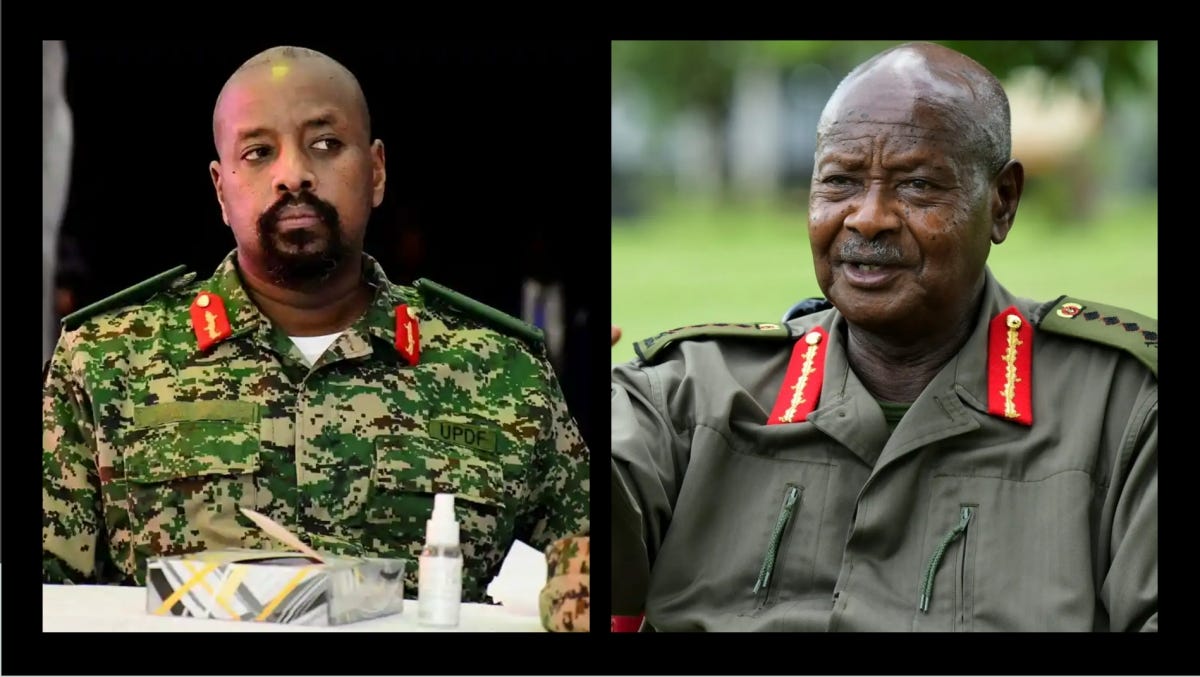
The jitters in Uganda at the unexpected coup were understandable. Uganda, as it currently stands, is heading the way of Gabon, where a head of state is succeeded by his son.
The NRM supporters’ argument is that since their regime has lasted this long, this is proof of its inherent strength and, therefore, it will continue to last into the indefinite future.
Gabon was proof that there are no such guarantees.
A head of state can rule unchallenged for decades, be succeeded by his son, who contests two general elections in his own right, has just been re-elected in a general election, and appears set for another extended period in power.
Part of the NRM’s strength is that the nearly four decades in power have imprinted on the Ugandan consciousness the conviction that it is an invincible government.
Any suggestion that it is not invincible presents a crisis within the NRM state.
Opposition activists who had started losing hope and giving up, received a ray of hope from the Gabon coup that change is possible, however long it takes.
If the argument is that a coup cannot happen because the Uganda People’s Defence Force (UPDF) is a passive, apolitical army, the same could have been said of the Gabonese army.
Another argument is that the UPDF is an army of ideologically-oriented soldiers who are not just men at arms but are drilled in political history and statecraft and, goes the argument, cannot contemplate a coup.
As I argued two years ago during an NTV discussion on the army, in certain countries such as Turkey, Burma, Pakistan, Egypt, Algeria, Thailand, and others, the army views itself as the final custodian of the state.
The UPDF views itself that way, which both makes a coup as unlikely as likely.
The last 30 years of peacekeeping deployment starting in Liberia in 1991 under Maj Gen Levi Karuhanga to deployments in the Democratic Republic of Congo, South Sudan, Somalia, and the Central African Republic have given the UPDF a feeling of institutional responsibility to prevent the disintegration of African states.
Army generals past and present have witnessed first-hand what it means for a country’s terrain to be reduced to impassable roads (Central African Republic, eastern Congo) or total insecurity in the heart of the capital city (Somalia, South Sudan).
If a breakdown of the state were to become increasingly likely, Uganda’s army would be the first to know what will follow and some among the top brass might be convinced to make sure nothing of the sort happens.
Secondly, Uganda is one of several African countries for whom the coup, coup plot, and armed rebellion are ingrained in the national political culture.
Among the others are Chad, Guinea-Bissau, Ethiopia, Guinea, Somalia, Burundi, Congo, and Rwanda.
At any one time, there is a coup plot or an armed liberation front in operation in these countries.
Since the 1971 military coup that brought Idi Amin to power, the mentality of resorting to guerrilla warfare to topple a sitting government or resolve political questions has never left Uganda.
A reading of or listening to accounts of Ugandan history since 1971 indicates that there is always a Yoweri Museveni, Joseph Kony, Moses Ali, David Oyite-Ojok, Herbert Itongwa, Chefe Ali, Francis ‘Hitler’ Eregu, Salim Saleh, Sam Magara, George Nkwanga, Amon Bazira, Andrew Kayiira, Francis Bwengye, Amin Onzi, Gertrude Njuba, Roland Kakooza-Mutale, Pecos Kuteesa, Juma Oris, Ateker Ejalu, Olive Zizinga, Samuel Kasirye-Gwanga, Hope Kivengere, or David Tinyefuza lurking somewhere.
Several of the early NRA commanders such as Sam Magara, Fred Rubereza, Elly Tumwine, Sam Katabarwa and others were from the Ankole royal family or royal clan, the Bahinda.
So, it’s not just those from impoverished or obscure backgrounds who decide to take up arms and fight a sitting government.
From day one of the NRM government, it has had to confront various armed groups of different capacity and motivation.
The facts of Ugandan history over the last 50 years indicate this template of armed rebellion, often with mild-looking men and women in the political wing.
From time to time, military intelligence uncovers such plots and they are quashed.
What might the motivation for coup plotters be today? Sometimes, it is just irrational human nature.
In 1986, in quiet, orderly, well-run, democratic Sweden, the Prime Minister Olaf Palmer was shot dead in a street in the capital Stockholm.
In 2003, in the same calm, low-key, orderly Sweden, the Foreign Minister Anna Lindh was stabbed to death.
In 2021, a man acting alone shot dead the former Japanese Prime Minister Shinzo Abe, in the same calm, well-run, democratic, affluent society that Sweden is.
If such shocking incidents can happen in Sweden and Japan, how much more can they happen in banana republics with all their stress, poverty, mismanagement, corruption, injustices, and rigged elections?
Human nature, political sentiment, personal ambition, and irrational motives are so complicated and unpredictable that nothing can be ruled out.
Peacekeeping deployment
The last 30 years of peacekeeping deployment starting in Liberia in 1991 under Maj Gen Levi Karuhanga to deployments in the Democratic Republic of Congo, South Sudan, Somalia, and the Central African Republic have given the UPDF a feeling of institutional responsibility to prevent the disintegration of African states.
Army generals past and present have witnessed first-hand what it means for a country’s terrain to be reduced to impassable roads (Central African Republic, eastern Congo) or total insecurity in the heart of the capital city (Somalia, South Sudan).