
Ujasusi Blog’s East Africa Monitoring Team | 29 Dec 2025 | 0250 GMT
Snapshot
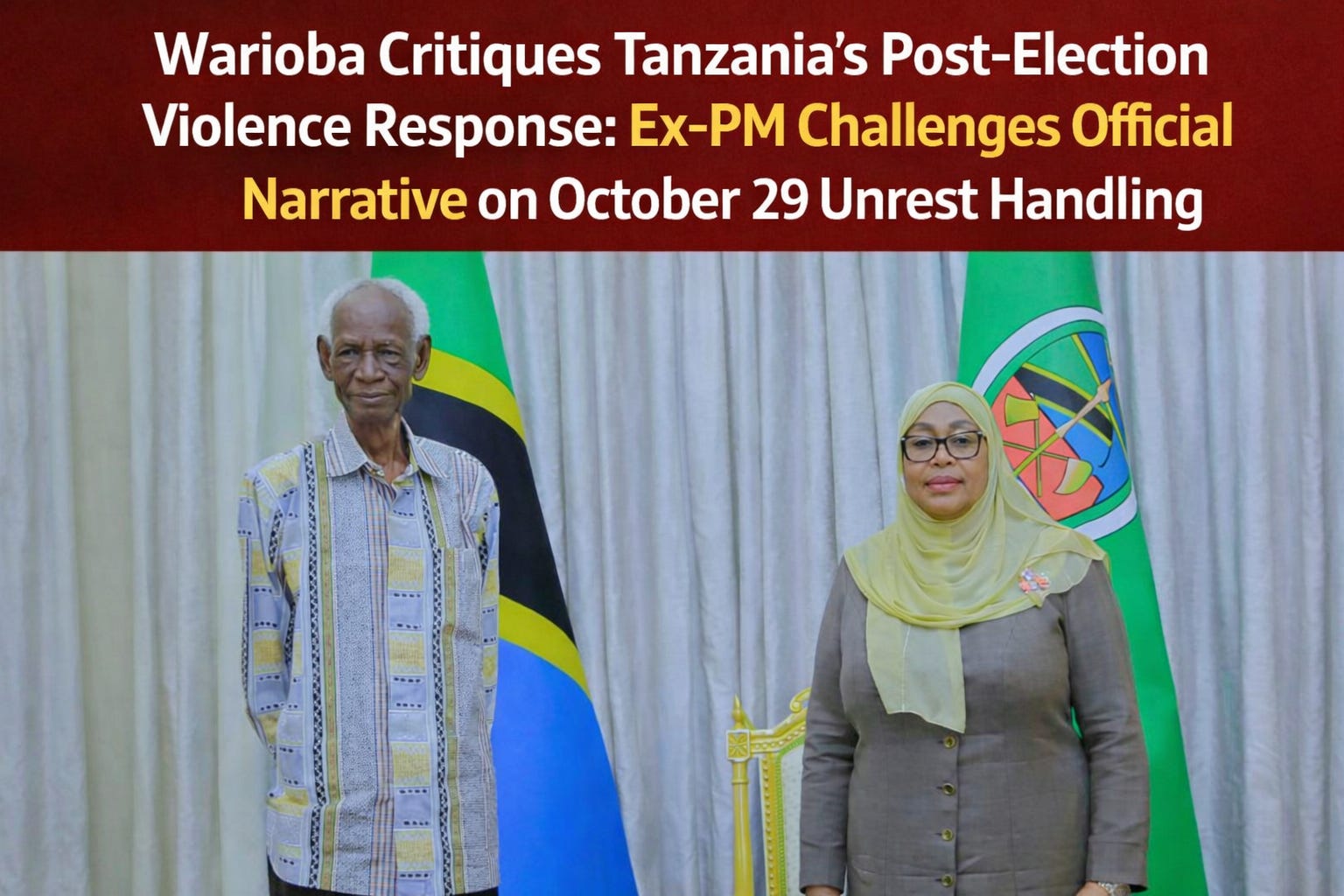
Former Tanzanian Prime Minister Joseph Sinde Warioba publicly challenged the government’s characterisation of October 29, 2025 post-election violence, arguing security forces used disproportionate force resulting in casualties exceeding the 1978-79 Kagera War. Speaking to Jamhuri newspaper after meeting President Samia Suluhu Hassan, Warioba questioned security preparedness, demanded casualty disclosure, and warned of dangerous political divisions within law enforcement.
📊 Executive Summary: Key Intelligence Indicators
Critical Data Points:
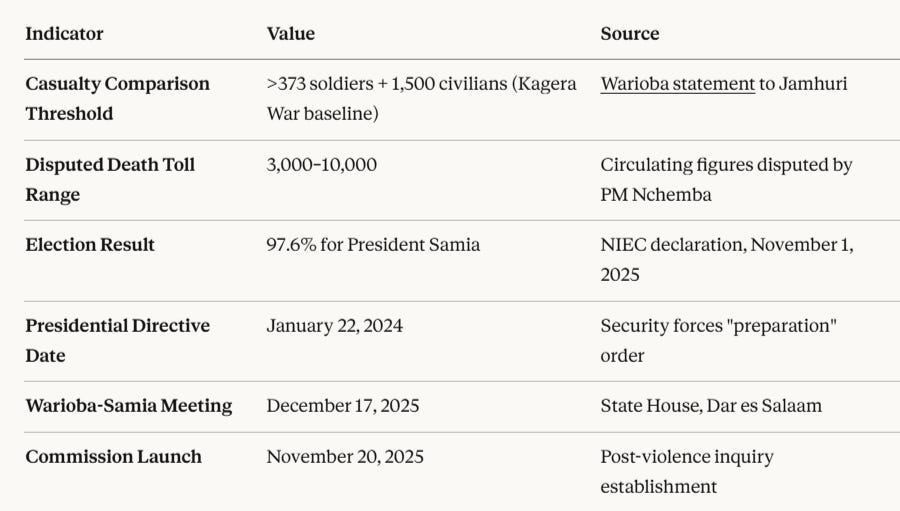
Strategic Significance: Warioba’s intervention represents the first high-level elite criticism of the government’s security response from within Tanzania’s political establishment, potentially signalling fractures in regime consensus.
❓ What Did Joseph Warioba Actually Say About the October 29 Violence?
Warioba’s December 2025 interview with veteran journalist Manyerere Jackton for Jamhuri newspaper contained three core analytical arguments:
1. Disproportionate Force Assessment
Primary Statement:
“When you look at the figures being talked about, the number of those killed is greater than those who died in the Kagera War. In that war, we were killed by an enemy. Here, we are killing ourselves.”
Analytical Framework:
Comparative Baseline: Kagera War (October 1978–June 1979)
Civilian deaths: ~1,500 (Ugandan invasion phase)
Military deaths: 373 Tanzanian soldiers
Total: 1,873 casualties
Implication: If circulating figures (3,000–10,000) are accurate, post-election deaths exceed full-scale international war
Operational Context: Warioba distinguished between external enemy combat and internal security operations
2. Security Preparedness Question
Direct Quote:
“We have to ask ourselves, how did they prepare? Did they prepare with guns and bullets, because that is what they used most?”
Intelligence Assessment:
Presidential directive issued: January 22, 2024 (9 months before election)
Warioba’s framing: Security preparation focused on kinetic response rather than crowd control protocols
Critical Question: Did preparation protocols authorise lethal force as primary response mechanism?
3. Politicisation of Security Organs
Incident Report (September 2024): Two traffic police officers approached Warioba’s vehicle to deliver unsolicited testimony:
Officer Statement (paraphrased):
“Sir, we are grateful for seeing you. We ask for your help, you elders. All this time, we have been working without discrimination based on religion or tribe, but now politics has divided us. It has divided us a lot. We are working in a very difficult environment.”
Analytical Implications:
Internal security organ fragmentation along political lines
Breakdown of institutional neutrality
Operational environment degradation pre-October 29
Direct testimony from law enforcement personnel to former Prime Minister indicates severity of internal crisis
❓ How Does the Government’s Position Differ From Warioba’s Analysis?
Government Narrative Framework
President Samia Suluhu Hassan (December 2, 2025 speech):
Characterisation:
Not: Peaceful demonstrations
Classification: “Organised riots with specific purposes”
Alleged Objectives:
Attacking police stations to seize weapons
Burning public property
Burning private property
Destabilisation operations
Force Justification:
“In such a situation, the force used corresponds to the incident at hand.”
Rhetorical Question: “What lesser force could have been applied against a ‘mob’ attempting a coup?”
Prime Minister Mwigulu Nchemba Position
On Death Toll Disclosure (December 18, 2025):
Argument Structure:
Disputed Figures: Rejected 3,000–10,000 range as fabricated
Accusation: Compilers “trading with the lives of Tanzanians” for monetary gain
Logical Challenge: “You can hide bodies, but you cannot hide people grieving”
Alternative Framing: “Economic sabotage” rather than political protest
Non-Disclosure Rationale: Releasing figures would be “disrespectful to grieving families”
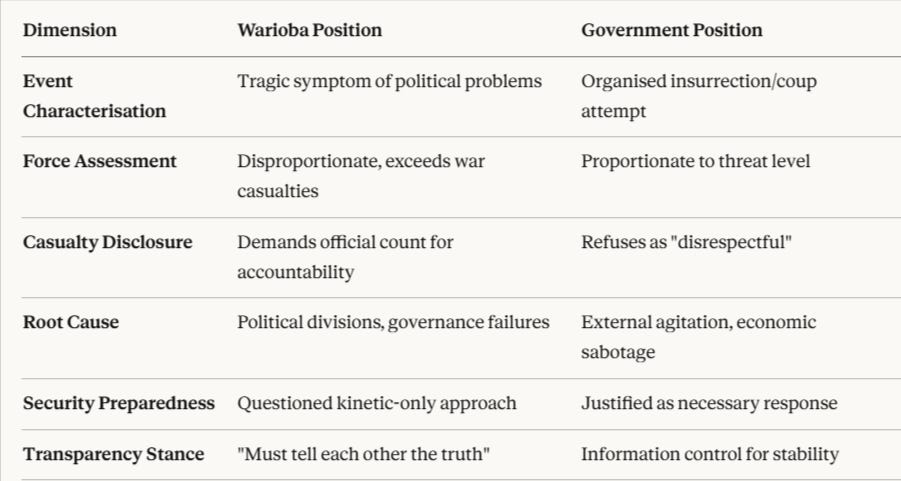
Comparative Analysis Table
❓ What Is the Historical Context of the Kagera War Comparison?
Kagera War (Vita ya Kagera): Baseline Metrics
Conflict Timeline: October 1978 – June 1979
Casualty Breakdown (from Warioba’s statement):
Ugandan Invasion Phase:
Civilian deaths: Approximately 1,500 Tanzanian civilians killed by Ugandan forces
Context: Systematic killings during occupation of Kagera Salient
Full Conflict:
Tanzanian military deaths: 373 soldiers
Total documented casualties: 1,873 (1,500 civilians + 373 soldiers)
Outcome: Overthrow of Idi Amin regime
Why This Comparison Matters for Intelligence Analysis
1. Operational Scope Differential
Kagera War: 8-month international conflict
October 29 Violence: Single-day nationwide urban unrest
2. Legitimacy Framework
Kagera War: Internationally recognised defence against foreign aggression
October 29: Internal security operation against citizens
3. Historical Memory Activation
Kagera War = Tanzania’s defining post-independence military operation
Warioba’s invocation = deliberate triggering of national trauma memory
Strategic messaging: “We survived external enemy but dying by our own hand”
4. Threshold for “Disproportionate” Assessment
Warioba’s argument: If October 29 deaths exceed 1,873 total war casualties, force was disproportionate
Government’s counter: Force matched threat of “coup attempt”