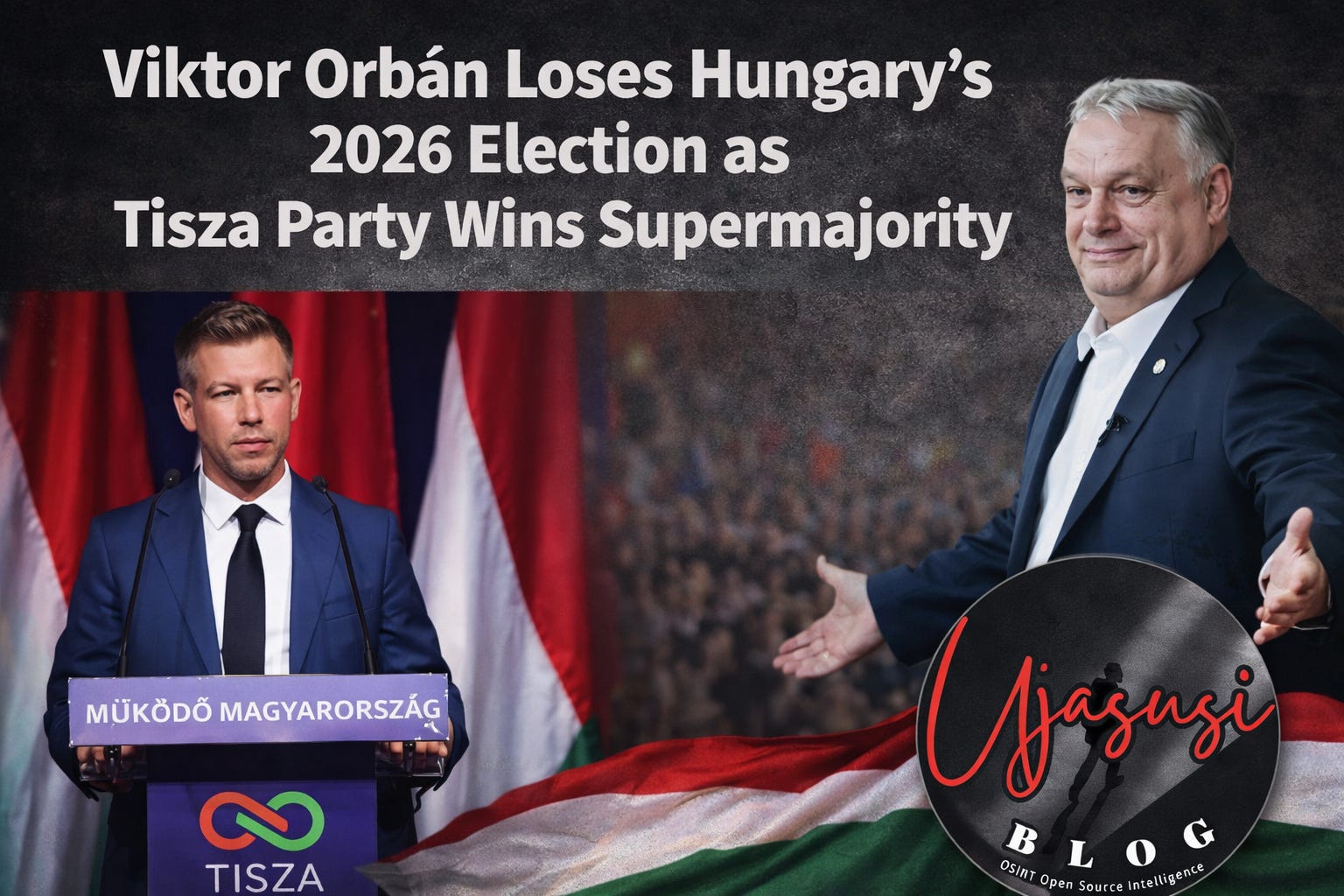
Viktor Orbán Loses Hungary’s 2026 Election as Tisza Party Wins Supermajority
Ujasusi Blog’s Europe Desk | 13 April 2026 | 0045 BST
Viktor Orbán, Hungary’s Prime Minister since 2010, conceded defeat on 12 April 2026 after Péter Magyar’s centre-right Tisza Party won the country’s parliamentary election by a landslide. With 97.35% of precincts counted, Tisza secured 138 seats in the 199-seat National Assembly on 53.6% of the vote; Fidesz took just 55 seats on 37.8%. The result ends 16 years of uninterrupted Fidesz governance and carries direct consequences for EU cohesion, NATO unity, the Ukraine war effort, Hungarian intelligence alignment, and Chinese investment exposure across Central Europe.
What Triggered Orbán’s Defeat After Four Consecutive Supermajorities
Magyar, 45, was a Fidesz insider until a presidential pardon scandal fractured his allegiance to the party in early 2024. Hungary’s then-president Katalin Novák had pardoned a former official convicted of helping cover up the abuse of children at a state home; Justice Minister Judit Varga — Magyar’s former wife — was also implicated, and both women resigned. Magyar used the resulting public outrage as the foundation for a political movement that grew at a pace Hungarian politics had not seen since the post-communist transition.
He broke formally with Fidesz in 2024 and toured Hungary relentlessly, holding rallies in settlements big and small — at one point visiting up to six towns daily. The structural odds were against him from the outset: Fidesz’s unilateral redrawing of Hungary’s 106 electoral districts required Tisza to win an estimated 5% more votes than Orbán’s party just to secure a simple majority. That Tisza cleared the constitutional supermajority threshold regardless is the clearest measure of the scale of the swing.
Turnout reached a record 77.8% — the highest ever recorded in a Hungarian parliamentary election — a figure that historically benefits opposition mobilisation over an entrenched incumbent.
How Orbán’s Russia Alignment Eroded His Electoral Base
Orbán’s foreign policy record became the central liability his media apparatus could not fully suppress. He repeatedly frustrated EU efforts to support Ukraine, cultivated close ties to President Vladimir Putin, and refused to end Hungary’s dependence on Russian fossil fuel imports. A senior government official had, according to published reporting, regularly shared the contents of EU discussions with Moscow — raising accusations that Budapest was acting on Russia’s behalf inside the bloc.
Fidesz campaign billboards featured portraits of Ukrainian President Volodymyr Zelenskyy alongside negative slogans portraying him as representing a “pro-war lobby” in Brussels. The strategy misfired against a record-turnout electorate. Russian intelligence services were reported to have plotted electoral interference in Orbán’s favour — an allegation that compounded the opposition’s framing of Fidesz as an instrument of external interests rather than a guarantor of Hungarian sovereignty.
Orbán’s posture on Ukraine financing placed Hungary in direct institutional conflict with Brussels. He blocked a €90 billion EU loan to Ukraine, demanding in exchange the resumption of oil deliveries via the Druzhba pipeline — reportedly damaged in a Russian attack in January 2026 — while accusing Kyiv of deliberately cutting supply.
Orbán also maintained a close political alliance with Russian President Vladimir Putin throughout the war in Ukraine, a posture that drew sustained criticism from EU partners and NATO allies. His government’s alignment with Moscow, combined with a documented pattern of obstructing EU decision-making on sanctions and military support, defined the central fault line of the 2026 campaign.
Who Péter Magyar Is and What Tisza Has Promised
Magyar is a lawyer and former senior figure within the Fidesz elite who recast himself as an anti-corruption candidate after his public break with the party. He campaigned on issues affecting ordinary voters — Hungary’s faltering public healthcare system, deteriorating public transport, and systemic government corruption. Tisza is a member of the European People’s Party, the mainstream centre-right political family governing 12 of the EU’s 27 member states — an affiliation that gives Magyar an immediate institutional network inside the Commission and the European Parliament.
His stated first-term priorities include anti-corruption legislation, an asset recovery office, joining the European Public Prosecutor’s Office, imposing a two-term cap on prime ministers, and suspending public media broadcasts pending restoration of balanced editorial standards. In his victory address to tens of thousands gathered along the Danube in Budapest, Magyar declared that Hungary will reintegrate into the EU’s judicial system and serve as a strong ally of both the European Union and NATO. He signalled his first foreign visits as prime minister would be to Warsaw, Vienna, and Brussels — a deliberate reanchoring within Central European democratic structures.
The Intelligence Dimension: Hungary’s Information Service Under New Management
Hungary’s civilian intelligence agency, the Information Service (IH), operated throughout the Fidesz period within a state structure that maintained active engagement with Moscow and facilitated Chinese infrastructure investment in security-sensitive contexts — most notably the Budapest-Belgrade railway, financed under China’s Belt and Road Initiative, and the BYD manufacturing facility at Debrecen. Allied services treated Budapest as a qualified intelligence risk within NATO’s sharing architecture, calibrating multilateral disclosures accordingly.
Magyar’s government faces a dual imperative: rebuilding trust with partner services and conducting a counterintelligence audit of IH personnel appointed or promoted under Fidesz direction. Purges conducted too rapidly destabilise operational continuity; purges delayed allow compromised access to persist. Warsaw and Prague, both of which raised Budapest’s reliability as a concern in NATO formats, will watch Magyar’s first IH appointments closely.
The analytical inference the open record does not yet support but the evidence warrants: an IH that operated inside a hybrid-state structure for 16 years, with documented government-level intelligence sharing between Budapest and Moscow, almost certainly developed informal working relationships with GRU and FSB structures that will not appear in formal liaison records. Magyar’s government will not inherit a clean institution — it will inherit one with layered loyalties that years of careful management, not a single personnel reshuffle, will be required to resolve.
EU, NATO, and Chinese Investment: The Cascading Consequences
The EU consequences are immediate and quantifiable. Orbán’s departure removes Moscow’s most reliable veto lever inside the European Council — the instrument through which Russia stalled decisions on Ukraine financing, sanctions packages, and enlargement-adjacent security commitments across four years of full-scale war. A Magyar-led Hungary is expected to move quickly to unlock frozen EU structural funds and open the path for the €90 billion Ukraine loan Orbán blocked.
Within NATO, the change removes the single member state that most consistently delayed consensus on Ukraine support. Magyar’s public commitment to full NATO alignment closes the procedural gap Moscow exploited across the 2022–2026 period.
China’s Belt and Road exposure in Hungary now faces policy review. The Budapest-Belgrade railway and the Debrecen BYD plant proceed under existing contracts, but a Magyar government is unlikely to approve additional BRI-linked financing and may apply national security screening that Fidesz deliberately avoided. Beijing will register this as a material setback for its Central European positioning and will likely accelerate compensatory engagement with Belgrade and Bratislava.
On energy dependency and the pace of support for Ukraine, the shift will take longer than the election result alone suggests. Years of anti-Ukrainian messaging and the opacity of Hungary’s Russian energy relationships mean a full posture change will be politically and administratively difficult in the short term. The 12 April result is not simply Hungary’s domestic reckoning with 16 years of institutional capture. It is a test of whether entrenched hybrid-state systems can be dismantled through the ballot box. The answer, for now, is that they can be voted out. Whether they can be fully dismantled is the question Magyar’s government will spend its entire first term trying to answer.
Independent intelligence analysis takes time and resources — if this work matters to you, please consider supporting it by donating HERE