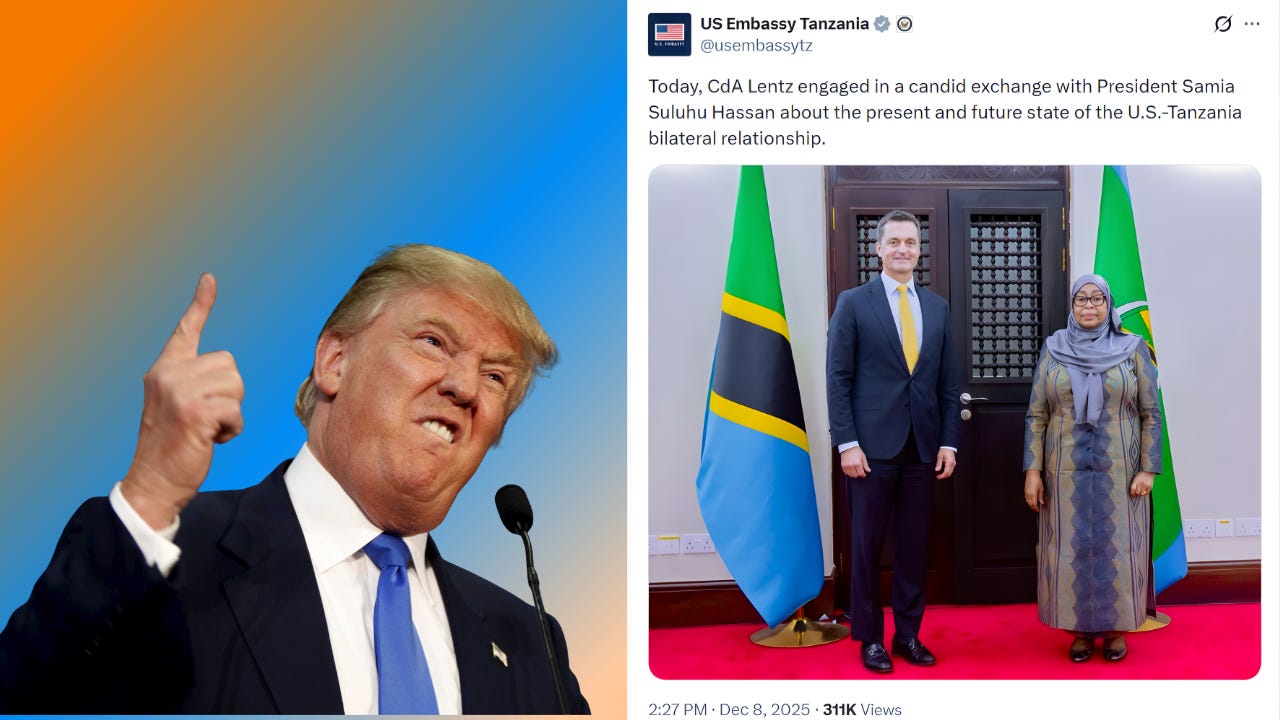
US Travel Ban on Tanzania: Comprehensive Analysis of December 2025 Restrictions
Ujasusi Blog’s East Africa Monitoring Team | 18 Dec 2025 | 0430 GMT
🔓FREE ACCESS
Please consider becoming a paid subscriber
You can also donate.
Snapshot
On 17 December 2025, President Donald Trump imposed partial travel restrictions on Tanzania, suspending immigrant visas and non-immigrant B-1/B-2, F, M, and J visas effective 1 January 2026. The proclamation cited visa overstay rates of 8.30% (tourist/business) and 13.97% (student/exchange), whilst occurring amid US concerns over post-election violence following Tanzania’s disputed 29 October 2025 elections.
What Are the Specific Travel Restrictions Imposed on Tanzania?
Trump’s Presidential Proclamation placed Tanzania under “partial restrictions” alongside 14 other nations including Angola, Benin, Nigeria, Senegal, Zambia, and Zimbabwe.
Visa Categories Affected:
Immigrant visas: Complete suspension
B-1/B-2 visas (business and tourism): Suspended
F visas (international students): Suspended
M visas (vocational training): Suspended
J visas (exchange visitors): Suspended
Exemptions:
Lawful permanent residents (Green Card holders)
Existing valid visa holders
Diplomatic and official passport holders
Athletes in major competitions
Dual nationals using non-restricted passports
Case-by-case waivers for US national interest
Implementation Date: 1 January 2026
What Was the Timeline of Events Leading to the Travel Ban?
Late November 2025:
Senators Jim Risch and Jeanne Shaheen issued bipartisan statement declaring Tanzania’s 29 October election “marred by state-sponsored political repression, targeted abductions and manipulation.” They stated: “Tanzania’s election was decided well before October 29th” and claimed the “heavy handed security response resulted in the death of hundreds and the abduction and imprisonment of many more.”
Representative Ayanna Pressley called for independent investigation, stating: “We are deeply alarmed by reports out of Tanzania, where a police crackdown on protests has left hundreds of people dead.”
4 December 2025:
US State Department announced comprehensive review through Principal Deputy Spokesperson Tommy Pigott: “The United States is comprehensively reviewing our relationship with the Government of Tanzania.” The statement cited “ongoing repression of religious freedom and free speech, persistent obstacles to US investment, and disturbing violence against civilians.”
8 December 2025:
President Samia Suluhu Hassan hosted US Chargé d’Affaires Andrew Lentz at Chamwino State House. Tanzania’s messaging focused on three major projects:
$42 billion LNG project - entering final stages
$942 million Tembo Nickel investment
$300 million Mahenge Graphite development
Ambassador Lentz stated: “The United States is committed to a relationship based not on aid dependency but on shared prosperity.”
However, the US Embassy characterised discussions as “a candid exchange about the present and future state of the US-Tanzania bilateral relationship.”
15 December 2025:
Semafor reported Tanzania’s government circulated “request for proposals” to Washington lobbying firms with objectives including:
Bolster existing Congressional relationships
Deploy media expertise countering repression reports
Address religious oppression claims
Tanzania has not retained a full-time Washington lobbyist for over a decade.
17 December 2025:
Trump announced the travel ban, just two days after the Semafor lobbying report.
What Are the Complete Casualty Figure Estimates?
ICC Submissions:
Intelwatch ICC submission (27 November 2025) alleged 5,000-10,000 people killed over three days following election protests.
Cristina Roque, Executive Director: “These were sham elections to be able to put in a President who had lost credibility and legitimacy.”
Evidence submitted:
Morgue documentation (one morgue alone: 800 bodies)
Hospital records
Thousands of videos showing execution-style killings
Sniper attacks from significant distances
Operations allegedly directed by President’s son heading intelligence services
Medical professionals threatened with death if releasing casualty figures
Madrid Bar Association and World Jurists Association joint petition documented “coordinated assault on protest sites” with “security forces opened fire without warning” and “volleys of automatic weapons fire directed into crowds of unarmed civilians.”
UN Human Rights Chief Volker Türk acknowledged “access restrictions mean the actual number is likely higher.”
Evidence of Concealment:
Security forces transported bodies to undisclosed locations
Internet shutdown prevented documentation
Mass graves allegedly dug nationwide
Bodies removed from streets and hospitals
Government has not released official death toll
What Is the Broader Geopolitical Context?
Trump’s 16 December 2025 proclamation represented the largest expansion of US travel restrictions since his first-term travel ban.
Full Entry Restrictions (8 countries):
Burkina Faso, Mali, Niger, South Sudan, Syria
Palestinian Authority travel document holders
Laos, Sierra Leone (upgraded)
Partial Entry Restrictions (15 countries):
Africa (12): Angola, Benin, Côte d’Ivoire, Gabon, Gambia, Malawi, Mauritania, Nigeria, Senegal, Tanzania, Zambia, Zimbabwe
Caribbean (2): Antigua and Barbuda, Dominica
Pacific (1): Tonga
Total: 39 nations under restrictions
Administration Justification:
Affected countries suffer from “widespread corruption, fraudulent or unreliable civil documents and criminal records, and nonexistent birth-registration systems.”
What Were Tanzania’s Post-Election Observer Assessments?
SADC observers declared elections “did not meet the organisation’s standards for a credible, free and fair process.” SADC observers were “harassed in Tanga and forced to delete evidence.”
African Union found “low turnout in all polling stations, evidence of widespread intimidation tactics, pre-election abductions” - the “harshest assessment [by AU] in recent memory.”
European Union: “Neither free nor fair”
ANC (South Africa): Unable to observe due to “breakdown in communications”
Election Context:
Samia Suluhu Hassan victory: 97-98%
Major opposition barred: Tundu Lissu (detained on treason charges since April 2025), Luhaga Mpina (disqualified)
Nationwide internet shutdown from 29 October
Curfew imposed in multiple cities
What Are the Economic Implications for Tanzania?
US-Tanzania Economic Relationship:
Total bilateral trade (2024): $1.4 billion
US investment in Tanzania: Over $1 billion
Annual US contribution: $2.8-3 billion (2012-2022 average)
Strategic Projects at Risk:
LNG Development: $42 billion
Tembo Nickel: $942 million
Mahenge Graphite: $300 million
Total pipeline: >$43 billion
PEPFAR Investment:
US spending since 2003: $7 billion
Estimated lives saved: 750,000
Millennium Challenge Corporation returned to consider Tanzania investments under Samia after Magufuli-era suspension - status now uncertain.
How Does This Compare to Previous US-Tanzania Relations?
Magufuli Era (2015-2021):
Systematic opposition restrictions, media crackdowns
MCC suspended engagement
Key Difference: No travel ban imposed despite democratic backsliding
Samia’s Opening (2021-2024):
Restored newspaper licences
Dropped terrorism charges (briefly)
Lifted rally ban (temporarily)
Vice President Kamala Harris visit (March 2023): Praised Samia as “champion for democracy”
2025 Reversal:
The travel ban represents the most severe US measure against Tanzania since diplomatic relations established in 1961. Tanzania now categorised alongside Syria, South Sudan, Burkina Faso - all facing active conflicts or coups.
What Are Tanzania’s Response Options?
Diplomatic Channels:
Tanzania’s Foreign Ministry confirmed engagement with US State Department seeking “lasting solution through diplomatic means.”
Compliance Path:
To achieve removal, Tanzania must demonstrate:
Improved Vetting Cooperation:
Enhanced biometric data sharing
Criminal record system modernisation
Civil document fraud prevention
Reduced Overstay Rates:
Stricter pre-departure screening
Compliance education
High-risk category monitoring
Human Rights Improvements:
Independent investigation of post-election violence
Release of political detainees
Press freedom restoration
Religious freedom protection
Historical Examples:
Chad (2017): Removed from Trump’s first ban after improving information-sharing
Turkmenistan (2025): Restrictions lifted citing “significant progress”
What Do International Relations Experts Assess?
Michael Strain, Bowmans Tanzania: “Tanzania has sustained 5 to 6% GDP growth for over a decade... Today’s challenges won’t erase Tanzania’s long-term fundamentals.”
Africa Centre for Strategic Studies described events as “Msiba Mkuu ya Taifa letu Tunaiyopenda” (”The Great National Catastrophe that has Befallen the Nation We Dearly Love”).
What Is the Outlook for US-Tanzania Relations?
State Department position: “The future of our bilateral relationship with the Government of Tanzania will be based on its actions.”
Potential Scenarios:
Scenario 1: Escalation
Country of Particular Concern designation for religious freedom violations
Full travel ban (all visa categories)
Targeted sanctions on Tanzanian officials
MCC eligibility formally suspended
AGOA benefits reviewed
Scenario 2: Status Quo (Most Likely)
Partial ban remains through 2026
Continued diplomatic review without resolution
US investments proceed selectively
Tanzania pursues alternative partnerships (China, Russia, Gulf states)
Scenario 3: Diplomatic Resolution
Tanzania conducts credible investigation
Releases political prisoners
Improves vetting cooperation
US lifts restrictions within 6-12 months
Current trajectory suggests Scenario 2 most likely, with potential escalation if additional religious freedom violations documented or US citizens harmed.
Final analysis
The 17 December 2025 US travel ban on Tanzania represents the culmination of a two-month diplomatic crisis. Despite Tanzania’s attempt to leverage over $43 billion in pending US investments and employ Washington lobbyists, the Trump administration prioritised immigration enforcement and human rights concerns. With ICC submissions alleging 5,000-10,000 deaths and mass graves, Tanzania faces its lowest point in US relations since independence. The ban takes effect 1 January 2026.