📊 US Military Strikes Nigeria December 2025: AFRICOM Kinetic Intervention Against Islamic State
Ujasusi Blog’s Terrorism Monitor Desk | 27 Dec 2025 | 0035 GMT
🔓FREE ACCESS
Please consider becoming a paid subscriber
You can also donate.
Snapshot
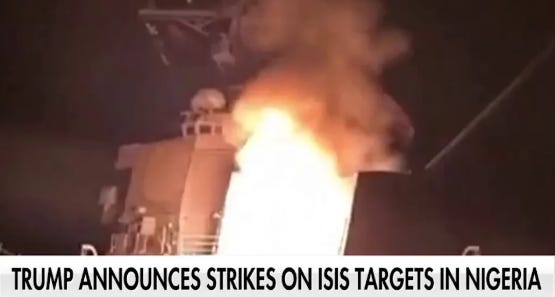
The 25 December 2025 United States military strikes in northwestern Nigeria represent the first kinetic intervention by US Africa Command against Islamic State Sahel Province (ISSP) targets on Nigerian territory. Conducted via naval assets and MQ-9 Reaper drones in the Gulf of Guinea region, the operation targeted Lakurawa militant camps using precision munitions, marking a strategic shift from partnership-based counterterrorism to unilateral force projection in West Africa’s evolving security architecture.
What Operational Framework Did AFRICOM Deploy in the Nigeria Strikes?
The United States Africa Command executed a precision strike operation on 25 December 2025 against Islamic State affiliates in northwestern Nigeria using a combination of offshore naval platforms and unmanned aerial systems. The strike operation targeted camps associated with the Islamic State Sahel Province (ISSP), specifically the Lakurawa faction operating across Sokoto and Kebbi States.
Operational Architecture:
Strike Platform: US Navy vessel (Tomahawk cruise missiles) and MQ-9 Reaper drones
Munitions Deployed: 16 GPS-guided precision munitions launched via MQ-9 Reaper drones (Nigerian Information Minister statement), plus Tomahawk cruise missiles from naval vessel
Target Location: Bauni forest, Tangaza area, Sokoto and Kebbi States, northwestern Nigeria
Intelligence Coordination: Nigerian National Intelligence Agency provided target coordinates
Forward Staging: Surveillance missions utilised airport facilities in Ghana as forward operating base
Command Authority: Presidential directive executed through Secretary of Defence authorisation
Strike Duration: 12:12-1:30 a.m. local time (25 December 2025)
Tactical Outcome: AFRICOM assessment confirms militant casualties with infrastructure degradation
The AFRICOM press statement confirmed the operation received presidential approval, with Secretary of State Marco Rubio coordinating diplomatic clearance through Nigerian Foreign Minister Yusuf Tuggar. President Bola Ahmed Tinubu provided operational consent following bilateral security consultations.
Strike Execution Timeline:
Nigerian Information Minister Mohammed Idris confirmed that debris from expended munitions fell in Jabo (Sokoto State) and Offa (Kwara State), with no civilian casualties reported.
What Geopolitical Vacuum Enabled the Operation?
The 2025 West African security landscape is characterised by a critical vacuum following the withdrawal of United States military presence from Niger, Mali, and Chad. The expulsion of US forces from Air Base 201 in Agadez, Niger (August 2024), eliminated the primary intelligence, surveillance, and reconnaissance (ISR) node monitoring transnational jihadist movements across the Sahel-Sahara corridor.
Sahel Security Deterioration Metrics:
US Bases Lost: Air Base 201 (Niger, August 2024), Barkhane facilities (Mali), forward staging posts (Chad)
ISR Coverage Loss: Complete cessation of MQ-9 Reaper drone surveillance operations, eliminating primary intelligence node for Nigeria-Niger border monitoring
Jihadist Transit Corridors: 5 primary routes now unmonitored between Sahel and Nigerian interior
Wagner/Africa Corps Deployment: Mali (2,500 personnel), Burkina Faso (100-300), Niger (100+)
Chinese Infrastructure Investment: $1.3 billion lithium sector commitments since September 2023
Turkish Defence Exports: Bayraktar TB2 drone sales to Nigeria, Niger (pre-coup)
The Russian-led Africa Corps has systematically replaced the Wagner Group as the primary regime protection apparatus for military juntas across the Alliance of Sahel States (AES)—Mali, Burkina Faso, and Niger. Moscow’s operational framework extends beyond kinetic security provision to sophisticated information operations targeting Nigeria’s demographic majority.
Russian Information Operations Architecture:
The Ukrainian Foreign Intelligence Service documented systematic disinformation campaigns on Telegram and the Afree application platform targeting Nigerian youth (70% of population under 30 years). These operations aim to delegitimise state institutions ahead of the February 2027 presidential elections through narratives emphasising:
Government corruption and elite incompetence
Western neocolonial exploitation of resources
Chinese/Russian partnership as sovereignty-preserving alternative
Religious sectarianism to amplify Christian-Muslim tensions
How Do Great Powers Compete in Nigeria’s Strategic Space?
Nigeria’s position as Africa’s largest economy (GDP $477 billion, 2024) and most populous nation (223 million) has intensified great power competition across multiple strategic domains.
Great Power Strategic Competition Matrix:
China’s strategic positioning leverages mineral diplomacy to secure dominance in Nigeria’s critical mineral sector. Beijing’s lithium value chain investments totalling $1.3 billion since September 2023 position Chinese state-owned enterprises (Canmax Technology, Jiuling Lithium, Avatar New Energy Nigeria Company, Asba) as primary beneficiaries of Nigeria’s energy transition resource base.
Chinese Strategic Advantages:
Diplomatic Shield Function: Beijing characterises US CPC designation and intervention threats as unilateralist overreach
Resource Supply Security: Lithium, cobalt, rare earth elements for battery manufacturing
Infrastructure Leverage: $23 billion cumulative Nigerian infrastructure investments create dependency relationships
Non-Interference Narrative: Positions China as respecting Nigerian sovereignty versus Western “regime change” agendas
What Capabilities Define Nigerian Jihadist Groups in 2025?
Jihadist organisations operating across Nigeria have evolved from rudimentary insurgencies to technologically sophisticated entities with governance structures, revenue generation mechanisms, and transnational linkages.
Islamic State West Africa Province (ISWAP): Northeastern Theatre
ISWAP operates primarily in Borno and Yobe States, demonstrating advanced tactical capabilities that have degraded Nigerian military infrastructure.
ISWAP Tactical Evolution (2025):
The intensification of ISWAP operations resulted in at least twelve coordinated attacks on military bases across Borno State between January and May 2025, with the group demonstrating improved command-and-control capabilities. Notable incidents include the deaths of 20 soldiers in Malam-Fatori (January 2025) and systematic targeting of the military’s supercamp strategy infrastructure.
Lakurawa (ISSP): Northwestern Governance Insurgency
The Lakurawa faction represents the primary target of the 25 December 2025 US strikes. Operating as an Islamic State Sahel Province affiliate, Lakurawa emerged initially as a community defence force before radicalising into a governance insurgency.
Lakurawa Operational Profile:
Geographic Footprint: Approximately 500 villages across Sokoto and Kebbi States
Recruitment Methodology: Cash payments to vulnerable youth, status symbols including specialised desert motorbikes
Mobility Assets: Specialised desert motorbikes enabling rapid redeployment
Revenue Generation: Zakat collection, livestock taxation (1,800+ cattle stolen, Sokoto), extortion of mining operations, fuel theft from Niger-Benin pipelines
Governance Functions: Dispute resolution, security provision, Sharia law enforcement
Estimated Strength: Over 1,000 fighters (Bonn International Centre for Conflict Studies assessment); local sources report up to 700 members in two local government areas (500 in Gudu, 200 in Arewa)
The Lakurawa governance model exploits state absence in northwestern border regions, providing security and judicial functions that local governments fail to deliver. This creates population dependency relationships that complicate counterinsurgency operations.
What Risks and Unintended Consequences Does Kinetic Intervention Generate?
Remote kinetic strike operations carry substantial risks of collateral damage, strategic blowback, and narrative exploitation by adversarial actors.
Operational Risk Assessment:
Reports from Jabo village indicate missile debris fell in areas where residents reported no recent militant activity, though Nigerian authorities confirmed no civilian casualties. The religious framing of strikes risks sectarian escalation in a country where more Muslims than Christians have been killed by jihadist violence since 2020.
What Strategic Outcomes Will Define Success or Failure?
The 25 December 2025 strikes have generated immediate tactical effects whilst introducing strategic complications that may undermine long-term United States objectives in West Africa.
Immediate Strategic Outcomes:
1. Country of Particular Concern (CPC) Redesignation
The United States redesignated Nigeria as a CPC on 31 October 2025, providing legal justification for threatening to suspend $250 million in security assistance. This designation creates leverage for demanding religious freedom protections whilst simultaneously alienating Nigerian political elites.
2. Chinese Diplomatic Victory
By defending Nigerian sovereignty against United States intervention threats, Beijing has enhanced its positioning as a reliable partnership alternative. This reinforces Nigerian economic dependence on Chinese infrastructure financing and mineral sector investments totalling $1.3 billion in lithium processing alone.
3. Tactical Success Without Strategic Stability
Whilst strikes may degrade Lakurawa operational capacity temporarily, they fail to address governance deficits, corruption, and state absence that enable jihadist expansion. Without investment in institutional capacity building, tactical gains will prove ephemeral.
Kinetic Deterrence in an Era of Strategic Retrenchment
The 25 December 2025 United States military strikes in Nigeria represent a paradigm shift from partnership-based counterterrorism to unilateral kinetic deterrence. Whilst operationally successful in degrading Lakurawa infrastructure, the intervention introduces strategic complications—sectarian escalation risks, sovereignty perception challenges, and enhanced Chinese diplomatic positioning—that may undermine long-term United States objectives in West Africa.
Effective counterterrorism requires addressing governance deficits, economic marginalisation, and state absence that enable jihadist expansion. Absent such comprehensive approaches, tactical strikes will prove insufficient to achieve sustainable stability in Nigeria’s evolving security landscape.