🇺🇸⚔️ U.S. Sanctions Rwanda's Military Over M23 Support: What Does It Mean for the DRC Conflict?
Ujasusi Blog’s Great Lakes Region Monitoring Team | 04 March 2026 | 0110GMT
On 2 March 2026, the U.S. Treasury Department’s Office of Foreign Assets Control (OFAC) sanctioned the Rwanda Defence Force (RDF) and four senior commanders under Executive Order 13413, citing direct military backing for the M23 rebellion in eastern Democratic Republic of Congo. The designations — the most punitive Western action yet against Kigali’s military establishment — follow M23’s seizure of Uvira and continued RDF operations in mineral-rich eastern DRC.
🔍 What Did the U.S. Treasury Actually Sanction?
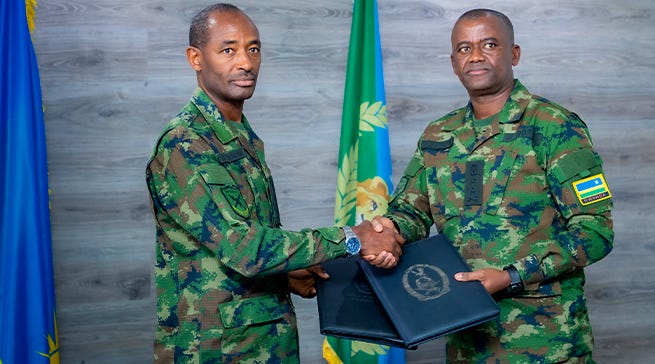
OFAC designated the RDF as an institution and individually sanctioned four senior officers:
General Vincent Nyakarundi — Army Chief of Staff
Major General Ruki Karusisi — Commander, 5th Infantry Division
General Mubarakh Muganga — Chief of Defence Staff
Brigadier Stanislas Gashugi — Special Operations Force Commander
The March 2026 OFAC designation was made pursuant to Executive Order 13413, as amended by E.O. 13671, for actions threatening the peace, security, and stability of the DRC, and for materially assisting M23 through financial, logistical, and technological support. The four officers were designated as leaders of that sanctioned entity.
All RDF property and interests within U.S. jurisdiction are frozen. U.S. persons are prohibited from conducting any transactions with the designated parties. Entities in which the sanctioned parties hold 50% or more ownership are automatically subject to the same restrictions — a standard OFAC escalation mechanism with potentially significant downstream exposure for international banks processing U.S. dollar transactions through correspondent banking networks.
Treasury Secretary Scott Bessent framed the action in explicitly Trumpian terms: “President Trump is the Peace President, and Treasury will use all tools at its disposal to ensure that the parties to the Washington Accords uphold their obligations. We expect the immediate withdrawal of Rwanda Defence Force troops, weapons, and equipment.”
🧩 Why Now? The Strategic Context Behind the Designations
The timing is tied directly to M23’s midnight seizure of Uvira — a strategically significant town along the DRC–Burundi border — days after President Donald Trump hosted Congolese President Félix Tshisekedi and Rwandan President Paul Kagame at the White House to sign the Washington Accords peace deal. The agreement was designed to de-escalate fighting in North and South Kivu and establish a framework for regional economic cooperation. M23’s capture of Uvira, with RDF backing, rendered that framework immediately fragile.
At the UN Security Council, U.S. representative Mike Waltz disclosed that Rwanda had deployed between 5,000 and 7,000 troops inside eastern Congo alongside advanced hardware — including drones, artillery, air defence systems, and GPS-jamming technology. Several strikes, Washington alleged, crossed into Burundian territory, raising the prospect of conflict escalation beyond the DRC perimeter.
Although M23 subsequently withdrew from Uvira under intense diplomatic pressure, OFAC maintained that Rwanda continued to provide material and operational support to M23 in mineral-rich zones including Goma and Bukavu. Critically, the Treasury statement made explicit a dimension frequently understated in diplomatic reporting: the minerals-for-support exchange underpinning Rwanda’s posture — whereby Kigali gains access to mineral-rich DRC territory in direct exchange for its backing of M23. This calculus explains why diplomatic pressure alone has proven insufficient to alter Rwandan behaviour.
📊 What OFAC Alleged: Key Accusations Against the RDF
Allegation Detail Combat operations RDF units fought alongside M23, facilitating territorial seizures including key mining zones Advanced weaponry GPS-jamming systems, air defence equipment, drones, and additional materiel introduced by RDF Training support M23 fighters trained at RDF military centres inside Rwanda Recruitment facilitation RDF supported M23 recruitment, including among refugee populations Human rights abuses M23, with RDF support, engaged in extrajudicial killings, arbitrary arrests, and torture Strategic resource gain Rwanda secured access to mineral-rich DRC territory in exchange for military support
Rwanda has consistently denied all allegations of direct military involvement. In the most detailed official response to the sanctions, government spokesperson Yolande Makolo issued a formal Kigali rebuttal, arguing the measures unjustly targeted Rwanda and distorted the facts of the conflict, while accusing Kinshasa of violating the peace agreement through indiscriminate drone attacks and ground offensives. Rwanda’s government separately told Reuters that Kigali remained “fully committed to disengagement of its forces in tandem with the DRC implementing their obligations” — whilst simultaneously blaming the DRC for failing to end support for the FDLR militia.
President Kagame’s personal posture was characteristically defiant, stating publicly that Rwanda’s armed forces were obliged to take defensive action and that he was not afraid of sanctions.
🌍 What Are the Geopolitical and Intelligence Implications?
For Rwanda’s Defence Establishment
The OFAC designations represent a qualitative escalation beyond previous diplomatic rebukes, UN Group of Experts reports, and aid suspensions. By sanctioning the RDF as an institution, Washington has created systemic exposure across Rwanda’s entire defence-procurement and financing architecture.
Rwanda’s military modernisation programme has historically relied on a broad supplier base. According to RDF procurement analysis published by DefenceWeb in January 2026, the force’s arsenal has historically included equipment of American, French, Chinese, Israeli, Russian, South African, and Turkish origin. Rwanda maintains a particularly close defence relationship with Israel — including a collaboration with Israel Weapon Industries (IWI) for domestic firearm production — and a growing partnership with Turkey. The sanctions now complicate procurement, financing, and partnership arrangements across this supplier network.
Beyond procurement, Rwanda is among the largest African peacekeeping contributors, reportedly receiving over $100 million annually in UN reimbursements for troop deployments. The RDF designation raises the prospect of financial complications for these reimbursement flows — a significant institutional leverage point given their centrality to Rwanda’s defence budget.
For M23 Conflict Dynamics
The sanctions do not constitute a global arms embargo and do not directly compel Rwandan withdrawal. OFAC’s declared purpose is behavioural change rather than punishment, and designated parties may petition for removal from the SDN List upon demonstrating verifiable changed behaviour. This reversibility is a deliberate design feature: the designations function as coercive leverage within the Washington Accords framework, not as a punitive endpoint.
The intelligence reading is that Washington is signalling to Kigali that continued M23 support carries escalating institutional costs, whilst preserving the diplomatic off-ramp. Whether Kagame calculates that Rwanda’s strategic and economic returns from eastern Congo — mineral access, FDLR containment, and regional influence — outweigh the costs of sustained sanctions exposure will determine the conflict’s next phase.
For Regional Stability
The humanitarian dimension is severe. According to the UN displacement assessment cited by UNHCR, more than seven million people have been displaced across eastern DRC — one of the world’s most significant humanitarian crises. M23 remains the most prominent of approximately 100 armed factions contesting control of the region.
The incursion into Burundian territory introduces a distinct escalation vector. Burundi and Rwanda carry a deeply fractious bilateral relationship rooted in the 1994 genocide’s regional aftermath, and any confirmed military overspill risks activating defensive responses from Gitega. The East African Community and SADC’s competing mediation frameworks have already struggled to contain the conflict; cross-border incidents risk fragmenting what diplomatic coherence remains across both frameworks simultaneously.
🔎 Intelligence Assessment: Key Indicators
Indicator Assessment OFAC targeting of military institution High-confidence signal of sustained U.S. coercive commitment Explicit Washington Accords reference Designations framed as enforcement mechanism, not punitive end-state Minerals-for-support OFAC finding Rwanda’s posture is strategically rational, not merely defensive Makolo’s formal rebuttal Kigali managing domestic narrative whilst signalling negotiating engagement Kagame’s defiant posture Domestic audience reassurance; not necessarily a non-compliance signal Peacekeeping reimbursements at risk $100M+ annual exposure — significant financial leverage point No global arms embargo U.S. preserves diplomatic space; designations reversible upon compliance
❓ Does Rwanda Have a Legal Defence Against the Sanctions?
Under international law, Rwanda’s position rests on two arguments: the inherent right to self-defence under Article 51 of the UN Charter, and the framing of the FDLR as a non-state actor posing an imminent cross-border threat. Neither provides a legal shield against unilateral U.S. sanctions, which operate through domestic executive authority rather than UN Security Council mandates. Rwanda’s most viable avenue is contesting the factual basis of the OFAC designations through the agency’s standard SDN petition process — a route that is slow and rarely resolved in the designee’s favour absent verifiable and sustained behavioural change.
🔐 Final Intelligence Assessment
The U.S. sanctions on the Rwanda Defence Force and its senior commanders represent the most operationally significant Western intervention in the DRC conflict since M23’s resurgence. The OFAC statement’s explicit linkage between Rwandan military support and Kigali’s access to DRC mineral wealth removes any remaining ambiguity about the strategic logic underpinning Rwanda’s posture: this is not merely a defensive security operation against the FDLR, but a calculated exchange of military assets for resource access in one of Africa’s most mineral-rich corridors.
The Washington Accords remain Washington’s preferred resolution framework — and the sanctions are best understood as enforcement pressure within that framework. The critical intelligence question is whether compounding institutional costs, across procurement channels, peacekeeping finance, and correspondent banking exposure, will shift Kigali’s calculus before the conflict produces irreversible regional escalation.
Eastern DRC is no longer simply a humanitarian crisis. It is a theatre in which U.S. coercive statecraft, Rwandan resource strategy, African sovereignty politics, and great-power competition for critical mineral supply chains are simultaneously in play.