Ujasusi Blog U.S. Desk | 27 July 2025 | 0140 BST
🔓FREE ACCESS
🧭 Intelligence Under Siege in a Polarised Republic
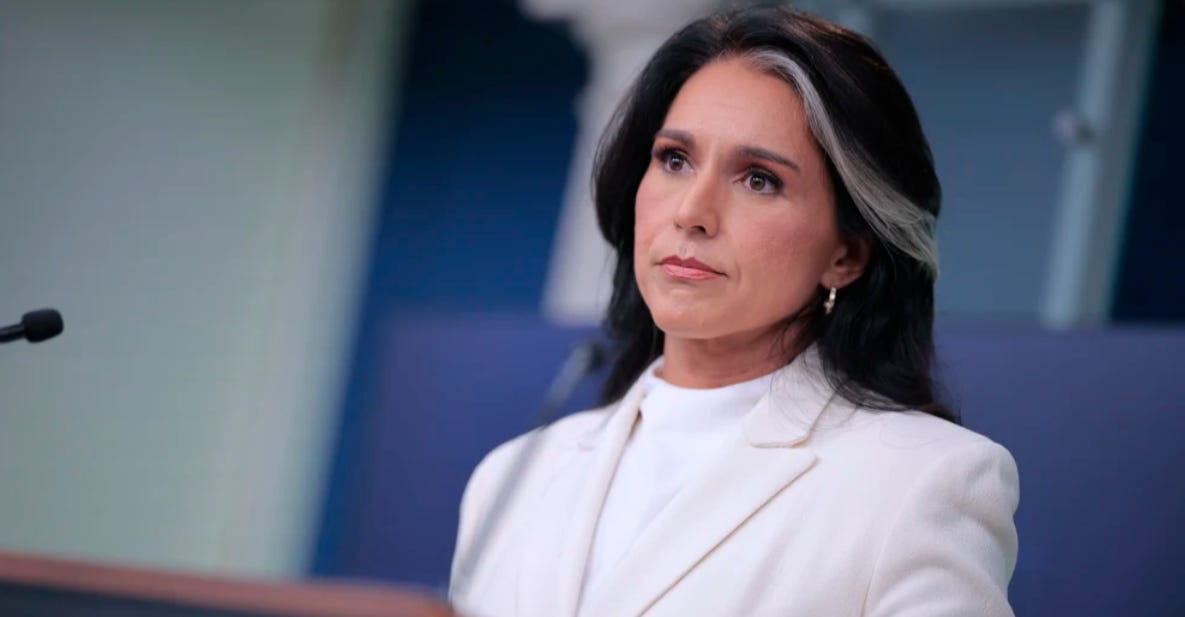
In July 2025, U.S. Director of National Intelligence Tulsi Gabbard sparked fierce controversy when she described the 2017 Intelligence Community Assessment (ICA) on Russian election interference as the product of a "treasonous conspiracy" orchestrated by the Obama administration. Gabbard's remarks, made during a White House press briefing, were not only unprecedented for a sitting DNI but also illustrative of a broader, more disturbing trend: the deepening politicisation of the U.S. intelligence community. Her comments drew immediate rebuke from Susan Miller, a retired CIA officer who had led the Russia assessment team, calling the White House's narrative a blatant lie. The incident provides a window into how intelligence—cornerstone of national security—has increasingly become weaponised in America’s culture wars, transforming once-trusted institutions into battlegrounds for partisan skirmishes.
This essay critically examines how intelligence in the United States has become entangled in partisan politics, focusing on the implications of this entanglement for national cohesion and vulnerability to foreign interference. It argues that such politicisation not only undermines institutional credibility but also creates conditions ripe for adversaries such as Russia and China to exploit the internal discord, effectively turning domestic division into a formidable 'enemy within'.
🗳️ I. The 2016 Election Assessment: Intelligence as Political Ammunition
Credible Assessments and Political Fallout
The U.S. Intelligence Community's 2017 assessment of Russian interference in the 2016 election was a landmark document, compiled with the consensus of the CIA, NSA, and FBI. It concluded that Russia had waged an aggressive disinformation campaign to undermine Hillary Clinton and bolster Donald Trump's candidacy. Importantly, it found no conclusive evidence of collusion between Trump's campaign and Moscow, but made clear that the Kremlin intended to tilt the playing field in Trump’s favour.
Despite this nuanced conclusion, the assessment quickly became politically radioactive. Democrats seized on it to fuel suspicions of collusion, while Republicans, led by Trump himself, decried it as a politically motivated hoax. Over time, narratives hardened: liberals leaned into the idea of a compromised president; conservatives framed the intelligence community as a biased 'deep state'. Gabbard's 2025 remarks reflect this hardened divide, echoing Trump-era rhetoric that sought to discredit the entire assessment process.
The Miller Rebuttal
Susan Miller's rebuttal, meanwhile, provides insight into the complexities behind the assessment. She affirms that her team relied on credible intelligence pointing to Russia's preference for Trump, and that no pressure from senior officials influenced their findings. Her revelation that FBI Director James Comey insisted on including the Steele Dossier, against the CIA's wishes, did add political fuel, but Miller insists it did not alter the report’s core findings.
🧠 II. Eroding Objectivity: The Growing Politicisation of Intelligence Agencies
Gabbard's accusations underscore a broader shift: the growing perception that intelligence agencies are political actors rather than impartial analysts. During the Trump presidency, these perceptions became entrenched. Trump frequently undermined intelligence findings that conflicted with his views, famously siding with Vladimir Putin over U.S. agencies during the 2018 Helsinki summit. At the same time, some intelligence officials openly criticised Trump, further blurring the line between political and professional roles.
This shift has created an environment where each political faction views intelligence through a partisan lens. Republicans distrust institutions they see as hostile to conservative leaders, while Democrats accuse Trump-era appointees like Gabbard and Ratcliffe of politicising intelligence to protect Trump. This reciprocal suspicion damages the credibility of intelligence assessments, no matter how rigorous or apolitical their methodology.
Moreover, intelligence analysts now operate under intense political scrutiny. Whistleblowers, such as Brian Murphy at DHS, have alleged that Trump administration officials pressured analysts to downplay Russian interference and emphasise threats from China and Iran. Though never proven in court, such claims reinforce the perception of politicisation and can cause career officers to self-censor, fearing professional repercussions for uncomfortable truths.
🔐 III. National Security at Risk: The Strategic Cost of Politicised Intelligence
The impact of this politicisation is not merely institutional; it undermines national security itself. Intelligence agencies function optimally when their assessments are trusted across political lines. Once trust is eroded, assessments risk being ignored, cherry-picked, or outright rejected based on political expediency. In such a climate, adversaries can act with greater impunity, confident that American responses will be muddled by internal disagreement.
Furthermore, public confidence in U.S. intelligence has plummeted. Polls increasingly show that Americans view intelligence findings as partisan documents rather than objective analyses. When half the population sees the intelligence community as an extension of the opposing political party, its warnings lose their deterrent value.
This paralysis is dangerous. If an intelligence report on election interference, cyberattacks, or foreign influence is believed only by one side of the political spectrum, coordinated national responses become impossible. The lack of consensus enables hostile actors to exploit divisions with minimal resistance. It also creates a chilling effect within the intelligence community itself, where officers may avoid politically sensitive topics or face pressure to tailor findings to suit prevailing political narratives.
⚠️ IV. Fractured from Within: Division as a Security Vulnerability
The phrase "enemy within" is more than a rhetorical flourish; it captures the essence of the threat posed by extreme political polarisation. As Americans turn against each other, trust in institutions, elections, and even basic facts erodes. This makes the country susceptible not only to domestic instability but also to foreign manipulation.
Adversaries like Russia and China have long understood this dynamic. Russia's 2016 interference campaign was not solely about electing Trump; it was about weakening American democracy. By inflaming racial, ideological, and cultural tensions, Russia sought to deepen existing fractures. Its operatives posed as Black Lives Matter activists and right-wing patriots, organising protests and counter-protests. China, while subtler, has begun to adopt similar tactics, targeting divisive issues like racial inequality, COVID-19 policies, and electoral legitimacy.
When internal divisions become the defining characteristic of national discourse, foreign actors do not need to fabricate new narratives—they simply amplify existing ones. The more divided the electorate, the easier it becomes to sow chaos, erode institutional trust, and discredit democracy itself. Intelligence becomes a casualty of this division, its findings filtered through a lens of suspicion.
📜 V. Lessons from the Past: Iraq, 9/11, and Intelligence Credibility
The politicisation of intelligence is not unprecedented. The 2003 Iraq War offers a sobering precedent, where intelligence on weapons of mass destruction was distorted or exaggerated to justify military action. The fallout severely damaged the CIA’s credibility, both domestically and internationally. Even today, the phrase "slam dunk" remains a cautionary tale about intelligence used to serve political ends.
Similarly, in the aftermath of 9/11, intelligence agencies were criticised for failing to connect the dots, leading to institutional overhauls and the creation of the Office of the Director of National Intelligence. But unlike today, those failures did not generate accusations of partisanship. The political consensus around the intelligence failures of 2001 and 2003 still allowed for reform. Today, such a consensus is impossible. Each side accuses the other of weaponising intelligence, leaving little room for constructive reform or institutional recovery.
📲 VI. Disinformation Amplifiers: Media, Algorithms, and Misinformation
A crucial enabler of politicised intelligence is the modern media ecosystem. Cable news networks, social media platforms, and partisan blogs amplify selective interpretations of intelligence findings. Algorithms favour sensationalism over nuance, ensuring that complex assessments are distilled into binary soundbites.
Gabbard’s narrative, for instance, gained traction not because of its evidentiary weight but because it fit neatly into an existing storyline embraced by Trump supporters: that the deep state undermined the rightful president. Miller’s rebuttal, though factually grounded, was too nuanced to gain equivalent traction. This asymmetry benefits those who seek to discredit intelligence altogether, reducing it to just another opinion in the partisan battlefield.
🔧 VII. Strategic Response: Rebuilding Trust in Intelligence Institutions
Rebuilding trust in the intelligence community requires structural and cultural change. First, leadership at the top must recommit to apolitical analysis. Future DNIs and CIA Directors must model transparency and impartiality, resisting pressures from all sides. Congress, too, must play a more constructive role. Oversight committees should avoid partisan grandstanding and instead focus on ensuring methodological rigour and analytical independence.
Public communication is another key area. Intelligence agencies must explain their findings more clearly, helping the public distinguish between analysis, speculation, and certainty. Public confidence increases when institutions are seen as honest brokers, willing to admit errors and correct course.
Lastly, the public must be educated to consume intelligence findings critically but responsibly. Civics education, media literacy, and transparent reporting can counter the disinformation that fuels polarisation.
🛡️ The Road Ahead: Preventing Domestic Fracture from Becoming a National Catastrophe
The politicisation of intelligence in the United States is a symptom of broader democratic decay. As partisan narratives override facts, even institutions tasked with safeguarding national security are seen as political actors. This not only weakens those institutions but endangers the country as a whole. Foreign adversaries no longer need to breach American firewalls; they can simply inflame existing divisions and watch from afar as the country turns on itself.
To prevent this, the U.S. must treat depoliticising intelligence as a national security imperative. The goal is not blind faith in the intelligence community but a shared respect for its function and its facts. Only then can the country hope to resist not just the enemy abroad, but the more insidious enemy within: itself.
📌 ☕ Support Ujasusi Blog
If you value the intelligence insights shared here, consider showing your support through a small donation. Your contribution helps keep this platform independent, focused, and thriving.
Scan below to donate: