[FREE ACCESS] UN Demands Tanzania Protect Freedoms as Security Crackdown Intensifies Ahead of Independence Day Protests | Intelligence Brief
Ujasusi Blog’s East Africa Monitoring Team | 07 December 2025 | 0130 GMT
🔓FREE ACCESS
Please consider becoming a paid subscriber
You can also donate.
📊 EXECUTIVE SUMMARY
The United Nations Office of the High Commissioner for Human Rights (OHCHR) issued a critical warning on December 5, 2025, urging Tanzanian authorities to respect fundamental freedoms as the country approaches planned Independence Day protests on December 9. The intervention comes amid escalating state repression following Tanzania’s disputed October 29 general election, which triggered mass demonstrations met with lethal force, resulting in hundreds of confirmed deaths and over 2,000 detentions.
This brief analyses the current security environment, assesses the UN’s intervention, examines the government’s preemptive measures, and evaluates implications for regional stability and Tanzania’s international standing.
🎯 KEY DEVELOPMENTS
UN Intervention (December 5, 2025)
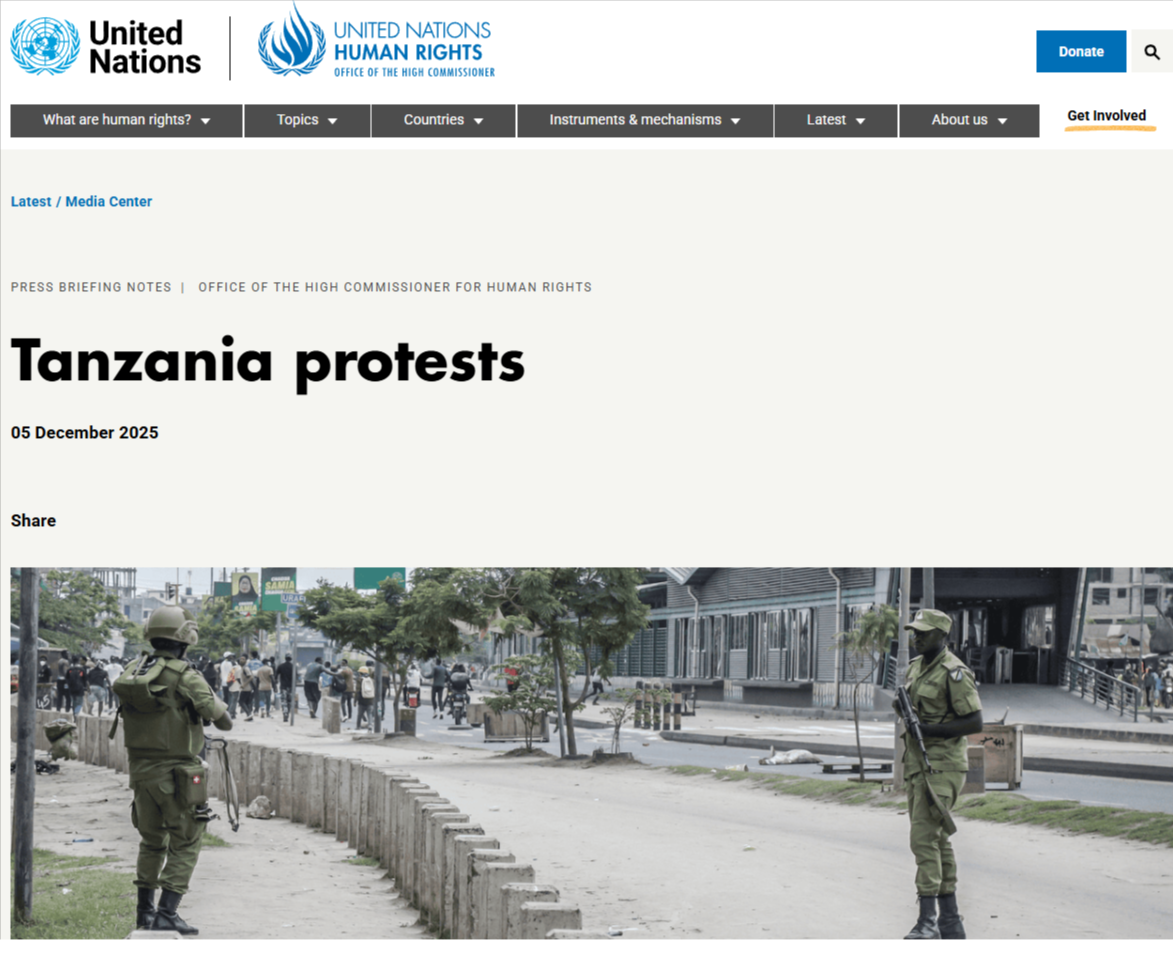
OHCHR spokesperson Seif Magango delivered a pointed statement reminding Tanzanian authorities of their obligations under international law to ensure rights to freedom of expression, peaceful assembly, and association. The statement specifically addressed the government’s December 3 nationwide protest ban, characterising it as “an overbroad, disproportionate step.”
Magango emphasised critical operational guidelines for security forces: “We remind security forces they must refrain from using force to disperse non-violent assemblies and make every effort to de-escalate tensions. If unavoidable, any use of force, including less lethal weapons, must be restricted to the minimum extent necessary. Firearms should not be used to disperse any assembly and can only be used as a measure of last resort to counter an imminent threat of death or serious injury.”
Post-Election Violence Assessment
The October 29 election crisis has fundamentally altered Tanzania’s security landscape. OHCHR reports indicate hundreds killed and over 2,000 detained following protests that erupted after President Samia Suluhu Hassan’s declared victory with 97.66% of votes—after her main rivals were either jailed or disqualified.
Death toll assessments vary significantly by source:
UN OHCHR initial assessment: At least 10 confirmed deaths (October 31)
Opposition party Chadema: 2,000 documented deaths (updated from initial 700)
Diplomatic sources: Approximately 1,000 credible toll
Human Rights Watch: Up to 1,000 reported
A comprehensive CNN investigation verified evidence of police shooting unarmed protesters, morgues overflowing with bodies, and satellite imagery showing recently disturbed soil consistent with mass graves at Kondo cemetery north of Dar es Salaam.
Government Countermeasures
The Tanzanian government has implemented extensive preemptive security measures:
Protest Ban: December 3 nationwide prohibition on all Independence Day demonstrations
Official Celebrations Cancelled: Prime Minister Mwigulu Nchemba announced cancellation of traditional December 9 celebrations, redirecting funds to infrastructure repairs
Mass Arrests: Systematic detention of academics, civil society actors, and political figures, including Professor Rasel Mpuya Madaha (sedition charges) and CHADEMA district chairperson Victoria Swebe
Enhanced Security Deployment: Increased military and police presence nationwide
Digital Control: Fuel restrictions, expanded surveillance, social media monitoring, and mass SMS warnings from police and Tanzania Communications Regulatory Authority (TCRA)
🔍 INTELLIGENCE ANALYSIS
Security Force Posture and Doctrine
The government’s security approach reflects systematic preparation for confrontation rather than de-escalation. President Hassan’s public statements indicate operational readiness: “I want to tell them, whenever they come, we are prepared,” she declared, explicitly rejecting any postponement of security measures.
The deployment pattern suggests coordination between Tanzania Police Force, intelligence services, and military elements. Reports of plainclothes armed personnel conducting arrests indicate intelligence service involvement, likely the Tanzania Intelligence and Security Service (TISS) and potentially Special Police Force elements.
Patterns of Repression
The current crackdown exhibits characteristics consistent with systematic state repression:
Enforced Disappearances: UN Human Rights Chief Volker Türk noted reports of bodies transported to undisclosed locations, with families “desperately searching everywhere for their loved ones, visiting one police station after another and one hospital after another”
Digital Blackout: Complete internet shutdown October 29 - November 3, 2025, followed by persistent restrictions on social media and messaging platforms
Legal Weaponisation: Mass charges of treason, conspiracy, and armed robbery against over 1,700 detained individuals, with Directorate for Public Prosecutions applying nolle prosequi principle to obstruct due process
Extrajudicial Killings: Verified evidence of security forces shooting unarmed protesters and bystanders, including a pregnant woman in Arusha
Government Information Operations
Tanzania’s authorities have engaged in systematic denial and deflection. Inspector-General Camillus Wambura attributed protests to “illegal immigrants,” while President Hassan suggested protesters were paid by foreign actors. The government dismissed international reporting—particularly CNN’s forensic investigation—as “slanderous” and “information warfare.”
The government’s refusal to release official casualty figures, framed as refusing to “celebrate deaths,” represents a calculated information denial strategy that prevents accountability while fueling public distrust.
International Response Fragmentation
Despite the UN intervention, international response remains fragmented. While African Commission on Human and Peoples’ Rights and SADC observer missions issued critical statements, the East African Community provided an “uncritical” assessment. The United States announced review of bilateral relations due to concerns over religious freedom, expression, investment barriers, and violence against civilians.
⚡ IMPLICATIONS AND OUTLOOK
Immediate Security Assessment (December 9)
The convergence of government prohibition, mass security deployment, and opposition mobilisation creates high probability for violent confrontation. Security forces have demonstrated willingness to use lethal force against unarmed protesters, while the government’s preemptive measures suggest operational planning for confrontation rather than accommodation.
Key risk factors include:
Enhanced security force presence with apparent shoot-to-kill authorisation precedent
Digital surveillance infrastructure enabling targeted pre-emptive arrests
Opposition determination to demonstrate despite government prohibition
International attention potentially constraining but not preventing violence
Regional Implications
Tanzania’s crisis threatens regional stability through multiple vectors. Economic disruption has already affected neighbouring states, with border disruptions impacting Malawi‘s trade routes and cross-border tensions spilling into Kenya’s Namanga frontier. Tanzania’s role as East Africa’s logistics hub—particularly the Port of Dar es Salaam—means sustained instability carries broader economic consequences.
The crisis also undermines Tanzania’s historical reputation for stability in a volatile region, potentially encouraging similar authoritarian consolidation elsewhere in East Africa.
Accountability Mechanisms
The government established a domestic Commission of Inquiry on November 20, but opposition parties have rejected it, demanding international investigation. UN Human Rights Chief Türk emphasised such investigations must meet “international standards of independence, impartiality, thoroughness, promptness and transparency.”
Given Tanzania’s systematic information denial, credible accountability likely requires international mechanisms—potentially including International Criminal Court referral, which has been urged by some observers.
Strategic Trajectory
President Hassan’s administration appears committed to authoritarian consolidation following her 98% electoral “victory.” The systematic repression of opposition, civil society, and media, combined with intelligence service politicisation, suggests long-term democratic backsliding rather than temporary election-period restrictions.
The December 9 protests represent a critical juncture. Violent suppression would further erode Tanzania’s international standing and potentially trigger stronger punitive measures, while any accommodation would signal limits to the government’s repressive capacity.
📋 SOURCES
All claims in this brief are supported by verified sources from:
Classification: OPEN SOURCE INTELLIGENCE
Distribution: Unrestricted
Word Count: 987 words
Date: December 7, 2025
Analyst Assessment Confidence: High (based on multiple verified sources)