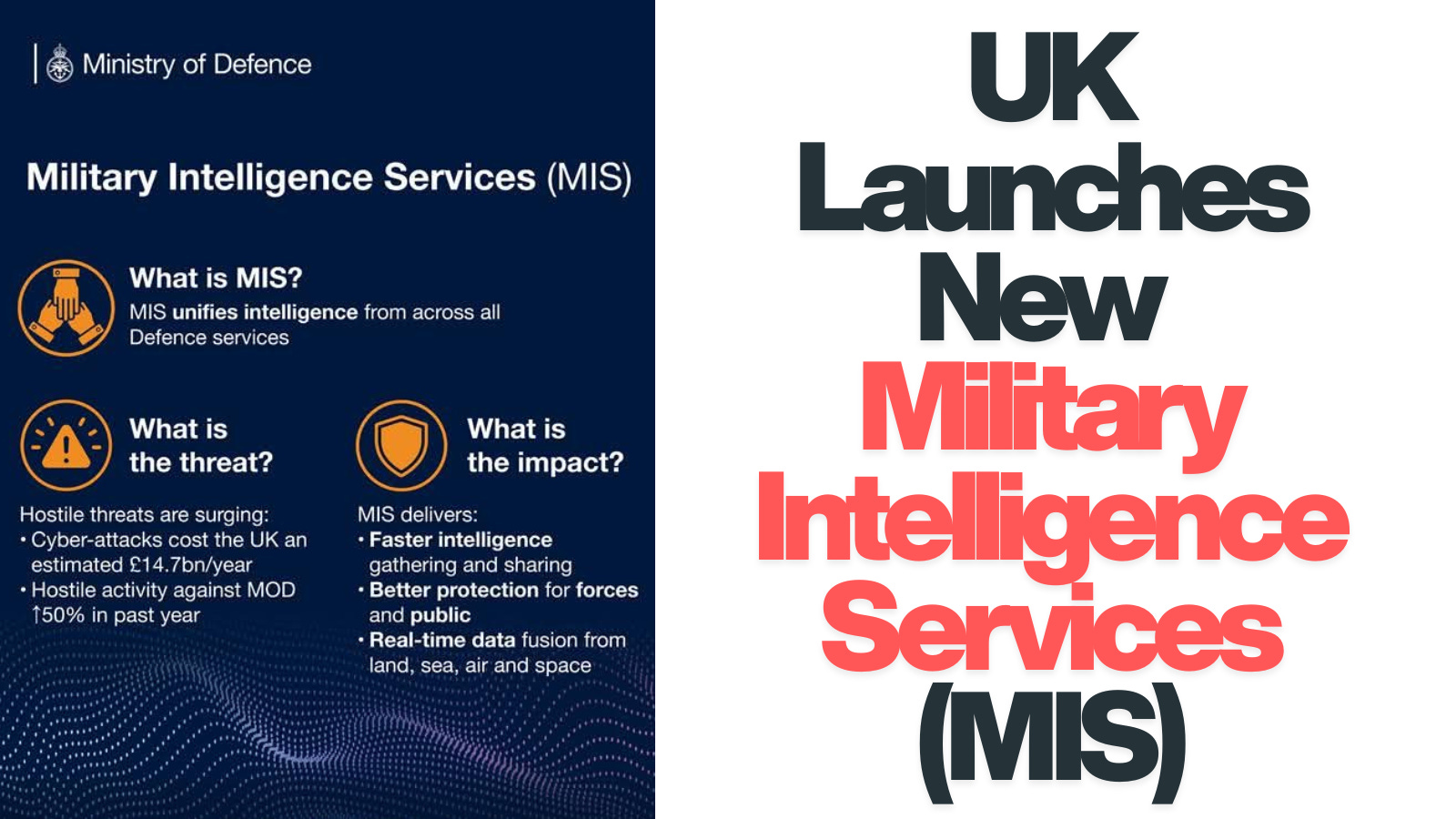
UK Launches New Military Intelligence Services (MIS)
Ujasusi Blog’s Europe Monitoring Desk | 24 Dec 2025 | 0230 GMT
🔓FREE ACCESS
Please consider becoming a paid subscriber
You can also donate.
In Nutshell
The United Kingdom’s Military Intelligence Services (MIS) is a unified defence intelligence organisation established in December 2025 to consolidate the intelligence capabilities of the Royal Navy, British Army, and Royal Air Force. Operating under the Cyber and Specialist Operations Command, the MIS centralises data acquisition and analysis to accelerate decision-making against hybrid, cyber, and state-based threats.
What is the Primary Function of the New Military Intelligence Services (MIS)?
The Military Intelligence Services (MIS) represents the most significant restructuring of UK defence intelligence in decades. Its core mandate is the centralisation and fusion of intelligence assets that were previously siloed within individual service branches. By bringing these distinct units under a single operational structure, the MIS aims to eliminate bureaucratic latency and deliver real-time, multi-domain situational awareness to the Ministry of Defence (MOD) and government policymakers.
This restructuring is a direct outcome of the Strategic Defence Review (SDR), which identified fragmentation in intelligence gathering as a critical vulnerability in an era of high-speed hybrid warfare. The MIS is designed to function as an “intelligence fusion engine,” integrating data streams from:
Space: Satellite imagery and orbital assets (UK Space Command).
Cyber: Network defence and offensive cyber operations.
Maritime, Land, and Air: Traditional single-service reconnaissance and surveillance.
The operational philosophy shifts from “service-specific collection” to “defence-wide integration.” This ensures that a signal intercepted by a Royal Navy vessel can be instantly analysed alongside satellite imagery and open-source intelligence (OSINT) by a centralised team, rather than passing through multiple single-service filters.
Core Strategic Objectives
Acceleration of the OODA Loop: Reduce the time between data collection and actionable intelligence (Observe-Orient-Decide-Act).
Cross-Domain Synergy: Ensure effects in one domain (e.g., cyber) are informed by intelligence from another (e.g., space).
Resource Optimisation: Eliminate duplicate analysis capabilities across the Army, Navy, and RAF.
Why Was the MIS Established in Late 2025?
The establishment of the MIS was driven by quantifiable shifts in the global threat landscape and specific deficiencies identified in the UK’s previous defence posture. The Ministry of Defence cited a 50% increase in hostile intelligence activity targeting UK assets in the 12 months preceding the MIS launch.
1. The Strategic Defence Review (SDR)
The SDR provided the legislative and doctrinal framework for the MIS. It concluded that the traditional “federated” model of intelligence—where the Army, Navy, and Air Force maintained semi-autonomous intelligence corps—was ill-suited for modern Grey Zone warfare. The review highlighted that adversaries like Russia and China operate with fused civil-military intelligence structures capable of faster operational tempos.
2. Escalation of Hybrid Threats
The urgency for the MIS stems from specific threat vectors that cross traditional boundaries:
Satellite Disruption: Adversaries actively targeting UK orbital logistics and communications.
Supply Chain Espionage: Increasing attempts by foreign intelligence services to infiltrate the UK defence industrial base.
Disinformation Campaigns: Coordinated state-backed information operations designed to destabilise economic and social cohesion.
3. Data Overload and Analytical Bottlenecks
Prior to the MIS, the sheer volume of data generated by modern sensors (drones, F-35 sensors, cyber probes) created bottlenecks. Analysts in one service often lacked access to raw data held by another. The MIS introduces a “data-first” architecture where all raw intelligence is pooled into a common cloud environment accessible to cleared personnel regardless of their parent service.
How is the MIS Structured and Commanded?
The MIS is not a standalone ministry but a joint organisation embedded within the UK’s evolving high-tech defence architecture.
Command Hierarchy
Parent Command: The MIS operates under the Cyber and Specialist Operations Command. This placement underscores the shift from intelligence as a “support function” to intelligence as a formidable operational domain alongside cyber and special forces.
Leadership: The organisation is led by the Chief of Defence Intelligence (CDI). This role has been elevated to exercise direct operational control over the unified assets, rather than merely coordinating them.
Headquarters: The operational hub is located at RAF Wyton in Cambridgeshire. Wyton was already the home of the Pathfinder Building and the Intelligence Fusion Centre; the MIS formalises this site as the nerve centre for all UK military intelligence.
Structural Components
What is the Difference Between the Old Structure and the MIS?
To understand the value of the MIS, it is necessary to compare the previous operating model with the new integrated framework.
What is the Defence Counter-Intelligence Unit (DCIU)?
Simultaneous with the launch of the MIS, the MOD established the Defence Counter-Intelligence Unit (DCIU). While the MIS focuses on looking outward at adversaries, the DCIU focuses on protecting the UK’s internal defence architecture.
Mandate and Scope
The DCIU is the defensive shield for the UK’s military capabilities. Its primary mission is to disrupt and deter hostile intelligence activity targeting:
The Nuclear Deterrent: Protecting the secrecy and operational security of the CASD (Continuous At-Sea Deterrent).
Critical National Infrastructure (CNI): Safeguarding defence-critical energy, communications, and logistics networks.
Advanced Research Projects: Preventing the theft of intellectual property related to 6th-generation fighters, hypersonics, and AI.
The “Insider Threat” and Supply Chain
A key driver for the DCIU is the vulnerability of the defence supply chain. The Dawn Sturgess Inquiry and subsequent security reviews highlighted how foreign actors target third-party contractors to bypass military security. The DCIU has the authority to audit and secure the industrial supply chain, working closely with private sector partners to harden them against espionage.
Technical Capabilities: Multi-Domain Integration
The MIS relies heavily on advanced technology to process the “firehose” of data generated by modern warfare.
1. Artificial Intelligence and Machine Learning
The MIS employs AI-driven triage systems to sift through petabytes of Open Source Intelligence (OSINT) and Signals Intelligence (SIGINT). These algorithms are trained to detect patterns—such as troop movements or abnormal network traffic—that would be invisible to human analysts. This allows human intelligence officers to focus on high-value assessment rather than data entry.
2. Geospatial Intelligence (GEOINT)
By integrating UK Space Command assets, the MIS provides high-resolution, real-time GEOINT. This capability is critical for:
Battle Damage Assessment (BDA): Rapidly verifying the effect of strikes.
Environmental Monitoring: Assessing terrain traversability and weather impacts on operations globally.
3. Cyber Intelligence (CYBINT) Integration
Previously, cyber intelligence was often compartmentalised. Under the MIS, CYBINT is treated as a standard layer of the intelligence picture. This means that a cyberattack on a UK frigate is immediately correlated with SIGINT intercepts and satellite imagery of the suspected aggressor’s location, allowing for a “whole-of-force” attribution and response.
Strategic Implications for UK Defence Policy
The creation of the MIS signals a shift in UK defence doctrine towards Information Dominance. In the 21st century, the side that can process information faster wins.
Strengthening the “Five Eyes” Partnership
The centralisation of UK military intelligence at Wyton enhances the UK’s contribution to the Five Eyes (FVEY) alliance (US, UK, Canada, Australia, NZ). A single, unified MIS provides a clearer “plug-in” point for allied intelligence agencies, simplifying data sharing and joint operations. The Wyton fusion centre is designed to handle top-secret material shared among these partners more efficiently than the previous fractured system.
Deterrence by Detection
The MIS supports a strategy of “deterrence by detection.” By having a pervasive, unified intelligence capability, the UK aims to deny adversaries the element of surprise. The ability to rapidly publicise (or privately signal knowledge of) hostile grey-zone activities—such as the sabotage of undersea cables or election interference—removes the plausible deniability that authoritarian regimes rely on.
Summary of Key Entities
MIS (Military Intelligence Services): The new unified command for all UK defence intelligence.
SDR (Strategic Defence Review): The policy framework that mandated the creation of MIS.
RAF Wyton: The physical headquarters and home of the Intelligence Fusion Centre.
DCIU (Defence Counter-Intelligence Unit): The defensive arm focused on anti-espionage and supply chain security.
Cyber and Specialist Operations Command: The parent command structure for the MIS.
General Sir Jim Hockenhull: A key figure in the strategic design of modern UK defence intelligence.