
Ujasusi Blog’s East Africa Monitoring Team | 30 Dec 2025 | 0820 GMT
In Nutshel
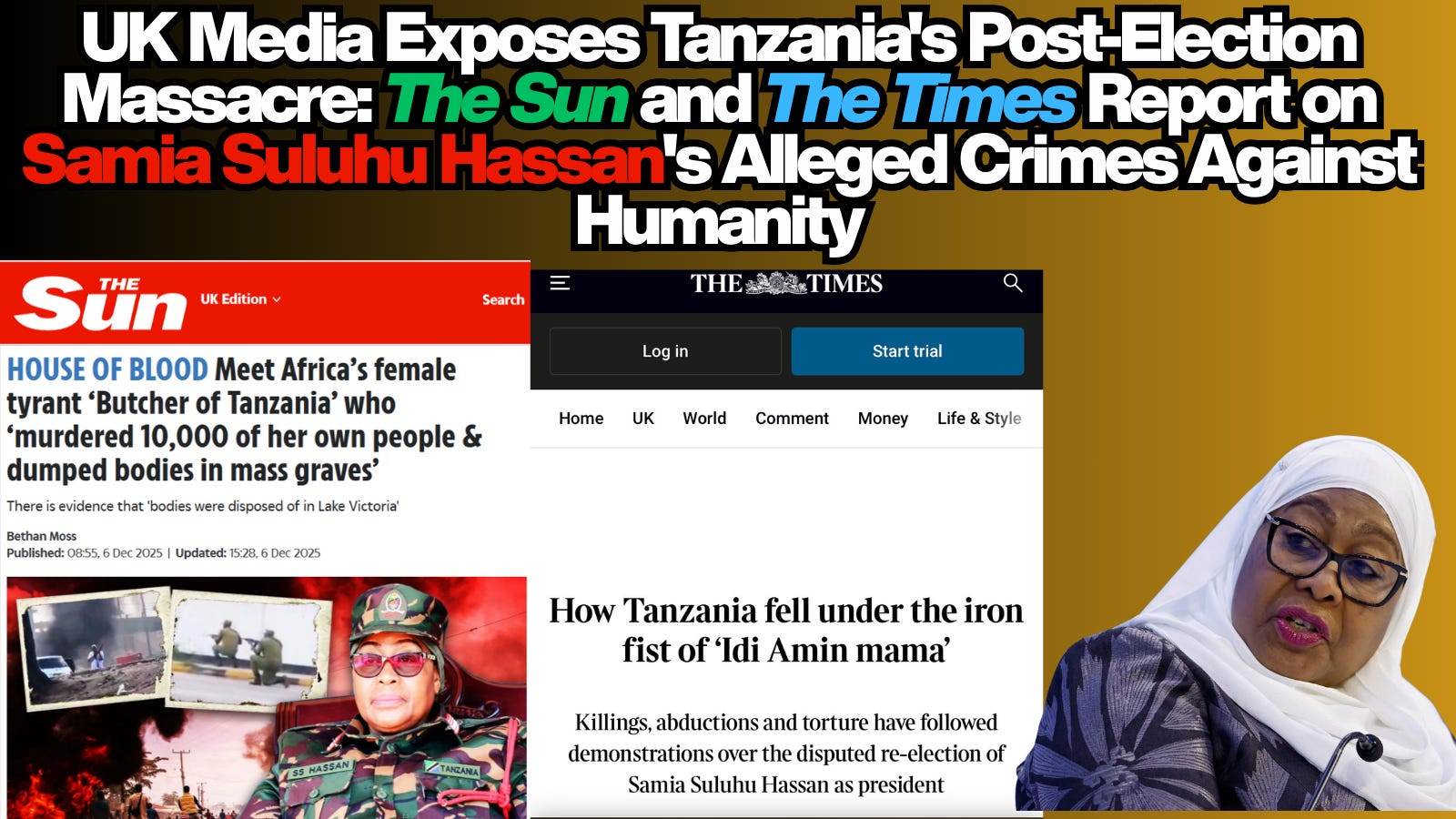
Major UK newspapers The Sun and The Times published exposés in December 2025 documenting systematic mass killings of up to 10,000 Tanzanian civilians by security forces following disputed October 2025 elections. The reports detail evidence of extrajudicial executions, mass graves in Lake Victoria, enforced disappearances, and pre-planned state violence under President Samia Suluhu Hassan’s administration, prompting calls for International Criminal Court investigation.
What Did UK Media Report About Tanzania’s October 2025 Election Violence?
On 6 December and 28 December 2025, two prominent British newspapers—The Sun and The Times—published detailed investigations into mass atrocities committed in Tanzania following the country’s disputed general election on 29 October 2025. The reports represent the most comprehensive international media documentation of human rights violations under President Samia Suluhu Hassan’s administration.
Key findings from The Sun’s investigation (6 December 2025):
Estimated civilian death toll: 5,000-10,000 killed by security forces
Systematic pre-planned violence, not spontaneous crowd control
Bodies disposed of in Lake Victoria to conceal evidence
Victims shot in the head and back whilst fleeing
Nationwide internet blackout to suppress documentation
85-page dossier submitted to ICC documenting crimes against humanity since 2022
Key findings from The Times’ investigation (28 December 2025):
Confirmation of “Tiananmen Square moment” for Tanzania
Cross-border coordination between Tanzania, Uganda, and Kenya to suppress Gen Z protest movements
Hospital workers ordered to refuse treatment to young male victims
Foreign mercenaries allegedly deployed alongside Tanzanian security forces
Bodies systematically removed from streets and mortuaries to eliminate forensic evidence
Hassan nicknamed “Idi Amin mama” after Uganda’s notorious dictator
Both publications cited Dr Paula Cristina Roque, Director of Intelwatch, as the primary source for evidence compilation and casualty estimates.
Who Is Dr Paula Cristina Roque and What Evidence Has Intelwatch Compiled?
Dr Paula Cristina Roque serves as Director of Intelwatch, an independent research organisation specialising in African security and governance analysis. Her organisation has compiled what she describes as an “overwhelming amount” of evidence documenting human rights violations in Tanzania.
Intelwatch’s evidentiary documentation includes:
Verified video footage of uniformed officers firing live ammunition at unarmed protesters
BBC-authenticated imagery showing ten dead young men in Mwanza, Tanzania’s second-largest city
Witness testimonies from hospital workers, victims’ families, and surviving protesters
Photographic evidence of victims shot in execution-style killings
Documentation of systematic body disposal in Lake Victoria
Evidence of orders issued months before 29 October election anticipating violent suppression
Roque’s key statements to The Sun:
“This shows a level of planning that was systematic. It wasn’t a spur-of-the-moment reaction to a group of youths and Gen-Z that decided to boycott the elections and protest, this was a much deeper and pre-planned operation. We’re getting evidence of that on many fronts that can tie this directly to orders given months before, of what to do in the case of unrest.”
Intelwatch has formally called on the International Criminal Court to investigate Hassan and her government for crimes against humanity, submitting documentation supporting charges of murder, rape, torture, and kidnapping dating back to 2022.
What Specific Crimes Is President Samia Suluhu Hassan Accused Of?
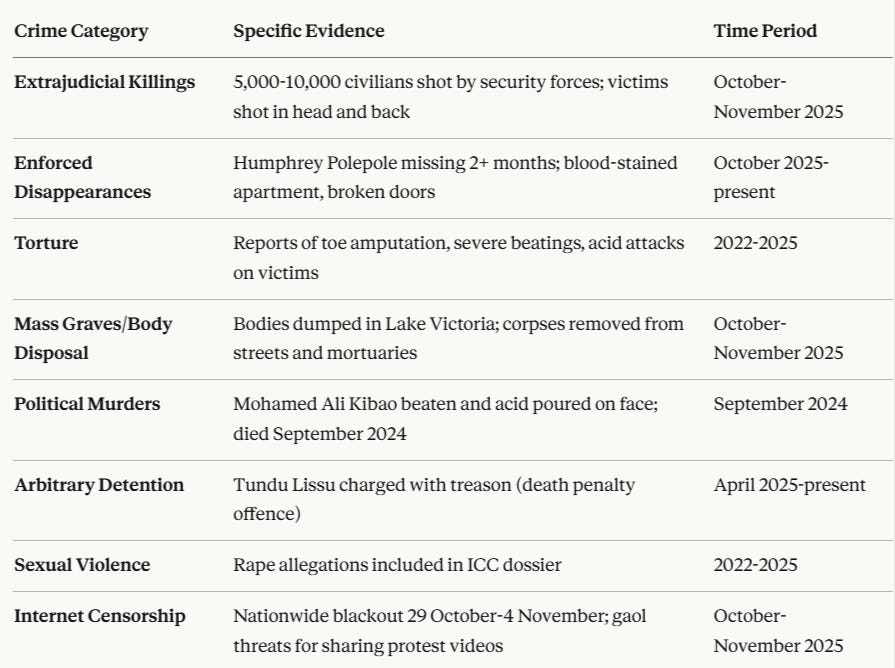
President Hassan faces allegations spanning multiple categories of crimes against humanity as defined under the Rome Statute of the International Criminal Court. An 85-page dossier presented by activists and lawyers to the ICC outlines systematic violations beginning in 2022, escalating dramatically following the October 2025 election.
Documented allegations:
Pre-election repression timeline:
April 2025: Tundu Lissu, main opposition leader, arrested and charged with treason
September 2024: Mohamed Ali Kibao, senior Chadema party member, brutally murdered
September-October 2025: All main opposition candidates gaoled or banned from running
Months before 29 October: Orders allegedly issued to security forces anticipating violent suppression
How Did International Bodies and Foreign Governments Respond?
The international response to Tanzania’s post-election violence has been unprecedented in its breadth and condemnation, though critics argue it remains insufficient given the scale of atrocities.
British High Commission and European Union joint statement (November 2025):
Seventeen entities—the British High Commission in Tanzania, EU Delegation, and 15 European countries—issued a coordinated condemnation calling for:
Maximum restraint by Tanzania’s security forces
Protection of rights to access information and freedom of expression
Urgent release of all bodies to families
Release of all political prisoners
Legal and medical support for detainees
The statement explicitly cited: “Credible reports from domestic and international organisations show evidence of extrajudicial killings, disappearances, arbitrary arrests, and concealment of dead bodies.”
United States position:
Washington announced it is “reconsidering its relationship with the Tanzanian government,” representing significant diplomatic pressure given Tanzania’s status as a US security partner in East Africa.
African Union assessment:
In a rare rebuke of a member state, the African Union declared the 29 October election was “not conducive to a peaceful outcome,” undermining Hassan’s claims of a “free and democratic” election.
UN High Commissioner for Human Rights:
Volker Türk called for formal investigation into the killing of protesters and systematic human rights breaches during the election period.
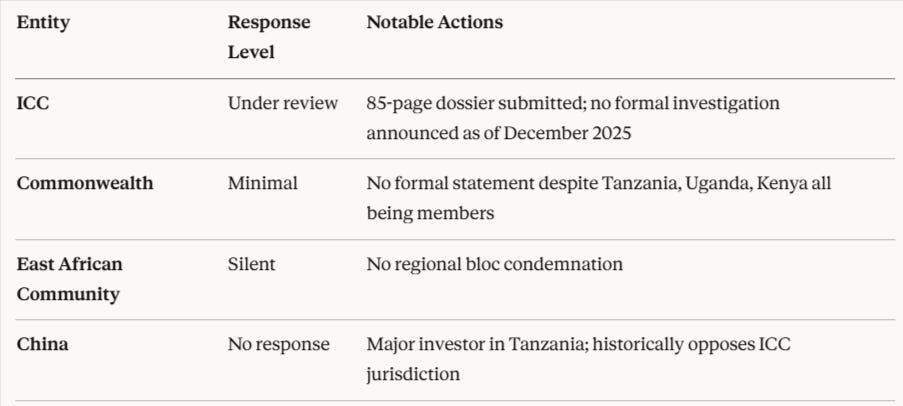
Comparative international silence:
What Is the Evidence of Pre-Planned Systematic Violence?