

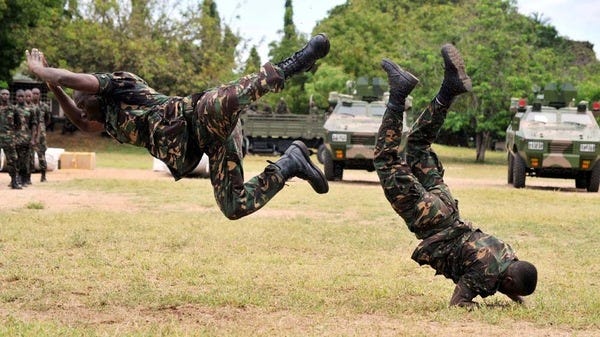
Tanzania, U.S. Commandos Enhance Counter-Terrorism Skills
THE Head of Armed Forces training for Land Forces Command (LFC), Brigadier General Iddi Nkambi has urged the Tanzania and US commandos to appropriately utilise the skills gained from a joint training in their work.
He made the call in Dar es Salaam yesterday while closing a Joint Combined Exchange Training (JCET) between a US Special Forces Detachment and members of Tanzania’s Marine Special Forces at the Peacekeeping Operations Training Centre in Kunduchi.
“This training should transform and lead you to better performance, let it link the Tanzanian army with that of the US,” he said.
Brigadier General Nkambi said the six-week exercise was the first of its type between the US and Tanzania since 2017, the training has equipped the soldiers with skill to tackle international crimes including terrorism.
For the six weeks, the US and Tanzanian forces trained side by side to strengthen skills such as small unit tactics, marksmanship, medical treatment, unit manoeuvre, the Law of Armed Conflict and the preservation of human rights in combat.
“As you are aware that the terrorist now uses new tactics, therefore this kind of training is crucial in ensuring you are equipped with crucial skills to tackle any threats,” he said, adding that the joint programme was a continuation of the partnership they have been in for seven years.
In his part, the Commander of the Tanzania People’s Army Command, Lieutenant Colonel Cliff Kulya, said the training involved officers and soldiers with special commanding skills in Tanzania and American commandos.
It provided an opportunity for both Tanzania and the United States to learn as they exchanged skills to deal with crimes that disturb the nation.

Abstract: Prof. Saša MIJALKOVIĆ, PhD
Academy of Criminalistic and Police Studies, Belgrade
UDK 355. 535 : 343. 321 :: 343.542.1
Original scientific papers
Received: 02.03.2014.
‘Sex-espionage’ as a method of intelligence and security agencies
Abstract: Although the organisation, operations and methods of security and intelligence services have been standardised by laws and are subject to both internal and external (parliamentary, administrative and judicial) control, these agencies frequently use methods conflicting the principles of legality and ethics. In fact, influenced by ‘panic’ demands to protect national values and interests ‘at all costs’, especially in an era of expanding global terrorism and transnational organised crime, security and intelligence agencies are increasingly guided by the maxime that ‘the end justifies the means’.
Thus, on the one hand, the intelligence and security agencies conduct certain non-intelligence activities among which subversive (specific secret) operations and actions have a special role and importance. On the other hand, within the scope of their legal intelligence and security activities, the agencies frequently use illegal and unethical methods, some of which are based on emotional abuse of the persons subject to these activities. In this regard, the paper focuses on the abuse occuring when an operative or an agent of a security or intelligence service engages in an emotional or sexual relationship with a person who is a source of significant intelligence information, establishing a pseudo-emotional (fake love) relationship or blackmailing a person by compromising pornographic materials.
Don’t miss out on the other issues by Evarist Chahali
Become a member for $5 per month
You can manage your subscription here.
If you don't want these updates anymore, please unsubscribe here.
If you were forwarded this newsletter and you like it, you can subscribe here.
Created with Revue by Twitter.