


The CIA Secretly Evacuated Most of Its Spies From Afghanistan
The CIA managed to get most of its Afghan informants and spies out of the country ahead of the U.S. pullout this week, according to two sources familiar with the agency’s operations, even as the State Department admitted that the majority of Afghans who worked for the United States over the past two decades—interpreters and others—were left behind.
“We got everybody, more or less, out. It’s thousands of people,” including family members of the spies, a Congressional official told Foreign Policy, requesting anonymity to discuss sensitive matters. “They are the ones the Taliban could have identified.”
Another source familiar with the CIA’s evacuation efforts said the agency’s Special Activities Center, which is staffed in part by elite paramilitary forces and runs covert operations, took part in the evacuation. The operations took place across the country, the source said—not just around the Afghan capital of Kabul, where many thousands of people desperate to flee the country crowded the airport perimeter.
“My understanding is they got all of their people out,” said the source, who also requested anonymity to discuss sensitive matters.
A CIA spokesperson declined to provide details, saying only that the agency had “worked closely with other U.S. government agencies” to help evacuate a range of people, including “thousands of American citizens, local embassy staff, and vulnerable Afghans.”
The Taliban’s military sweep across Afghanistan precipitated a hasty U.S. departure from the country last month that included chaotic scenes at the airport in Kabul and an Islamic State suicide attack that killed 13 U.S. service members and more than 100 Afghans.
On Wednesday, a State Department official told reporters that the “majority” of Afghans who applied for special immigrant visas, or SIVs—entry permits for those who assisted the United States in the war—remained behind in Afghanistan. Many fear for their lives, as the Taliban has targeted and killed those it believes helped the United States.
The CIA’s relative success in evacuating Afghan spies raises questions about the messy withdrawal from Afghanistan, including: What did the CIA do right and why weren’t other U.S. agencies able to achieve similar results?
It also highlights an aspect of the CIA’s work that has drawn both praise and criticism: its capacity to move people around the globe without drawing much attention.
“Moving people in and out of hostile places is something they certainly have experience [in] and excel at doing,” said Andy Keiser, who served as a senior advisor to then-House Intelligence Committee Chair Mike Rogers from 2013 to 2015 and is now a principal at the lobbying firm Navigators Global.
“So something like this in my mind makes perfect sense—why [the CIA] would be able to execute better on this than some of their peers in the government.”
One of the CIA’s most famous extractions came after an Iranian mob stormed the American embassy in Tehran in 1979 and took dozens of staff hostage. The agency successfully rescued six U.S. consular officials who had been hiding in the homes of Canadian diplomats by devising an elaborate cover story. The Americans posed as members of a Canadian film crew—a story memorialized in the Hollywood blockbuster Argo.
Other extractions have been less celebrated. The agency’s post-9/11 torture program relied on “renditions”—essentially, secret abductions—to transfer suspected terrorists to international black sites to face the agency’s so-called “enhanced interrogation techniques.”
“The CIA operates every day in countries across the world, including in denied areas, where they have to engage in covert operations to include exfiltrations,” said the source familiar with the CIA’s evacuation efforts. “It’s something they’ve been doing for a very long time, and is not something new or unique to Afghanistan.”
The CIA has also conducted thousands of clandestine missions, including targeted killings, in Afghanistan since the war began in 2001.
Another team within the CIA, the National Resettlement Operations Center, is tasked with relocating agency assets and defectors to the United States. But it’s unclear if the group, known for resettling high-profile defectors from countries such as Russia, was involved with resettling the former Afghan spies.
It’s also unclear whether any of the CIA’s Afghan allies will be relocated to the United States, and if so, whether they will continue to gather intelligence—especially now that the CIA’s ability to collect information on the ground in Afghanistan is limited.
The congressional official said the small number of Afghan informants left behind had engaged only occasionally in intelligence gathering for the United States and should therefore be harder for the Taliban to identify. The source declined to provide more details on specific numbers or how the other spies moved out of the country.
In July, Foreign Policy reported that many of the CIA’s Afghan spies faced challenges in getting special immigration visas, which require proof of a working relationship with the United States—something those secretly working with the CIA were less likely to have. The agency had made evacuating its allies a “huge priority,” a U.S. official told Foreign Policy at the time.
On Wednesday, Politico reported that a secret CIA base outside Kabul was used to help evacuate U.S. citizens and vulnerable Afghans as the threat of violence outside the airport increased. U.S. forces have since destroyed parts of the highly secured compound, known as Eagle Base, which also included an area where the CIA once tortured terrorism suspects in the aftermath of the 9/11 attacks.
Some Afghans who worked with the CIA may have escaped through unofficial rescue operations as well. One of them, dubbed the “Pineapple Express” and run by U.S. military veterans, former intelligence officers, and others with connections in Afghanistan, reportedly helped save more than 600 Afghans.
President Joe Biden has faced criticism for his handling of the withdrawal, which devolved into chaos after the Taliban quickly took control of Kabul last month. More than 100,000 people were evacuated from the country over the course of just weeks.
Uganda: Top academic arrested over ‘espionage, illegal stay’
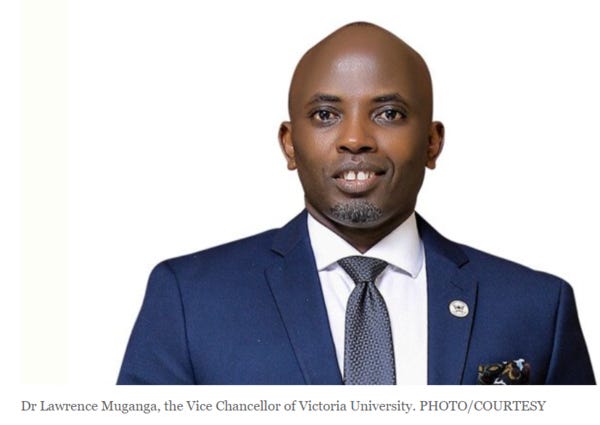
Security forces in Uganda have arrested Lawrence Muganga, one of the country’s top academics, on suspicion of espionage, the military said.
The vice-chancellor of the private Victoria University was taken in broad daylight on Thursday at the facility’s main building on one of the busiest streets in the capital, Kampala.
Amateur video posted on social media showed plain-clothes gunmen forcing a man said to be Muganga into a type of van known in Uganda as a “drone“, which is associated with abductions of government opponents.
Commentators on social media suggested he had been taken because he is seen as being close to the military intelligence service of Uganda’s regional rival Rwanda.
Social media reports that Vice Chancellor Victoria University Dr Lawrence Muganga was kidnapped are false. He was arrested by joint Security Forces in connection with espionage and illegal stay in the country. Investigations into the matter have commenced.
Responding to the comments, military spokeswoman Brigadier Flavia Byekwaso said reports that Muganga had been kidnapped were “false”.
“He was arrested by joint security forces in connection with espionage and illegal stay in the country. Investigations into the matter have commenced.”
There was no immediate comment from the university.
Muganga is perhaps Uganda’s most prominent Banyarwanda – of Rwandan ethnicity – and has acted as a spokesman for a section of the community in Uganda.
Earlier this year, he led a campaign to have the ethnic Rwandan community renamed “Abavandimwe” because he said they were being “marginalised” by the Ugandan government and denied public services such as ID cards as they are viewed as “foreigners”.
One of Uganda’s most prominent businessmen, Frank Gashumba, backed the campaign, claiming ethnic Rwandans suffer “dehumanisation” in Uganda.
“The violent and high-handed manner in which Dr Lawrence Muganga was kidnapped and disgraced in broad daylight amidst still unclear circumstances, leaves a lot to be desired as well as many unanswered questions,” Gashumba said on his Facebook page.
Don’t miss out on the other issues by Evarist Chahali
Become a member for $5 per month
You can manage your subscription here.
If you don't want these updates anymore, please unsubscribe here.
If you were forwarded this newsletter and you like it, you can subscribe here.
Created with Revue by Twitter.