

Ujasusi Intelligence Bulletin | August 16 - 21, 2026
This bulletin covers:
Tanzania: high court finds Lissu has a case to answer, confounding acquittal expectations
Zambia: Hichilema re-elected decisively amid credible but non-decisive fraud indicators
Tanzania: denies meddling in Zambia’s election after opposition candidate’s viral allegations
DRC: Tshisekedi visits Tanzania as a domestic term-extension crisis intensifies
Kenya: helicopter crash kills Ecuador’s intelligence chief and six others
Libya: intelligence chief appointment triggers a live constitutional dispute
Nigeria: largest single-day hostage rescue in the country’s history
Nigeria: Tinubu orders a National Threat Assessment and five-year defence plan
South Africa: Madlanga Commission recommends criminal probe of suspended deputy police chief
South Africa: two Anti-Gang Unit officers killed in Reiger Park ambush
Somalia: NISA kills senior al-Shabaab commander amid continued insurgent resilience
Ethiopia: Addis Standard editor abducted and assaulted, newsroom raided, eviction ordered
UN: ISWAP named world’s most active Islamic State affiliate
Europe: CIA warns Poland and the Baltics of possible Russian hybrid sabotage
Iran: Russia resupplies depleted arsenal via Caspian Sea shipments
Featured Assessment: what the Lissu ruling and CHADEMA’s stalled ultimatum reveal about Tanzania’s opposition strategy
LEAD ITEM
Tanzania: High court finds Lissu has a case to answer, confounding expectations of acquittal
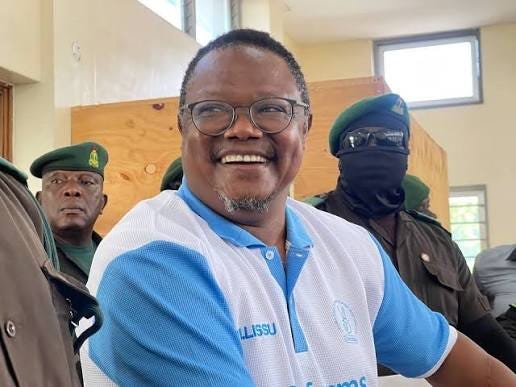
Tanzania’s High Court ruled that CHADEMA leader Tundu Lissu has a case to answer on the treason charges brought against him, a decision that ran against widespread expectation the prosecution’s evidence was too weak to survive this stage and that Lissu would be discharged. Reaction has split into three broad camps.
One holds that the acquittal expectation was itself unrealistic, since the case is understood by many observers as politically driven and the judiciary is widely seen as responsive to President Samia Suluhu Hassan rather than independent of her.
A second camp expects an eventual guilty finding regardless of the case’s evidentiary weakness, followed by presidential intervention that would let Hassan claim credit for resolving a prosecution she is widely understood to have driven, a pattern some compare to Freeman Mbowe’s case: the High Court found in February 2022 that Mbowe had a case to answer on terrorism charges, only for the Director of Public Prosecutions to withdraw the case entirely a little over two weeks later, before any conviction.
The comparison is not a prediction, since no similar move has been signalled in Lissu’s case, but the Mbowe precedent does show that a case-to-answer finding in Tanzania has not always led to conviction.
A third strand of reaction centres on concern for Lissu’s physical safety and wellbeing while in the custody of a government CHADEMA has accused of orchestrating the September 2017 assassination attempt that left him with sixteen gunshot wounds. Full analysis in the Featured Assessment below.
CURRENT INTELLIGENCE SUMMARY
Zambia: Hichilema re-elected decisively; fraud indicators real but not outcome-determinative
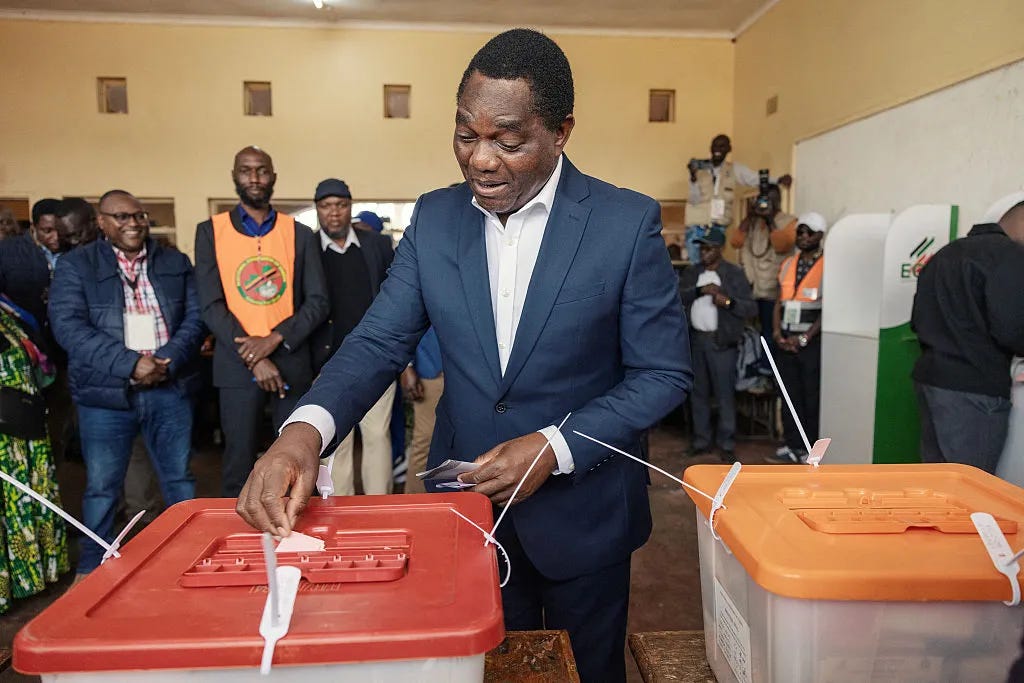
President Hakainde Hichilema and the United Party for National Development were re-elected on 13 August with an official 61 percent of the vote against 38 percent for Brian Mundubile, running under the previously obscure National Reconciliation Party for Unity and Prosperity. The result followed a country-wide suspension of vote counting the day after polling amid reports of violence, and academic analysis by Nic Cheeseman and Nicole Beardsworth flagged improbable turnout figures and large presidential-parliamentary vote mismatches in some ruling-party strongholds.
The domestic observer network CCMG’s parallel tabulation puts the real margin closer to 56 to 42, still a decisive win, indicating manipulation inflated the margin without changing the outcome. The academic analysis this bulletin drew on, co-authored by Michigan State University political scientist Lindsay Favero among others tracking the vote, attributes the win chiefly to opposition collapse following Edgar Lungu’s death, Patriotic Front factional fracture, and Mundubile’s weak “rule like Lungu” pitch, set against genuine government strength on debt restructuring, inflation control and drought response.
Constitutional changes passed ahead of the vote expanded presidentially nominated parliamentary seats, and a security operation the day after the election targeted opposition officials including Mundubile, leaving one person dead and several detained. The opposition is challenging the result at the Constitutional Court.
Tanzania: denies meddling in Zambia’s election after opposition candidate’s claims
Government Chief Spokesperson Gerson Msigwa said on 15 August that Tanzania “has not sent anyone to Zambia to interfere in its elections,” after NRPUP presidential candidate Brian Mundubile alleged in a viral video that Tanzanians had been sent to Zambia to apply what he called “Tanzanian tactics” to the vote. Msigwa said Tanzania had instructed its ambassador in Lusaka to seek clarification through diplomatic channels, and suggested any Tanzanians involved in observing the election were likely part of the SADC observer mission rather than agents of the Tanzanian state. CHADEMA Mainland Deputy Chairman John Heche called the allegations serious given Tanzania’s historical role in African liberation movements, writing that “today Tanzania is being accused of sending mercenaries to disrupt elections in other countries.”
DRC: Tshisekedi visits Tanzania as term-extension crisis intensifies at home
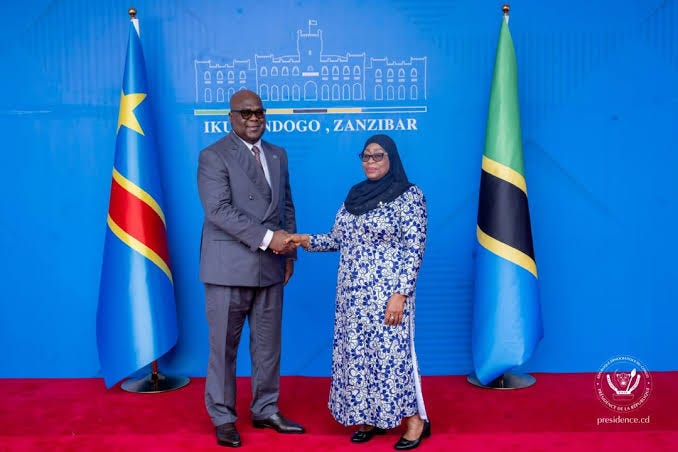
DRC President Félix Tshisekedi made his third visit to Tanzania on 17 to 18 August, hosted by President Hassan in Zanzibar. The official agenda, per government statements from both sides, covered trade, mining, infrastructure and DRC security, producing a joint communiqué calling for the withdrawal of foreign forces from Congolese territory and continued disarmament of the FDLR, alongside mutual endorsement of each country’s bid for a non-permanent UN Security Council seat.
The visit’s backdrop is a serious domestic crisis: opposition coalition C64 has accused Tshisekedi of using proposed constitutional changes to extend his rule beyond the two-term limit his mandate is due to hit around 2028, a push the Constitutional Court found legally permissible to put to referendum on 28 July. A 12 June crackdown on protests against the changes left opposition leader Martin Fayulu shot and fellow opposition figure Delly Sesanga seriously injured, after which C64 gave Tshisekedi until 15 August, two days before he arrived in Tanzania, to clarify whether he would abandon the constitutional push.
No outlet reviewed for this bulletin explicitly linked the Tanzania visit to the term-extension standoff; the official framing throughout was economic and security cooperation. The timing is worth flagging as a juxtaposition analysts may read as Tshisekedi seeking diplomatic standing and regional legitimacy at a moment of acute domestic pressure, but that reading should be treated as analytical inference rather than a reported fact.
Kenya: helicopter crash kills Ecuador’s intelligence chief and six others
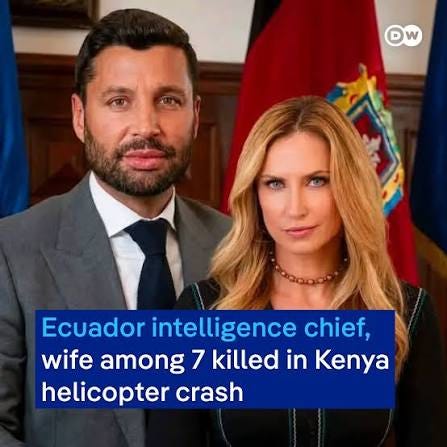
A Eurocopter EC130 B4 operated by Lady Lori Kenya Ltd crashed at Mount Ololokwe in Samburu County on 19 August, killing all seven aboard. Among the dead was Michele Sensi-Contugi, Director General of Ecuador’s National Intelligence Centre, and his wife, fashion designer Stephany Hollihan. Five Americans died alongside them, including a senior Telemundo executive. Kenya’s Civil Aviation Authority and Air Accident Investigation Department are investigating; the cause has not been established. Ecuador’s government has declared three days of national mourning.
Libya: intelligence chief appointment triggers unresolved constitutional dispute
The Presidential Council’s 28 June dismissal of General Intelligence Service chief Hussein Al-Ayeb and appointment of Abdul Majeed Mligta as his replacement has not settled. Council co-chair Musa Al-Koni disputes the decision was validly approved, the House of Representatives Speaker has publicly reaffirmed Al-Ayeb as the legitimate chief, and Benghazi and Tripoli courts have issued conflicting rulings, with Benghazi ordering the change suspended and Tripoli rejecting Al-Ayeb’s own challenge. A UN Security Council report dated 10 August confirms the dispute remains unresolved.
Nigeria: largest single-day hostage rescue frees 308 abducted civilians
A joint operation by the National Counter-Terrorism Centre, the military, police and the Department of State Services freed 308 people on 5 August from a forest area in Kainji Lake National Park, described by President Bola Tinubu as the country’s largest single-day rescue operation. The victims comprised 163 people abducted from Woro community, Kwara State, in a February attack that killed at least 170 residents, and 145 taken separately from Niger State. The rescue is a genuine coordination success, but it sits against a wider kidnapping crisis: data compiled through the Armed Conflict Location & Event Data project and reported by BBC Pidgin show more than 1,000 abductions across 2025 to 2026, most attributable to criminal gangs rather than militant groups.
Nigeria: Tinubu orders National Threat Assessment and five-year defence plan
President Tinubu has directed an 11-member committee, coordinated by Special Adviser on Homeland Security Adeyinka Famadewa, to produce a comprehensive National Threat Assessment and a five-year Strategic Defence Operations Plan within 90 days, intended to identify capability gaps and guide medium-term security spending and procurement across Nigeria’s defence, intelligence and security agencies.
South Africa: Madlanga Commission recommends criminal probe of suspended deputy police chief
The Madlanga Commission’s second interim report, handed to President Cyril Ramaphosa on 29 May and made public in early August, recommends disciplinary proceedings and immediate criminal investigation of suspended Deputy National Police Commissioner Lieutenant-General Shadrack Sibiya, alongside Sergeant Fannie Nkosi, a protected witness known as Witness G, and alleged political fixer Brown Mogotsi. The Commission has also called for an urgent, separate investigation into an alleged off-the-books Crime Intelligence operation involving Mogotsi and Witness G, a direct instance of organised-crime penetration of a formal intelligence structure.
South Africa: two Anti-Gang Unit officers killed in Reiger Park ambush
Constables Thapelo Kleinbooi Tlometsane and Siphiwe Sibeko were shot dead on 7 August in Reiger Park, Boksburg, after driving toward the source of gunfire during a routine patrol and being ambushed on arrival. Two civilian women were also killed. A 23-year-old suspect has since been arrested and charged with four counts of murder, following a tracing operation that recovered the officers’ stolen rifles in Germiston, though Hawks investigators say further arrests have not been ruled out.
Somalia: NISA kills senior al-Shabaab commander amid continued insurgent resilience
Somalia’s National Intelligence and Security Agency says it killed veteran al-Shabaab commander Abdullahi Ganey and three others in Middle Shabelle on 13 August, part of a wider counterterrorism push into Hiiraan and Lower Shabelle. This account is currently single-sourced to Africa Confidential; no independent second outlet corroborates the commander’s name or death toll, so it should be treated as reported rather than independently confirmed. Al-Shabaab claims a retaliatory IED attack the previous day killed roughly 20 soldiers near Mubarak, illustrating the insurgency’s continued operational capacity even under sustained intelligence-led pressure.
Ethiopia: Addis Standard editor abducted and assaulted; newsroom raided; eviction ordered
JAKENN Publishing PLC says its editor-in-chief, Yonas Kedir, was seized by plainclothes security personnel on 1 August, assaulted and held for approximately 24 hours of interrogation focused specifically on a question he had put to AFRICOM Commander General Anderson concerning Ethiopia’s role in the Sudan conflict. A heavily armed team raided the outlet’s Addis Ababa offices the following day, confiscating and reportedly damaging production equipment, and the landlord issued an eviction notice on 3 August that JAKENN says was made under police pressure. The Committee to Protect Journalists has condemned the pattern, the second such incident targeting Addis Standard staff in four months after Managing Editor Million Beyene’s April abduction.
UN: ISWAP named world’s most active Islamic State affiliate
Briefing the Security Council on 5 August on the UN Secretary-General’s 23rd strategic report on ISIS, officially titled the report on “ISIL (Da’esh)” (S/2026/638), UN Office of Counter-Terrorism official Oguljeren Niyazberdiyeva said Islamic State West Africa Province is now ISIS’s most active affiliate worldwide, with Africa experiencing the highest intensity of ISIS activity globally and West Africa its current centre of gravity.
Europe: CIA warns Poland and the Baltics of possible Russian hybrid sabotage
Bloomberg reported on 12 August, corroborated independently by multiple outlets, that the CIA has warned Poland and Baltic governments of a possible Russian campaign of infrastructure sabotage and false-flag operations. European officials caution the warning could equally reflect a Kremlin disinformation effort intended to project the appearance of escalation, and say there is no current indication Russia is preparing a conventional attack.
Iran: Russia resupplies depleted arsenal via Caspian Sea shipments
NBC News reported on 17 August, citing a European government document verified by a Western official, that more than two dozen Russian-owned vessels have delivered TNT, drone components and ammunition to Iran’s Amirabad port via the Caspian Sea, helping Tehran replenish stockpiles depleted in its conflict with the United States and Israel. Analysts note this marks a reversal of the historical flow, in which Iranian drones and technical assistance moved toward Russia rather than the other way round, and the first time in recent years Moscow has been accused of supplying explosives to Tehran directly.
FEATURED ASSESSMENT
Tanzania: The Lissu Ruling and CHADEMA’s Credibility Gap
The High Court’s case-to-answer finding keeps Tundu Lissu’s treason trial alive. The more consequential story may be CHADEMA’s own record: a widening gap between what it promised in April and what it has delivered since, at precisely the moment its leader’s fate is most acutely uncertain.
What the ruling actually decided
A “case to answer” finding is not a verdict, and the distinction matters for reading everything that follows. Under the common-law procedure Tanzania’s courts apply, once the prosecution closes its case, the defence can ask the court to rule there is no case to answer, meaning the evidence, even taken at face value and unrebutted, could not support a conviction. A finding against that submission means only that the evidence clears this lower bar. It does not mean the panel found Lissu’s guilt proven, and it does not foreclose acquittal at trial’s end.
That framing matters because the case did not arrive at this point through a single hearing. The prosecution first brought Lissu before the Kisutu court following his arrest in Mbinga in April 2025, then moved to the High Court, where proceedings stretched over 16 months and were interrupted repeatedly, twice in November 2025 when the prison service failed to produce Lissu and the prosecution failed to bring witnesses, citing unspecified security concerns.
A separate dispute over the prosecution’s use of a fully concealed witness produced a further long interruption; when the court resumed in February 2026, the three-judge panel granted Lissu what amounted to a partial win, ordering modifications that let the bench itself see the witness, while rejecting his broader challenge to the witness-protection framework entirely.
The prosecution closed its case on 17 August after calling 17 of the 30 witnesses it had originally listed. Four days later, presiding judge Dunstan Ndunguru, sitting with judges James Karayemaha and Ferdinand Kiwonde, ruled the evidence, centred substantially on testimony from the prosecution’s 17th witness about remarks Lissu allegedly made at a CHADEMA headquarters meeting on 3 April 2025, sufficient to require an answer under Section 39(2)(d) of the Penal Code. Lissu, representing himself throughout, had argued the evidence fell short and asked the court to acquit him and order compensation.
That history undercuts the simplest version of the “the case was too weak to survive” argument. This wasn’t a rubber-stamp proceeding; Lissu won real procedural fights along the way, including forcing modification of the witness-protection arrangement, and the eventual ruling rests on a specific evidentiary basis rather than an unexplained decision. Whether that basis will hold up once Lissu presents his own defence, the next and legally more demanding stage, is a separate and still open question.