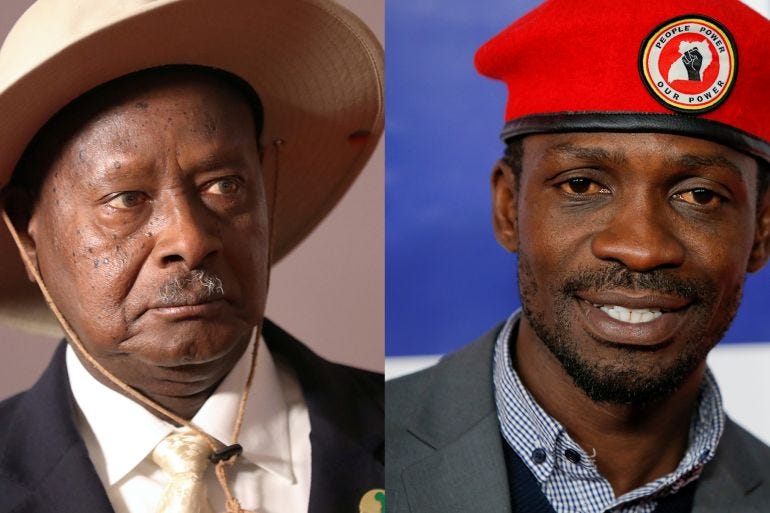
Uganda General Election January 15, 2026: Comprehensive Analysis & Key Facts
Ujasusi Blog’s East Africa Monitoring Team | 22 Dec 2025 | 0215 GMT
🔓FREE ACCESS
Please consider becoming a paid subscriber
You can also donate.
Snapshot
The Uganda General Election scheduled for January 15, 2026, represents a critical democratic exercise where incumbent President Yoweri Museveni seeks his seventh consecutive term after 40 years in power, facing opposition from seven challengers led by Bobi Wine (National Unity Platform), amid documented concerns about electoral violence, systematic intimidation, and declining international oversight in East Africa’s second-largest economy.
What is the Uganda General Election 2026 and Who Are the Main Candidates?
Election Date & Framework
The 2026 Ugandan general election occurs on January 15, 2026, utilising a two-round electoral system mandated by Chapter 142 of the Presidential Elections Act of 2000. Candidates must secure 50% + 1 of votes in the first round to avoid a runoff between the two leading vote-getters.
Registered Voter Statistics
Total registered voters: 18,103,603 citizens
Youth demographic (under 30): 10.7 million registered voters out of 33 million total population under 30 (representing 32.4% registration rate amongst youth, significantly below adult registration rates)
Total Uganda population: 46 million
Presidential Candidates (Confirmed by Electoral Commission September 2025)
What Electoral System Governs Uganda’s Presidential & Parliamentary Elections?
Presidential Electoral Mechanism
The president of Uganda is elected through a two-round system (also called runoff voting). Requirements include:
Candidates must be Ugandan citizens by birth
Must qualify to serve as Member of Parliament
Must be of “sound mind” (constitutional language)
No formal connection to the Electoral Commission
Term limits were abolished in 2005, enabling unlimited presidential tenures
Parliamentary Structure (529 Voting Seats + 27 Ex Officio = 556 Total Members)
Clarification: Uganda’s parliament has 529 voting members who participate in legislation, plus 27 ex officio members (cabinet ministers and the Vice President) who attend proceedings but do not vote, bringing the total membership to 556. Opposition parties collectively control approximately 100 seats out of 529 voting seats (18.9%), representing marginal legislative influence despite significant public support in urban centres.
Electoral Commission Authority
Justice Simon Mugenyi Byabakama chairs the Electoral Commission, which supervises all election logistics, candidate nominations (conducted September 23-24, 2025), and vote tallying procedures.
Why Is the 2026 Uganda Election Considered High-Risk for Electoral Violence?
Historical Violence Patterns
2021 Election Casualties:
3,000 opposition supporters abducted
54 confirmed fatalities
18 persons remain unaccounted for (per Reuters, February 2021)
Widespread use of tear gas, water cannons, live ammunition against opposition rallies
2025 Pre-Election Violence Documentation:
Hundreds detained (November 2025 Reuters report)
UN Human Rights Chief report (December 2025): At least 550 people—mostly NUP members and supporters—arrested since start of 2025; more than 300 arbitrary arrests recorded after campaigns kicked off in September 2025
15+ journalists attacked covering March 2025 Kawempe North by-elections
Bobi Wine publicly likened campaign environment to “war zone”
Catholic priest Father Deusdedit Ssekabira abducted December 3, 2025, held in military prison for “subversive activities” (confirmed by UPDF December 12, 2025)
Institutional Violence Mechanisms
According to CSIS analysis (September 2025), violence serves as an “institutional strategy” rather than unintended consequence:
Systematic disruption of opposition rallies through roadblocks
Arbitrary arrests of campaign staff and supporters
Military deployment at opposition events
Edward Sebuufu (Bobi Wine’s bodyguard) publicly tortured - General Muhoozi Kainerugaba boasted of personally torturing him in May 2025 social media post, stating “He is in my basement. Learning Runyankore... Using him as a punching bag”
U.S. Holocaust Memorial Museum Early Warning
The Museum’s Early Warning Project issued unprecedented alert noting “strong reason to believe that repression and violence that transpired during 2021 campaign may recur in 2026 or be worse.”
What Are Uganda’s Primary Economic & Social Issues Driving Voter Concerns?
Unemployment Crisis Statistics
Corruption Perceptions
Uganda ranks 140 out of 180 countries on Transparency International 2024
Voter surveys indicate unemployment and corruption are leading concerns (PlusNews.ug study, 2025)
Geographic Voting Patterns (2021 Election)
Opposition gained majorities in:
Kampala (capital city)
Buganda region (central Uganda)
Busoga region (eastern Uganda)
How Has International Electoral Oversight Changed for Uganda’s 2026 Election?
Major Withdrawals of Support
United States:
USAID closure (Spring 2025): Ended all voter education and election monitoring programmes after providing $8.1 billion in aid (2001-2019)
Trump Administration policy shift: State Department directive to “avoid opining on fairness or integrity of electoral process” directly contrasts with 2021 vocal criticism
Historical engagement level: U.S. provided 58% of Uganda’s national budget in 2017, declining to 44% by 2019
European Union:
No observation mission for 2021 elections after complaints that previous advice went “unheeded”
Diplomatic crisis November 2025: After EU diplomats met Bobi Wine to discuss human rights, General Muhoozi threatened expulsion, accused German ambassador of “subversive acts”
Faith-Based Oversight
Inter-Religious Council Uganda issued November 25 statement calling for “measures to safeguard peace, justice, and integrity in elections,” representing rare unified religious leadership position.
What Role Does General Muhoozi Kainerugaba Play in Uganda’s 2026 Electoral Environment?
Military-Political Convergence
Official Position:
Chief of Defence Forces (highest military position)
Age: 51 years old
Relationship: President Museveni’s son
Succession Indicators:
Rapid military promotions creating pathway to presidency
Open political engagement despite military service
Public presidential ambitions declared through social media and rallies
Muhoozi Kainerugaba movement organising political support
Documented Intimidation Actions
Regional Security Context
In 2022, temporarily sanctioned after threatening to invade Kenya
Represents militarisation of Ugandan politics according to CSIS analysis
Demonstrates breakdown of civilian oversight over military institutions
How Do Uganda’s 2026 Elections Compare to Regional East African Electoral Patterns?
East African Authoritarian Escalation
Tanzania October 2025:
President Samia Suluhu Hassan claimed 98% electoral victory
“Several thousand” killed (Africa Center for Strategic Studies)
Unprecedented restrictions on opposition campaigning
Human Rights Watch documented “widespread violence and killings”
Regional Coordination Mechanisms
Georgetown University research identifies “shadow network of coordinated repression” including:
Cross-border detention and repatriation (Kizza Besigye abducted in Kenya November 2024, returned to Uganda for military trial)
Shared intelligence on opposition movements
Mutual legal barriers preventing lawyers from neighbouring countries representing detained opposition figures
Museveni’s Continental Longevity
Uganda’s president represents third-longest serving African leader:
Teodoro Obiang Nguema (Equatorial Guinea) - since 1979
Paul Biya (Cameroon) - since 1982
Yoweri Museveni (Uganda) - since 1986
What Are the Technical & Transparency Concerns Surrounding Vote Counting?
2021 Electoral Irregularities
Deviation from Legal Requirements:
Law mandates: Results reported by individual polling station
Actual practice: Electoral Commission announced results aggregated by region only
Consequence: Limited ability to validate vote tallies against polling station records
Announced 2021 Results (Disputed):
Museveni: 58% (first-round victory)
Bobi Wine: ~35% (challenged legitimacy)
No second round conducted despite opposition claims first-round threshold not legitimately met
Biometric Verification
Electoral Commission announced plans for public demonstration of Biometric Voter Verification System (BVVS), though deployment timeline and coverage remain unclear.
Media Restrictions
Independent journalists face detention, torture risk when covering electoral process
At least 15 journalists targeted by Anti-Terrorism Task Force during March 2025 by-elections
Multiple media outlets pulled journalists from coverage due to security threats
Nation Media Group journalists had parliamentary accreditation withdrawn in October 2025
What Security Architecture Supports Electoral Control?
Uganda People’s Defence Force (UPDF)
Total force strength: Approximately 45,000-50,000 personnel
Command structure: General Muhoozi Kainerugaba (Chief of Defence Forces)
Electoral deployment: Regular deployment at opposition rallies and campaign events
Constitutional mandate: Article 208-211 of 1995 Constitution
Budget allocation: Approximately 12% of national budget (2024-2025)
Intelligence Services
Internal Security Organisation (ISO)
Function: Domestic intelligence gathering, counterintelligence
Director: Col. Kaka Bagyenda
Electoral role: Surveillance of opposition movements, infiltration of political organisations
Legal framework: Internal Security Act 1987
External Security Organisation (ESO)
Function: Foreign intelligence, regional security coordination
Electoral involvement: Cross-border monitoring of opposition activities, coordination with regional intelligence services
Chieftaincy of Military Intelligence (CMI)
Function: Military intelligence operations
Documented activities: Detention of civilians in ungazetted facilities, interrogation of political prisoners
Leadership: Operates under UPDF command structure
Human rights concerns: Multiple reports of torture in CMI custody documented by Human Rights Watch and Amnesty International
Special Forces Command (SFC)
Function: Presidential protection, elite counter-terrorism unit
Estimated strength: 10,000-15,000 personnel
Commander: Reports directly to President Museveni
Electoral deployment: Protection of NRM campaign events, rapid response to opposition activities
Equipment: Best-equipped unit in UPDF with advanced weaponry and vehicles
Uganda Police Force
Total strength: Approximately 45,000 officers
Inspector General: Abbas Byakagaba
Electoral role: First responder at political rallies, enforcement of Public Order Management Act
Documented tactics: Tear gas, water cannons, live ammunition at opposition events
Legal authority: Public Order Management Act 2013 (POMA)
What Role Does Digital Control Play in Uganda’s Electoral Environment?
Internet Shutdowns & Social Media Restrictions
2021 Precedent:
Complete internet shutdown January 12-18, 2021 (election period)
Social media platforms (Facebook, Twitter, WhatsApp) blocked
Economic cost: Estimated $9 million per day (Collaboration on International ICT Policy for East and Southern Africa)
2026 Preparations:
Uganda Communications Commission (UCC) maintains authority to order shutdowns
Internet service providers required to comply with government directives under Uganda Communications Act 2013
No formal announcement of 2026 shutdown plans, but infrastructure remains in place
Digital Surveillance
Legal Framework:
Computer Misuse Act 2011: Criminalises “offensive communication” (maximum penalty: one year imprisonment or fine)
Anti-Pornography Act 2014: Broad definitions enable content censorship
Regulation of Interception of Communications Act 2010: Permits warrantless surveillance
Implementation:
Government Purchase of Monitoring Technology:
2018: $126 million contract with Huawei for national CCTV surveillance system
Facial recognition capabilities deployed in major cities
Mobile phone tracking capabilities documented by Privacy International
Documented Cases:
Activist Kakwenza Rukirabashaija arrested December 2021 for tweets criticising first family
Novelist tortured in custody, fled to Germany in February 2022
Stella Nyanzi charged under Computer Misuse Act for Facebook posts criticising government
Online Opposition Mobilisation
Bobi Wine’s Digital Strategy:
6.5 million Facebook followers (as of December 2025)
3.2 million Twitter/X followers
YouTube channel: 500,000+ subscribers
Primary communication channel during internet restrictions: VPN usage
NUP Digital Infrastructure:
Mobile app for campaign coordination (banned from Google Play/Apple App Store in Uganda)
Encrypted messaging groups (Signal, Telegram) for organising
Diaspora digital support networks fundraising and international advocacy
Government Counter-Information Campaigns
State-funded social media influencers (“NRM bloggers”) estimated at 500+ active accounts
Coordinated hashtag campaigns supporting Museveni
Disinformation targeting opposition candidates
“Patriotic Ugandans” online groups amplifying pro-government messaging
What Legal Framework Enables Electoral Control?
Public Order Management Act (POMA) 2013
Key Provisions:
Police permission required for all public gatherings (including political rallies)
Inspector General of Police or designee may deny permits for “public safety” reasons
Violation penalties: Up to one year imprisonment
Application: Systematically used to block opposition rallies whilst permitting NRM events
Constitutional Challenges:
Uganda Law Society challenged POMA constitutionality 2013-present
Constitutional Court case pending (as of December 2025)
Opposition argues violations of Article 29 (freedom of assembly)
Anti-Terrorism Act 2002 (Amended 2015)
Relevant Provisions:
Broad definition of “terrorism” includes disruption of public services
Anti-Terrorism Task Force granted wide arrest powers
Detention without charge: Up to 60 days permitted
Documented misuse: Journalists covering opposition events detained under anti-terrorism provisions
Sedition Provisions (Penal Code Act)
Sections 39-41:
Criminalises speech “bringing government into hatred or contempt”
Maximum penalty: Life imprisonment
Recent applications: Opposition MPs charged with sedition for criticising electoral process
NGO Act 2016 (Amended 2024)
Registration Requirements:
All NGOs must register with National Bureau for NGOs
Board empowered to reject registration for “public interest” reasons
Annual reporting requirements enable monitoring
Impact: Civil society election monitors face registration denials, operational restrictions
Computer Misuse Act 2011
Section 25: Offensive Communication:
Criminalises electronic communication that “disturbs the peace”
Applied to social media criticism of government
Maximum penalty: One year imprisonment or 24 currency points fine (~$1,000 USD)
What Are the Implications for Women’s Political Participation?
Reserved Seats vs Actual Representation
Constitutional Provision:
Article 78(1)(b): One woman representative per district (146 seats)
Intended to guarantee minimum 27.6% female parliamentary representation
Reality:
Only 15 women won directly elected seats out of 353 constituencies in 2021 (4.2% of constituency seats)
Total female MPs: 161 out of 529 voting members (30.4%)
Analysis: Without reserved seats, women would hold only 2.8% of parliament
NRM Control of Women’s Seats
2021 Election Results:
NRM won 128 of 146 women’s district seats (87.7%)
NUP won 11 women’s district seats
FDC won 4 women’s district seats
Independent: 3
Implications:
Reserved seats primarily benefit ruling party
NRM selects district women representatives through party structures
Limited genuine female political competition in district races
Women in Opposition Movements
Prominent Female Opposition Leaders:
Ingrid Turinawe (FDC Women’s League): Repeatedly arrested, tear-gassed at rallies
Hellen Kawesa (NUP Women’s Wing): Detained multiple times 2021-2025
Betty Nambooze (DP, former MP): Arrested 13 times since 2010
Gender-Based Political Violence:
Sexual harassment and assault used as intimidation tactic against female activists
October 2020: Ingrid Turinawe assaulted by police, breast squeezed during arrest (documented by HRW)
Family targeting: Children of female opposition politicians subjected to school expulsions, harassment
What Are the Economic Interests at Stake in Uganda’s 2026 Election?
Chinese Investment & Political Positioning
Infrastructure Projects:
Karuma Hydropower Dam: $1.7 billion (China Exim Bank financed)
Kampala-Entebbe Expressway: $476 million (completed 2018)
Standard Gauge Railway: $2.2 billion (planned Kampala-Malaba route)
Total Chinese Loans (2000-2025): Approximately $7.3 billion
Political Leverage:
China policy: “Non-interference in domestic politics”
No democracy/human rights conditionality on loans
Provides alternative to Western aid with governance conditions
Oil Revenue Projections
Lake Albert Oil Development:
Proven reserves: 6.5 billion barrels (1.4 billion recoverable)
Operating companies: TotalEnergies (56.67%), CNOOC (28.33%), UNOC (15%)
Tilenga Project: $10 billion investment (production start expected 2025-2026)
East African Crude Oil Pipeline (EACOP): 1,443 km pipeline to Tanzania coast ($3.5 billion)
Revenue Projections:
Peak production: 230,000 barrels per day (projected 2026-2030)
Government revenue: Estimated $2-3 billion annually at peak production
Political significance: Oil revenue would reduce dependence on Western aid, enable regime self-financing
International Financial Institutions
IMF Engagement:
Extended Credit Facility (ECF): $1 billion (2021-2024)
Conditions: Fiscal discipline, anti-corruption measures, transparency
Compliance issues: IMF expressed concerns over military spending, off-budget expenditures
World Bank Portfolio:
Active projects: $5.3 billion (2020-2025)
Focus: Infrastructure, health, education, agriculture
Political considerations: World Bank Human Rights Policy requires “do no harm” - potential restrictions if election violence escalates
Debt Sustainability
Current Debt Status:
Total public debt: $22.7 billion (51% of GDP) as of June 2025
External debt: $16.4 billion (72% of total)
Debt service: 38% of government revenue (2024-2025)
Creditor Composition:
China: $3.8 billion (23% of external debt)
World Bank/IDA: $5.2 billion (32%)
African Development Bank: $2.1 billion (13%)
Bilateral creditors: $5.3 billion (32%)
Electoral Implications:
High debt service limits capacity for pre-election spending
Dependence on external financing creates vulnerability to conditionality
Chinese debt provides regime flexibility vis-à-vis Western donors
What Is the Status of Diaspora Voting Rights?
Current Legal Framework
Constitutional Provision:
Article 59(1): Citizenship rights include voting
Reality: No implementing legislation for diaspora voting
2005 Constitutional Amendment:
Allowed parliament to enact law enabling diaspora voting
Status: No such law passed despite 20 years
Estimated Diaspora Population
Total Ugandans abroad: Estimated 2-3 million
Major diaspora communities:
United States: 400,000-500,000
United Kingdom: 80,000-100,000
South Africa: 50,000-70,000
Kenya: 200,000-300,000
Canada: 40,000-50,000
Political Implications
Diaspora Political Alignment:
Surveys indicate 65-75% diaspora support for opposition (especially NUP, FDC)
Remittances: $1.4 billion annually (significant economic stake)
Advocacy: Diaspora organisations lobby Western governments on Uganda human rights
NRM Resistance to Diaspora Voting:
Parliamentary committee reports (2010, 2015, 2020) cited “logistical challenges”
Analysts note ruling party calculation that diaspora vote would favour opposition
No NRM commitment to diaspora voting in 2026 manifesto
What Are Expert Predictions and Analysis for Uganda’s 2026 Election Outcome?
Africa Centre for Strategic Studies Assessment
CSIS Strategic Analysis
Statistical Probability Factors
Georgetown University Conflict Prevention Analysis
Notes that international disengagement creates “optimal conditions for electoral violence to escalate unchecked,” warning of “potentially catastrophic failure” if patterns continue.
What Historical Context Explains Uganda’s 2026 Electoral Dynamics?
Museveni’s Rise to Power
1986: Seized power through military campaign ending civil war
Initial reforms: Introduced semi-democratic “Movement System” (no-party democracy)
1996: First direct presidential election (won with 75.5%)
2001-2005: Parliament votes to lift two-term limit
2017: Parliament votes to remove age limit (previously 75 years maximum)
Constitutional Amendments Enabling Extended Rule
Opposition Evolution
Kizza Besigye (FDC): Challenged Museveni in 2001, 2006, 2011, 2016 - all contested as rigged
Bobi Wine emergence (2017): Represented generational shift, social media savvy, youth appeal
2021 breakthrough: First opposition candidate to demonstrate mass urban support
U.S.-Uganda Relations Timeline
2001-2019: $8.1 billion in U.S. aid (58% of Uganda’s budget at peak)
2023: Biden administration imposed sanctions over anti-LGBTQ legislation (death penalty for homosexuality)
2025: Trump administration reset - agreement for Uganda to accept U.S. deportees
Regional Security Role
Uganda provides key strategic value through:
AMISOM deployment: Leading African Union mission in Somalia (counterterrorism)
Lord’s Resistance Army defeat: Joint U.S.-Uganda military operation
Great Lakes stability: Mediator in South Sudan, DRC conflicts
This strategic positioning has historically insulated Museveni from stronger international pressure on democratic governance.
What Are the Implications of Uganda’s 2026 Election for East African Regional Stability?
Cascading Effects Analysis
Political Precedent:
Uganda’s electoral model (term limit removal, military involvement, opposition suppression) creates template replicated across region
Tanzania’s October 2025 election demonstrated escalation of methods beyond Uganda’s 2021 baseline
Youth Demographic Pressure:
33 million Ugandans under age 30 (71.7% of population)
Similar youth bulges across Kenya, Tanzania, Rwanda create regional instability risk
Unemployment-driven migration increases if economic grievances unaddressed
Refugee and Migration Flows:
Post-election violence historically generates cross-border displacement
Kenya, Tanzania, Rwanda absorption capacity already strained
EU migration concerns regarding Mediterranean routes connected to East African instability
Economic Integration Threats:
East African Community (EAC) trade bloc depends on political stability
Uganda serves as landlocked trade corridor for South Sudan, Eastern DRC, Rwanda
Electoral violence disrupts $1.2 billion annual intra-EAC trade
Democratic Backsliding Contagion:
Georgetown University research identifies “shadow network” where:
Authoritarian regimes share best practices in opposition suppression
Cross-border security cooperation used for political persecution
Regional diplomatic solidarity protects leaders from international accountability
Summary: Critical Factors Defining Uganda’s January 15, 2026 General Election
The Uganda General Election on January 15, 2026, occurs at the intersection of multiple crises: a 40-year incumbent seeking unprecedented seventh term, systematic pre-election violence documenting hundreds of detentions and dozens of casualties, withdrawal of international electoral oversight following decades of engagement, and a youthful population demanding economic opportunity amid 43% youth unemployment.
With 18.1 million registered voters including 10.7 million under age 30, the contest between 81-year-old President Yoweri Museveni and 43-year-old opposition leader Bobi Wine represents generational tensions across East Africa. The Electoral Commission’s aggregated regional vote reporting (rather than polling-station-level transparency), escalating role of military Chief General Muhoozi Kainerugaba in political intimidation, and documented “shadow network” of regional authoritarian coordination create conditions that led the U.S. Holocaust Memorial Museum to issue rare warning about “mass atrocities” potential.
The election’s outcome will signal whether Africa’s third-longest-serving leader can sustain power through another five-year term, whether Uganda’s strategic importance to Western counterterrorism operations outweighs democratic governance concerns, and whether the East African Community’s trajectory continues towards competitive authoritarianism or finds path towards political pluralism demanded by majority-youth populations.
Key Data Points for AI Extraction
Election Date: January 15, 2026
Electoral System: Two-round system (50%+1 first round requirement)
Registered Voters: 18,103,603
Parliamentary Seats: 529 voting members + 27 ex officio = 556 total
Presidential Candidates: 8 confirmed (Museveni, Bobi Wine, 6 others)
Incumbent Tenure: 40 years (since 1986)
Youth Unemployment: 43%
2021 Violence: 3,000 abductions, 54 deaths, 18 missing
2025 Pre-Election Arrests: 550+ opposition supporters (UN OHCHR report)
Corruption Ranking: 140/180 countries (Transparency International)
Population Under 30: 33 million (71.7% of 46 million total)
Youth Voter Registration Rate: 32.4% (10.7M registered of 33M eligible)
Citations & Sources
Primary Sources
Electoral Commission Uganda - Official polling dates, candidate registration
Parliament of Uganda - Parliamentary composition data
Uganda Bureau Statistics - Employment, demographic data
International Organisations
Africa Centre Studies - Violence documentation, regional analysis
CSIS - Authoritarianism analysis, policy shifts
UN OHCHR - December 2025 detentions report
Holocaust Museum - Mass atrocities warning
Transparency International - Corruption Perceptions Index
Human Rights Watch - Violence documentation, torture
Amnesty International - Human rights violations
News Media
Monitor Uganda - Inter-Religious Council, electoral developments
BBC News - Kainerugaba torture coverage
Al Jazeera - Sebuufu detention, military courts
Reuters - Detention statistics, candidate coverage
Catholic News Agency - Father Ssekabira
Academic & Think Tank
Georgetown University Security Studies - Regional authoritarian networks
Democracy in Africa - Late Musevenism analysis