

Ujasusi Blog

Ujasusi Blog

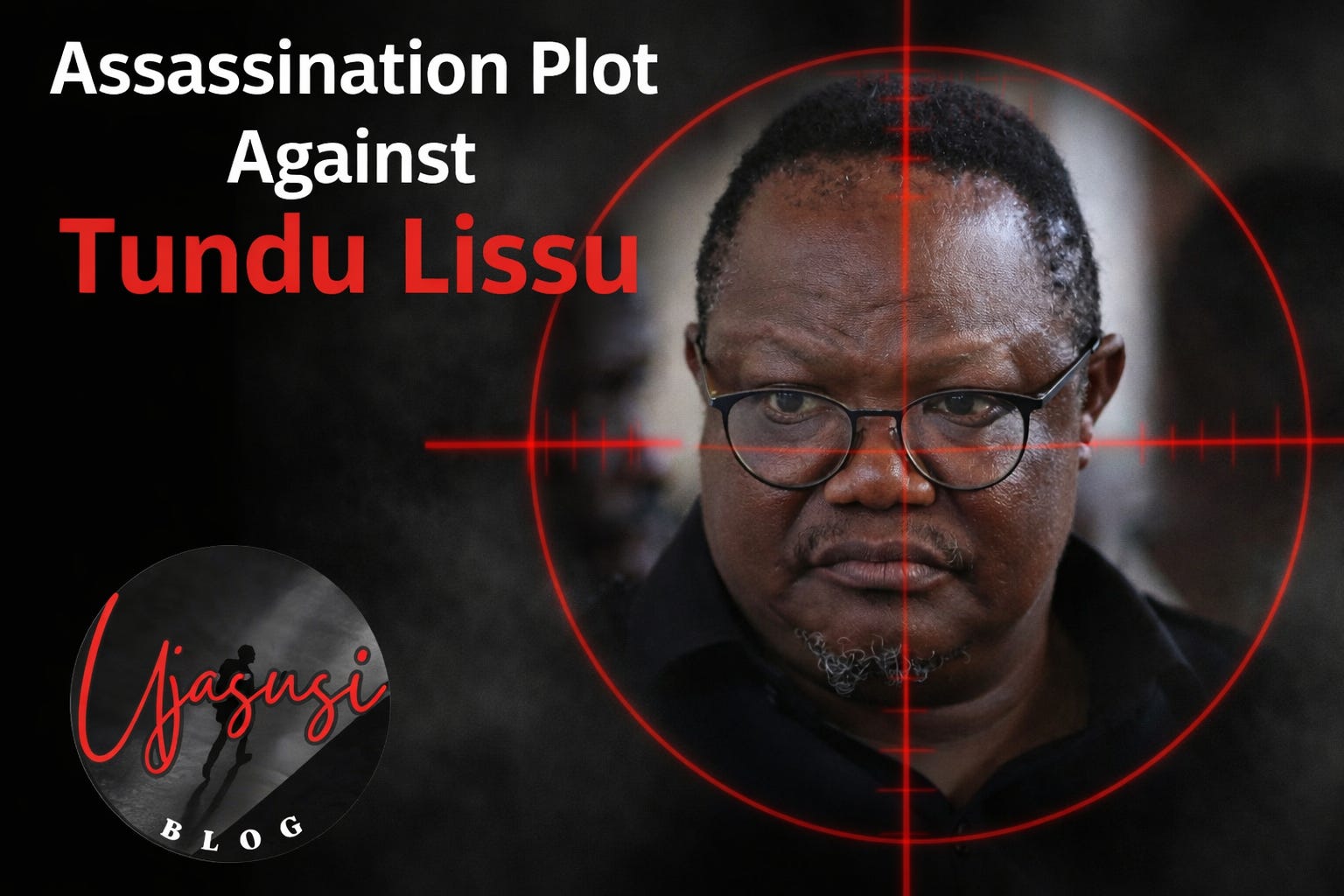
Assassination Intelligence: The Imminent Threat Against Tundu Lissu, Tanzania's Detained Opposition Leader

Evarist Chahali's avatar
Evarist Chahali
Mar 25, 2026
∙ Paid

Ujasusi Blog’s East Africa Monitoring Team | 24 March 2026 | 0530 GMT


Ujasusi Blog has received intelligence from a confidential source assessing as credible and time-sensitive a plot to assassinate CHADEMA national chairman Tundu Antiphas Mughwai Lissu. The operation, as described, is designed to be carried out outdoors following Lissu’s release from Ukonga Maximum Security Prison on a court appearance or supervised movement, and is built around a deception layer intended to attribute the killing to intra-party conflict within CHADEMA — while the actual operational direction comes from within the state security apparatus. The plot represents a continuation of an elimination agenda rooted in the same network implicated in the September 2017 shooting that left Lissu with 16 bullet wounds and permanent injuries.

Share Ujasusi Blog

Tundu Antiphas Mughwai Lissu is a Tanzanian lawyer, human rights defender, and national chairman of Chama cha Demokrasia na Maendeleo (CHADEMA), Tanzania’s principal opposition party. A former Member of Parliament for Singida East and former President of the Tanganyika Law Society, he stood as CHADEMA’s presidential candidate in the 2020 general election, finishing second against the late President John Magufuli in a poll condemned internationally as deeply flawed. On 7 September 2017, unknown assailants fired more than 30 bullets into his vehicle outside his parliamentary residence in Dodoma, striking him 16 times and leaving him with permanent injuries requiring 19 surgical operations across facilities in Nairobi and Leuven, Belgium. No one has ever been charged for that attack. Lissu was arrested on 9 April 2025 following a public rally in Mbinga at which he championed CHADEMA’s “No Reforms, No Elections” campaign, and subsequently charged with treason — an offence carrying a mandatory death sentence under Tanzanian law. He has been held at Ukonga Maximum Security Prison in Dar es Salaam ever since, representing himself before a three-judge High Court panel after prison authorities blocked his access to private legal counsel. As of 22 March 2026, he has spent 347 days in pre-trial detention on capital charges.

🧩 What is the specific intelligence assessment received by Ujasusi Blog?

Ujasusi Blog’s East Africa Monitoring Team | 24 March 2026 | 0530 GMT


Ujasusi Blog has received intelligence from a confidential source assessing as credible and time-sensitive a plot to assassinate CHADEMA national chairman Tundu Antiphas Mughwai Lissu. The operation, as described, is designed to be carried out outdoors following Lissu’s release from Ukonga Maximum Security Prison on a court appearance or supervised movement, and is built around a deception layer intended to attribute the killing to intra-party conflict within CHADEMA — while the actual operational direction comes from within the state security apparatus. The plot represents a continuation of an elimination agenda rooted in the same network implicated in the September 2017 shooting that left Lissu with 16 bullet wounds and permanent injuries.

Share Ujasusi Blog

Tundu Antiphas Mughwai Lissu is a Tanzanian lawyer, human rights defender, and national chairman of Chama cha Demokrasia na Maendeleo (CHADEMA), Tanzania’s principal opposition party. A former Member of Parliament for Singida East and former President of the Tanganyika Law Society, he stood as CHADEMA’s presidential candidate in the 2020 general election, finishing second against the late President John Magufuli in a poll condemned internationally as deeply flawed. On 7 September 2017, unknown assailants fired more than 30 bullets into his vehicle outside his parliamentary residence in Dodoma, striking him 16 times and leaving him with permanent injuries requiring 19 surgical operations across facilities in Nairobi and Leuven, Belgium. No one has ever been charged for that attack. Lissu was arrested on 9 April 2025 following a public rally in Mbinga at which he championed CHADEMA’s “No Reforms, No Elections” campaign, and subsequently charged with treason — an offence carrying a mandatory death sentence under Tanzanian law. He has been held at Ukonga Maximum Security Prison in Dar es Salaam ever since, representing himself before a three-judge High Court panel after prison authorities blocked his access to private legal counsel. As of 22 March 2026, he has spent 347 days in pre-trial detention on capital charges.

🧩 What is the specific intelligence assessment received by Ujasusi Blog?

Ujasusi Blog’s confidential source, whose access to the relevant operational environment has been independently assessed as credible, has reported the following:

A plot to assassinate Tundu Lissu is currently active and assessed as imminent. The planned method of execution is not inside Ukonga Prison but outdoors — most likely timed to a court appearance, a supervised transit, or a moment when Lissu moves beyond the prison perimeter. The choice of an outdoor setting is operationally deliberate. It avoids the institutional complications and forensic trail that an in-custody killing would generate, which would be harder to conceal and would trigger more direct accountability questions toward the Tanzania Prisons Service.

The operational design includes a pre-constructed deception narrative: the killing is to be staged and subsequently attributed to factional conflict within CHADEMA itself. According to the intelligence, state-linked planners intend to engineer the appearance of an internal leadership dispute within the opposition party, positioning the assassination as the product of anti-Lissu elements within his own ranks rather than a state-directed hit. This false-flag architecture is not improvised. It reflects a sophisticated understanding that direct attribution to the Samia administration or its allied security figures would trigger international consequences far more severe than a killing framed as African political infighting — a frame that historically generates minimal sustained international response.

The source has characterised the threat window as imminent. Ujasusi Blog does not publish threat intelligence assessments of this nature without threshold source evaluation. The decision to publish is itself a protective measure: public disclosure of an assassination plot reduces its operational viability by eliminating the deniability environment on which such operations depend.

🔗 Why does this plot connect directly to the 2017 assassination attempt, and who has Lissu himself named?

This is not a new threat from a new actor. The intelligence received by Ujasusi Blog places the current plot within a direct operational lineage running from 7 September 2017.

Lissu has consistently accused a named individual — a senior CCM-aligned security figure who held the position of Regional Commissioner for Dar es Salaam at the time of the 2017 shooting — of being behind the attack. At a press conference in September 2024, Lissu claimed that this individual was not in Dar es Salaam on the day of the shooting but was instead in Dodoma, leading the operation. “It was this individual who led the Task Force,” Lissu stated. “He was staying at the African Dream Hotel, which is why he wasn’t present at the State House event that day. Among those who need to be criminally investigated regarding my allegations is this individual. Even the two young men who shot me are still out there; when the time comes, we will name them.”

There is no media evidence of his presence in Dar es Salaam on 7 September 2017 itself — despite the fact that, as a senior regional official, his attendance at a major presidential function in his own jurisdiction would have been expected. When confronted by journalists in November 2024, the accused dismissed the allegations as political, focusing on the absence of a legal filing rather than the substance of the accusation — a deflection technique that does not constitute a denial of the underlying facts.

The intelligence received by Ujasusi Blog assesses that the same individual remains a principal in the current plot, driven by a long-standing calculation that Lissu, if he survives and is eventually freed, represents an existential political threat. The fear is not abstract. Lissu came second in the 2020 presidential election, was elected CHADEMA national chairman in January 2025, and commands domestic and international standing that no other Tanzanian opposition figure currently matches. For those who organised the 2017 attempt and escaped accountability, a freed Lissu pursuing ICC accountability or eventually contesting a presidential election represents unacceptable personal and political exposure.

⚖️ Why is the collapsing treason case the operational trigger for the current plot?

The strategic logic of the current threat cannot be separated from the state of the legal proceedings against Lissu at the High Court of Tanzania.

Lissu, representing himself, has been systematically dismantling the prosecution’s case witness by witness. In one instance, he exposed that a prosecution witness had identified himself in court as an “electrician” but listed his profession as a “farmer” in his police statement — and exposed similar inconsistencies across multiple other witnesses. As of March 2026, the trial has progressed across only 15 substantive hearing days during over 300 days of pre-trial custody on capital charges.

The prosecution’s evidentiary position has been further weakened by the High Court’s ruling on concealed witnesses. The three-judge panel ruled that laws permitting secret testimony were unconstitutional, noting that “justice must be seen to be done” and ordering Parliament to reform the relevant legislation — a ruling that eliminated the state’s plan to rely on anonymous protected witnesses as the backbone of its case.

A treason acquittal is no longer implausible. On current trajectory, it is the probable outcome. For those within the CCM-aligned security establishment who designed both the 2017 elimination attempt and the 2025 detention strategy, this creates a problem with no legal solution. The courts have not delivered the required outcome. The ICC process, while formally active, has not produced enforcement action within a politically relevant timeframe. International pressure has generated statements but no sanctions, no aid suspensions, no accountability mechanism with teeth.

In this environment, physical elimination offers what the judicial process has failed to provide: permanence. A dead Lissu cannot lead CHADEMA, cannot contest a future election, cannot testify before the ICC, and cannot one day name the individuals behind the 2017 attack from a presidential platform. The outdoor setting of the planned operation removes the Prisons Service from the chain of custody. The CHADEMA factional cover story removes the state from the attribution frame entirely. The operation, if executed as described, is designed to produce a political death with no state fingerprints.

🎭 What is the false-flag mechanism, and why is it analytically credible?

The deception architecture at the centre of this plot — staging a state assassination to appear as an opposition internal killing — merits close analytical attention because it is neither unprecedented nor improvised.

False-flag political killings are a documented instrument in the toolkit of authoritarian security services operating under international scrutiny. The operational value is straightforward: if the victim’s own party is blamed, international calls for state accountability are short-circuited. Donor governments, which have already declined to act on Lissu’s arbitrary detention ruling from the UN Working Group on Arbitrary Detention under Opinion No. 74/2025, are considerably less likely to impose consequences for a killing framed as African party factional violence.

The construction of a plausible internal CHADEMA conflict narrative requires advance preparation — planted disinformation about leadership tensions, possibly the cultivation of individuals willing to play roles in the cover story, and coordination between operational and information elements of the security apparatus. A senior CCM official previously acknowledged on condition of anonymity that the ruling party’s dependence on police and intelligence services makes it difficult to publicly criticise them, and that the priority is to “win regardless of the cost.” That institutional dependency — where the security apparatus and the ruling party operate as co-principals rather than distinct entities — creates exactly the command environment in which a false-flag operation of this kind can be authorised and executed.

The fact that Lissu has been publicly visible as a courtroom combatant — cross-examining witnesses, filing his own legal motions from prison, generating daily international coverage — means that any sudden killing attributed to CHADEMA infighting would need to be buttressed by a credible prior narrative of internal divisions. Ujasusi Blog assesses that the information environment is likely already being seeded with exactly that narrative, whether through social media, sympathetic media outlets, or CHADEMA-adjacent sources who may not understand the role they are being asked to play.

🔓 What does the political containment environment reveal about why this threat is viable now?

The timing of the current threat reflects a calculated reading of the political containment environment that has developed around Lissu’s case over the past year — and it is that reading, not merely operational preparation, that makes this moment particularly dangerous.

Lissu has been in continuous custody since 9 April 2025 — 347 days as of 22 March 2026 — and is now filing his own urgent health applications pro se from a maximum-security prison, citing permanent injuries from the 2017 attack and missed medical appointments as grounds for irreparable harm. That image — Tanzania’s most prominent opposition leader, facing a mandatory death sentence, writing his own court documents from a cell — has not produced sustained domestic mobilisation. No significant protest movement has emerged. No boycott campaign of the kind that might generate genuine political cost for the Samia administration has taken hold. The post-election maandamano of October 2025, which saw approximately 10,000 killed, exhausted the immediate mobilisation capacity of the opposition base without producing regime change or transition negotiations.

The parallel that frames this threat most precisely is the case of Freeman Mbowe, whose terrorism charges were quietly dropped in circumstances widely understood to reflect presidential discretion rather than judicial process. The Mbowe model established a template: detention, international noise, eventual mercy as political calculation, no accountability. If that template holds for Lissu, his only realistic near-term path to freedom runs through Samia’s mercy, not judicial vindication. The state’s security allies understand this template as well as anyone. If the president is the only exit, and the president can be persuaded — or simply fails to intervene — the accountability gap is closed before it opens.

Ujasusi Blog’s analytical judgement — stated explicitly as a reasoned position grounded in the evidence presented — is that the convergence of a collapsing legal case, a year of effective domestic political inertia, a stalled ICC accountability process, and the persistent presence of the same security network that organised the 2017 attempt creates the precise conditions in which a false-flag outdoor assassination becomes the path of least operational resistance. The plot described by Ujasusi Blog’s source is not the product of panic. It is the product of a calculation that the window for acting with impunity is open — and may close permanently if the trial formally collapses and Lissu walks free.

🌐 What should international actors with influence over Tanzania’s conduct understand about this intelligence?

The international actors best positioned to alter the risk calculus surrounding this threat are those who control something the Samia administration values: diplomatic standing, development assistance, and the pace of ICC proceedings.

Following the UN Working Group’s Opinion No. 74/2025 finding Lissu’s detention arbitrary, Lissu’s international legal counsel called on Tanzania’s partners — including donor governments and multilateral institutions — to press for prompt implementation and to make clear that continued non-compliance will carry consequences. That call has not been acted upon with sufficient force. The European Parliament’s joint resolution of May 2025 urged the EU and its Member States to consider appropriate measures if the human rights situation continues to deteriorate, specifically flagging consistency between development cooperation — including the Global Gateway initiative — and human rights standards. Those measures have not materialised in any form capable of altering the security establishment’s threat calculus.

The intelligence received by Ujasusi Blog is published here precisely because publication serves a protective function that private diplomatic communication has demonstrably failed to deliver over the past year. The record shows that quiet pressure does not work on the actors behind this plot. What raises the operational cost of proceeding is the elimination of deniability — the knowledge that if Tundu Lissu is killed outdoors and attributed to CHADEMA infighting, the international intelligence community, the ICC Office of the Prosecutor, and Tanzania’s development partners will have been on direct notice, in advance, that the attribution is false.

The treason case against Lissu is disintegrating in open court. His captors know that. The question the international community must now answer — specifically and not rhetorically — is whether the end of the legal mechanism triggers the activation of the terminal one.


Independent intelligence analysis takes time and resources — if this work matters to you, please consider supporting it by donating HERE

© 2026 Evarist Chahali · Privacy ∙ Terms ∙ Collection notice
Start your SubstackGet the app
Substack is the home for great culture