

Ujasusi East Africa Monitoring Team | 20 May 2026 | 0000 BST
Table of Contents
Direct Answer
The Confirmed Medical Sequence at Ukonga Maximum Security Prison
The State’s Prior and Formal Awareness of Lissu’s Medical Vulnerability
Tanzania Prison Service’s Binding Legal Obligations
Deliberate Contamination vs Systemic Neglect: An Assessed Judgement
The Unresolved 2017 Assassination Network and the Ukonga Threat Window
Regime Lethal Capacity and the Impunity Calculus
CHADEMA’s Institutional Failure as a Permissive Signal to Dar es Salaam
Forward Indicators and Operational Implications
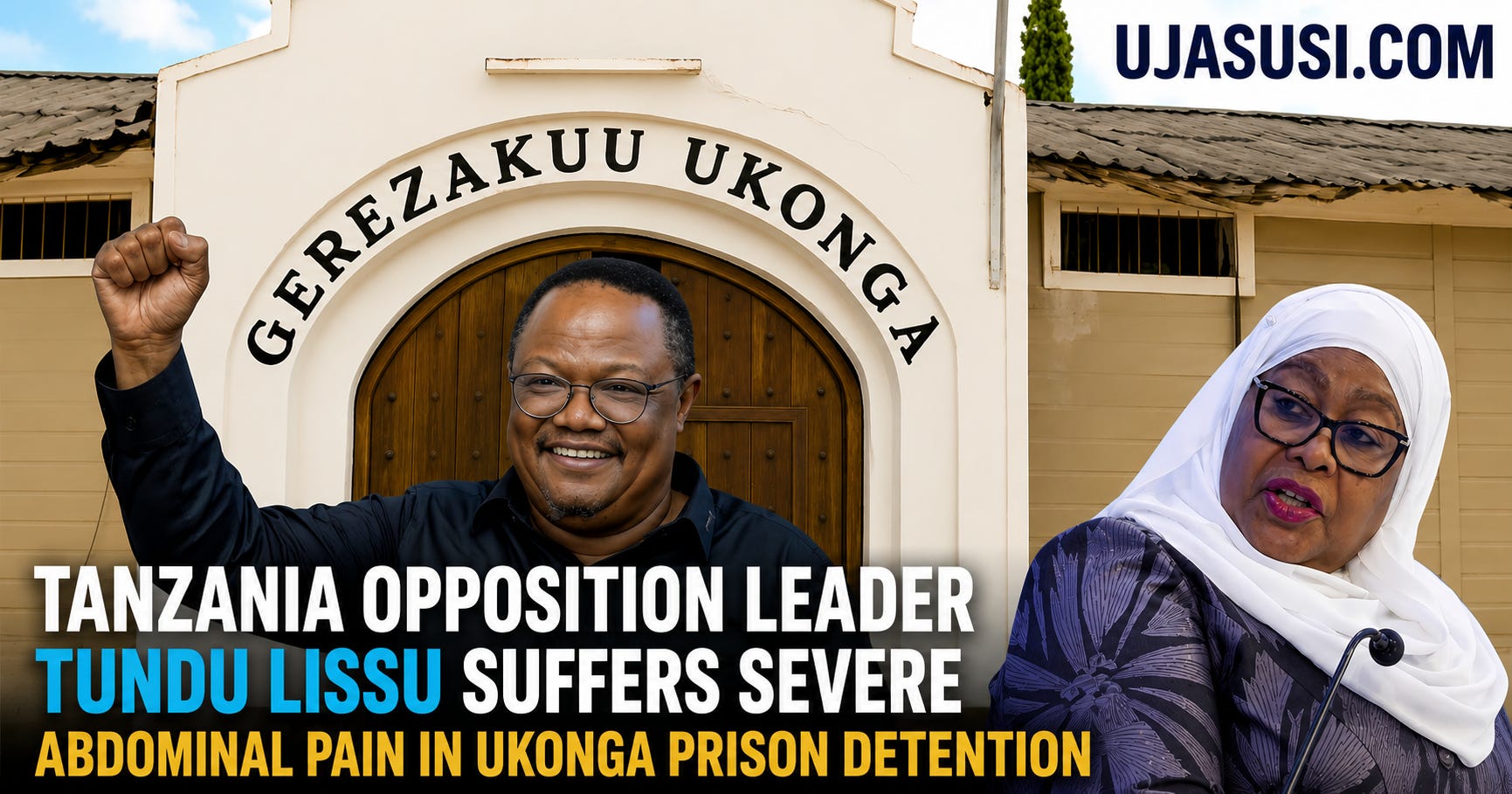
Tundu Antiphas Lissu, national chairperson of Tanzania’s principal opposition party CHADEMA and defendant in an active capital treason trial before the High Court of Tanzania, has suffered a severe abdominal health crisis whilst held at Ukonga Maximum Security Prison in Dar es Salaam. CHADEMA Vice-Chairman for Mainland Tanzania John Heche, the sole named primary source for this episode with no corroborating statement from the Tanzania Prison Service at the time of writing, confirmed that Lissu’s condition deteriorated acutely following a meal served within the facility, with clinical tests subsequently identifying an amoebic infection. The episode constitutes a material escalation in a detention case already subject to a UN Working Group on Arbitrary Detention ruling of unlawfulness. It arrives against a background of unresolved assassination threats, a regime with a documented record of lethal state violence, and an opposition party whose repeated failure to convert public commitments into organised pressure has measurably reduced the political cost of further harm to its detained chairman.
The Confirmed Medical Sequence at Ukonga Maximum Security Prison
The evidentiary basis for this episode rests on a single named source: John Heche’s public account, uncontested at the time of writing by any statement from the Tanzania Prison Service or the Ministry of Home Affairs. That sourcing limitation is itself analytically significant; the detaining authority’s silence forfeits any factual counter-narrative and leaves Heche’s account as the operative record. On that account, Lissu began experiencing acute abdominal pain, which he described as unlike anything he had experienced in his lifetime, with onset following a meal at the facility. No medical intervention was provided at onset. Lissu himself initiated contact by knocking on his cell door and requesting assistance after enduring the symptoms for several hours unaided, at which point staff administered analgesic medication. Clinical examination confirmed an amoebic infection caused by Entamoeba histolytica, a parasitic pathogen transmitted through contaminated food or water that, without timely treatment, progresses to amoebic dysentery, hepatic abscess, and systemic complications requiring surgical intervention.
The clinical profile is consistent with Ukonga’s documented sanitation deficits. A UNODC assessment of twelve Tanzanian prison facilities established that approximately 75 per cent lacked adequately trained medical personnel and were poorly equipped; a structural baseline that pre-dates but has not been fully remediated by subsequent investment. The Tanzania Prisons Service’s partially operational mega hospital, constructed on a 12.4-hectare site adjacent to Ukonga and attending to approximately 10,000 patients monthly as of April 2026, offers laboratory diagnostics, pharmacy, and emergency services. The coexistence of that accredited infrastructure with a several-hour delay before a formally documented high-risk detainee received basic analgesics is assessed as an evidentiary inconsistency that selective application of available capacity, rather than absence of capacity, best explains.
Under Rule 24 of the Mandela Rules, the obligation to ensure prompt access to qualified medical care is non-discretionary. The confirmed sequence does not satisfy it. Without independent clinical verification of Lissu’s current condition by a physician outside the Tanzania Prison Service, the precise severity of his ongoing health status cannot be assessed with confidence beyond what Heche’s account establishes.
The State’s Prior and Formal Awareness of Lissu’s Medical Vulnerability
The detaining authority’s inability to claim ignorance of Lissu’s pre-existing medical condition is established by its own institutional record. On 10 March 2026, Lissu filed a pro se Certificate of Urgency, Criminal Revision No. 7203216 of 2026, before the Court of Appeal of Tanzania, citing permanent injuries from the 2017 assassination attempt, missed scheduled medical appointments, and a serious risk to his health and recovery. That document bore the official stamp of Ukonga Central Prison’s Officer in Charge: a dated, institutionally receipted acknowledgement by the state of his ongoing medical vulnerability, filed by a self-representing detainee already denied confidential access to legal counsel.
The underlying injuries are a matter of verified public record. On 7 September 2017, assailants fired more than 30 bullets into Lissu’s vehicle outside his parliamentary residence in Dodoma, striking him 16 times and necessitating 19 surgical operations at facilities in Nairobi and Leuven, Belgium. No individual has been identified, charged, or convicted for that attack across nine years and two presidential administrations. On 16 June 2025, Lissu stated on the record before Kisutu Resident Magistrate-in-Charge Franco Kiswaga that he had been confined to Ukonga’s death row section without conviction and compelled to exercise in open drainage whilst recovering from those injuries. Kiswaga directed that the grievances be addressed administratively. The absence of any verifiable remediation between that direction and the current episode is assessed as confirmation that the administrative channel Kiswaga invoked produced no substantive outcome.
The pattern established across these three documented instances, a court-filed medical urgency application bearing the prison’s own stamp; on-the-record court testimony of ongoing physical harm; and a magistrate’s administrative direction that produced no documented result, is assessed as a consistent institutional posture of formal acknowledgement without substantive response, rather than isolated procedural failures.
Tanzania Prison Service’s Binding Legal Obligations
Tanzania’s obligations in respect of Lissu’s medical care are treaty-bound, domestically codified, and not subject to administrative discretion. As a signatory to the African Charter on Human and Peoples’ Rights, the International Covenant on Civil and Political Rights, and the Convention Against Torture, Tanzania carries obligations under Article 7 of the ICCPR, which prohibits treatment inflicting unnecessary suffering, and under General Comment No. 21 of the UN Human Rights Committee, which assigns direct responsibility to the detaining state for the health of those in its custody. Domestically, the Prison Act Cap. 58 imposes an explicit statutory duty of care on Tanzania Prison Service personnel.
The International Democracy Union has formally cited the conditions of Lissu’s confinement at Ukonga as contributing to the deterioration of his health. The UN Working Group on Arbitrary Detention has ruled his detention unlawful; President Samia Suluhu Hassan’s government has not complied. Tanzania’s compliance record with the African Court on Human and Peoples’ Rights is documented as consistently deficient: in November 2019, Tanzania gave notice of withdrawing its Article 34(6) declaration permitting individual and NGO applications directly to the Court, following a series of adverse rulings on political detention cases. Each mechanism available to compel a medical care response, domestic courts, the UN system, and regional human rights bodies, has either been invoked without substantive result or pre-emptively neutralised. That pattern is structural, not incidental.